The Sinosphere · Volume 30, The Red-Lees Jar, the Ten-Second Slice and a Coast Two Tongues Call Home
Xiamen popiah, or runbing (润饼)
Xiamen, Fujian
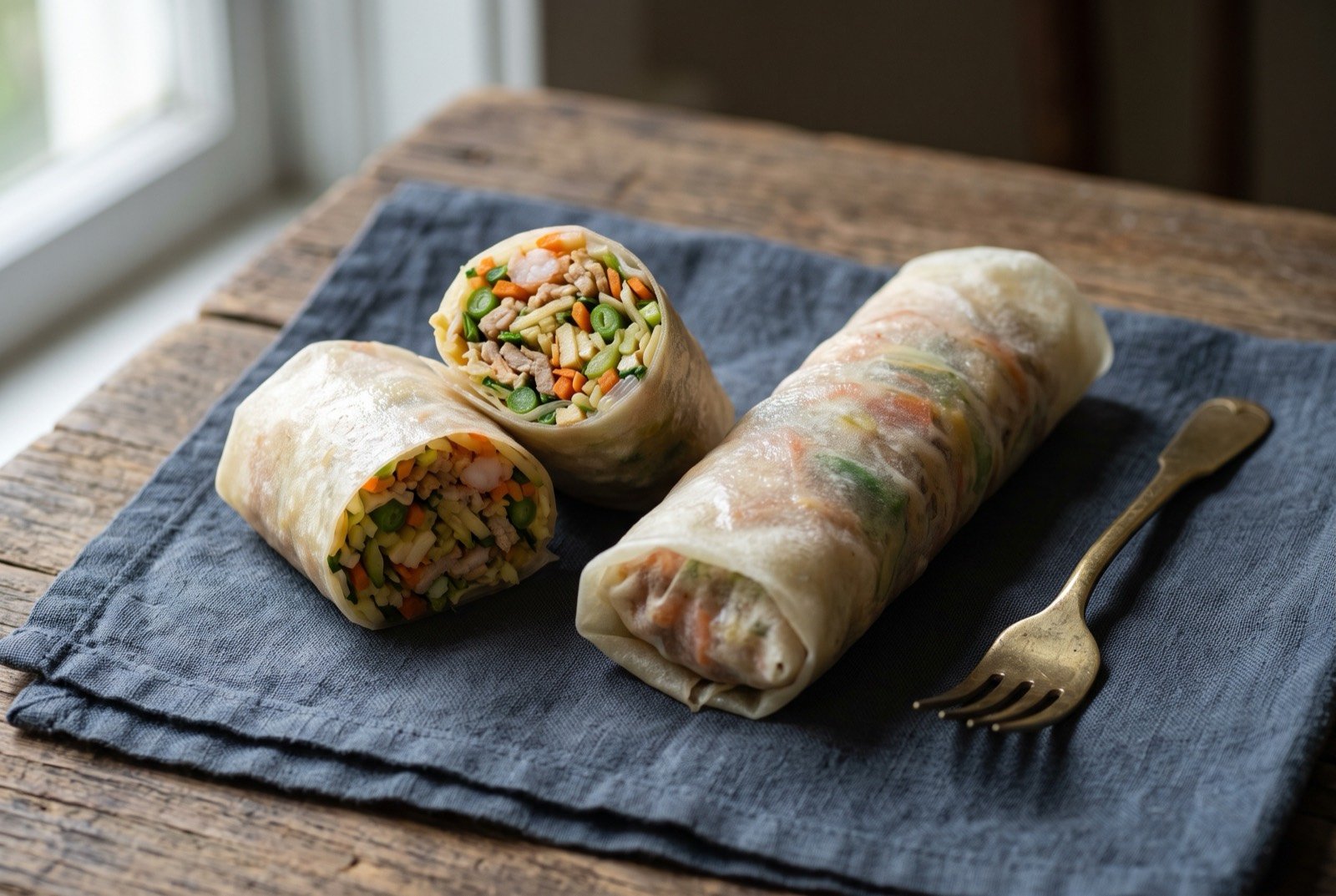
An illustration of the dish, not a photograph of it cooked.
- Time
- Not statedNo source states a time and the atlas has too few comparable dishes to estimate one.
- Reviewed
- Not yet reviewed from inside the tradition
- Cooked
- Not yet cooked and reported
The Philippines' lumpia is a direct linguistic and technical descendant, "lumpia" itself a phonetic transliteration of 润饼, carried by the overwhelmingly Hokkien-descended Chinese population of the Philippines and adapted over subsequent centuries with Spanish, American and local influence. The popular Cai Fuyi origin legend for the wrapper does not survive checking: Quanzhou's own heritage documentation finds no crisis in his recorded career to match the story and calls the premise implausible (see The History in Layers, above). A better-supported lineage traces the dish instead from the ancient "spring plate" (春盘) custom into today's hot-filled wrap during the Qing.
As tradition built it
Serves 6 to 8 as a wrap-your-own spread. A full afternoon for the savoury Qingming filling.
Ingredients
For the wrapper
- 1 part, by weight wheat flour
- about 1.1 parts, by weight water
For the savoury Qingming filling, ten items
- as available garlic
- as available tofu
- as available peas
- as available carrot
- as available pork belly
- as available oyster
- as available cabbage
- as available rice vermicelli
- as available fried potato
- as available coriander
For the sweet year-end version instead
- as available maltose syrup, brushed on the wrapper
- as available sugared mashed potato, as the filling
Method
- Beat the wheat flour and water repeatedly into a tough, wet dough.
- Take a fistful of the dough directly in hand and wipe it in a single rotating motion across a gently heated flat pan, leaving behind a wrapper as thin as paper, the dough mass itself acting as the tool rather than being rolled or poured. A simplified home version instead mixes a pourable batter and ladles it thin, a real but lesser stand-in for the harder hand-wipe skill.
- Cook each of the ten filling items, garlic, tofu, peas, carrot, pork belly, oyster, cabbage, rice vermicelli, fried potato and coriander, separately.
- Lay everything out for the diner to assemble their own wrap.
- For the sweet year-end version, brush the wrapper with maltose syrup and fill with sugared mashed potato instead.
What a modern chef changes
Ten fillings held to ten separate doneness points, and two glazes reduced apart
The dish's own logic, applied ingredient by ingredient
Method
- Leave the hand-wipe wrapper technique alone. It resists mechanisation and should not be replaced; what a modernist kitchen can improve is everything the wrapper holds.
- Cook each of the ten fillings sous vide, separately, at the precise temperature and time that ingredient actually wants, the oyster barely warmed through, the pork belly rendered slow and low, the carrot kept genuinely crisp, rather than accepting the compromise a single wok pan forces on ten different vegetables and proteins cooked in sequence.
- Reduce the pork and vegetable cooking liquids separately through a chinois into two concentrated glazes, one for brushing the wrapper before filling, one for dressing at the table, so the ten-fold completeness the dish is named for reads as ten distinct, sharply defined flavours rather than one softened, wok-blurred whole.