The Sinosphere · Volume 30, The Red-Lees Jar, the Ten-Second Slice and a Coast Two Tongues Call Home
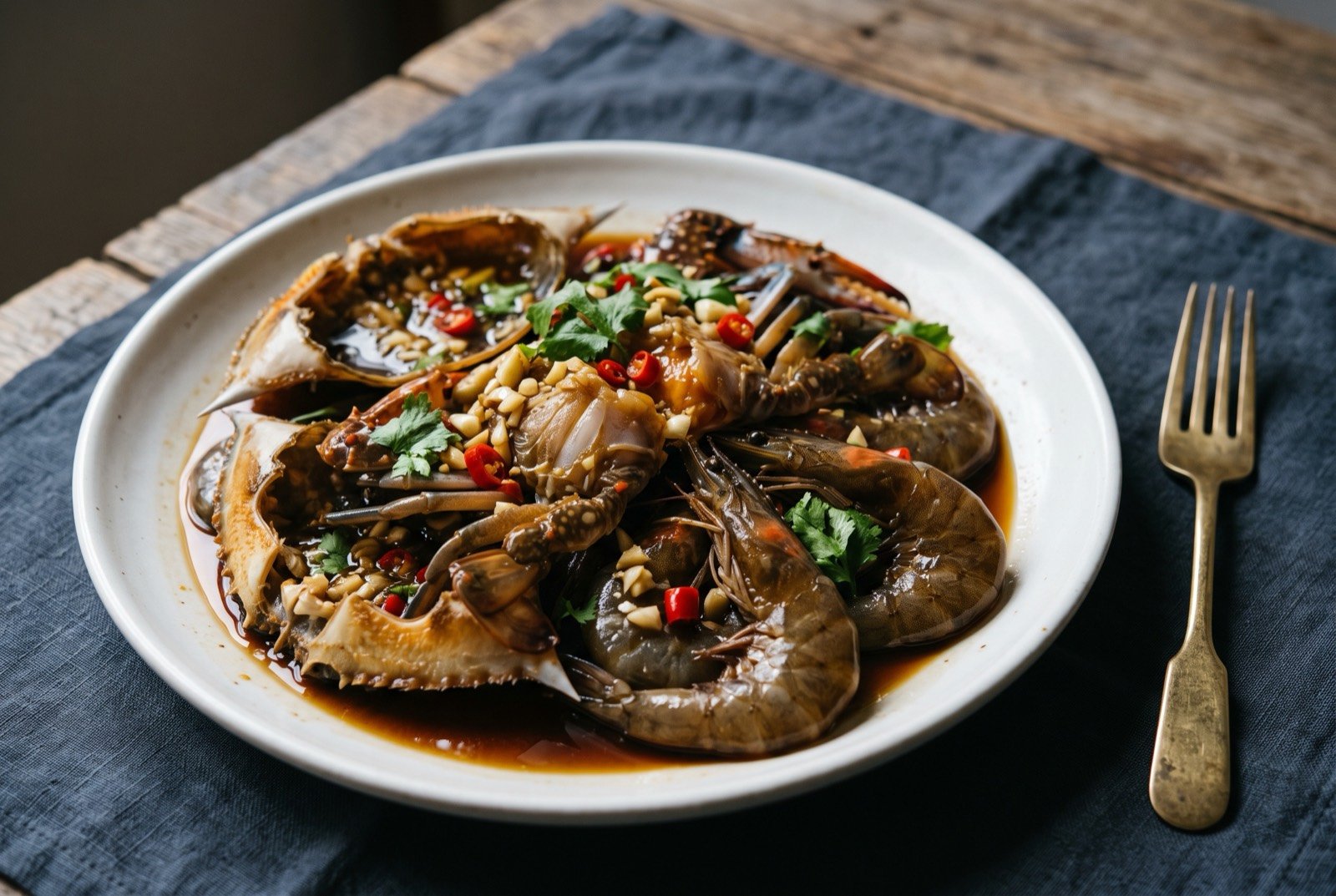
Chaoshan raw-marinated seafood, reworked safely (生腌)
Chaoshan coast, Guangdong
Illustration
- Researched
- Researched from 80 sources in the brief
An honest statement before any recipe. Raw marinating traces in Chinese-language sources to at least the Song dynasty, and by the Qing was recorded as the height of Chaoshan delicacy. This chapter states plainly, because the tradition's own food-safety literature does, that none of the traditional marinating agents, spirits, vinegar, soy, fish sauce, garlic and chilli, reliably kill the parasites, bacteria or viruses raw seafood can carry. Experimentally, even 48 hours in high-proof spirit does not kill the liver fluke (Clonorchis sinensis) cysts most closely linked to raw-marinated crab and blood cockles; the parasite can live in the human bile duct for 20 to 25 years, carries a 4.5 to 6.1 times elevated risk of bile duct cancer, and was classified a Group 1 carcinogen by the International Agency for Research on Cancer in 2009. Beyond parasites, raw or undercooked marinated seafood can carry Vibrio, E. coli, Listeria and Salmonella. This chapter does not print the traditional method as a safe home recipe, and no reader should treat marination alone as a substitute for cooking.
As tradition built it
The traditional method, described, not prescribed
Not printed here as a safe home recipe. See the intro and the Elevation below.
Ingredients
- as available live crab, prawn, mantis shrimp, blood cockles and oysters
- as available salt, for scrubbing
- to taste spirits
- to taste vinegar
- to taste soy or fish sauce
- to taste garlic
- to taste chilli
Method
- Traditionally, the live crab, prawn, mantis shrimp, blood cockles and oysters are scrubbed with salt and marinated in spirits, vinegar, soy or fish sauce, garlic and chilli for anywhere from a few minutes, for small, quick-absorbing shellfish, to 24 hours, for thick-shelled, roe-bearing crab.
- This chapter does not carry that method through to a recipe a reader should follow, because none of those marinating agents reliably make the seafood safe to eat raw. See the Elevation for the route this chapter actually recommends.
Notes
This is described so the reader understands the tradition being reworked, not so it can be followed as written.
What a modern chef changes
Sous vide pasteurisation first, the traditional marinade applied after, not before
A genuinely different, controlled process, not a faster version of the traditional one
Method
- Pasteurise first. Hold the prepared crab, prawn or cockle at a precisely controlled time and temperature verified to eliminate the relevant pathogens and parasites for that species and cut, consulting current food-safety guidance directly since this varies and is not a fixed number this chapter can safely generalise, while remaining low enough to keep a tender, close-to-raw texture.
- Build the traditional marinade exactly as the tradition specifies, garlic, chilli, shacha, soy, a good spirit.
- Apply the marinade after pasteurisation, not before, so the flavour profile the dish is known for survives intact while the actual safety risk is handled by verified temperature control rather than by folklore about alcohol or vinegar.
Notes
This chapter treats this as elevation in the atlas's own stated sense, doing a traditional thing deliberately, with real technique, rather than importing a foreign method, but here the deliberateness has to include a safety step the tradition itself, honestly, does not have.