The Sinosphere · Volume 30, The Red-Lees Jar, the Ten-Second Slice and a Coast Two Tongues Call Home
Chaoshan beef balls (牛肉丸)
Chaoshan coast, Guangdong
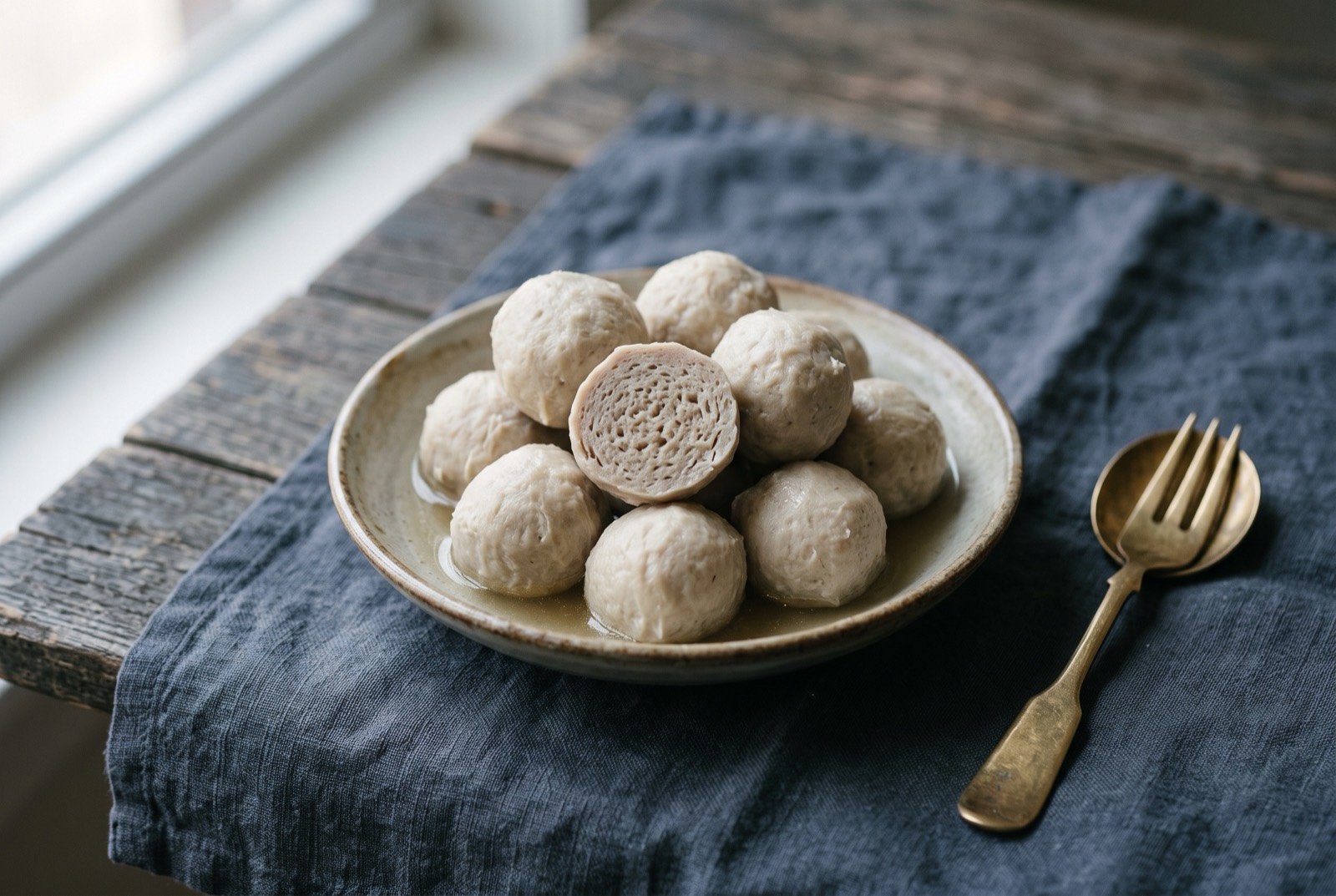
An illustration of the dish, not a photograph of it cooked.
- Time
- 8 minutes
- Reviewed
- Not yet reviewed from inside the tradition
- Cooked
- Not yet cooked and reported
Made from the roughly two-thirds of a hotpot carcass unsuited to thin slicing. A properly made ball should bounce at least 10cm off a table when dropped, and its cut cross-section should show a rough, honeycomb-like porosity from the trapped air the beating worked into it.
As tradition built it
Makes a batch of balls. The beating and throwing takes real time and must stay under 10°C throughout; poaching is about 8 minutes.
Ingredients
- 500g, sinew removed, as the base for the amounts below leg meat, sinew removed
- 15g tapioca starch, a little, as a binder
- about 4 egg white
- 2g bicarbonate of soda
- 5ml fish sauce
- about 8g shacha sauce
- 1g white pepper
- 5g sugar
- 100ml, staged ice water, staged, to keep the paste cold
Method
- Slice the leg meat flat and score it crosshatch.
- Beat it with two 1.5kg iron rods in steady rhythmic strokes until it becomes a fibre-free paste, never a knife, which would sever the muscle fibre that gives the finished ball its bounce, working over or with staged ice water to hold the paste at or below 10°C throughout.
- Throw the paste repeatedly against the work surface until it holds together on its own.
- Reinforce with a little tapioca starch, egg white and bicarbonate of soda, and season with fish sauce, shacha, white pepper and sugar.
- Squeeze the paste by hand through the web between thumb and forefinger into balls.
- Poach at a gentle simmer for around 8 minutes.
What a modern chef changes
A blender's pulse in place of the iron rod, a hidden fat pocket, and a sous vide poach
Rung 6
Method
- Pulse the meat in a high-power blender in short bursts rather than running it continuously, always over ice, the closest kitchen equivalent to iron-rod beating available to most cooks, breaking the meat down into the same fibrous paste without the hand-beating most home kitchens cannot sustain for the necessary length of time.
- Fold in roughly 5 percent finely diced, frozen beef fat at the very last moment before the balls are formed, so it melts under poaching heat into a small internal juice pocket, a genuine and traceable refinement of the traditional recipe's own occasional practice of adding fat or ice granules for the same effect, not an imported idea.
- Poach sous vide at a precisely held temperature just below a rolling simmer instead of on the stovetop, giving a more evenly cooked ball with less risk of the surface overcooking before the centre catches up, particularly useful for the larger balls a home cook is likely to shape less consistently than a professional street-stall hand.