The Sinosphere · Volume 30, The Red-Lees Jar, the Ten-Second Slice and a Coast Two Tongues Call Home
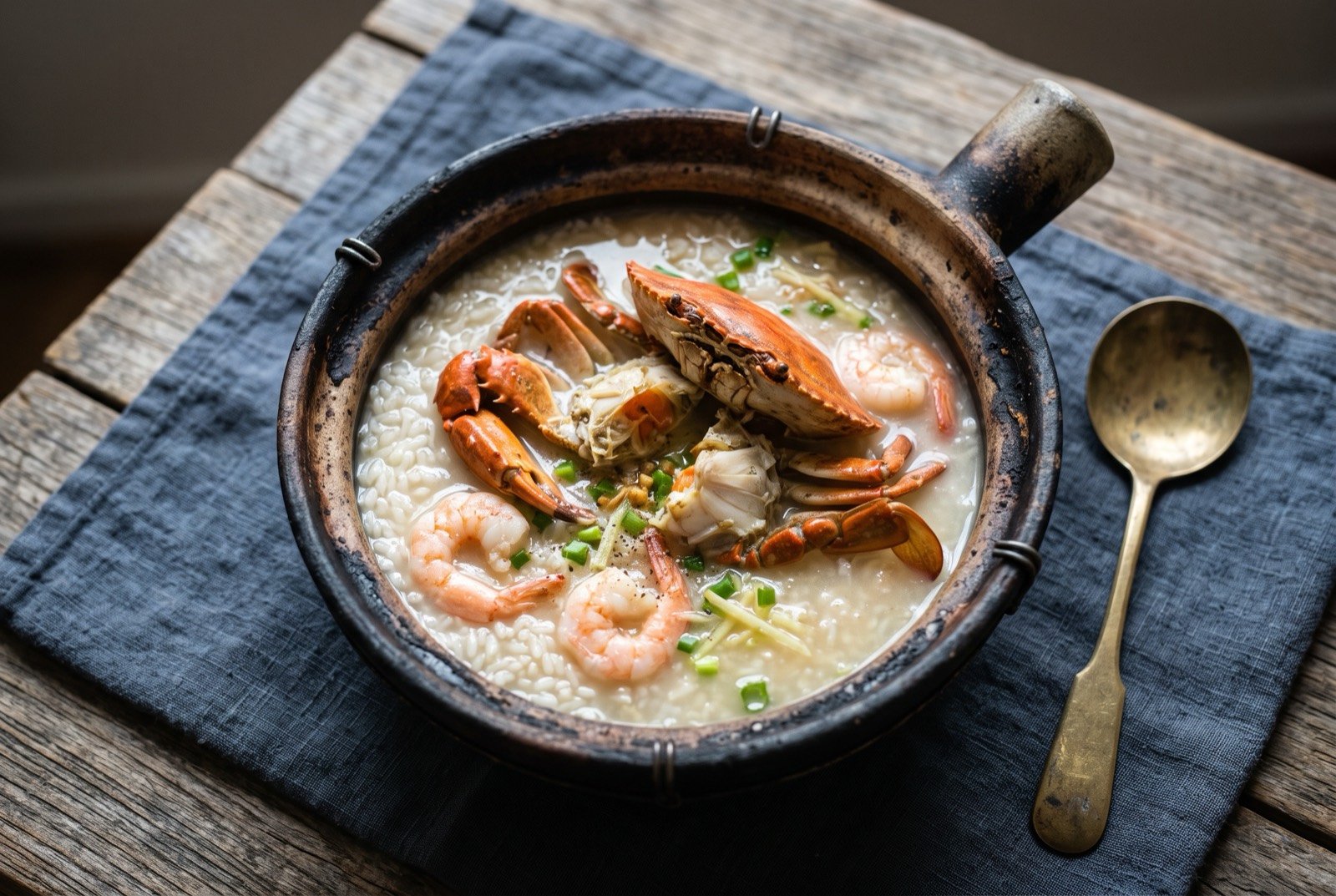
Chaoshan sandpot congee, with da laang (潮汕砂锅粥 and 打冷)
Chaoshan coast, Guangdong
Illustration
- Researched
- Researched from 80 sources in the brief
Chaoshan congee is not a side dish, it structures an entire evening's eating: "night congee" (夜粥) describes a whole late-night dining culture built around open-air stalls. Where Cantonese congee (粥) is cooked down smooth, Chaoshan congee, locally called 糜 (mí), is deliberately looser and thinner, the grains kept distinct rather than broken down, "rice remains rice, water remains water." The term da laang's own etymology is genuinely contested, three competing explanations circulate, and this chapter does not adjudicate between them.
As tradition built it
Serves a table, as part of a wider da laang spread.
Ingredients
For the sandpot congee
- 1 part rice
- 5 to 8 parts, on the loose side for the Chaoshan style water
- 1 a whole crab, fresh prawn, or pigeon, cooked directly into the pot
For the da laang spread alongside it
- as available braised lu shui items
- as available fish rice, a whole fish poached in strong brine and served at room temperature, unfilleted
- as available raw-marinated seafood
- as available stir-fries
- as available pickled sides
- as available grain cakes (粿)
Method
- Cook the rice loose and thin in water, keeping the grains distinct rather than broken down, the Chaoshan style rather than the smooth Cantonese one.
- Cook a whole crab, fresh prawn, or pigeon directly into the pot, so the congee itself turns savoury and fresh rather than merely being topped afterward.
- Lay out the da laang spread alongside it: braised lu shui items, fish rice, raw-marinated seafood, stir-fries, pickled sides and grain cakes, for the diner to eat their way through across the evening.
What a modern chef changes
A pressurised base kept grain-distinct, a separately poached centrepiece, and a lu shui glaze for the fish rice
Applies the ladder's stock and clarity discipline to a home-scale project
Method
- Build the congee base in a pressure environment for a fraction of the traditional cooking time, while keeping the final texture loose and grain-distinct by adding the crustacean or bird only in the last few minutes.
- Poach the crustacean or bird separately, sous vide, to precisely the doneness the dish wants, rather than simmering it directly in the pot where it would overcook long before the rice finishes.
- Compose the da laang spread around the same logic as the tradition, a wide, considered range of small dishes rather than one plated centrepiece, but dress the fish rice at the table with a chinois-clarified version of the lu shui braising liquid, reduced to a light glaze, a genuine refinement rather than a replacement of the format.