The Sinosphere · Volume 35, The Sour Jar, the Steam Funnel and a Border That Runs Both Ways
Guilin mifen, Guilin rice noodles
Guilin, Guangxi
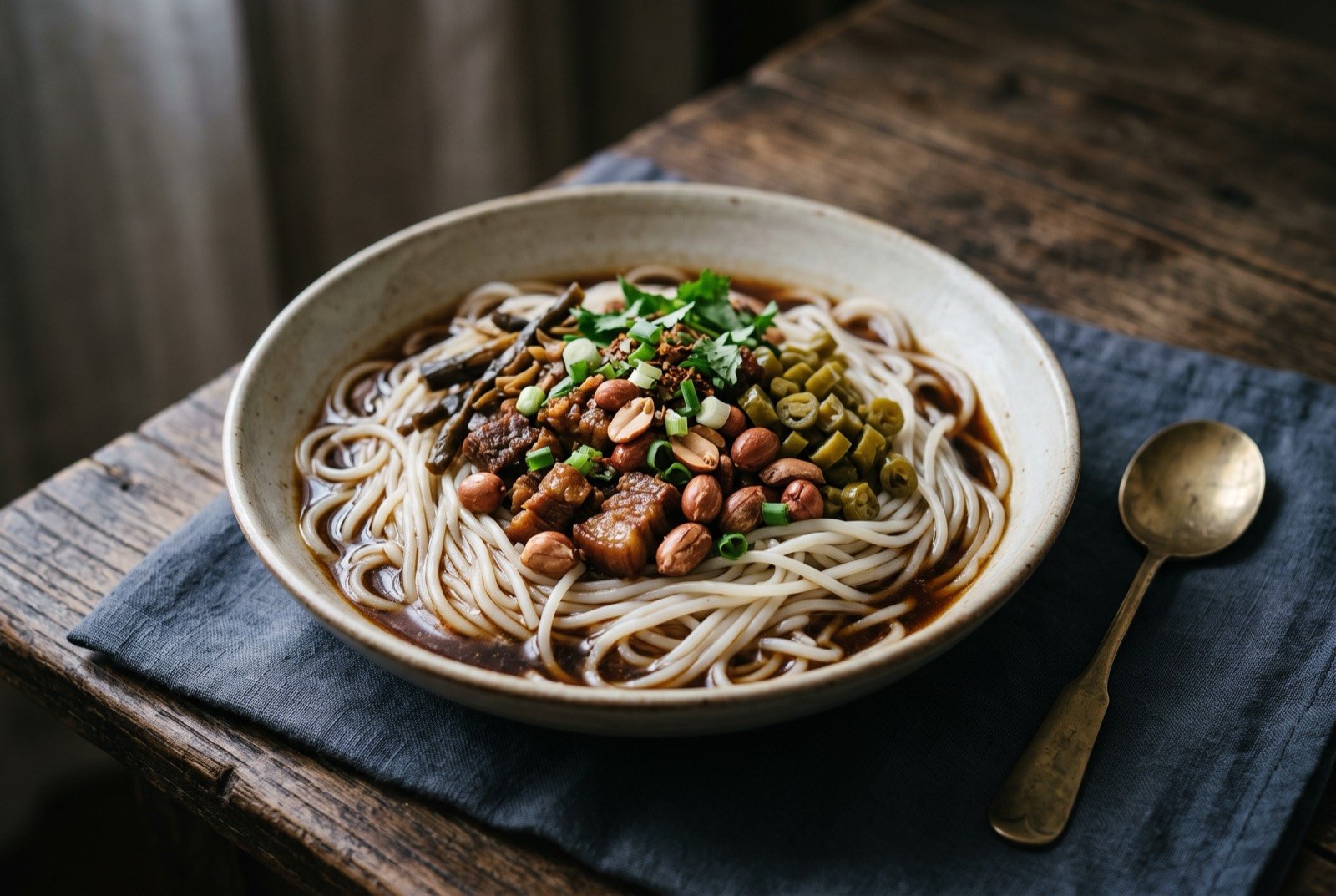
An illustration of the dish, not a photograph of it cooked.
- Time
- 5 hours
- Reviewed
- Not yet reviewed from inside the tradition
- Cooked
- Not yet cooked and reported
Guilin, Guangxi. An older, separate tradition from luosifen, built on a spiced brown lu shui broth.
As tradition built it
Serves 4. Lu shui: 5 hours to build, longer once established as a running master stock. Assembly: 10 minutes.
Ingredients
- 500 g pig head bone or pork bone
- 500 g beef bone
- 4 litres water
- 2 star anise
- 1 cassia bark stick
- 1 tsp fennel seed
- 1 tsp small fennel or cumin
- 2 bay leaves
- 2 cloves
- 1 black cardamom pod (cao guo)
- 2 dried tangerine peel pieces
- 1 small piece liquorice root
- 1 tbsp fermented black bean
- to taste salt and light soy, to taste
- 400 g fresh or dried thin rice noodles
- to taste braised pork or beef, chopped peanuts, pickled vegetable, spring onion, to finish
Method
- Blanch the bones, then simmer in the water at a rolling boil, reducing to a bare simmer for 5 hours. Strain.
- Toast the star anise, cassia bark, fennel seed, small fennel or cumin, bay leaves, cloves, black cardamom, tangerine peel and liquorice root in a dry pan for around 15 minutes until fragrant, then tie into a muslin bag.
- Simmer the spice bag in the strained stock for a further 2 hours, then season with salt, light soy and fermented black bean.
- Scald the rice noodles and drain into bowls.
- Ladle over a little of the lu shui, less a soup than a seasoning liquid, and top with braised meat, peanuts, pickled vegetable and spring onion.
What a modern chef changes
A Cantonese-style master stock, tightened and clarified.
Rung 1
Method
- Keep the lu shui as a genuine running master stock, straining and refreshing it after each use rather than making it fresh each time, the same discipline this atlas's Jiangnan volume (AS-29) already applies to its own braising liquids.
- Sous vide the braised meat topping at a controlled low temperature in a portion of the lu shui itself, for an evenly tender result without the risk of overcooking a large cut on the stovetop.
- Strain the finished lu shui through a chinois before serving, for a completely clear, glossy seasoning liquid rather than one clouded by spice sediment.