Asia · Volume 35
Yunnan, Guizhou and Guangxi
The Sour Jar, the Steam Funnel and a Border That Runs Both Ways
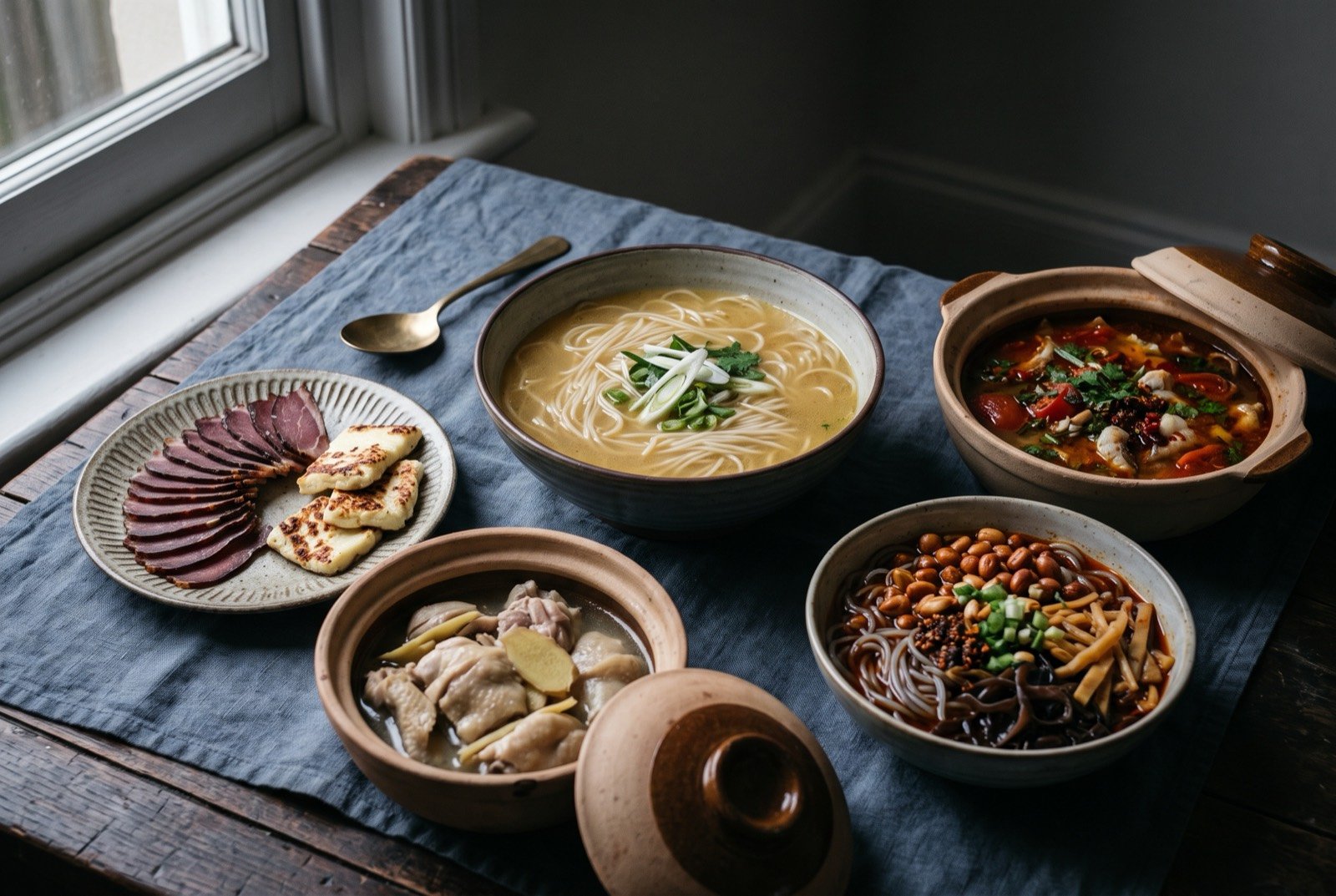
Three provinces that refuse to agree on what makes food taste right. Yunnan, China's most ethnically plural province by a wide margin, twenty five recognised minority groups holding a third of its population, runs on ham and, unusually for a country whose cuisines are overwhelmingly dairy-averse, on cheese: two Bai and Sani crafts, rushan and rubing, made nowhere else in China. Guizhou has no salt of its own, never has, and answers that with a jar: sourness fermented from rice water or wild tomato standing in for the seasoning a landlocked mountain province could never reliably buy. Guangxi, threaded by navigable rivers into the Gulf of Tonkin, tastes of neither: its three great rice noodles run on long-simmered bone broth and fresh or fermented garnish, a lowland, subtropical logic closer to Hanoi than to Kunming. Every restaurant technique in these cuisines has an indigenous ancestor, the claim this atlas returns to in every volume, and here it shows up in the mountain cheesemaker's acid-and-heat curd stretch, chemically identical to a mozzarella kitchen's, and in the ham curer's cave, running the same salt-humidity-and-months logic as a Spanish bodega, worked out independently by Bai and Yi communities who never needed Europe to tell them how. This is also the volume where the atlas's own argument about culinary regions over borders shows its sharpest edge: Yunnan's southern river valleys share more technique with the Shan hills and northern Thailand across the border than with Han China to the east, a crossing this atlas has already made once, from the other side, in Volume AS-42. Every dish as tradition built it, then what a modern chef would change.
Sources and review · What this chapter does not assert · How we research · Spotted something wrong?
A Sense of Place
Three ecologies, three logics, one province each
Yunnan is not one food world but three, stacked by altitude and latitude. The cooler Yunnan-Guizhou plateau uplands around Xuanwei, Zhaotong and the Bai and Yi highlands near Dali and Chuxiong are pig-and-dairy country, the only part of China where cured ham sits alongside a genuine mountain cheese tradition. The Mekong (Lancang), Nu-Salween and Red River valleys running south into Xishuangbanna and Dehong belong to the Dai and Jingpo river-valley world, tropical, rice-and-fish, sharing ecology and technique directly with northern Thailand, Laos and Shan State across the border rather than with lowland Han China. And the terraced mountains of the Ailao and Wuliang ranges around Yuanyang are Hani and Yi wet-rice terrace country, the ecology behind the long-street banquet and a genuine rice-and-fish paddy economy. Rice is the starch everywhere, but in three forms that map onto ethnicity rather than geography alone: long-grain rice cooked plain for the Han and most groups, glutinous rice steamed in bamboo for the Dai, Jino, Blang, Lahu and Jingpo, and rice reprocessed into mixian (rice noodles) and erkuai (pounded rice cake), a centrality found nowhere else in China in this form. Sourness, not chilli, is the flavour that actually organises the cuisine across most of Yunnan's ethnic groups: sour bamboo shoot, sour fish brine, whey-soured curds and zhergen root all do work that most of China asks vinegar or fermented bean paste to do alone, and it predates chilli's post-Columbian arrival by a wide margin.
Guizhou answers a harder ecological constraint. It is the only Chinese province with no salt well, salt lake or coastline of its own; every grain of salt it has ever used arrived overland, principally along the Sichuan-Guizhou salt road from Sichuan's Jianwei and Leshan salt-well districts, a route that formed in the Ming, matured in the Qing and only declined after 1946. A folk exchange rate puts the historic cost at one jin of salt for forty jin of rice. The scholar Yan Qiyan's four-word summary of Qing-dynasty Guizhou's diet, 淡 (bland, salt-poor), 野 (wild-foraged), 酸 (sour) and 生 (raw), glosses sourness directly as compensation for salt scarcity, and the terrain itself, "地无三尺平" ("not three feet of level ground"), is named as the reason salt could not be distributed efficiently even from nearby provinces. Guangxi's karst river system, the Xun, Liu and Li draining into the Gulf of Tonkin, sits at the opposite ecological extreme: lowland, humid, subtropical, close to the coast and to Vietnam, with easy water transport that Guizhou's landlocked highlands never had. This is why Guangxi's signature foods are rice-noodle soups built on long-simmered bone broth and fresh or pickled garnish, closer in spirit to northern Vietnamese cooking than to either of its neighbours in this volume.
A table of peoples, logic and dishes
| Place and people | Defining logic | The dishes that carry it |
|---|---|---|
| Bai (Dali basin, Yunnan) | dairy fat and protein, a real outlier in Chinese cooking | rushan, rubing, three-course tea, shengpi, badawan |
| Sani, a Yi subgroup (Stone Forest, Yunnan) | shared dairy craft with the Bai | rubing |
| Yi (Chuxiong and highland Yunnan) | whole-animal hospitality, buckwheat where rice fails | tuotuo rou, kuqiaoba |
| Hani (Honghe terraces, Yunnan) | terrace rice-and-fish, communal feasting at scale | changjie yan, terrace fish, dipping-sauce chicken |
| Dai (Xishuangbanna and Dehong, Yunnan) | glutinous rice, sour fermentation, river-valley grilling, shared with mainland Southeast Asia | sour bamboo fish, lemongrass fish, bamboo rice, sapie |
| Jingpo (Dehong, Yunnan; also Kachin in Myanmar) | foraged wild vegetable, pounding not frying | chongcai, guiji |
| Miao (Wenshan, Yunnan; Qiandongnan, Guizhou) | household-fermented sourness as a daily staple | sour soup, five-colour Sisters' rice, Kaili suan tang yu |
| Dong (Qiandongnan, Guizhou; Sanjiang, Guangxi) | pickled fish, communal long-table hospitality | yanyu, the reunion feast, youcha |
| Buyi (Guizhou) | a third, separately named sour tradition | buyi suan |
| Zhuang (Guangxi, China's largest single minority) | ancient wet-rice culture, whole-animal poaching | baiqie, bahang ji, five-colour Sanyuesan rice |
| Han urban Guangxi (Guilin, Liuzhou, Nanning) | bone broth and fermented garnish, riverine noodle cities | Guilin mifen, luosifen, laoyoufen |
The History in Layers
The legends this chapter checked, and mostly did not believe
Every dish in this volume with a famous origin story turns out, on checking against the record rather than the retelling, to rest on less than the story implies, and this chapter states that plainly rather than repeating the folklore as fact, the way most English-language writing on this region does.
Guoqiao mixian's scholar-and-wife legend does not survive checking. The story, a scholar studying in isolation on an island in Mengzi's South Lake, his wife discovering that a fat layer sealed across a broth's surface kept it hot enough by the time she crossed the bridge to cook thin-sliced raw meat at the table, is repeated across nearly every English-language source on the dish as settled history. It is not. China's own Intangible Cultural Heritage database states plainly that "the specific era when guoqiao mixian began cannot be verified," and the only documentary trace is a 1995 county gazetteer recording the legend as already-circulating folklore, not a contemporary account. Worse, the popular detail that anchors the story physically, the lakeside pavilion the scholar supposedly studied in, was built by a Republican-era warlord explicitly copying Jiaxing's South Lake pavilion, decades after the legend is meant to be set: a detail repeated as if it proves the story's antiquity actually disproves it. Neighbouring Jianshui runs a rival, differently dated legend naming a specific scholar, Li Jingchun, and a specific restaurant, Baoxing Lou, said to have sold a version of the dish decades before Mengzi's claimed date. This chapter treats the dispute as genuinely live and unresolved rather than picking a side, and states the "three hundred years old" figure as folk tradition, not documented fact.
Guilin mifen's Qin-dynasty founding is the same genre of story, and Chinese sources say so themselves. The popular account has Qin Shi Huang's army cooks, garrisoning the region during the Lingqu Canal's construction, grinding rice into noodle-shaped food to ease homesick northern soldiers off wheat. A leading Chinese-language industry account calls this directly "a beautiful legend that does not survive scrutiny," and places the noodle's more likely emergence in the late Tang or early Song, when Guilin was capital of the Southern Han kingdom, with the dish only becoming a true commercial street food in the Song. What is genuinely documented, rather than legendary, is the late Qing to Republican period, including a written record that the painter Qi Baishi, visiting Guilin in 1905, favoured the horse-meat rice noodles at the city's Huixian Lou restaurant.
Qi guo ji's named inventor deserves the same caution its neighbours get. Jianshui tradition credits a cook named Yang Li with devising the pierced steam-funnel pot during the Qianlong era while preparing a delicacy for a visiting emperor, a story built from the same local-legend cloth as the two above. What is independently verifiable, and matters more for a cook than the legend does, is the vessel itself: potter Xiang Fengchun is credited with refining the specific unglazed Jianshui purple-clay pot in 1921, and the cooking method it enables, a chicken sealed with no added liquid and cooked entirely by condensing steam, is a real, physically describable technique regardless of who first thought of it.
Rubing and rushan's dating rests on inference, not documents, and both crafts should be credited by name to the Bai and Sani, not to "Yunnan" generically. Rushan's earliest textual trace is one line in the Ming-dynasty Nanzhao Yeshi, proving only that it existed by the Ming. A popular story crediting Mongol soldiers under Kublai Khan with introducing the dairy technique that Bai women then adapted is plausible, given the Mongols' own well-documented dairy tradition, but explicitly speculative even in the Chinese sources that repeat it. Rubing's case rests on stronger, if still circumstantial, ground: its Bai-language name, "yond bap," literally means "goat milk," and the argument that it predates the ninth century rests on the Tang-dynasty gazetteer Manshu recording the Nanzhao kingdom relocating the He Man people, accepted by scholars as Bai ancestors, to the area around Kunming, matched against Sani oral tradition claiming a Dali-area origin. The source making this argument states, in the same breath, that "the history of rubing cannot be verified." This chapter carries that caution forward rather than asserting a firm date.
Pu'er's "ancient" fermentation is a 1970s industrial invention, and this needs stating precisely rather than left vague. Raw pu'er (生茶) ages slowly and unpredictably over years through natural oxidation, a genuinely old practice tied to the Tea-Horse Road that also carried Xuanwei ham and Nuodeng salt between Yunnan and Tibet. Ripe pu'er's rapid, controlled wodui, "pile fermentation," which uses microbial heat and moisture to convert chlorophyll, polyphenols and protein into the mellow, earthy sweetness drinkers know, has real informal precedent from the late 1950s, when tea shipped to Hong Kong was sometimes deliberately dampened in transit. But the industrialised, standardised process used today was only developed at the Kunming Tea Factory, succeeding in 1973 and reaching a unified method across the industry by 1975, the actual origin of the "75" in product codes like 7572. Most drinkers assume ripe pu'er is ancient. It is roughly fifty years old, layered onto a genuinely old raw-tea trading tradition.
Luosifen is young, and its youth is the actual story worth telling, not a gap to paper over. Chinese sources agree the dish is a product of the 1950s to 1980s, with several competing 1980s founding legends, a dry-noodle vendor setting up next to a snail-soup stall, the Gudu Jie wholesale market's rise after the Cultural Revolution, a single improvised night when a noodle stall ran out of bone broth. By 1986 dedicated luosifen stalls were spreading through Liuzhou's streets, and the dish achieved national intangible cultural heritage status within roughly forty years of its invention, a pace Chinese cultural journalism has itself flagged as unusual. This chapter presents that speed as a genuine, interesting case of food culture and heritage recognition moving together in real time, not as a lesser claim than an ancient dish would carry.
The salt road, the caravan trade, and the crossing this atlas has already made once
Guizhou's salt road is this volume's clearest case of geography dictating cuisine directly: a province with no salt of its own, buying it at a folk rate of one jin of salt for forty jin of rice, answering the shortfall with a jar of fermenting rice water instead. But Chinese food writing itself pushes back on treating that as the whole explanation. Fermentation extends shelf life, sharpens appetite in a humid climate, and produces nitrates and other compounds with real nutritional value regardless of the salt question, and at least one strand of Chinese commentary argues sourness was independently invented by multiple ethnic groups across the region rather than caused by salt scarcity alone. This chapter presents salt scarcity as the dominant, well-evidenced scholarly account, credited to Yan Qiyan's Qing-era characterisation, while naming that a single-cause version of the story is contested even within the literature that repeats it.
Yunnan's own historic trade network, the mule-caravan routes controlled through the Yuan to Qing dynasties principally by the province's Hui Muslim community, is where this volume's border stops being a boundary and becomes a hinge. Following the suppression of the Panthay Rebellion in 1873, and again around 1949, large numbers of Yunnanese Hui migrated south into Myanmar's Shan State and northern Thailand along these same routes, carrying Yunnanese wheat-noodle, pickled-mustard and fermented-soybean-disc technique into what is now the Chin Haw and Panthay Yunnanese-Muslim food culture of that region, documented at length across the border in this atlas's own AS-42, "The Golden Triangle." That chapter has already traced khao soi's disputed ancestry back through exactly this migration, named the Yunnanese caravan houses that ran the route, and established Doi Mae Salong's "Little Yunnan" identity as a living continuation of it. This chapter does not re-derive that history: it names the Yunnan end plainly and sends the reader across the border to where the fuller account already stands, the clearest single demonstration in the whole atlas of the rule that a shared history is content, not a problem to route around.
Guangxi's own history runs the same logic in a different direction. Its Zhuang population, China's largest single ethnic minority, are documented as genuinely ancient wet-rice cultivators, with Longan county named in Chinese sources as an early centre of wild-rice domestication; the Sanyuesan festival's ancestor-worship and courtship functions, and its five-colour rice, sit on top of that deep-time rice culture rather than replacing it. Zhuang food ethnography in English is thin to the point of near-absence, a genuine gap this chapter names rather than fills with confident-sounding generalisation borrowed from the province's better-documented noodle cities.
The Flavour Arsenal
Zhergen (折耳根, fishwort, houttuynia cordata root), eaten raw, cold-dressed, stir-fried or stewed, is this volume's most divisive flavour and the clearest ingredient cutting across nearly every ethnic table it covers, from Yunnan's Lahu, who pound it into a coarse paste with roasted peanuts, chilli and coriander, to Guizhou's standard cold-dressed preparation, cut into inch lengths, salted, then dressed with crushed dried chilli, soy sauce, vinegar, garlic and a touch of sugar. It carries a strong, genuinely fishy-medicinal smell that outsiders, Han visitors from further north and east included, typically find repellent on first exposure, a real regional flavour boundary worth naming honestly rather than softened for a Western reader.
Muxiangzi (木姜子, Litsea cubeba, mountain pepper), a citrusy, resinous fresh or oil-infused berry, is specific to Guizhou's flavour signature and does not appear in Sichuan or Hunan's arsenals, the clearest single aromatic marker that Guizhou's sourness runs on a genuinely different logic from its chilli-forward neighbours.
Sour bamboo shoot (酸笋, suan sun), the Dai, Guizhou and Guangxi souring agent, is a genuine live lactic-acid fermentation, not a vinegar shortcut: peer-reviewed Chinese food-science literature identifies a diverse community of lactic-acid bacteria, prominently Leuconostoc, Lactobacillus, Lactococcus and Weissella, with one isolated strain, Limosilactobacillus fermentum, showing the strongest antibacterial activity of those tested. Its notorious smell, wrongly attributed in English-language writing to the river snails in luosifen, is overwhelmingly the shoot's own fermentation product, and correctly fermented sour bamboo tastes considerably milder than it smells, a genuine case of retronasal olfaction, the aroma released while chewing, carrying savoury notes to the palate that the same compounds read as unpleasant from across a room.
Red and white sour soup (红酸汤, 白酸汤), Guizhou's two structurally distinct fermentation bases, are not variations on one recipe. White sour soup, the older base, is rice-washing water or thin congee fermented 5 to 6 days at 30 to 35°C with an "old sour" starter, in the manner of a sourdough mother. Red sour soup, developed only after the tomato reached Guizhou in the Ming-Qing period, ferments fresh wild "maolajiao" tomato and chilli for 5 to 6 months, then a further half month once ground. Treat them as chemically and historically separate, not as one dish's two colours.
Zao la jiao (糟辣椒), Guizhou's fermented chilli condiment, is distinct from both Sichuan's pickled chilli and Hunan's chopped duojiao: fresh medium chillies, hand-chopped rather than blended to avoid bruising, mixed with ginger, garlic and salt, sometimes a little baijiu or rock sugar, sealed and fermented a minimum of roughly ten days at home scale, artisanal batches cellared over a hundred. No oil may touch any tool in the process, since fat contamination spoils the ferment. The result is bright red, only mildly spicy and sour-fragrant, a base seasoning rather than a table condiment.
Rushan (乳扇) and rubing (乳饼), the Bai and Sani stretched and pressed milk products, are a genuine, well-documented exception to China's general dairy-averse rule. Rushan is curdled with a pre-made "sour water" starter at roughly a 4:1 milk-to-starter ratio, heated to 60 to 70°C, then hand-kneaded, wound onto sticks and stretched thin to dry between bamboo poles over two to three days. Rubing, resembling a milk tofu, is curdled with the juice of a locally foraged sour fruit, then filtered, pressed and partially dehydrated. Chinese food-science literature describes rushan directly as "our country's traditional stretched-curd cheese," the same pasta filata family as mozzarella and provolone, with published parameters (acid-whey curdling around 50°C, curd set within 60 seconds, hot-water stretch at 70°C, pH 4.6) that map almost exactly onto a home mozzarella method.
Xuanwei ham (宣威火腿) and Nuodeng salt-well ham (诺邓火腿), alongside Jinhua and Rugao, are among China's three most celebrated named regional hams and the only pair from the southwest. Xuanwei's is cured from the local Wujin black pig, slaughtered in deep winter, salted in three separate passes, then hung and matured for one to three years in caves held at a fairly constant 13 to 16°C and 72 to 80 percent humidity, conditions the plateau's climate provides largely unaided, and is prized above all for keeping "three years without spoiling." Nuodeng's ham is the more technically distinctive of the two, because what sets it apart is the salt, not the pig: drawn by hand from a 2,300-year-old brine well and reduced over a wood fire into crystallised salt that is unusually potassium-rich rather than plain sodium chloride, a genuine mineral difference local sources credit with a milder cure and sweeter aftertaste. The well itself no longer meets modern iodine-fortification requirements for table salt, a real tension between an intangible-heritage food product and public-health policy this chapter names rather than glosses over.
Wild mushrooms, and a real safety flag, not a colourful aside. Yunnan holds over 900 of the world's roughly 2,500 known wild edible mushroom species, 90 percent of China's total, with matsutake alone worth close to 140 million yuan a year to Shangri-La prefecture and exported overwhelmingly to Japan. This is a genuine livelihood for minority foraging communities, not folklore. It is also a genuine public-health problem: Yunnan disease-control data for 2011 to 2019 recorded 445 poisoning deaths province-wide, 250 of them from wild mushrooms, and June to August is both peak eating season and peak poisoning season, the same months, the counterintuitive fact worth keeping over a generic caution. Jianshouqing (见手青), a bolete that bruises blue when cut, is toxic raw and, undercooked, produces effects Chinese health authorities compare directly to LSD's mechanism; its toxins are heat-labile but genuinely dangerous at a "looks nearly done" stage, official guidance naming toxin levels as highest around the 15-minute mark and dropping sharply by 20, with the mushroom not to be reheated, since the toxin appears to partially reactivate on cooling. This is a hard technique constraint for any recipe using this species, not a style note.
Edible flowers, spanning 303 documented species across 74 families used by Yunnan's ethnic groups, are genuinely calendar-shaped rather than year-round: bitter-thorn, pear and golden-sparrow blossom in spring, rose, pomegranate and walnut flower in summer, day-lily in autumn, camellia and magnolia in winter. Among the Bai, the Start of Summer festival marks the flower deity Nazhi's birthday with a dedicated flower banquet.
Pu'er tea, raw and ripe distinguished above, is Yunnan's own export crop, and is genuinely findable in Britain; see Sourcing, below.
The Technique Ladder
Rung 1. Seal the broth in fat, and let a thermometer do what folklore used to
Guoqiao mixian's whole mechanism, a broth held so hot that a floating fat layer traps enough residual heat to cook paper-thin raw meat and egg dropped in at the table, is a precision-cooking technique that has simply always been executed by eye rather than by instrument. The broth is built from old hen or black-boned chicken, sometimes with added ham, duck or pork bone, simmered around ninety minutes to extract both flavour and bone fat, which is deliberately left floating rather than skimmed, because that fat cap is what keeps the assembled bowl at temperature. The eating order is fixed and functional, not decorative: raw meats and egg go in first while the broth can genuinely cook them, then vegetables, the noodles added last so they do not go soggy in transit, "raw before cooked, meat before vegetables."
What a cook does with this rung. Hold the finished broth at a specific target temperature with a probe thermometer rather than trusting the "hot enough to walk across a bridge" folk framing, and know, with more certainty than the original method offers, whether a raw quail egg or sliced pork loin dropped in at table will actually reach a safe internal temperature rather than simply looking cooked.
Rung 2. Cure in salt and time, the same craft as a Spanish bodega
Xuanwei and Nuodeng ham's methods, three separate salting passes, months to years of humidity- and temperature-controlled aging, a managed surface mould and yeast flora doing slow proteolytic and lipolytic work, are structurally the same craft as jamón serrano or prosciutto: salt penetration followed by patient climate control, not a marinade. No source found in researching this volume draws that comparison explicitly; it is this chapter's own informed technique analysis, offered because a reader who already understands why altitude, humidity and months matter for European charcuterie already has the frame of reference to understand why they matter here too.
What a cook does with this rung. Treat any home-curing attempt at this style of ham as a genuine dry-curing project measured in months, not days, and lean on existing charcuterie knowledge (a controlled chamber, weighed salt percentages, tracked humidity) rather than improvising.
Rung 3. Stretch the curd like a cheesemaker, because it is the same chemistry
Rushan is not aesthetically similar to mozzarella, it is mechanically the same process: acid-whey coagulation at a controlled temperature, a fast curd set, then a hot-water stretch at a specific pH. Published Chinese food-science parameters, curdling around 50°C, curd set within 60 seconds, hot-stretch at 70°C at pH 4.6, map with unusual precision onto a standard home mozzarella method using citric acid rather than reserved whey starter.
What a cook does with this rung. Use a dairy thermometer and a candy-making mindset. This is the clearest case in the whole volume where the indigenous version and the restaurant, or in this case artisan cheesemaking, version are cooking the same chemistry, not just aiming for a similar result.
Rung 4. Seal the vessel, and let condensation do the cooking
Qi guo ji's Jianshui purple-clay pot has no water added directly to its contents: chicken and aromatics sit in a sealed pot with a central funnel, set over a pan of boiling water, so that only rising steam, condensing and dripping back through the funnel, cooks the meat and builds its own concentrated broth over two to three hours. It is a closed, self-basting system.
What a cook does with this rung. A stacked steamer and a sealed vessel, or a combi steam oven held at a precise temperature, approximates the mechanism closely; the point is a closed system with no added liquid, not a specific pot.
Rung 5. Ferment on a schedule, not by feel
Guizhou and Guangxi's sourness runs on genuinely different fermentation timelines that should not be collapsed into one instruction. White sour soup ferments 5 to 6 days at 30 to 35°C. Sour bamboo shoot runs roughly two weeks to a month at ambient temperature. Zao la jiao needs a minimum of ten days, artisanal batches over a hundred. Red sour soup needs 5 to 6 months, then a further half month ground. The white sour soup and sour bamboo shoot timelines are directly achievable in a home dehydrator or proving drawer held at a steady low temperature, the same equipment and the same temperature band this atlas's AS-42 brief already identifies for Burmese lahpet's fermentation, worth cross-referencing rather than re-deriving. Red sour soup and long-cellared zao la jiao are a genuine months-long commitment a home cook needs to plan for, not gloss as quick pickling.
What a cook does with this rung. Match the equipment to the timeline honestly: a dehydrator for the week-scale ferments, a labelled jar and a calendar reminder for the month-and-season-scale ones.
Rung 6. Read the fungus by the clock, not by appearance
Jianshouqing's twenty-minute rule, above, belongs here as a hard technique constraint rather than a safety footnote: toxin levels peak around fifteen minutes of cooking and fall sharply by twenty, and the dish must be eaten hot and never reheated. Any recipe using this or a related bolete species in this chapter follows that rule without exception.
The Ferment and Preserve Bench
White sour soup (白酸汤)
Guizhou's older sour-soup base: rice-washing water or thin congee, fermented 5 to 6 days at 30 to 35°C in an unglazed, straw-smoked clay jar, sped with a spoonful of an existing "old sour" starter.
Red sour soup (红酸汤)
The younger, more famous base, developed only after the tomato reached Guizhou: fresh wild "maolajiao" tomato and chilli, sealed and fermented 5 to 6 months, then ground and fermented a further half month.
Zao la jiao (糟辣椒)
Guizhou's fermented chilli condiment: hand-chopped fresh chilli, ginger, garlic and salt, sealed and fermented a minimum of ten days at home scale, no oil ever allowed near the process.
Sour bamboo shoot (酸笋, suan sun)
The Dai, Guizhou and Guangxi souring agent: fresh bamboo shoot, shredded or sliced, packed under water or light brine and left to ferment at ambient temperature for two weeks to a month, a genuine lactic-acid fermentation with real peer-reviewed food-science literature behind it, not a vinegar shortcut.
Rushan (乳扇)
Technically an acid-coagulated stretched curd rather than a true ferment, included here for its kitchen logic: milk curdled with a sour-water starter or citric acid, kneaded and stretched hot, then air-dried, the same mechanism as home mozzarella-making.
Sourcing in Britain
Verified September 2026. Where a supplier could not be fully confirmed, that is said rather than smoothed over.
Xuanwei ham: the honest wall
No UK grocer stocks it. The only sightings were eBay listings shipping from outside Britain with no verifiable compliance with the UK's post-Brexit ban on pork product imports from outside a short list of approved countries, the same restriction that already rules out Jinhua ham for this atlas's Jiangnan volume. Jamón serrano, a comparable salt-dry-cured whole leg, is the honest, well-precedented substitute, following that same volume's precedent exactly. It is not Xuanwei's flavour, smokier and more mineral, from a different pig breed, and this chapter says so rather than pretending otherwise.
Rubing and rushan: not found, and no credible substitute exists
No UK retailer, specialist grocer or restaurant supply chain stocks either fresh dairy product. Halloumi and paneer do not map onto rushan's character closely enough to recommend as a stand-in; a reader wanting the real texture should attempt the home-mozzarella method in Dishes 2 and the Technique Ladder rather than buy a mismatched substitute.
Pu'er tea: genuinely available, and worth buying properly
Postcard Teas (London) stocks aged puerh by named vintage; Rare Tea Company sources directly from organic Yunnan gardens; Yunnan Sourcing ships to the UK from the US, the reference point for serious puerh by named mountain and vintage, though import duty applies. A basic ripe (shou) puerh from any of these is entirely adequate for cooking use.
Sichuan-adjacent pantry basics, checked against named UK stockists
Facing heaven dried chillies and Sichuan-style fermented broad bean paste (doubanjiang) are both stocked by Sous Chef; Wing Yip, See Woo and Loon Fung are the three established UK Chinese supermarket chains worth checking for the region's broader pantry, without this chapter claiming a specific branch's shelf stock on a given day.
Sour bamboo shoot: available, but not the same fermentation
Jarred sour bamboo shoot under the Chang brand is genuinely stocked by several UK retailers, but Chang is Thai, a different, usually shorter lactic-acid brine ferment than Guizhou or Guangxi's suan sun. It is the closest buyable analogue found, honestly named as an analogue rather than the real product under a different label. A home dehydrator ferment, following Rung 5 above, is the more authentic route for a reader with the time.
Guilin mifen and luosifen: a real and useful finding
Fresh Guilin-style thin rice noodles are stocked directly by Mixian, a UK-based fresh noodle producer in Gillingham, Kent. Packaged instant luosifen has had a genuine export boom out of China in recent years, and that boom has reached Britain: Starry Mart and Oriental Mart both list Haohuanluo-brand Liuzhou snail rice noodle, stock fluctuating but the product line real and checkable, not an import-only curiosity.
Fresh river or stone snail: not needed at home
No UK retailer of the correct species was found, but luosifen's actual flavour driver is the pork-bone-and-spice stock, not the snail meat itself; building the stock from the spice bundle plus pork and beef bones, as Dish 7's modernist version does, reproduces the dish's real character without the snail.
Wild mushrooms
Dried matsutake explicitly sourced from Yunnan reaches UK addresses only via slow international shipping from Chinese sellers, not a same-day UK specialist. For the wider category of Yunnan's other wild fungi, Oriental Mart stocks dried Chinese mushrooms generally; dried porcini, a standard UK delicatessen item, is the honest, available substitute for the earthier boletus varieties this region is famous for.
Zhergen (houttuynia root): not available, and this chapter says so without hedging
Sold in Britain only as an ornamental or medicinal-extract plant, never as a fresh culinary root. Growing it from a live ornamental plant is not a credible sourcing recommendation for a cookery chapter, and this chapter treats Dish 5 as a dish to understand and adapt from, not one that can be made with the true ingredient at home.
Wolfberries, black fungus and dried tofu skin: no gap
All three are stocked by named UK retailers (Oriental Mart's Zheng Feng wolfberry and Pak-Pui black fungus; Tuk Tuk Mart and Zing Asia for dried tofu skin) at ordinary prices.
Horse meat
Not sold for human consumption in mainstream UK retail; a well-marbled beef substitute, as offered in Dish 9, is the honest and only practical route for a British kitchen, and the dish's real interest, the small-bowl ritual and the spiced lu shui, survives the substitution intact.
A UK restaurant doing this region's food specifically
YUN, on Brick Lane, describes itself as London's first dedicated Yunnan restaurant and centres its menu on guoqiao mixian; Andrew Wong's two-Michelin-starred A. Wong in Pimlico includes named Yunnan minority dishes on its Collections of China tasting menu, the strongest UK evidence that this volume's food has reached a genuine fine-dining register. Guilin Ramen House, branded "Taste of Guangxi in London," lists Guilin rice noodles, Liuzhou snail noodles and Nanning laoyoufen directly on its own menu. Maotai Kitchen, in London's Chinatown, describes itself as the only UK restaurant specialising in Guizhou cuisine, with a head chef from the region; its current trading status could not be confirmed by direct call, only by listing recency.
Kit
A dairy thermometer and a candy-making mindset cover Dish 2's rushan work. A dehydrator with its heating element off, already this reader's tool of choice for this atlas's Burmese fermentation, does the same job for Dishes 4, 6 and 7's home ferments. A chinois earns its keep on every broth in this chapter.
The ranked list, the ingredients that decide great from grim
- Genuine aged Shaoxing wine or a dry sherry, not a salted "cooking wine," for any dish in this chapter calling for rice wine.
- Jamón serrano, honestly named as a substitute, never as Xuanwei or Nuodeng ham itself.
- A home-made rushan, following Rung 3, over any dairy substitute, since none maps onto its texture.
- Home-fermented sour bamboo shoot over the jarred Thai analogue, where time allows.
- A genuine, named-vintage Pu'er over an anonymous "Chinese black tea" bottling, for any dish where it appears as an ingredient rather than a drink.
- Facing heaven chillies and Pixian doubanjiang, bought by name from a UK specialist, over an unlabelled jar.
Voices and Sources
- Jakob A. Klein, social anthropologist at SOAS, University of London, wrote the strongest scholarly source found for this volume, "Heritagizing Local Cheese in China: Opportunities, Challenges, and Inequalities" (Food and Foodways, 26:1, 2018), framing rubing explicitly as a Bai and Sani craft. This chapter could only confirm the article's abstract-level framing during research; its fuller ethnographic detail should be sought directly by any reader going further into rubing's story.
- Yan Qiyan, the historian whose four-word Qing-era characterisation of Guizhou's diet, bland, wild-foraged, sour, raw, anchors this chapter's salt-and-sourness argument, was reached only through secondary journalism during this research, not his own published work; the framework should be credited to him while noting that gap honestly.
- Huang Guiqiu, of Guangxi Normal University's Institute of Ethnic and Folk Culture, is the clearest named Zhuang-affiliated scholar this research located, though his own published focus is Zhuang folk religion rather than food specifically. A dedicated Zhuang food ethnographer, in English or in Mandarin, was not found, a real gap this chapter states rather than fills with confidence it does not have.
- Andrew Wong, chef-patron of A. Wong, Pimlico, the first Chinese chef to hold two Michelin stars outside Asia, whose Collections of China tasting menu treats "the minority cuisines of Yunnan" as a structural part of a menu spanning the whole country, is the clearest evidence this volume's food has reached serious international recognition.
- Xin Liu, founder of Hong 0871 in Beijing and Shanghai, ships over 90 percent of his ingredients in from Yunnan and pairs Nuodeng ham with rushan on his own menu under exactly the geographic logic Dish 2 above borrows directly. Hannah Che, author of The Vegan Chinese Kitchen, documented Dali's Chuntian Jiejie, a private-kitchen chef working by restraint rather than complexity, the volume's clearest alternative model of elevation to Hong 0871's ingredient-forward maximalism.
- Fuchsia Dunlop, Britain's leading authority on regional Chinese cooking, has written directly and vividly that food in southern Yunnan "often has more in common with the culinary traditions of Laos, Myanmar and Vietnam" than with northern Chinese cooking, a judgement this chapter's whole framing agrees with. No dedicated chapter, article or cookbook section by her on Yunnan, Guizhou or Guangxi specifically was found in researching this volume, a real gap in the best available English-language authority's coverage.
Things this chapter has deliberately not asserted
- That crossing-the-bridge rice noodles definitively originated in Mengzi. The town's own most repeated legend contains a documented chronological error, and Jianshui has a competing, arguably earlier-documented restaurant lineage. This chapter treats the origin as a genuine, unresolved local dispute.
- That rushan and rubing's link to Mongol-introduced dairy technique is verified history. It is repeated as popular legend in Chinese secondary sources, but no primary Yuan-era document was found; it is presented here as tradition, not fact.
- That rubing definitively dates to the ninth century. The linguistic and migration-based argument for this date is, by its own source's admission, unverifiable as history, and this chapter treats it as a plausible but unconfirmed inference.
- A single canonical broth ratio for crossing-the-bridge noodles, or a single official spice-bag ratio for luosifen or Guilin mifen's lu shui. Real household, restaurant and commercial variation exists in all three cases, and this chapter gives representative, sourced quantities rather than inventing false precision.
- That the qi guo ji swiftlet's-nest emperor legend, or Yang Li's inventor credit, is documented history rather than the same genre of folk origin tale as the noodle legends above.
- That salt scarcity alone and exclusively explains Guizhou's sour-food culture. It is presented as the dominant, well-evidenced scholarly account, while naming that a single-cause version of it is genuinely contested even within the Chinese-language literature that repeats it.
- The precise chemical compound responsible for luosifen's smell. Chinese popular science coverage attributes it to sulphur-containing volatiles from the fermented bamboo shoot, but this chapter did not locate a peer-reviewed source isolating the specific compound, and states that as commonly asserted rather than independently verified here.
- That mafen originates in Nanning. The working assumption in some general accounts of Guangxi's noodles ties it there; the strongest sourcing found for this chapter places it specifically in Guilin, and this chapter follows that correction.
- That laoyoufen carries specific Zhuang ethnic attribution. It is documented as a 1930s Han-Chinese Nanning teahouse dish; nothing in the sources reviewed attributes it to Zhuang tradition specifically, despite sitting inside a province whose deep rice culture is Zhuang.
- That any chef, in China or Britain, has reworked crossing-the-bridge noodles with sous vide or another precision-cooking method. No such example was found in researching this chapter; Dish 1's modernist version is this chapter's own extension of the dish's existing logic, not a documented restaurant technique.
- The comparison of Xuanwei and Nuodeng ham curing to Spanish or Italian charcuterie. No source found makes that comparison explicitly; it is this chapter's own informed technique analysis, flagged as such in the Technique Ladder rather than attributed to a source that does not exist.
- That any UK stockist of rubing, rushan, fresh zhergen root, fresh river or stone snail, or a legal Xuanwei ham import route exists. This chapter states plainly that none was found in its own research, a different, more honest claim than asserting none exists anywhere.
Seal the broth in fat, and let a thermometer do what folklore used to
Guoqiao mixian's whole mechanism, a broth held so hot that a floating fat layer traps enough residual heat to cook paper-thin raw meat and egg dropped in at...
Cure in salt and time, the same craft as a Spanish bodega
Xuanwei and Nuodeng ham's methods, three separate salting passes, months to years of humidity- and temperature-controlled aging, a managed surface mould and...
Stretch the curd like a cheesemaker, because it is the same chemistry
Rushan is not aesthetically similar to mozzarella, it is mechanically the same process: acid-whey coagulation at a controlled temperature, a fast curd set...
Seal the vessel, and let condensation do the cooking
Qi guo ji's Jianshui purple-clay pot has no water added directly to its contents: chicken and aromatics sit in a sealed pot with a central funnel, set over a...
Ferment on a schedule, not by feel
Guizhou and Guangxi's sourness runs on genuinely different fermentation timelines that should not be collapsed into one instruction.
Read the fungus by the clock, not by appearance
Jianshouqing's twenty-minute rule, above, belongs here as a hard technique constraint rather than a safety footnote: toxin levels peak around fifteen minutes...
The dishes
- Guoqiao mixian, crossing-the-bridge rice noodles Mengzi and Jianshui, Honghe prefecture, Yunnan
- Nuodeng ham and rushan, the Dali table Yunlong county, Dali prefecture, Yunnan; Bai
- Qi guo ji, Jianshui steam-pot chicken Jianshui, Honghe prefecture, Yunnan
- Suan sun zhu yu, Dai sour bamboo fish soup Xishuangbanna, Yunnan; Dai
- Zhergen liangban, cold-dressed fishwort root salad Guizhou
- Kaili suan tang yu, Miao sour fish soup Kaili, Qiandongnan Miao and Dong Autonomous Prefecture, Guizhou
- Liuzhou luosifen, snail rice noodles Liuzhou, Guangxi
- Guilin mifen, Guilin rice noodles Guilin, Guangxi
- Mafen, Guilin horse-meat rice noodles Guilin, Guangxi
Sources and review
- Reviewed
- Not yet reviewed from inside the tradition
- Cooked
- Not yet cooked and reported
Where this volume comes from
3 research briefs on file for this volume, researched to the rules on How we research. Published 5 September 2026. Last changed 8 September 2026.
The brief's own account of its sources
Roughly 30 distinct sources were used for this section. The large majority, perhaps 26 to 28, are Mandarin-language and either published in Yunnan (provincial and prefectural government cultural-heritage pages for Nuodeng, Changshu-equivalent local gazetteer material, provincial news outlets such as 云南网/yunnan.