Asia · Volume 37
Tibet
The Barley Line, the Butter Churn and What Exile Carried Out
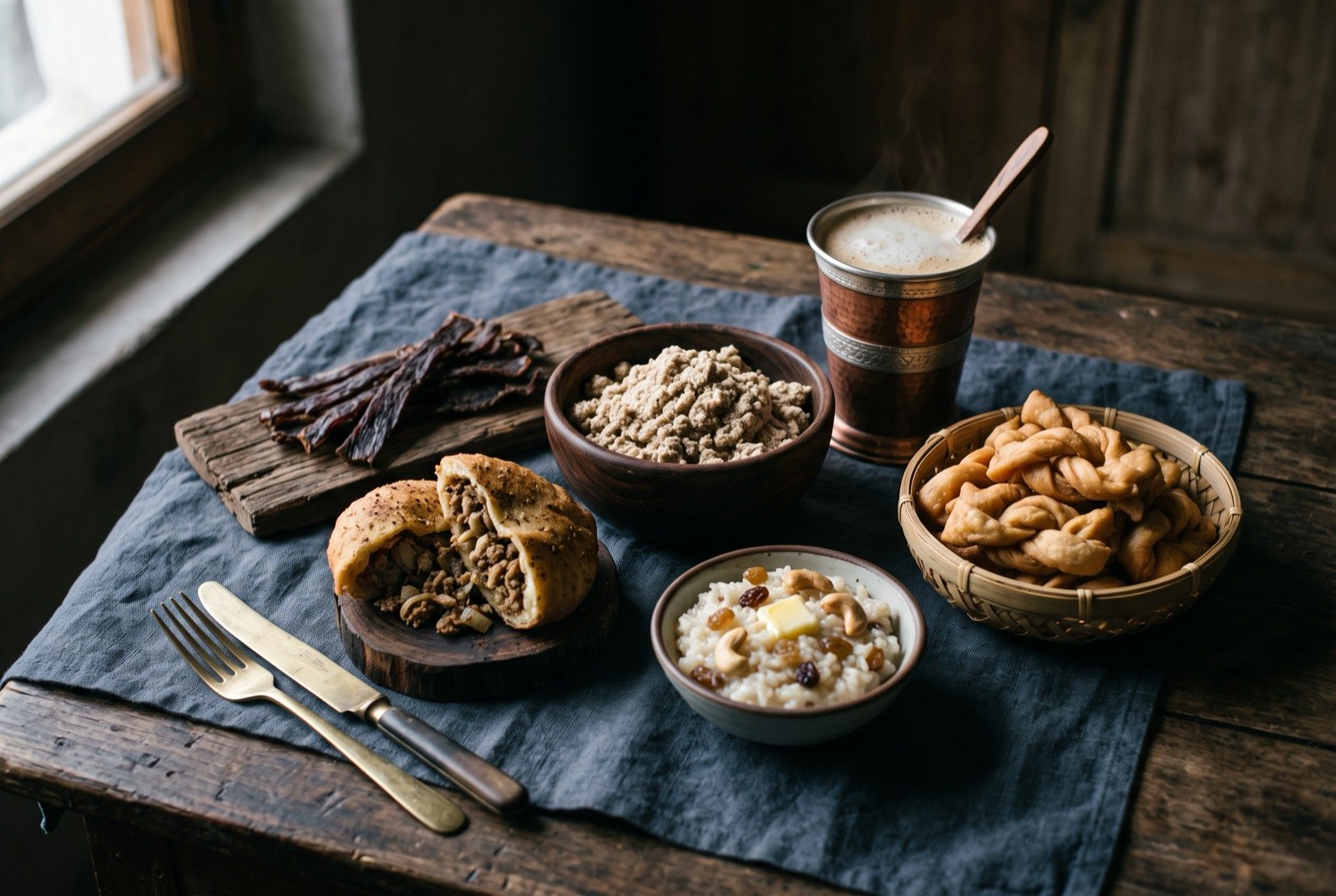
A high-altitude food world built on barley, yak and butter, shaped by Buddhist ritual and altitude ecology rather than the empires that shaped Han cuisine next door: Ü-Tsang, Kham and Amdo, administratively inside the People's Republic of China but culinarily its own, kept alive since 1959 chiefly by the diaspora exile carried into Dharamshala, Kathmandu and beyond. Not one undifferentiated "Tibetan food," but three ecologically distinct regions taken separately, and every dish as tradition built it, then what a modern chef would change.
Sources and review · What this chapter does not assert · How we research · Spotted something wrong?
A Sense of Place
This chapter sits inside a section of the atlas called the Sinosphere, and it does not entirely belong there. Above roughly 3,500 metres almost nothing that defines Han Chinese cooking will grow: no rice, no soy in any quantity, none of the wok-and-oil grammar built on a hot, fast fire and a ready supply of green vegetable. What grows instead is barley, hulless enough to survive a growing season that other cereals cannot, and what feeds people through the winters that barley alone cannot cover is the yak: milk, butter, meat, hide for tents, dung for fuel where wood does not grow at all. Tibetan food is built on that ecology and on a Buddhist ritual calendar layered over it, not on the Ottoman-Manchu imperial cooking that shaped the volumes either side of it in this book, and its closest living relatives, tsampa and butter tea chief among them, are shared with Nepal, Bhutan, Ladakh, Sikkim and Darjeeling, the High Himalaya volume already written elsewhere in this atlas, rather than with Sichuan or Yunnan next door. The Tibet Autonomous Region and the Tibetan-populated prefectures of Sichuan, Qinghai, Gansu and Yunnan sit administratively inside the People's Republic of China. Its culinary logic does not, and this chapter says so rather than filing the plateau under "Chinese food" because a map does.
It also has to say something else plainly, once, before anything else: independent food journalism inside Tibet itself, and open cultural documentation more broadly, face real, well-documented access and censorship restrictions under the current administration. Almost everything genuinely in-tradition in this chapter reaches it through the exile diaspora, chiefly Dharamshala, Kathmandu's Boudhanath quarter and Tibetan communities across North America, Switzerland and Britain, rather than through open access to the plateau itself. That is not a caveat to apologise for. Exile has been the condition of a meaningful share of Tibetan cultural production for well over sixty years, and diaspora writers, cooks and chefs are treated throughout this chapter as legitimate carriers of the tradition, not as a lesser substitute for material that cannot currently be reached inside Tibet.
Tibetans traditionally divide their own country into three regions, chölka sum: Ü-Tsang, the central and west-central plateau around Lhasa and the Yarlung Tsangpo river system; Kham, the lower, wetter eastern belt now split across western Sichuan, northwestern Yunnan and a strip of the Tibet Autonomous Region; and Amdo, the high pastoral northeast, now mostly Qinghai province with slivers of Gansu and Sichuan. A commonly repeated saying assigns each a character: the strongest religious influence to Ü-Tsang, the best horses to Amdo, the most beautiful people, or in another common version the best men, to Kham. This chapter takes that three-way division seriously rather than treating "Tibetan food" as one undifferentiated thing, because the differences are real, ecological before they are cultural, and because the exile community's own parliament formally reserves equal seats for all three regions regardless of population, a tri-regional self-conception built into the institution itself.
Ü-Tsang's ecology is the starkest in this book. Naked, hulless barley is, per agronomic literature, the only cereal that reliably matures above roughly 4,200 metres, and cereal cultivation is documented at extreme altitude in Ngari for millennia; archaeobotanical evidence places naked six-rowed barley in Tibet from around 3,500 years ago, with a shift toward barley-dominant farming during the first millennium BC. Naked barley today still accounts for over 65 per cent of Tibet's food-crop production and covers nearly 70 per cent of farmland, which is the entire reason Tibetans are sometimes referred to, in their own cultural sources, as tsampa-eaters. Central Tibet is not purely arable, either: fieldwork among nomads above roughly 4,900 metres by Melvyn Goldstein and Cynthia Beall recorded sheep and goats as the larger share of herds by headcount, with yak and dri, the female yak, at only around 13 per cent, even though yak and dri products, butter above all, are disproportionately central to the culinary and material culture. Before 1959, this whole economy sat under a monastic estate system: the three great Gelug monasteries of Lhasa, Drepung, Sera and Ganden, held 321 manorial estates between them, roughly 147,000 ke of land and 26 pastures, and Tibet's monasteries collectively owned as much as half the country's farmland, with peasant farmers paying tax and labour in grain and corvée. That structure, Ü-Tsang's specifically, not Kham's or Amdo's more dispersed nomadic economies, is the material basis of Shoton, the Lhasa "yoghurt banquet" festival discussed below.
Kham sits at generally lower altitude, with steep river gorges, forested lowland and alpine grassland running through what is now western Sichuan and northwestern Yunnan. Real agricultural variety exists here beyond barley: corn, buckwheat, soybean, kidney bean and potato appear alongside barley and wheat, and pork turns up as a livestock animal in a way it never does on the high pastoral plateau. Kham's defining fact, per the peer-reviewed fieldwork of Ute Wallenböck, is that it has the longest-standing contact of any Tibetan region with Chinese culture, simply because it borders Sichuan and Yunnan directly, and that contact shows up on the plate: sepen, Tibetan chilli sauce, has a distinct Kham style, chilli-oil based and garlicky, seasoned with Sichuan peppercorn for numbing heat, closer in character to a Sichuan chilli oil than the plainer, more tomato-based sepen of central Tibet. Amdo, by contrast, is overwhelmingly pastoral, high grassland rather than Kham's forest, with barley, wheat and, increasingly, potato as the main crops wherever cultivation is possible at all, and yak, sheep and the yak-cattle hybrid dzomo carrying the pastoral economy. Wallenböck's fieldwork in Henan Mongol Autonomous County, Qinghai, documents Amdo specifically as a real historical contact zone with Turkic Muslim, Chinese and Mongol communities, not a speculative one, and Amdo is disproportionately the exile diaspora's own place of origin: the fourteenth Dalai Lama was born in 1935 in Taktser, a farming village in Amdo, to a household that ate wheat flour, tsampa, meat, butter, buttered tea and barley beer like any other Amdo farming family, and Chögyam Trungpa, who founded Shambhala Buddhism in the West and shaped how Tibetan Buddhism became known outside Asia, was born in Nangchen, Kham, in 1939.
Peoples, ecological logic, the dishes that carry it
| Region | Defining ecological logic | The dishes that carry it |
|---|---|---|
| Ü-Tsang (central Tibet, Lhasa) | Barley-only altitude ecology; a monastic estate economy organising the grain supply; the Tea Horse Road bringing brick tea in from Sichuan and Yunnan | Tsampa, balep korkun, dresi, khapse, guthuk, sha kampo |
| Kham (eastern Tibet) | Lower altitude, forest and mixed agriculture, direct and longstanding Sichuan contact | Sepen with Sichuan peppercorn, khampa poethek, paoze, bhatsa marku |
| Amdo (northeastern Tibet) | High pastoral grassland; documented Turkic, Mongol and Chinese contact; disproportionately the diaspora's own home region | Thukpa, documented to this region specifically rather than to the plateau generically; distinct momo shaping; laphing; unsweetened milk tea |
The History in Layers
The deepest layer here is not a trade route or an empire but altitude itself, a ceiling that decides what can be grown at all before any human choice enters the picture. Onto that sits the Tea Horse Road, Cha Ma Gu Dao, formalised as state policy under the Song dynasty's Sichuan Tea and Horse Agency in 1074 and continued through the Ming and Qing: brick tea from Sichuan and pressed tea from Yunnan moved into Tibet in exchange, originally, for Tibetan horses, roughly one horse for 59 kilograms of brick tea in some periods, more than 25,000 horses exchanged for tea from Sichuan and Yunnan in peak years. After the Qing court stopped requiring horses in the eighteenth century, tea kept moving in for wool, hides, gold, silver and medicinal herbs gathered from the high plateau instead. This trade is the direct ancestor of pö cha, butter tea, meaning the single most iconic food item in this whole chapter is, by ingredient, a joint product of the plateau's own pastoral economy and thirteen centuries of cross-border trade, not a purely indigenous invention standing apart from it.
Religion is the second force, and its central tension is worth stating exactly rather than smoothing over. Tibetan Buddhism preaches compassion toward all sentient beings, explicitly including animals, while the monastic code permits monks to eat meat under a "rule of threefold purity," an animal not seen, heard or suspected to have been killed specifically for the eater, and some tantric vow-sets actually require ritual meat consumption. Geoffrey Barstow's history of the question, the standard academic reference, traces genuine debate over this from the tenth century to the 1950 invasion, and identifies more than 110 individual lamas, active before 1950, who personally renounced meat on ethical grounds, real evidence of a longstanding minority vegetarian tradition inside Tibetan Buddhism rather than a modern graft from outside it. The reason meat nonetheless remained the norm for most Tibetans, monks included, is ecological rather than doctrinal: at altitude, on a short growing season and thin arable land, vegetables and pulses are scarce, and yak, sheep and goat meat were a genuine nutritional necessity for most of Tibetan history, a tension the current Dalai Lama himself has spoken about directly, saying he has tried to keep to vegetarianism but has been advised by doctors to continue eating meat for his health.
That religious calendar produced dated, place-specific history rather than vague festival colour in at least one case worth naming directly. Shoton, the "yoghurt banquet," began in the mid-eleventh century at Drepung Monastery, one of Lhasa's three great Gelug houses: monks observed a summer retreat indoors specifically to avoid inadvertently killing insects underfoot, a direct expression of the non-harm ethic above, and when the retreat ended, lay people from the surrounding area brought the monks fresh yoghurt as alms, and the festival grew from that exchange. Tibetan opera was attached to it under the fifth Dalai Lama, a personal enthusiast of the form, performed initially only inside Drepung for monks and invited nobility until his own move from Drepung to the Potala Palace in 1653 broadened the audience. It is one of the very few dishes in this whole chapter with a named monastery, a named ruler and a datable event behind its ritual meaning, rather than a folk-etymology just-so story.
Trade cut the other way too, in a documented case study from Amdo's border with Mongol territory that this chapter can say more precisely than almost anything else in it, because Wallenböck's fieldwork rests on named informants and named archival Tibetan and Qing-era sources rather than tourism copy. In Henan Mongol Autonomous County, Qinghai, ethnically Mongol but Tibetan-speaking and Tibetan-Buddhist, a Mongol informant told Wallenböck directly: "We are not really Mongols. We do not speak Mongolian but Tibetan. Now we eat tsampa like the Tibetans even though we used to refer to it as 'torma tsampa,'" and a Qing-era Tibetan-authored historical source confirms tsampa was historically unknown to Mongols as an everyday food, only as ritual butter-and-tsampa sculptures. Butter moved the other way: the same sources state Mongols in this area historically made and ate no butter of their own, only mare's and sheep's milk, until Tibetan contact introduced it. Whether air-drying meat, often marketed in the West as quintessentially Tibetan, is in fact a technique borrowed from the Mongols rather than native Tibetan practice is, per Wallenböck, a genuinely open scholarly question, not a settled one, and this chapter leaves it exactly there. The same scholarship carries a piece of real emic vocabulary worth keeping: Tibetans in this contact zone categorise food as dkar zas, "white food," milk, butter, cheese and yoghurt, anything free from killing, against dmar zas, "red food," meat and blood, a conceptual line this chapter's own dish list sits astride rather than on one side of.
The modern moment is a rupture, not a gradual change, and this chapter states the bare, broadly agreed facts of it plainly rather than either dwelling on them at length or looking away. The People's Republic of China took control of Tibet in 1950 and 1951; a 1959 uprising in Lhasa ended with the fourteenth Dalai Lama fleeing into exile in India, followed over the following years by monks and laypeople from across the whole Tibetan cultural region, Amdo and Kham included, not only Ü-Tsang, in numbers this chapter could not find a hard, sourced figure for despite specific searching. The monastic estate system described above was dissolved, and the Cultural Revolution's assault on religious institutions across China fell on Tibet's monasteries with particular force, disrupting at a stroke the ritual calendar and the agricultural relationships that had organised food and festival together for centuries. What survived, and what this whole chapter is built from, survived largely in exile: in Dharamshala, in Kathmandu's Boudhanath quarter, and in Tibetan communities that took shape from the 1960s onward in India, Nepal, Switzerland and, later, North America. Jamyang Norbu, the Tibetan writer whose essay on restaurant culture anchors this chapter's honest diagnosis below, makes the specific, material point that exile food is often diminished not through vague nostalgia but through a genuine loss of particular ingredients, the classic Lhasa noodle broth bhö-thuk depending, in his account, on "Wabalinga yak meat and bone broth" that exile cooks simply could not replicate abroad.
The Flavour Arsenal
Staples
| Ingredient | What it does |
|---|---|
| Naked (hulless) barley | The only cereal that reliably matures above roughly 4,200 metres; roasted and ground into tsampa, the daily staple; over 65 per cent of Tibet's food-crop production |
| Wheat | Grown at lower altitude in Kham, Amdo and river valleys; balep flatbread, shabhaleb pastry dough |
| Droma | A small wild-dug tuber, likened in flavour to sweet potato, central to "proper" dresi and needing a thorough rinse to remove grit before use |
Dairy and fat
| Ingredient | What it does |
|---|---|
| Dri butter | Churned from female yak milk; the cooking fat of an economy that cannot grow oil crops at scale, used in butter tea, khapse dough, dresi and worked into tsampa dough |
| Chura / chura kampo | Dried yak cheese made from the milk solids left after butter is churned off; soft and fresh (chura loenpa) or hard, dried for weeks and gnawed rather than bitten (chura kampo); a portable protein for herders |
| Sho | Yak-milk yoghurt, deliberately sour and full-flavoured, set with a starter culture from a previous batch |
Preserved proteins
| Ingredient | What it does |
|---|---|
| Sha kampo | Wind-dried yak jerky, preserved by a specific cold, dry northwesterly wind and low humidity rather than by salt or smoke |
| Gyuma | Blood sausage, filling of blood, meat, fat and either barley or wheat flour, stuffed into cleaned intestine casing |
Trade goods that became staples
| Ingredient | What it does |
|---|---|
| Brick tea | Compressed tea from Sichuan and Yunnan, moved up the Tea Horse Road for over a thousand years; the base liquid of butter tea, meaning Tibet's defining drink is only half a plateau product |
| Salt | Essential to butter tea's savour, historically a trade good moving alongside tea and wool |
Kham's departure from the central Tibetan table
| Ingredient | What it does |
|---|---|
| Sichuan peppercorn | Used in Kham's sepen and in dishes like khampa poethek and paoze, a numbing heat with no equivalent in central Tibetan seasoning, a direct mark of Kham's long Sichuan contact |
| Chilli oil | Kham's sepen is chilli-oil based and garlicky, closer to a Sichuan condiment than to central Tibet's plainer, more tomato-forward version |
The Technique Ladder
Rung 1. Roast once, in bulk, then never cook again
Tsampa's whole technical logic is that the energy-intensive step, roasting the barley, happens once, well before any meal, and what happens at the table afterwards is assembly by hand, not cooking. On a plateau where fuel is scarce and the growing season short, this converts one concentrated act of heat into a food that then needs no fire at all, a genuinely different economy of effort from a cuisine built around cooking to order.
Rung 2. Churn until it emulsifies, not until it is merely mixed
Butter tea's dongmo, a tall wooden churn worked by hand with a paddle for a sustained period, is doing real emulsification chemistry: forcing fat, water and dissolved tea solids into a stable suspension rather than leaving butter floating loose on the surface of hot liquid. The vigour and duration of the churning is the entire difference between tea with melted butter on it and a genuine, silky emulsion, the actual point of the drink.
Rung 3. Preserve with cold, dry wind, not salt or smoke
Sha kampo depends on a specific named wind, locally called the Drukpa wind, blowing steadily from the northwest, and a humidity threshold below roughly 30 per cent, rather than on brine or smoke as the primary preservation mechanism. This is an altitude and climate-specific technique, not a generic drying method that would transfer unchanged to a wetter or warmer place.
Rung 4. Set with acid, then desiccate past the point of spoilage
Chura's technique is not rennet cheesemaking but acid coagulation of the milk solids left after butter is churned off, cured a few days at room temperature, then dried until moisture drops below roughly 15 per cent, hard enough to keep for months without refrigeration. It is a preservation strategy built for a place with abundant dairy in summer and none in winter, converting a perishable surplus into a food that survives the season it was made in by several multiples.
Rung 5. Let threefold-purity ethics decide who slaughters, and when
Because monks and many lay Buddhists are meant to avoid meat killed specifically for them, Tibetan meat culture has historically kept the killer or butcher role separate from the eater, often as a specific, sometimes stigmatised occupational role, and timed to the calendar rather than to daily need. The mid-November slaughter timing recorded for gyuma-making in Kham reflects both a genuine preservation need, cold weather arriving, and, plausibly, a wish to kill once for a whole season's needs rather than repeatedly through the year.
Rung 6. Season with Sichuan peppercorn as a marker of contact, not decoration
Kham's sepen and dishes built around it use Sichuan peppercorn's specific numbing heat, mala, in a way central Tibetan cooking simply does not, a direct, traceable result of Kham's long geographic border with Sichuan rather than a spice reaching for interest. Reading a Tibetan dish's chilli profile is, in this chapter's own small way, reading which part of the plateau it came from.
The Ferment and Preserve Bench
1. Chura kampo
Separate butter from dri or, outside Tibet, cow milk by churning; cure the residual milk solids at room temperature for 2 to 3 days, then slice and sun-dry, or oven-dry on a low heat, until hard enough to require real chewing, rehydrated in the mouth with saliva or softened in hot tea. A naming note the writer should carry into the chapter's own prose: "chhurpi" is primarily the Nepali, Sikkimese, Bhutanese and Ladakhi name for this same family of hard, acid-set dried cheese; central Tibetan sources instead say chura, soft, or chura kampo, hard. The two are very likely the same technique family under different regional names, but no source found states this identity outright, so it is presented as a strong likelihood rather than a confirmed fact.
2. Sho
Filter fresh yak milk, heat gently, traditionally over a yak-dung fire, until it just begins to rise and foam, remove from the heat, and stir in a small amount of old yoghurt as a starter culture. One tourism-industry source states the milk sets into thick, sour yoghurt in as little as 5 hours; this figure could not be independently verified and should be treated as plausible rather than settled. Sho is the namesake food of the Shoton festival described above, a rare case of a ferment with a documented, place-specific ritual origin rather than a generic "eaten at festivals" claim.
3. Chhaang
Steam barley, cool it, and ferment with a herbal starter culture, called pab or phabs, for two to five days depending on climate and the individual family recipe, each household's starter producing its own distinct character. Diaspora communities without easy access to Tibetan barley have documented themselves substituting rice or millet, an honest adaptation worth naming as such rather than treating barley as a non-negotiable ingredient the dish cannot survive without.
Sourcing in Britain
Tsampa is, unexpectedly, the best-sourced ingredient in this entire chapter. Your Kathmandu and Woody's Health Food both sell ready-made roasted barley flour under the tsampa name, UK-wide, and the do-it-yourself method genuinely works if neither is to hand: dry-roast pearl or, better, hulled barley in a dry pan or a low oven until it colours and smells toasted, then grind fine in a high-power blender or a dedicated spice grinder. It will not be quite as fine as commercially stone-milled tsampa, and hulled barley's tougher bran will show more than pearl barley's does, but this is a tested method, not a hand-wave, and sits squarely inside a long British tradition of roasting and grinding barley for exactly this kind of use.
Chura kampo, the hard dried cheese, is a genuine and welcome win: The Rising Store, a Nepali grocer trading from Dudley with UK-wide delivery, sells it directly, describing it, not inaccurately, as among the hardest cheeses in the world. This is the same product Tibetans use, reaching Britain via the Nepali diaspora supply chain rather than a Tibetan one specifically, not a stretched substitute standing in for the real thing. No UK retailer was found selling the soft, fresh version, which does not survive shipping. The Rising Store also sells marcha, the dried yeast starter used across the Himalayan belt to ferment barley or rice into chhaang, solving the one genuinely hard-to-source ingredient in that recipe; barley itself is trivial to find anywhere.
Yak meat and yak butter are, honestly, not available in Britain at all. No true-bred yak farm currently operates here, a fact stated plainly on a mainstream UK butcher's own website, and none of the country's established exotic-meat retailers, who do sell kangaroo, ostrich and wild boar without difficulty, list yak in their current ranges. Yak butter fares no better: searches turn up only a confusable cannabis strain sharing the name, wholesale "yak ghee" with no consumer stockist, and a copper churn sold as decorative cookware. The honest substitutes, stated as substitutes rather than equivalents, are grass-fed Highland or Galloway beef shin or brisket for long, stewed cookery, since yak's flavour sits somewhere between beef and venison and a hardy upland British breed gets closer than standard supermarket beef; and venison haunch or loin where a leaner, quicker-cooked cut is wanted, since venison and yak share a similar leanness and gaminess. A good cultured, high-fat British butter is the honest stand-in for dri butter throughout this chapter, richer than a standard block but still lacking yak butter's distinct tang, a gap this chapter has not tried to disguise.
Brick tea for butter tea has no direct UK equivalent either, but a very close and honestly labelled substitute does: a ripe, or shou, pu-erh brick from a UK tea specialist, Rare Tea Company and The Teapot both stock one, is the same broad category of compressed, fermented tea historically traded up the Tea Horse Road, robust and dark enough to stand up to boiling and whisking with fat and salt. Dried Tibetan turnip has no UK match at all: what turns up under a turnip search is Chinese pickled dried turnip, a different, seasoned preparation entirely. For the fresh vegetable, ordinary British turnip or swede is genuinely close, a hardy, cold-climate brassica not unlike the Tibetan original, and a home dehydrator will get a determined cook the rest of the way to a dried form no retailer currently sells.
A small, real scene of Tibetan food actually exists in Britain, worth naming rather than assuming away. Kailash Momo in Woolwich is widely reported as London's only Tibetan restaurant, family-run and serving momos, thenthuk and butter tea. Momo Bar, trading from the Glass Arcade of Bristol's St Nicholas Market, run by Ugyen Choephell since 2015, is the strongest single find in this whole research pass: a genuinely Tibetan-run stall, verified against local press and the council's own market listing, and proof that Tibetan food in Britain is not solely a London story. House of MoMo in Stoke Newington is Nepalese-led with Tibetan cuisine credited alongside, and the Kagyu Samye Dzong Buddhist centre in Bermondsey runs a genuine Tibetan tearoom, though it is not a grocery source. No dedicated Tibetan grocer, as distinct from these restaurants and the Buddhist centre, was found operating anywhere in Britain; the Nepali grocery sector, chiefly Your Kathmandu and The Rising Store, does the real work of Himalayan pantry sourcing for a British Tibetan-food reader, exactly as it does for this chapter's sibling volume on the wider High Himalaya.
Voices and Sources
Jamyang Norbu, the Tibetan writer, essayist and former Tibetan Youth Congress activist, supplies this chapter's single most valuable piece of in-tradition commentary, his essay on Tibetan restaurant culture naming both a real, pre-1950 Lhasa restaurant scene most outside accounts assume never existed, and the specific ingredient loss, Wabalinga yak meat and its bone broth, behind why exile noodle cooking so often falls short of the dish it is trying to replicate. Lobsang Wangdu, a Tibetan who spent over twenty years as a Buddhist monk before co-founding YoWangdu with his American wife Yolanda O'Bannon, and the anonymous author of Simply Tibetan, writing explicitly for a younger diaspora audience and drawing on named Kham interview subjects like Rinchen Tashi for its most detailed fieldwork-adjacent material, supplied the majority of this chapter's specific recipe detail. Tsering Wangmo, a Tibetan refugee who ran the Lhasa Moon restaurant in San Francisco, wrote the earliest and most directly in-tradition English-language Tibetan cookbook this research found. Yeshi Jampa, who grew up herding livestock on the Tibetan plateau and learned to cook inside a yak-hair tent, and his English wife Julie Kleeman, run Taste Tibet in Oxford, the strongest UK find in this whole chapter by a wide margin: a Guardian and BBC Good Food Top Ten pick, a 2021 BBC Food and Farming Awards finalist, celebrated at the Observer Food Awards 2022, and the authors of Taste Tibet: Family Recipes from the Himalayas. Dawa Bhuti, trained at Mercer Kitchen, Rouge Tomate and Reynard before opening Dawa's in Woodside, Queens, with her father Ngodup Gyaltsen, and Doma Wang, born in Kalimpong, ranked in India's Top 30 Chefs three times and celebrated as Kolkata's "Momo Queen" for The Blue Poppy Thakali, are the two clearest living examples this research found of Tibetan-heritage cooks bringing serious outside technique back to their own tradition. Phayul, in Jackson Heights, holds a Michelin Guide Bib Gourmand, the single clearest piece of third-party culinary recognition found anywhere for a Tibetan restaurant, independently praised by Norbu himself. Academically, Geoffrey Barstow's Food of Sinful Demons (Columbia University Press, 2018) on meat and Buddhist ethics, Ute Wallenböck's 2021 peer-reviewed fieldwork on Amdo-Mongol foodways, and Melvyn Goldstein and Cynthia Beall's fieldwork among Tibetan nomads anchor this chapter's ecological and historical claims.
Things this chapter has deliberately not asserted
- That "chhurpi" and "chura kampo" are confirmed to be the same word or dish rather than parallel, closely related traditions: no source found states this identity outright, so this chapter presents it as a strong likelihood, not a settled fact.
- That the gyuma recipe given here reflects central Tibetan, Ü-Tsang practice specifically: the richest source found for it is a Kham nomadic account, and no equivalent Ü-Tsang-located version could be found.
- That thukpa is a central Tibetan invention: the earliest detailed Western account of it, via the Jesuit missionary Ippolito Desideri and cited in Wallenböck's scholarship, locates it specifically in Amdo, even though it is now eaten across the whole plateau and the wider Himalaya and is treated in full elsewhere in this atlas, in the sibling High Himalaya volume, as a shared dish rather than one this chapter re-treats.
- That air-drying meat is a native Tibetan technique rather than one borrowed from Mongol neighbours: Wallenböck raises this directly as an open scholarly question, and this chapter has left it open rather than settling it either way.
- That Kham cuisine today has become "largely Sichuan-influenced" as a broad, present-day fact: this specific framing rests only on tourist-board copy; the narrower, better-supported claim, that Kham's sepen and named dishes use more chilli and Sichuan peppercorn than central Tibet's, is what this chapter has actually asserted.
- That the exile diaspora is demonstrably more Amdo or Kham in character than Ü-Tsang by population: this chapter found no quantified breakdown of exile population by region of origin, only a documented early-exodus tilt toward Kham and two historically consequential figures born in the eastern regions, and presents the idea as a plausible, historically grounded observation rather than a demonstrated fact.
- That any Tibetan restaurant anywhere in the world holds a Michelin star, as distinct from the Bib Gourmand recognition Phayul in Queens has genuinely earned: no such restaurant was found.
- That a documented, chef-led modernist Tibetan dish, a reworked tsampa, an elevated chhurpi service, a Tibetan yak tartare, already exists at any named restaurant: the technique ladder in this chapter is offered as grounded extrapolation from verified traditional practice, not as reportage of a kitchen that has already done it.
- And, running under all of the above, that open access to food culture inside present-day Tibet is comparable to the access this atlas has had researching almost everywhere else in it: it is not, independent food journalism and cultural documentation inside the Tibet Autonomous Region and Tibetan-populated PRC prefectures face real restrictions, and this chapter is built, honestly and by necessity, from what the exile diaspora has carried out and written down rather than from open reporting inside Tibet itself.
Roast once, in bulk, then never cook again
Tsampa's whole technical logic is that the energy-intensive step, roasting the barley, happens once, well before any meal, and what happens at the table...
Churn until it emulsifies, not until it is merely mixed
Butter tea's dongmo, a tall wooden churn worked by hand with a paddle for a sustained period, is doing real emulsification chemistry: forcing fat, water and...
Preserve with cold, dry wind, not salt or smoke
Sha kampo depends on a specific named wind, locally called the Drukpa wind, blowing steadily from the northwest, and a humidity threshold below roughly 30 per...
Set with acid, then desiccate past the point of spoilage
Chura's technique is not rennet cheesemaking but acid coagulation of the milk solids left after butter is churned off, cured a few days at room temperature...
Let threefold-purity ethics decide who slaughters, and when
Because monks and many lay Buddhists are meant to avoid meat killed specifically for them, Tibetan meat culture has historically kept the killer or butcher...
Season with Sichuan peppercorn as a marker of contact, not decoration
Kham's sepen and dishes built around it use Sichuan peppercorn's specific numbing heat, mala, in a way central Tibetan cooking simply does not, a direct...
The dishes
- Tsampa Ü-Tsang, central Tibet
- Balep korkun Ü-Tsang, central Tibet
- Dresi Ü-Tsang, central Tibet; eaten across Tibet at weddings and Buddhist holidays
- Guthuk Ü-Tsang and pan-Tibetan
- Khapse Pan-Tibetan, central Tibetan Losar tradition
- Sha kampo Pastoral Tibet, especially Amdo and Kham nomad country
- Gyuma Kham nomad country (Drongpa and Gegye nomadic societies)
- Shabhaleb Ü-Tsang, central Tibet
Sources and review
- Reviewed
- Not yet reviewed from inside the tradition
- Cooked
- Not yet cooked and reported
Where this volume comes from
3 research briefs on file for this volume, researched to the rules on How we research. Published 5 September 2026. Last changed 8 September 2026.
The brief's own account of its sources
Combined total: roughly 57 web searches and 6+ direct page fetches across both research passes (37 searches/6 fetches for the central Tibet pass, 20 searches/fetches for the Kham/Amdo pass). Tibetan and diaspora-identified voices, directly quoted or credited (the house-style priority tier): the Central Tibetan Administration (tibet.net); the Tibetan Nuns Project (tnp.