Asia · Volume 32
Hong Kong and Macau
The Stocking, the Shelter and the Spice Route
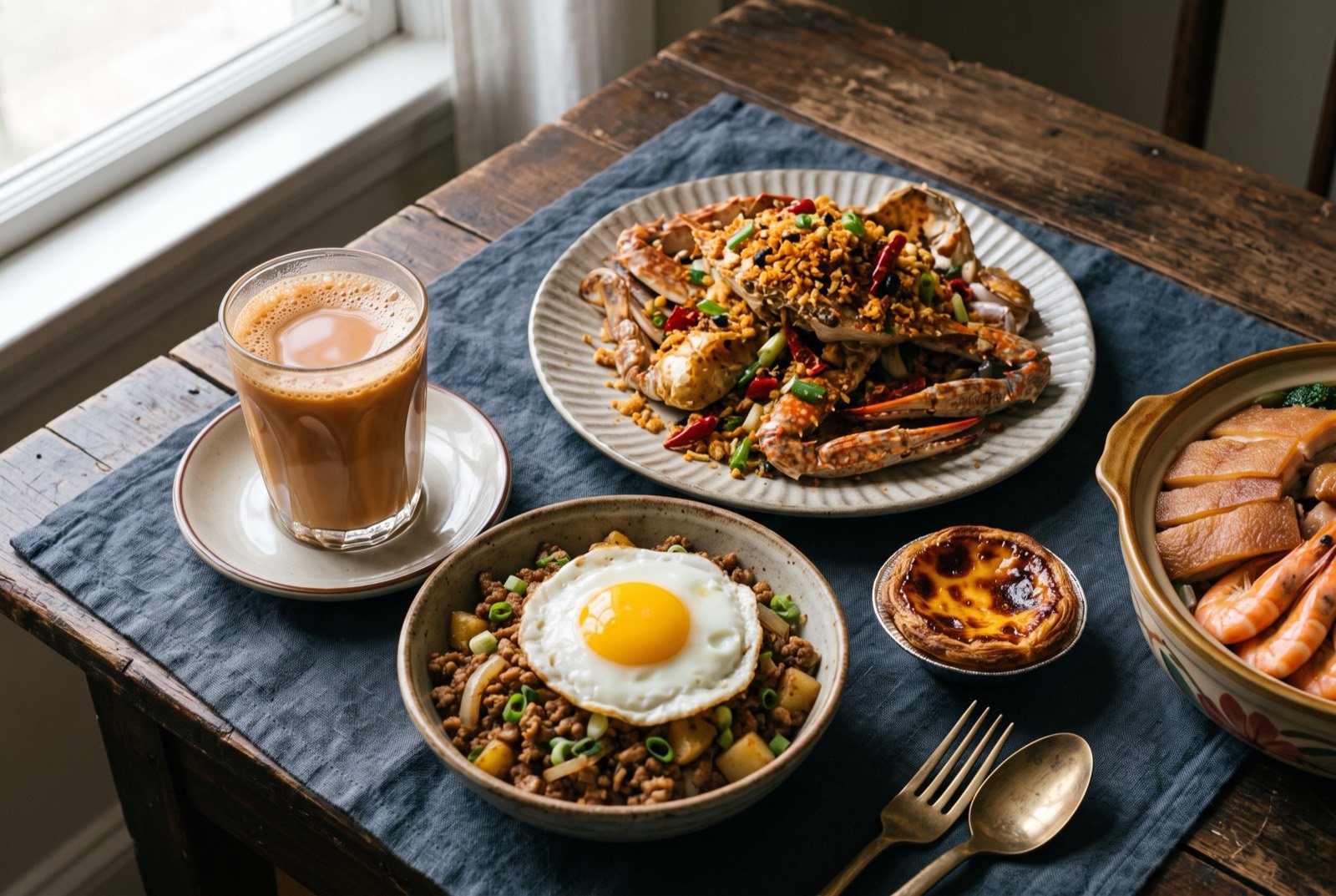
Hong Kong and Macau, taken seriously. Not two cities that dressed a Cantonese base in colonial garnish, but two separate chemical reactions: a British colonial economy democratised into a fast, cheap eating culture in one, four centuries of Portugal's own African, Goan, Malaccan and Cantonese trade network fused into a genuinely new cuisine in the other, and every dish as tradition built it, then what a modern chef would change.
Sources and review · What this chapter does not assert · How we research · Spotted something wrong?
A Sense of Place
Most writing about either city collapses fast into cliché: Hong Kong as "East meets West," Macau as "the Las Vegas of Asia" with a quaint Portuguese quarter attached. Both descriptions are lazy in the same specific way. They treat the colonial layer as decoration on top of an unchanged Cantonese base, when what actually happened in both cities was closer to chemistry than to decoration: a base cuisine reacted with an imported one and produced compounds that exist in neither parent tradition. Hong Kong's cha chaan teng is not Cantonese food with British side dishes bolted on; it is what happens when a British colonial food economy, stratified so that ordinary Chinese residents were priced and, for a long stretch, socially excluded from Western dining, gets democratised by cooks who had never been taught the "correct" way to make any of it and simply built their own version from what was cheap and available. Macau's cuisine is a stranger and older case still: not two ingredients reacting but four or five, Portuguese technique carrying African chilli, Goan spice, Malay ferment and Cantonese wok work into one kitchen over four hundred years, by way of the same trading network that also, elsewhere, produced Goa's own vindaloo and sorpotel as its structural twin at the opposite end of the same empire.
Hong Kong's ecology is a fishing port and a refugee city first, a colony second. Cantonese cooking arrived with the people who already lived on the Pearl River Delta and the boat-dwelling fishing communities of Causeway Bay, Yau Ma Tei, Kwun Tong and Lei Yue Mun long before the British flag went up in 1841, and it stayed the base layer of every kitchen in the territory afterward. What British rule added was not a cuisine so much as a social structure: a stratum of Western dining that ordinary Chinese residents could not afford and, for decades, were not welcome inside. The bing sat, iced drinks and ice cream parlours that first appeared in the 1910s and 1920s, began adding sandwiches and buttered toast in the years after the Second World War specifically because Western food remained unaffordable and unwelcoming through the normal channel, and by the 1950s that workaround had become its own institution, the cha chaan teng, "Western food made Chinese" in the words of one Hong Kong feature on the subject, not Western food imported wholesale. Waves of refugees and migrants from across China (Shanghai's own émigré community especially) layered further, non-British ingredients into the same kitchens; two of this cuisine's most identifiably "colonial" dishes, borscht and Spam-and-egg instant noodles, turn out on inspection to be Russian-via-Shanghai and American-via-wartime-military-supply respectively, not British at all, a correction worth making plainly rather than repeating the tidier but less accurate story.
Macau's ecology is Portugal's own maritime trade network, arriving from four directions at once. Portuguese settlement is conventionally dated from 1557, and from the start it was never a two-culture encounter. Early Portuguese arrivals in Macau married Indian, Malay and Chinese women; by the mid-seventeenth century, migration from Guangdong and Fujian accelerated intermarriage between Portuguese and Chinese populations specifically, producing the mestiço community that calls itself Macanese, filhos da terra, children of the land. But the ingredients travelling into Macau's kitchens came from every stop on Portugal's own Estado da Índia trading route: piri-piri chilli, itself a South American plant carried by Portuguese trade to Africa and renamed there in Swahili before reaching Macau; balichão, a fermented shrimp paste of Malay origin; tamarind, arriving via the Goa leg of the network; curry spicing and coconut milk, arriving specifically via Malacca and the Ming-era Southeast Asian spice trade, not from Africa as a casual reading of "African chicken" might suggest. Macau's cuisine is what the whole Portuguese empire tastes like when it lands in one small Cantonese-speaking peninsula and stays there for four centuries, cooked increasingly by women (recipes transmitted mother to daughter within families) belonging to a community that today numbers, by the most-cited but genuinely disputed figure, somewhere between 8,000 and 13,000 people still resident in Macau itself, with larger diaspora populations in Canada, the United States and Portugal.
A table of zones, logic and dishes
| City | Defining logic | Carried by |
|---|---|---|
| Hong Kong (Cantonese base, British colonial economy) | A fishing port and refugee city's kitchens democratising a Western dining world Chinese residents were priced and socially excluded from; wok technique and Cantonese ingredients doing the actual cooking under borrowed Western names | Milk tea, cha chaan teng borscht and French toast, wonton noodle soup, typhoon shelter crab, salt and pepper squid, poon choi |
| Macau (Cantonese base, Portuguese Estado da Índia network) | Four centuries of one trading empire's own African, Goan, Malaccan and Cantonese stops combining in one kitchen, transmitted mother to daughter, now the community's primary marker of an identity its own creole language is losing | Minchi, galinha à Africana and à Portuguesa, tacho, balichão and tamarindo dishes, bacalhau adaptations, the Macau egg tart |
Neither cuisine has stood still under the twenty first century's own pressures, and both are genuinely live rather than preserved. Hong Kong carries a real, currently expanding wave of BN(O) visa migration into Britain (around 52,000 Hongkongers relocated to the UK in 2022 alone), producing a fresh, currently trading scene of new Cantonese restaurants in London built specifically to serve that new community rather than to please assumed British tastes, discussed below and in the sourcing section. Macau's own cuisine, meanwhile, is the subject of active, organised preservation work rather than casual survival: a dedicated cultural brotherhood founded specifically to collect family recipes before they vanish, a national intangible heritage listing, and Macau's own UNESCO Creative City of Gastronomy status, awarded in 2017, sit alongside a genuinely small number of restaurants (Macau's high-end dining scene, discussed under modernist technique below, is heavily weighted toward preserving Portuguese and Macanese cooking rather than reinventing it) still serving the tradition daily.
The History in Layers
Hong Kong's Western-food-for-the-excluded story starts specifically with ice, not with tea. On Lok Yuen, founded 1913, began as a Western-style cheap eatery, and its ice-room section, selling home-made ice cream and cold drinks under ceiling fans through the territory's humid summers, is where the word "bing sat" (ice room) comes from; further bing sat followed through the 1920s and 1930s. It was only in the years after the Second World War, with proper Western dining still out of reach financially and, in practice, socially, that bing sat began adding sandwiches, buttered toast and simple Western-style dishes cheaply, and through the 1950s and 1960s that expanding menu, taken out under restaurant and food-premises licences, became today's cha chaan teng. The format's own inventions, char siu spaghetti in tomato soup, a Spam-and-sausage omelette, the "cocktail bun" made from leftover bread mixed with sugar, are described by Hong Kong food writers themselves as "Western food made Chinese," a genuine new cuisine rather than an imported one worn thin.
Two of that cuisine's most reliably "British colonial" dishes are, on inspection, nothing of the sort. Spam is an American product, invented in 1937 by Jay Hormel during the US Depression, and it reached Hong Kong specifically via American military supply routes through Asia during and after the Second World War, the same channel that carried it to Korea and the Philippines; the specific Chinese-manufactured brand still on Hong Kong supermarket shelves today, Meilin, was first imported only in 1958, a Mainland Chinese brand rather than a British one. Instant noodles arrived by an equally non-British route: Winner Food Products introduced its "Doll" brand instant noodles to Hong Kong after one of its founders travelled to Japan specifically to learn noodle-manufacturing technique, and by 1969 cha chaan teng were using them heavily enough that the company began producing an unpackaged, restaurant-grade noodle cake for the trade. The instant-noodles-Spam-and-fried-egg combination that reads, to an outside eye, as the clearest possible symbol of British colonial food culture, is in fact American wartime supply chain plus Japanese manufacturing technique plus a Hong Kong company's own initiative, absorbed into a British colonial economy rather than issued by it. The British layer holds far better for milk tea, for borscht's Western-dining-democratised-downward story, and for the whole social structure that made cha chaan teng necessary in the first place; it should not be stretched to cover every Western-shaped object on the menu.
Hong Kong milk tea's own history is better documented than either of those, precisely because Hong Kong itself has formally recognised it as heritage. Lan Fong Yuen, founded 1952 in Central by Lam Muk-ho, is credited with pioneering the cloth-bag straining method that gives the drink its "silk stocking" nickname, the cotton filter bag darkening with repeated use to a colour resembling flesh-toned stockings. Milk tea-making technique was added to Hong Kong's Intangible Cultural Heritage list in 2014 and proposed, by 2017, among the ten representative items of Hong Kong's intangible cultural heritage overall, a genuine, government-recognised status this chapter's other cha chaan teng dishes mostly lack.
Borscht's Hong Kong story runs through two competing routes that local sources themselves disagree on the weight of. White Russian refugees fleeing the Revolution and Civil War opened Russian restaurants in pre-war Hong Kong, bringing borscht directly; separately, from the 1940s, Shanghainese migrants brought their own already-once-removed "Haipai" (Shanghai-style) version of Russian cuisine into the territory, including its own borscht. Ming Pao, a genuine Hong Kong newspaper, states plainly that most borscht found in ordinary Hong Kong eateries today descends from the Shanghai route rather than directly from Russian émigré cooking, and, tellingly, is not made with beetroot in the traditional Russian or Ukrainian manner at all; it is tomato-based, casually called "red soup" and paired conceptually with "white soup" (cream of mushroom or similar) as the two pillars of Hong Kong's own "soy-sauce Western food" starter course. Cheap, filling ingredients, cabbage, tomato, beef, potato, carrot, made it an affordable full meal with bread, and that affordability is precisely why it entered the cha chaan teng canon in the first place.
Typhoon shelter crab was invented on the water, not in a restaurant, and it stopped being invented on the water for a reason worth stating plainly. Fishing families lived on boats moored in Hong Kong's typhoon shelters, purpose-built harbours sheltering fishing vessels from storms, particularly at Causeway Bay (built after an 1874 typhoon, on the site of today's Victoria Park), and some ran "water kitchens" cooking for other boat-dwellers and, increasingly, for visitors rowing out specifically to eat there. This is where the dish, crab stir-fried at very high heat with garlic, fermented black beans and dried chilli, was invented, dated to the 1960s and 1970s. In 1995, cooking aboard boats in the shelter was banned after fires and worsening water-pollution concerns; boat-dwelling families and their floating restaurants moved ashore, opening stalls under the Canal Road Flyover in Causeway Bay and along Jaffe Road and Lockhart Road in Wan Chai, which is where "typhoon shelter" cooking is now found on land. More than one shop claims the clearest lineage back to the original floating kitchens, and this chapter does not adjudicate between them.
Poon choi carries two flight-of-the-emperor legends and one much more credible practical explanation, and the honest version keeps all three. Both legends involve the Southern Song court fleeing the Mongol invasion through the Pearl River Delta and being fed by villagers who had only pork, radish, fish and shrimp on hand, serving it communally in wooden washbasins for want of individual dishware; neither should be treated as verified history. What is much better attested is that poon choi is the specific festive food of the walled villages (圍村) of Hong Kong's New Territories, home to indigenous clans tracing lineage to the Song and Yuan dynasties, and that villagers there have used wooden basins to serve composite feast dishes at clan celebrations for an estimated four hundred-plus years. A more prosaic, and arguably more credible, explanation favoured by some historians is simply that rural households rarely owned enough plates and bowls for a large communal wedding or funeral, so well-scrubbed laundry buckets and washing basins were pressed into service as serving vessels. Whichever version a reader prefers, the dish's actual construction, frying, deep-frying, roasting, boiling, braising and marinating in sequence before everything is layered into one basin, makes it a genuine technique showcase for this chapter's whole argument: a modernist chef's tasting-menu deconstruction of poon choi is really just re-sequencing techniques New Territories clan cooks already used.
Macau's own layered history starts with marriage, not with trade goods. Portuguese settlers arriving from the mid-sixteenth century intermarried first with Indian, Malay and Chinese women, and, by the mid-seventeenth century, specifically with women from the growing Guangdong and Fujian migrant population, producing the mestiço Macanese community. The community developed Patuá, a Portuguese-based creole now nearly extinct with only a handful of fluent speakers, kept alive partly through an annual Patuá-language theatre tradition; both cuisine and theatre were named together when Macau's own cultural heritage was inscribed on China's national intangible cultural heritage list in 2021. As the community disperses, its cuisine has become, by its own writers' account, the primary legible marker of Macanese identity that remains, precisely because the creole language is dying and intermarriage has diluted any tidier ethnic self-definition. Macau's UNESCO Creative City of Gastronomy designation, awarded 2017, the third Chinese city in the network, sits alongside a genuinely active preservation effort: the Confraria da Gastronomia Macaense, founded 2007 by a coalition of Macanese community associations, exists specifically to collect family recipes before they are lost, holding 17 documented variants of minchi alone in its own archive, since roughly thirteen Macanese cookbooks published between 1983 and 2014 have still left most family recipes undocumented, transmitted only within households.
Minchi is the clearest single demonstration of what "Macanese fusion" actually means mechanically, rather than as a slogan. Cecília Jorge, a genuinely Macanese-community food writer whose account is the strongest single source on the dish, frames its technique as fusion at the level of method, not flavour: meat diced small "the Chinese way" for ease of eating, then sautéed in garlic and a large quantity of chopped onion "the Portuguese way." The name most likely derives from the English "to mince," probably carried via the Macanese community resident in early British Hong Kong, a small but telling detail: even this most Portuguese-Chinese of dishes has an English fingerprint on its own name.
Galinha à Africana's origin is genuinely unsettled, and the mechanism behind it is more interesting than any single inventor's name. Three competing stories recur across every source consulted: a hotel chef, Américo Ângelo, inventing it at the Pousada de Macau in the 1940s after a trip to Portugal's African colonies; a Portuguese-family recipe evolved gradually from Mozambican piri-piri chicken; or its popularisation after Portuguese army officers who had served in Mozambique, Angola and Portuguese Guinea retired to Macau after the 1974 Carnation Revolution. No contemporary 1940s menu, newspaper mention or Pousada archival record corroborates any one of the three, and this chapter does not pick a winner. What is much better documented, in a serious academic essay published by the American Historical Association, is the historical plausibility underneath the legend: from the 1940s, African colonial troops from Mozambique, Angola and Portuguese Guinea served in the Macau garrison, and two of Macau's four consulates-general today represent Angola and Mozambique, "echoing these historical ties." The dish's own popularisation is dated to the early 1950s, genuinely twentieth century, despite Portuguese presence in Africa dating back to the seventeenth century, a distinction worth naming plainly: old colonial contact and a specific mid-century invented restaurant dish are two different things, and this chapter treats them as such, in the same spirit as this atlas's earlier debunking of other "ancient" dish claims elsewhere.
Piri-piri's own journey into that dish is a clean, single-ingredient case study in the Columbian Exchange arriving somewhere entirely unexpected. Peri-peri is the Swahili word for pepper, describing a Portuguese cultivar of the Brazilian malagueta chilli, itself a South American plant, grown mainly in southern Africa before spreading onward. A New World chilli, carried by Portuguese trade first to Africa, renamed there in a Bantu language, and only then carried onward into a Cantonese-speaking kitchen on the far side of the Indian Ocean: three continents and one empire in a single ingredient's biography.
Galinha à Portuguesa (Portuguese chicken) is frequently confused with African chicken in English-language writing, and the Chinese and Portuguese record is considerably clearer than the English one. African chicken is a hot, piri-piri-forward grilled or roasted dish; Portuguese chicken is chicken pieces baked with potato, tomato, onion, chorizo or Chinese sausage and a mild, yellow, curry-and-coconut-milk sauce, not chilli-hot at all, traditionally served with rice. English Wikipedia states outright that the dish "is not found in Portuguese cuisine," dating its invention in Portuguese Macau to somewhere between the sixteenth and eighteenth centuries, a Macau-born dish wearing a Portuguese name; Chinese-language sources corroborate this by listing it alongside African chicken as a named Macanese dish, not an imported Portuguese one. More usefully still, the correction this brief's research turned up against the assumption that both dishes' richness is "African": the turmeric-and-coconut-milk base of Portuguese chicken, and much of African chicken's own sauce besides, traces to the Malacca and Southeast Asian spice route, not to Africa or Portugal, a genuinely local Macau press source tracing this specifically to Ming-era Malacca and Makassar trade routes that brought pepper, turmeric, cloves and cinnamon into Macau, where they met Cantonese technique and Portuguese baking. Piri-piri chilli's own African route stands; a generalised "African ingredients" story for the rest of the sauce does not, and this chapter keeps the two claims separate rather than letting one borrow the other's evidence.
Balichão and tamarindo name the Malay and Goan legs of the same network with unusual precision. Balichão, a fermented shrimp paste made traditionally from tiny "silver shrimp," is of Malay origin, word and technique both; its cultural weight in Macau was such that Chinese Macau residents reportedly called Macanese people themselves "balichão products" and Macau "the land of balichão," a striking measure of how central one Malaccan-route condiment became to the community's own identity as seen from outside it. It is now nearly impossible to make in the traditional way, since the specific small shrimp supply has vanished. Tamarindo, from the Arabic tamar-hindi, "date of India," came via the Goa leg instead, used as a paste condiment; Chinese Macau residents traditionally avoided it, believing it toxic in excess, despite it being recognised elsewhere as a mild digestive, a small but genuine cross-cultural mismatch worth naming rather than smoothing away.
Tacho is the clearest "two colonial cured-meat traditions side by side" dish in the whole cuisine, and it is a genuine hybrid, not simply "the Macanese cozido." It combines the structural logic of Portuguese cozido, a boiled stew of meats and vegetables, with the Cantonese technique of tá-pin-lou, hotpot-style cooking by the fire or at the table, and its fuller name, tchau-tchau pele, honours pork skin as the ingredient that "concentrates the essence of all its cooking companions." Chinese ham stands in for Portuguese presunto, Chinese sausage for Portuguese chouriço; a rule of one green vegetable and one white governs the rest. It is a dish built to be gathered around, described by Cecília Jorge as "the community's cultural reference," a social ritual as much as a recipe.
Bacalhau (dried salt cod) is unambiguously a Portuguese import, and the Macanese contribution is entirely in adaptation. Fried salt cod balls, bacalhau à Gomes de Sá, stewed bacalhau with potato and pepper, and, specific to the Chá Gordo banquet tradition discussed below, Bacalhau Tcha-Tini, cornflour-dredged and cooked with coconut milk and served with rice, are named Macanese adaptations of a fish that arrives ready-salted from an entirely different ocean. Even bacalhau's own "Portuguese" starting point is not a clean single-origin story: one Macanese food historian notes that pastéis de bacalhau's own origin is itself debated between Portugal, the Netherlands and Indonesia.
Chá Gordo, "fat tea," is the banquet context every one of these dishes actually lives inside. Held for baptisms, weddings, confirmations and Catholic holidays, it is described across sources as "the most refined meal of the community," mixing Portuguese and Asian flavours with local ingredients from across the old trade network, and functions today as the social mechanism through which a dispersed, shrinking community "reinforces social bonds," including diaspora recreations of the same banquet in Lisbon.
The Macau egg tart's own history is the best documented dish in this entire chapter, and it disproves, on inspection, its own most-repeated pairing. Lord Stow's Bakery was founded in Coloane, Macau, on 15 September 1989 by Andrew Stow, an Englishman resident in Macau since 1979, who had tasted pastéis de nata on a trip to Portugal but had no access to the Lisbon convent recipe's own guarded formula (that recipe, and the tart's own Lisbon history, belongs to this atlas's Portugal volume, EU-10, and is not re-treated here). Using his own pharmaceutical and health-food background, Stow built a heavier, British-style custard on a family recipe, using Portuguese puff pastry technique but replacing the traditional cinnamon dusting with a bruléed, caramelised sugar top closer in effect to a crème brûlée than to the Lisbon original. Portuguese expatriates in Macau reportedly considered his version inauthentic at launch; it was local Chinese customers who actually popularised it. Stow's wife Margaret later divorced him and split the business, founding the rival Margaret's Café e Nata; separately, the recipe was licensed to KFC, which used it to popularise the Macau-style egg tart across Hong Kong, mainland China and Taiwan, explaining how a single 1989 bakery invention became the version of "Portuguese egg tart" familiar across Cantonese-speaking Asia today, structurally distinct from both the Cantonese daan tat (home to Volume AS-31, a shortcrust, no-caramelised-top design with its own separate lineage) and Lisbon's pastéis de nata (home to Volume EU-10). Chinese-language sources pair serradura, the sawdust pudding, alongside the egg tart as another dessert supposedly "from Portugal"; given the egg tart itself turns out to be a Macau invention wearing a Portuguese name, that pairing should make a reader properly sceptical of serradura's own unexamined origin story, and no source in any of the three languages searched for this chapter, English, Portuguese or Chinese, actually substantiates a Portugal origin for serradura with any specificity of place, restaurant or date. This chapter does not assert one.
The newest layer of this history is happening in London, not in either port city, and it is worth naming before this chapter turns to technique. Around 52,000 Hongkongers relocated to the UK in 2022 alone under the BN(O) visa scheme, and that migration has produced, per current UK food journalism, "a safe and supportive customer base" letting operators cook authentically rather than adapting to assumed British tastes: a currently expanding wave of new Cantonese restaurants and stalls across London, discussed by name in Voices and Sources below. Macau's own cuisine has almost no equivalent UK foothold at all, a genuine and honestly stated gap this chapter returns to under Sourcing.
The Flavour Arsenal
The tea and dairy bench (Hong Kong)
| Ingredient | Role |
|---|---|
| Black tea blend (Ceylon and Assam commonly named) | The base of Hong Kong milk tea, brewed strong and hot for repeated straining |
| Evaporated milk (淡奶) | Milk tea's richness; denser and more caramelised than fresh milk, without dairy-fat heaviness |
| Condensed milk (煉奶) | Added on top after brewing for sweetness; also serradura's own base ingredient |
| Cloth filter bag | The "stocking," pulled between two vessels repeatedly to strain and aerate |
The Cantonese pantry bench
| Ingredient | Role |
|---|---|
| Light and dark soy sauce | Seasoning backbone across almost every dish in this chapter |
| Oyster sauce | Everyday savoury depth, XO sauce's simpler cousin |
| Fermented black beans (豆豉) | Typhoon shelter crab's other defining seasoning alongside garlic and chilli |
| Dried flounder (大地魚) | Wonton soup broth's own signature note, alongside pork bone and shrimp shell |
| Shaoxing wine | Marinades and deglazing across the whole bench |
| Jinhua ham | Banquet-grade depth in wonton broth and poon choi alike |
| Chinese five spice, Sichuan peppercorn | Salt-and-pepper squid's finishing seasoning |
The Estado da Índia bench (Macau)
| Ingredient | Route into Macau |
|---|---|
| Piri-piri chilli | South America, via Portuguese trade, to southern Africa, renamed there in Swahili, then onward to Macau |
| Balichão (fermented shrimp paste) | Malay origin, word and technique both |
| Tamarindo (tamarind) | The Goa leg of the network, from Arabic tamar-hindi |
| Coconut milk, turmeric, curry spicing | The Malacca and Southeast Asian spice route, Ming-era trade, not Africa |
| Bacalhau (dried salt cod) | A straightforward Portuguese import, unadapted at the ingredient level |
| Bay leaf | Mediterranean, Portuguese; essential to balichão's own preservation, nicknamed "balichão leaf" in Cantonese |
| Chinese sausage (lap cheong) and Chinese ham | Standing in for Portuguese chouriço and presunto in tacho |
Starches and staples
| Ingredient | Role |
|---|---|
| Doll brand instant noodles (公仔麵) | The specific, historically dateable brand behind cha chaan teng's instant-noodle dishes |
| Potato | Minchi's own everyday partner, diced small and fried |
| Bread | The cha chaan teng starch: toast, the pineapple bun, the deep-fried French-toast sandwich |
| Rice | The plate under nearly everything else in this chapter |
| Puff pastry | The Portuguese-technique half of Macau's egg tart lineage |
The Technique Ladder
Six rungs, each doing real, explicable work.
Rung 1. Read milk tea's straining as a mechanical bitterness-removal discipline, not an ingredient trick
The "silk stocking" technique pours strong, hot black tea repeatedly between two vessels through a long, fine-weave cloth filter, commonly cited at up to eight passes. Each pass strains out fine particulate sediment that would otherwise register as grit or bitterness, and aerates the tea at the same time. A bad milk tea is very often simply under-strained, over-steeped black tea with condensed milk added to mask the resulting bitterness, rather than tea that has actually had the bitterness removed by mechanical means. Treat repetition, not a single fine strain, as the actual discipline.
Rung 2. Treat wok hei as a heat-output problem, and solve it with different equipment, not cleverer technique
Commercial Chinese wok burners run at roughly 100,000 to 150,000 BTU; even a good domestic gas ring tops out around 18,000 BTU. Wok hei, the Maillard reaction and light caramelisation happening in rapid pulses as food is tossed through a very hot flame edge, requires the pan to recover heat almost instantly after cold ingredients hit it; a burner that cannot do this makes the food "sweat," releasing moisture into a cooling pan rather than searing it. A Big Green Egg run hard, with a flat carbon-steel wok or plancha insert set directly over roaring lump charcoal and preheated far past anything a gas ring sustains, is genuinely closer to a commercial burner's behaviour than any home hob, because the pan itself then acts as thermal mass rather than depending on constant burner recovery. This is the one technique on this ladder where the honest answer is "use hotter equipment," not "compensate cleverly for weaker equipment."
Rung 3. Build a double-fry batter, and fry the garnish separately from the protein
The shattering crust on typhoon shelter crab and salt-and-pepper squid alike comes from a batter or dredge combining wheat flour, for structure and browning, with cornflour, which fries to a glassier, crisper shell with far less gluten toughness, and often a little baking powder for a lighter, fluffier set. Resting a wet batter chilled lets any developed gluten relax before frying. Double-frying, a lower first pass to cook through, a hotter second pass to crisp, is the standard professional fix for the trade-off between cooked-through and still-crisp, since a single fry hot enough to crisp the outside in the time available would overcook the centre of a whole squid or crab piece first. For typhoon shelter crab specifically, the fried garlic must be fried completely separately, to a dry, pale-gold, non-oily crispness, and tossed with the just-fried crab only at the very last moment off the heat; garlic fried in the same oil as the protein, or held for more than a few minutes, turns soft and stale, which is the single most common way a takeaway or buffet version of this dish fails.
Rung 4. Build a layered feast from the bottom up, and never reheat it as one mass
Poon choi is built, not combined: cheap, absorbent ingredients (daikon, dried tofu, taro) go at the bottom of a single large vessel, mid-tier braised items in the middle, and the most expensive items (whole prawns, abalone, roast duck, poached chicken) go on top, only briefly warmed there, so their own juices and everything above them drip down and season the layers below over a long, slow simmer. Reheating the assembled dish as a single mass inverts this logic entirely, overcooking the delicate top layer while the dense bottom is still catching up, which is precisely why commercially sold poon choi is so often criticised in Hong Kong for missing premium ingredients or arriving with a scorched bottom. Cook the base layers well ahead in a heavy vessel that can hold a steady low heat for hours (a Big Green Egg run indirect is a genuinely good match here), and add the top-layer items only in the last fifteen to twenty minutes, or just before serving.
Rung 5. Choose the lamination that matches the tradition, and understand what each one is actually doing
Chinese and Cantonese "water and oil dough" lamination wraps a lard-or-shortening "oil dough" inside a plainer "water dough," folded and rolled only two to three times, producing a short, crumbly, biscuit-like shell closer to shortcrust than to a true laminate; this is the Cantonese daan tat's own pastry, and it is not this chapter's business (home Volume AS-31). European-style puff pastry, folded and rolled at least six times, is a true butter lamination producing many thin layers that puff dramatically and shatter rather than crumble, and it is the pastry underneath both Lisbon's pastéis de nata (home Volume EU-10) and Macau's own egg tart. Lard melts at a lower, blander temperature than butter, giving a cleaner shell that lets a custard dominate; butter reads richer but competes with the filling. Bake either style's custard at genuinely high heat for a short time, since what matters is scorching the top before the custard centre overcooks, a very hot Big Green Egg with a pizza-stone setup, or a domestic oven at its absolute maximum, being the only realistic route to anything close.
Rung 6. Build a Macanese sauce as separate trade-route layers, then combine them deliberately
A dish like galinha à Africana is not one sauce; it is a Portuguese-Mozambican piri-piri marinade, a Goan-route curry spice character, and, in some kitchens, a Southeast Asian coconut-milk body, built and understood as three distinct legs of one trade network rather than blended together as a single vague "fusion" flavour from the start. Make the piri-piri paste from scratch (fresh and dried bird's-eye chillies, garlic, paprika, a little vinegar, blitzed smooth in a high-power blender) and marinate ahead of time; toast and freshly grind the curry spices in a dedicated spice grinder rather than reaching for a pre-mixed powder, since the dish's identity depends on that layer reading as distinct, not generic; finish over high, then indirect, heat so the sauce reduces and clings rather than staying a thin marinade. The same discipline applies to tacho's pairing of Portuguese chouriço and Chinese lap cheong: combine them because their different fat content and spicing (chouriço's paprika smokiness against lap cheong's sweeter, anise-forward cure) is the actual point of the dish, not because one can substitute for the other.
The Ferment and Preserve Bench
Balichão, Malay-origin fermented shrimp paste made traditionally from tiny silver shrimp, is now nearly impossible to make in the traditional way in Macau itself, the specific shrimp supply having vanished; its Cantonese nickname, "balichão leaf," for the bay leaf essential to preserving it, is a small linguistic fossil of exactly how central the ferment once was.
Fermented black beans (豆豉), salted and dried soybeans fermented with Aspergillus oryzae, are typhoon shelter crab's other defining seasoning, alongside garlic and dried chilli, and appear widely across Cantonese cooking generally as a savoury, slightly bitter counterpoint to fatty or oily dishes.
Chinese sausage (lap cheong), air-dried and cured with sugar and rose wine, sits in tacho as the direct structural counterpart to Portuguese chouriço, and the two are meant to be cooked together rather than treated as interchangeable, their different fat content and spicing, chouriço's paprika smokiness against lap cheong's sweeter, anise-forward cure, doing genuinely different work in the finished stew.
Bacalhau (dried salt cod) is itself a preservation technology rather than a fresh ingredient, and it needs proper soaking, changed water at least twice over 24 to 48 hours, before it can be cooked in any of its Macanese adaptations.
Sourcing in Britain
Verified September 2026. Where a supplier could not be fully confirmed, that is said rather than smoothed over.
The ranked list: what decides great from grim
- Live crab, not frozen, for typhoon shelter crab. Frozen crab from a supermarket fish counter gives a genuinely duller dish; Young Cheng Fresh Seafood Shop, Chinatown London, tanks live crab and lobster and supplies several Chinatown restaurants themselves.
- Black & White evaporated milk versus Carnation for Hong Kong milk tea. Black & White's thicker, more caramelised character is what Hong Kong tea houses actually use; Carnation is a workable but noticeably different substitute, and should not be presented as interchangeable.
- Fresh, or at minimum properly reconstituted dried, African bird's eye chilli versus a bottled Nando's-style sauce for galinha à Africana. No UK source for fresh piri-piri chilli was confirmed; dried, from a specialist like Chilli Wizards, is the honest substitute, and bottled peri-peri sauce is a genuinely different, softer product.
- Doll brand instant noodles versus a generic instant noodle, where a dish specifically calls up cha chaan teng food memory: the cultural specificity is part of the dish here in a way it usually is not for instant noodles.
- Pearl River Bridge over Amoy for everyday Cantonese cooking soy sauce. Amoy is what is already in most British cupboards; Pearl River Bridge, or Lee Kum Kee, is what an actual Hong Kong kitchen reaches for, a real difference in salinity and depth, not snobbery.
- South African canned abalone versus omitting abalone from poon choi altogether, given that true whole dried abalone at the top grade was not confirmed as UK-buyable; canned South African abalone is an honest middle path, not a compromise to be embarrassed about.
Named shops and delis
Hong Kong. Wing Yip, four UK superstores (Cricklewood and Croydon, plus Birmingham and Manchester), the UK's largest Chinese and Oriental grocer since 1970. See Woo, 18 to 21 Lisle Street, Chinatown, founded 1975, over 8,000 imported ingredients. New Loon Moon Supermarket, 9 Gerrard Street, Chinatown's oldest Asian specialist store. Longdan, founded 2006, the strongest all-round UK-wide online Chinese and pan-Asian grocer, free delivery across England and Wales. Young Cheng Fresh Seafood Shop, Chinatown, for live crab and lobster. A genuine wave of newer online Hong Kong specialists, several clearly founded for the BN(O) migration cohort, is worth naming: Tuk Tuk Mart (Manchester-rooted), WaNaHong, UK Dried Seafood Ltd (a confirmed UK branch of a Sai Ying Pun wholesaler), Starry Mart, Oriental Mart (Nottingham). Outside London: Wing Yip superstores in Manchester (Oldham Road) and Birmingham; Chung Wah Supermarket and WH Lung, Liverpool; Lim's Chinese Supermarket, Glasgow, trading since 1971.
Macanese and Portuguese. No dedicated Macanese shop exists anywhere in the UK, a genuine and honestly stated gap. Portuguese groceries, sufficient for bacalhau, olive oil and Maria biscuits, come through London's two real Portuguese clusters: Stockwell and South Lambeth, "Little Portugal," and Golborne Road, W10, home to Lisboa Delicatessen. Online: Delícias UK, Portugalia Online, Portugalia Marketplace for bacalhau specifically.
Honest gaps
Longevity brand condensed milk, the historically correct Hong Kong brand, has no confirmed UK stockist; Carnation is the practical substitute. A dedicated Macanese-specific curry powder does not exist as a UK product; build the equivalent from a mild Goan-style masala base (turmeric, coriander, cumin, mild chilli, a little cassia and clove) rather than reaching for generic supermarket curry powder. Fresh African bird's eye chilli is not confirmed buyable anywhere in the UK; dried is the honest substitute. Whole top-grade dried abalone (吉品鮑/禾麻鮑), as distinct from the canned South African product, is not confirmed as UK-buyable through any standard listing. Genuine bamboo-pole noodles for wonton noodle soup are, unsurprisingly, not something this research confirmed as UK-buyable at all; the best fresh egg noodles available through any of the Chinatown grocers above are the honest substitute, and the chapter does not pretend otherwise. Any UK restaurant serving Macanese food properly is close to nonexistent: Macau Kitchen, Edinburgh, self-described as the UK's only Macanese and Malacca Portuguese restaurant, is the sole standing lead, with occasional London pop-ups but no permanent London presence.
Voices and Sources
From inside the tradition
- Cecília Jorge, Macanese-community food writer, whose interviews for Crónicas Macaenses on minchi, tacho, tamarindo and balichão are the strongest single body of sourced, quantified Macanese home cooking this chapter draws on.
- Aida de Jesus (1915 to 2021), called the "godmother of Macanese cuisine," who founded Restaurante Riquexó in the early 1980s, credited with being the first to bring Macanese home cooking into a public restaurant setting.
- Antonieta Manhão ("Chef Neta"), whose trilingual cookbook Receita Di Casa: Homemade Macanese Cuisine compiles 19 traditional oral recipes and won two categories at the 31st Gourmand World Cookbook Awards, explicitly tied to Macanese cuisine's national intangible heritage status.
- Annabel Jackson, author of Taste of Macau: Portuguese Cuisine on the China Coast, the first English-language book on this cuisine, built over nearly ten years from Macanese family recipe collections and chefs' own files rather than an outside gloss.
- The Confraria da Gastronomia Macaense, founded 2007 by a coalition of Macanese community associations, whose own recipe archive (17 documented variants of minchi alone) is the single most authoritative body of Macanese recipes this chapter could confirm existed, even where its full text could not be accessed directly.
- Chan Yan Tak, Lung King Heen, whose "meticulous, mostly traditional Cantonese dishes with occasional French flourishes" are the benchmark of technically disciplined, largely traditional-method Cantonese fine dining.
- Danny Yip, The Chairman, whose stated return to steaming and stir-frying as the two techniques that "preserve and enhance the natural flavours of the ingredients," sourced hyperlocally from Aberdeen's own catch and the restaurant's own small farm, is this chapter's clearest working demonstration of elevating tradition rather than importing French method.
- Vicky Cheng, VEA and Wing, whose paired restaurants apply French technical training to Cantonese subject matter (VEA) and European technique to reinterpret classic Chinese dishes (Wing), a clean, documented case study for this chapter's technique-ladder thinking.
- Alvin Leung, Bo Innovation, whose "X-treme Chinese" concept applies molecular-gastronomy technique directly to traditional Cantonese, Hangzhou and Sichuan recipes, the most overtly modernist Hong Kong chef this research found and the clearest real-world precedent for this chapter's own home-kitchen elevation sections.
- Angela Hui, British-Chinese food writer and author of Takeaway (2023), a memoir of growing up working in her family's Chinese takeaway in Wales, the clearest first-person account this research identified of the actual gap between food cooked to survive on a fryer for a non-Chinese clientele and the food a Hong Kong or Guangdong family actually knows.
The gap, named rather than papered over
No single named, in-print, community-authored English-language Macanese cookbook could be confidently identified as this chapter's primary recipe source, beyond Cecília Jorge's own published recipe writing and Antonieta Manhão's award-winning trilingual book. Aida de Jesus, the community's most celebrated cook, explicitly declined to publish one in her lifetime, and the Confraria's own archive, the most authoritative single body of Macanese recipes, is not, as far as this research could establish, published as one accessible book. A reader wanting more quantified Macanese recipes than this chapter supplies should start with Manhão's Receita Di Casa directly. Separately, this chapter's research found no evidence of a Macanese equivalent to Hong Kong's own modernist Cantonese movement, no restaurant doing to Macanese food what Vicky Cheng or Alvin Leung do to Cantonese food; that is stated here as a genuine finding, but the Portuguese-language search specifically for this question was only partial, and a dedicated pass through Macau's own Portuguese press (Ponto Final, Jornal Tribuna de Macau) might yet surface a counter-example this chapter has not found.
Things this chapter has deliberately not asserted
- That Spam and instant noodles are "post-war British-era imports." Spam is American, reaching Hong Kong via wartime US military supply routes; instant noodles arrived via a Hong Kong company founder's own trip to learn Japanese noodle-manufacturing technique. Neither is meaningfully a British colonial import, whatever the wider cha chaan teng format's genuine debt to a British-stratified dining economy.
- That serradura originated in Portugal. No source in English, Portuguese or Chinese substantiates this with any named region, restaurant or date, and this chapter treats the common claim as unverified rather than repeating it.
- That Américo Ângelo invented galinha à Africana at the Pousada de Macau in the 1940s, as a settled fact. This is one of three competing, uncorroborated anecdotes recurring across every source consulted, with no contemporary archival record found for any of them.
- That coconut milk and palm oil arrived in Macanese cooking via Africa. Local Chinese- and Portuguese-language sources trace the coconut milk and turmeric in both African chicken and Portuguese chicken to the Malacca and Southeast Asian spice route specifically; piri-piri chilli's own African route is separately well sourced and is not affected by this correction.
- That any single shop, Kei Kee or another, is the undisputed "first" typhoon shelter crab kitchen. Two rival Causeway Bay establishments are named across sources, and this chapter attributes rather than adjudicates.
- That poon choi's origin traces specifically to the Five Great Clans of the New Territories. This link appeared in aggregated search summaries but could not be traced to a citable source, and is not asserted.
- That Macau's high-end dining scene has no modernist movement at all, as a fully settled conclusion, rather than as a finding from a research pass that only partially searched Macau's own Portuguese-language press; see the gap named above.
- That Kam's Roast Goose descends directly from a chef trained at Yat Lok. This lineage claim recurs in secondary sources but could not be traced to a first-tier confirmation.
- That the galinha à Africana and Macau egg tart recipes given above are any named restaurant's own formula. Both dishes' true recipes are genuinely unpublished, trade secrets in the case of the egg tart, simply undocumented and restaurant-to-restaurant variable in the case of African chicken, and the recipes in this chapter are credible builds from documented composition, stated as exactly that rather than passed off as an insider's leak.
Read milk tea's straining as a mechanical bitterness-removal discipline, not an ingredient trick
The "silk stocking" technique pours strong, hot black tea repeatedly between two vessels through a long, fine-weave cloth filter, commonly cited at up to eight...
Treat wok hei as a heat-output problem, and solve it with different equipment, not cleverer technique
Commercial Chinese wok burners run at roughly 100,000 to 150,000 BTU; even a good domestic gas ring tops out around 18,000 BTU.
Build a double-fry batter, and fry the garnish separately from the protein
The shattering crust on typhoon shelter crab and salt-and-pepper squid alike comes from a batter or dredge combining wheat flour, for structure and browning...
Build a layered feast from the bottom up, and never reheat it as one mass
Poon choi is built, not combined: cheap, absorbent ingredients (daikon, dried tofu, taro) go at the bottom of a single large vessel, mid-tier braised items in...
Choose the lamination that matches the tradition, and understand what each one is actually doing
Chinese and Cantonese "water and oil dough" lamination wraps a lard-or-shortening "oil dough" inside a plainer "water dough," folded and rolled only two to...
Build a Macanese sauce as separate trade-route layers, then combine them deliberately
A dish like galinha à Africana is not one sauce; it is a Portuguese-Mozambican piri-piri marinade, a Goan-route curry spice character, and, in some kitchens, a...
The dishes
- Hong Kong Milk Tea (絲襪奶茶) Central, Hong Kong
- Hong Kong-Style Borscht (羅宋湯) Hong Kong
- Wonton Noodle Soup (雲吞麵) Guangzhou's Xiguan district
- Typhoon Shelter Crab (避風塘炒蟹) Causeway Bay
- Salt and Pepper Squid (椒鹽鮮魷) Hong Kong
- Poon Choi (盆菜) New Territories, Hong Kong
- Minchi (免治) Macau
- Galinha à Africana (Macanese African Chicken) Macau
- The Macau Egg Tart Coloane, Macau
Sources and review
- Reviewed
- Not yet reviewed from inside the tradition
- Cooked
- Not yet cooked and reported
Where this volume comes from
3 research briefs on file for this volume, researched to the rules on How we research. Published 5 September 2026. Last changed 8 September 2026.
The brief's own account of its sources
Hong Kong section: of roughly 35 to 40 distinct sources cited or consulted, approximately 28 to 30 are genuinely Hong Kong-local, either Cantonese-language (zh-yue.wikipedia.org, zh.wikipedia.org/zh-hk, hk01.com, wetoasthk.com, cup.com.hk, ol.mingpao.com, mpweekly.com, thinkhk.com, am1430.net, ufood.com.hk, ohpama.com, sparklerfood.com.hk, elderly.gov.hk, pwsdal.com, openrice.com/hongkong, history.cuhk.edu.hk, hkwl.org, Michelin Guide HK Chinese edition) or Hong Kong-published English (South China Morning Post, Michelin Guide HK English edition, Zolima CityMag, HKU teaching pages).