Asia · Volume 36
Taiwan
The Millet Before the Rice, the Noodle a Retreat Invented, and the Tea the Whole World Copied
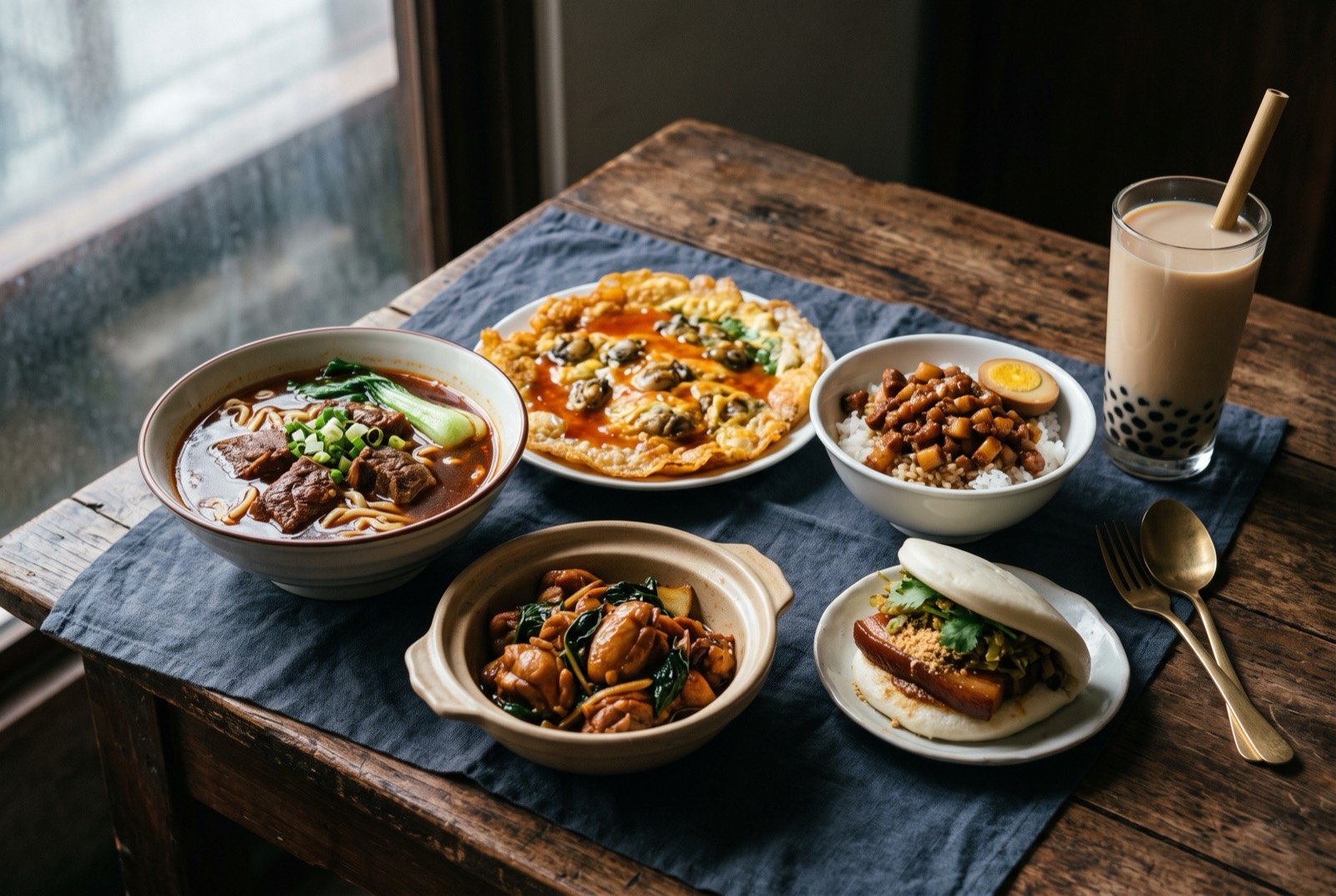
Most of this atlas's volumes are argued into existence: a border gets drawn somewhere ecology, trade, religion and empire say it should be, and the chapter defends that line. Taiwan does not need the defence. It is an island, so the ecological case makes itself, and its history arrived in such distinct, dateable layers that a reader can put a decade on almost every course of the meal. The island's first cooks were Austronesian peoples who had no rice at all, only millet, taro and whatever the mountains and the reef gave up; some linguists trace the whole Austronesian language family, spoken today from Madagascar to Easter Island, back to boats that first left this coast. Then came Hoklo and Hakka settlers from Fujian and Guangdong, then seventy years of Japanese colonial rule, then, in 1949, the sudden arrival of a defeated national army and everyone who had followed it: soldiers, officials and civilians from every mainland province, thrown together in military dependants' villages with US-aid flour rations and whatever Taiwanese produce was to hand. Beef noodle soup, the dish most outsiders now call quintessentially Taiwanese, was invented by that retreat, not by anyone who had been on the island for generations. Every restaurant technique in these cuisines has an indigenous ancestor, the claim this atlas returns to in every volume, and Taiwan is where the claim runs both directions in the same sentence: André Chiang, the chef who took modern Taiwanese cooking to three Michelin stars, has said outright that inheriting three-cup chicken was never the point, inheriting what "three-cup" means as a flavour grammar is; and Taiwan's Indigenous peoples are, right now, rebuilding a millet economy that Japanese and Nationalist rice policy had nearly erased, one seed bank and one "millet mother" at a time. Every dish as tradition built it, then what a modern chef would change, which in this volume is as often a Taiwanese chef's own project as an imported one.
Sources and review · What this chapter does not assert · How we research · Spotted something wrong?
A Sense of Place
An island that never had to choose one staple
Taiwan is small, mountainous and generous: a subtropical island split down its spine by the Central Mountain Range, whose highest peak, Yushan (Jade Mountain), tops 3,950 metres, tall enough that the island runs from lowland rice paddy to alpine cloud forest inside a couple of hours' drive. The west is a broad, fertile alluvial plain, built by rivers running off that spine, and it is where the rice, sugarcane and market-garden vegetables that feed the cities are grown. The east coast is a narrower, wilder strip, the Hualien-Taitung Rift Valley pinned between the Central Mountains and the Pacific, and it is the historic home of several of the island's largest Indigenous peoples. The coastline itself is a working larder in its own right: Taiwan's oyster aquaculture, strung on bamboo racks in shallow coastal water, is old and large enough that fresh oysters became a genuine everyday staple rather than an occasional treat, which is the entire reason the oyster omelette could become a year-round street dish rather than a seasonal one. Typhoons arrive reliably between early summer and autumn, and more than one dish in this chapter, Tainan's danzai noodles chief among them, was invented specifically to survive the weeks a typhoon season keeps a fishing boat in harbour.
A table of peoples, logic and dishes
| Group | Defining logic | The dishes that carry it |
|---|---|---|
| Indigenous Austronesian peoples (Amis, Bunun, Paiwan, and others) | millet as the ritual axis of the mountain calendar; wild-vegetable foraging and river or reef fishing on the coast; no rice at all until Han contact | cinavu, palakaw-trapped fish and shrimp, siraw, millet wine |
| Hoklo (Hokkien-descended, from Fujian) | rice-and-seafood coastal cooking; sweet potato starch as the defining thickener; sugar as a mark of hospitality in the old sugar capital, Tainan | oyster omelette, braised pork rice, danzai noodles, gua bao |
| Hakka | a highland minority tradition built on preservation against real scarcity: salting, pickling and sun-drying; a ritual economy in which ancestor-worship offerings become the family's protein | Hakka stir-fry, flat rice noodles, the three-stage preserved mustard greens, lei cha |
| The 1949 mainland-diaspora wave (juancun, military dependants' villages) | multiple regional Chinese cuisines thrown together by wartime scarcity and US-aid flour rations, fused with Taiwanese produce into dishes that exist nowhere on the mainland | beef noodle soup, sesame flatbread and fried dough sticks, hand-made dumplings |
| The Japanese colonial layer (1895 to 1945) | loanwords and specific products grafted onto the existing table, not replacing it | bento culture, tempura-derived fish cake, oden |
The History in Layers
The island the whole Pacific may have come from
Long before any of the layers below, Taiwan was already Austronesian. Archaeological settlement on the island is generally dated to around six thousand years ago, and a substantial body of historical linguistics, associated above all with the linguist Robert Blust, treats Taiwan as the most likely homeland of the entire Austronesian language family: the family's deepest internal branches are found only on Taiwan, while every Austronesian language spoken anywhere else, from the Philippines and Indonesia to Madagascar off the coast of Africa and Hawaii and Easter Island in the middle of the Pacific, descends from branches that left the island later. This is a mainstream position in comparative linguistics rather than a settled, uncontested fact, and this chapter states it at that level of confidence: probable, widely accepted, not beyond all argument. What is not in dispute is that Taiwan's Indigenous peoples, today officially sixteen recognised nations including Amis, Atayal, Paiwan, Bunun, Puyuma, Rukai, Tsou, Saisiyat, Tao, Thao, Kavalan, Truku, Sakizaya, Seediq, Hla'alua and Kanakanavu, were living on millet, taro, foraged wild vegetables and what the coast and rivers gave up for thousands of years before any Han settler arrived, and this chapter's Flavour Arsenal, Dishes and Voices sections all treat that inheritance as this volume's opening subject, not its footnote.
Dutch sugar, Zheng's siege, and Qing settlement
The Dutch East India Company held southern Taiwan from 1624 to 1662, and the Spanish briefly held the north from 1626 to 1642; it was the Dutch administration, not any later government, that first taught local Siraya (a plains Indigenous, or Pingpu, people around modern Tainan) sugarcane cultivation and introduced cattle-powered crushing mills. Sugar exports from the port of Tainan grew for the next two centuries under Qing rule, and the fact that sugar was historically expensive and its use a marker of hospitality is the specific, traceable reason Tainan food is sweeter than the rest of the island's to this day: recorded mill numbers in the Tainan region rose from 75 in 1696 to 349.5 by 1764, and the habit of adding sugar as a gesture of generosity was reinforced again when Tainan became a major sugar-industry centre a second time under Japanese rule. Koxinga (Zheng Chenggong) drove the Dutch out in 1662 after a siege of Fort Zeelandia at Tainan; the popular story that his hungry soldiers invented the oyster omelette during that siege, mixing sweet potato starch with whatever oysters and greens were on hand, is told everywhere in Taiwan and should be told as exactly that, a beloved foundation legend, not a documented fact. The more prosaic and better-evidenced account is that Hoklo settlers from Fujian, where oyster-and-starch pancakes were already a coastal staple, brought the dish with them, and Taiwan's own oyster aquaculture is what turned it into an everyday food rather than an occasional one.
Han settlement intensified through the eighteenth century, chiefly two groups: Hoklo settlers from southern Fujian, and Hakka settlers whose migration to Taiwan is generally dated from the 1680s and 1690s, intensifying through the Yongzheng and Qianlong reigns. Hakka settlers arriving after the best coastal farmland was already taken pushed into the hill country of Miaoli, Hsinchu and Taoyuan in the north, and along the Xiao Liuqiu and Donggang rivers into the Pingtung plain in the south; when the Zhu Yigui rebellion broke out in 1721, Hakka villages there organised into six militia divisions, the Liudui (six corps), to defend themselves and assist Qing forces, and that six-part territorial identity still names the region's Hakka culture today. This settlement, on both sides, came at real cost to the plains Indigenous peoples whose land it was: Qing administration sorted Indigenous communities into "cooked" (熟) and "raw" (生) categories according to how far they had assimilated to Han rule and taxation, a colonial bureaucratic distinction this chapter names rather than launders.
Japan's forty years, and the dish it made possible without meaning to
Japanese colonial rule ran from 1895 to 1945, and its food legacy is best understood as specific grafts onto the existing table rather than a replacement of it. The most consequential graft, for this chapter's purposes, is agricultural rather than culinary: pre-1895 Taiwan's staple rice was long-grain indica (秈米), which does not hold a spooned meat sauce well, and the colonial government's breeding and promotion of a stickier, japonica-type rice known as Penglai rice (蓬萊米) is what food-name historian Cao Ming-tsung argues made braised pork rice possible as a proper street dish, since only after this "white rice revolution" could a bowl of rice actually carry a sauce rather than let it run off. Cao's own account is honest about the limits of the evidence: no reference to "滷肉飯" by that name has turned up in Qing-era or colonial-era records, so this is a plausible, well-argued inference from a respected specialist, not a documented invention date, and this chapter presents it at exactly that confidence level. Elsewhere the colonial layer survives mostly as loanwords riding on real Japanese products: the lunchbox culture the Taiwanese still call biandang began as station and platform food from 1906, following the model of Japan's own trackside ekiben; tianbula, Taiwan's extruded fish-and-starch stick, is not mainland Japanese tempura at all but a Taiwanese mishearing of the Kansai-dialect name for a Kagoshima fried fish cake, Satsuma-age, so thoroughly that the two foods have since diverged completely in form; and oden, rendered in Taiwanese as o-lian ("black wheel"), entered Taiwanese street food the same way. The colonial government's rice-centred agricultural policy is also named, alongside slash-and-burn hillside cultivation's own poor yields and outmigration to the cities, as one of the documented pressures that pushed Indigenous millet cultivation into steep decline over the twentieth century, a decline this chapter's Voices section returns to as a live, present-tense revival rather than only a lament.
1949: an army that had nowhere else to go, and the food it made from what it had
Retrocession to the Republic of China followed Japan's 1945 defeat, and the Nationalist government's own authoritarian response to the 228 Incident of 1947 and the martial-law decades that followed it are the tense backdrop against which the next wave of migration has to be read: the 1949 arrivals were not landing in an empty or a simply welcoming Taiwan. When the Nationalist government retreated to Taiwan in 1949 after losing the Chinese civil war, close to two million soldiers, officials and civilians came with it, drawn from every mainland province, and a large share of them were housed in purpose-built military dependants' villages, juancun. Taiwanese food writing is consistent and specific about why juancun cooking is its own thing rather than simply "mainland food in Taiwan": these households were living under real material scarcity through the 1950s and 60s, cut off from home-province ingredients, so cooks improvised across regional lines and substituted Taiwanese produce for what a faithful regional dish would have called for. One structural driver named directly in Taiwanese sources: under 1950s US aid, the Ministry of National Defence distributed fixed flour rations to the villages, and northern Chinese migrants, from wheat-eating rather than rice-eating home regions, used those rations to reproduce dumplings, flatbreads and noodle soups that then spread out of the villages into everyday Taiwanese eating generally.
Beef noodle soup is the textbook case, and it is worth checking rather than simply repeating. The story usually told: Sichuanese air force families around Kangshan, near Kaohsiung, an air base whose officer school had relocated from Chengdu, adapted a home dish of beef braised in doubanjiang (chilli bean paste), Sichuan peppercorn and star anise, combining it with noodles made from ration flour to recreate a taste of home; food historian Lu Yao-tung is the name most often credited with this account, and Kangshan's own doubanjiang industry, founded by a retired air force NCO named Liu Ming-te, is real and well documented. But Academia Sinica historian Tseng Pin-tsang has said plainly, on the record, that decades of investigation into this claim remain at the level of inference, not documented fact: no single "ur-shop" has ever been identified, only a 1962 Kaohsiung noodle shop generally agreed to be the earliest identified one, and a competing account places the dish's real origin in Tainan instead. A genuinely separate, better-attested 1949 thread runs alongside the Sichuan story rather than underneath it: Hui Chinese refugees, chiefly from Gansu, brought a halal, doubanjiang-free clear-broth beef noodle tradition in the Lanzhou style, and this chapter treats the two as parallel 1949 inventions, not variants of one dish.
The dishes this volume had to arbitrate
Three-cup chicken is marketed everywhere as archetypally Taiwanese, and its own origin traditions are Jiangxi Hakka, not Taiwanese at all. Two competing Jiangxi legends survive, one crediting a jailer's improvised braise for the imprisoned Song patriot Wen Tianxiang, one crediting a farming family's send-off meal for a departing brother in Wanzai county; a researcher who checked Ming, Qing and Republican-era Jiangxi gazetteers found no record of a dish called "three-cup" by that name before a 1958 published Jiangxi recipe book. Taiwan's own contribution is real and specific: Taiwanese rice wine replaced the mainland's sweet fermented wine, sesame oil replaced lard, and Taiwanese basil, now considered indispensable, was added, largely by Hakka communities who had settled the island long before 1949 as well as by Jiangxi-origin cooks who arrived with the retreat. This chapter tells the dish as a Hakka-mainland tradition, genuinely transformed in Taiwan, not as a Taiwanese invention with a borrowed name.
Stinky tofu is usually filed under Hoklo night-market cooking, including by this chapter's own working brief before the research came back, and the evidence does not support that filing. Taiwanese sources are candid that the dish only reached the island after 1949, carried by mainland migrants from several provinces, with one specific strand traced to a Suzhou style that had already travelled to Shanghai; it was then thoroughly naturalised into Hoklo-run night-market stalls, which is why it reads as native today. This chapter corrects its own starting assumption rather than repeating it.
Gua bao's Three Kingdoms-era origin legends, involving Zhang Fei slicing open a bun and Zhuge Liang inventing a filled bun to end a human sacrifice, are folk etymology and are named here as exactly that. What is better attested is a flatbread-and-filling dish reaching Taiwan from Quanzhou in Fujian, where the Fujian original was eaten wet, in a bowl of broth; Taiwanese settlers are credited with drying it out into the hand-held form familiar today, convenient for labourers, and with the specific Taiwanese custom of eating it at the year-end worker's banquet under the folk name "tiger biting the pig," from the shape of the folded white bun around its braised pork filling. No Taiwanese academic source pins down exactly when the dry, hand-held form emerged, and this chapter says so rather than inventing a date.
Cinavu, this chapter's Paiwan dish, sits at the centre of a genuine, unresolved naming dispute in Chinese-language food journalism, not a settled one this chapter can adjudicate. The clear majority of sources identify cinavu (variously transliterated 吉拿富, 吉拿夫, 奇那富 or 祈納福) as Paiwan in name and origin, and its cognate dish in Rukai cuisine, mashed to a smooth paste with no visible grain and wrapped without an edible inner leaf, as abai (阿粨). At least one otherwise reasonable piece of mainstream Taiwanese food journalism runs a headline that reverses this attribution while its own body text confirms the majority position, which is a genuinely instructive muddle rather than a hidden consensus. Following this atlas's standing rule for contested claims between neighbouring traditions, this chapter attributes cinavu to Paiwan, names its Rukai cousin, and does not adjudicate a dispute the Taiwanese sources covering it have not settled themselves. Nor does this chapter call it "indigenous zongzi", a flattening umbrella term that several of the sources consulted specifically object to, since Rukai, Paiwan and Puyuma communities each hold their own name and their own definition for their own version.
A living tradition, rebuilding what it lost
This is not a closed history on either side of the Han-Indigenous line. Taipei's Michelin Guide, running since 2018, gave Taïrroir three stars in 2023, the first three-star recognition anywhere for a restaurant built specifically around modern Taiwanese cuisine, and chef André Chiang has since founded a "Taiwan Flavour Codex" research institute to do formally, for Taiwanese cooking, what Sichuan cuisine's canonical twenty-four flavour types already do for Sichuan: name and document the island's own recurring flavour combinations so the next generation inherits the grammar rather than a fixed dish list. At the same time, and entirely separately, Taiwan's Indigenous peoples are in the middle of a documented millet revival: a 2023 to 2026 field project recorded more than four hundred millet varieties across ten Indigenous peoples, a Bunun school principal citing fifty-two known varieties among the Bunun alone and calling the true number likely higher still; on Orchid Island, Tao elders warn that only two local millet varieties now survive; and at Jianshi in Hsinchu, an Atayal woman named Pagung Tomi, known as "Millet Mother," has spent a decade sourcing historic Atayal seed from a national seed bank and is now trialling forty to forty-eight varieties, framing the project as language revival as much as agriculture, since the Atayal language itself once carried more than a dozen distinct words for the stages of millet's growth that fell out of everyday use along with the crop. This chapter's Indigenous dish, cinavu, and its modern dish, bubble tea, both belong to Taiwan's present tense, not only its past.
The Flavour Arsenal
Starches and staples. Sweet potato starch (地瓜粉) is the oyster omelette's defining ingredient, giving the batter its characteristic gelatinous, slightly chewy set rather than a plain egg-omelette texture; it is usually cut with tapioca starch (太白粉, sometimes labelled 木薯粉) for a crisper edge, and a little in-laimi (在來米) rice flour for structure. Millet (小米) was the staple of the island's Indigenous peoples for millennia before rice, organising the entire Bunun ritual calendar around its planting, weeding and harvest, and it survives today as a live revival project as much as an ingredient. Rice itself carries its own small colonial history: pre-1895 Taiwan grew long-grain indica rice, and it took the Japanese-era breeding of stickier, japonica-type Penglai rice to make a dish like braised pork rice possible at all. Taro (芋頭) is the true staple of Paiwan and Rukai farming in the mountainous south, a crop needing close to a full year to mature, preserved by boiling, pressing into cakes, or drying into taro jerky and flour for the lean months.
Ferments and preserved proteins. Doubanjiang, as made in Kangshan near Kaohsiung, is a Taiwanese soybean-based approximation of the Sichuanese product it was named for, genuinely different from Sichuan's own broad-bean-based Pixian doubanjiang, and it is the seasoning that gives red-braised beef noodle soup its colour and depth. Mijiu (米酒), Taiwan's rice wine, is a fermented rice base spiked with distilled alcohol to a standard 19.5% ABV under the old state tobacco and liquor monopoly, a deliberate, traditional practice rather than a modern shortcut, and it behaves quite differently on protein from either Shaoxing wine or sake. Fu cai, mei gan cai and suan cai are not three different vegetables but three sequential stages of processing the same mustard green (芥菜), a preservation tradition Hakka settlers developed after arriving in Taiwan, distinct from the drier and wetter forms known in their mainland homeland: suan cai is salted and jar-fermented for one to two weeks; fu cai is that same pickle further air-dried and packed tightly, upside down, for a further month; mei gan cai is taken all the way to full dryness and rolled for long storage. Siraw, an Amis preserved fish or meat cured with salt, or salt and starch, miso or alcohol lees, is how a catch or a kill too large to eat at once is kept, eaten raw, grilled or in soup.
Leaves. False comfrey (假酸漿) is the specific inner wrapping leaf for Paiwan cinavu, imparting a mild, herbal bitterness that is part of the dish's identity rather than an incidental wrapper; shell ginger (月桃) leaf usually binds the outer layer. Jiu ceng ta, Taiwanese basil, a holy-basil-type cultivar rather than sweet Italian basil, is added off the heat at the very end of cooking three-cup chicken, chosen specifically because it survives hard, fast heat without wilting bitter the way sweet basil does. Garlic chives (韭菜) go into the oyster omelette batter in central Taiwan, and coriander finishes danzai noodles.
Seeds and pods. Tree beans (樹豆), a form of pigeon pea, are named repeatedly as arguably the single most important Bunun side dish, most often cooked into a soup alongside wild vegetables. Sichuan peppercorn and star anise arrived with the 1949 juancun wave, part of beef noodle soup's seasoning rather than anything native to Hoklo or Hakka cooking. Betel nut (檳榔) belongs in this chapter as history and social fact, not as an ingredient: it is a chewed stimulant, not a food, and it carries genuine ceremonial weight across several Indigenous peoples, discussed fully below, that the later, commercialised "betel nut beauty" roadside-stand phenomenon of the 1980s is not a continuation of.
Chillies. Taiwan is honestly not a chilli-forward cuisine next to its Sichuan and Hunan neighbours in this same culinary region. What heat there is arrives mostly through doubanjiang in the 1949-diaspora dishes; the island's own savoury backbone runs on soy sauce, sugar, rice wine and fermentation rather than on chilli.
The Technique Ladder
Rung 1. Double-stock construction
Build a base stock from bones and trim, separately from a braising liquid or a shellfish reduction, then combine the two at the end rather than relying on one long single simmer. This is how chef Kai Ho treats beef noodle soup at Taïrroir, and it is exactly how danzai noodles' shrimp-shell broth is meant to be built: two flavours developed to their own full depth before they ever meet.
Rung 2. Sous vide for collagen-rich and fibrous textures
A long, precise, low-temperature cook renders collagen fully without overcooking the surrounding muscle, and does the equivalent job on a fibrous ingredient like rehydrated dried squid: full softening without the toughening a hard boil risks. This is the single most transferable technique in the chapter for the reader's own kit.
Rung 3. Precise heat control over starch and sugar chemistry
Caramelising sugar into rendered pork fat before the liquid goes in is what separates a properly unctuous braised pork rice from a flat one; holding a sweet-potato-starch batter at the right temperature for the right time is what gives an oyster omelette its characteristic springy-chewy (Q) set rather than a plain egg pancake. Both are the same underlying discipline: watching the pan, not the clock.
Rung 4. Treating a flavour formula as portable, not fixed to one dish
Chiang's own argument about three-cup chicken, made in his own words: the inheritance was never the chicken, it is the method itself, soy sauce, sesame oil, rice wine and hard, fast heat, that a cook can move onto a different protein entirely once it is properly understood.
Rung 5. Pounding, wrapping and steaming precision for a ceremonial parcel
Cinavu's method, pounding millet to a paste, packing it around well-marbled meat, wrapping it in leaf and steaming it evenly through, rewards a controlled, even heat far more than the fast, high-heat techniques above; a precise, gentle steam does the same job traditional open-fire steaming does, more evenly.
Rung 6. Precision extraction and short-shelf-life discipline
Bubble tea's base tea has a correct water temperature, steep time and resting period by leaf type, and its tapioca pearls are only good for three to six hours once cooked. Neither of these is an exotic technique. Both are simply not being followed with discipline by most shops outside Taiwan, which is the whole diagnosis of why the export version so often disappoints.
Ferment or Preserve Bench
1. Doubanjiang, Kangshan-style
A Taiwanese soybean-based reworking of the Sichuanese original, distinct from Sichuan's own broad-bean Pixian doubanjiang. No genuine Kangshan-brand product was confirmed sourceable in Britain; a mellow Pixian doubanjiang is the honest substitute, named as a substitute rather than passed off as the real thing.
2. Mijiu (米酒)
A fermented rice base cut with distilled alcohol to 19.5% ABV under the old state monopoly, deliberately rather than as a shortcut. Genuine Taiwanese michiu, under the Taijade and TTL names, is actually stocked in Britain under its own name, so there is no real excuse to default to a Shaoxing or sake substitute here.
3. Fu cai, mei gan cai and suan cai
Three sequential stages of processing the same mustard green, developed by Hakka settlers after arriving in Taiwan. A reader wanting to make their own from British-grown or bought mustard greens: sun-dry the whole plants 1 to 3 days to soften, layer with salt and tread underfoot, weight with stones, and seal in a jar 1 to 2 weeks for suan cai; for fu cai, further air-dry that pickle and pack it tightly, upside down, in a sealed jar for a further 30 days; for mei gan cai, take it all the way to full dryness and roll for long storage.
4. Siraw
The Amis fermented, salted fish or meat that keeps a large catch or kill for later use. This chapter names it honestly as beyond safe replication in a British kitchen without the specific culture and community knowledge behind it, a dish to understand rather than to attempt, in the same spirit this atlas has taken elsewhere with ferments it cannot responsibly walk a reader through from a chapter alone.
Sourcing in Britain
Verified September 2026. Where a supplier could not be fully confirmed, that is said rather than smoothed over.
Soy sauce, mijiu and basil
Kimlan and, more thinly, Wan Ja Shan are both genuinely stocked under their own Taiwanese names by multiple independent UK Asian grocers, including Oriental Mart, WaNaHong and Long Dan; there is no supply reason to default straight to a generic bottle here. Taiwanese soy sauce runs slightly sweeter and less salty than mainland Chinese light soy, closer to a mild Japanese shoyu than a punchy Cantonese one, which is worth seeking out rather than assuming interchangeable.
Taijade and TTL-brand Taiwanese rice wine are stocked under their own name by at least four independent UK sellers, including Oriental Mart and Yau Bros, and should be the first recommendation rather than a fallback: it is fermented rice cut with added distilled alcohol to a standard, historically deliberate 19.5% ABV, genuinely different in character from Shaoxing wine's longer-aged, more oxidative depth or sake's cleaner, lower-proof brew. Where it truly cannot be found, Shaoxing is the closer everyday substitute for depth, a dry sake the better substitute for a cleaner profile, and neither should be presented as equivalent.
Fresh jiu ceng ta itself was not found under that name at any UK retailer. Thai holy basil is the better of the two realistic substitutes, since it shares jiu ceng ta's heat-stable, clove-and-pepper character, but UK stock is thin and intermittent; growing it from seed at home, with the dehydrator drying a home-grown crop for the shoulder season, is a genuinely workable fallback. Italian sweet basil, which wilts and turns bitter under the same hard, fast heat, should be treated as the last resort only, changing the dish's character rather than approximating it.
Starches, pearls and preserves
Sweet potato starch is generically available via Amazon and general Asian grocers, though no single named UK brand and current stock page could be confirmed with confidence; tapioca starch is a routine, well-stocked commodity item everywhere.
Dried tapioca pearls are genuinely well stocked in Britain, from Sous Chef to several dedicated bubble tea suppliers including Boba Box and Bubble Crush UK, several sourcing directly from Taiwan. Cooking dried pearls fresh at home, following the method above, gets close to shop quality and is well within the reader's kit; hand-rolling pearls entirely from scratch is achievable but a much bigger time investment for a marginal gain, and even most shops in Taiwan buy in pre-formed pearls rather than doing it.
The specific Taiwanese fu cai was not found under that name at any currently trading UK retailer. The broader Chinese salted or pickled mustard green family, stocked at Sous Chef and Oriental Mart among others, is the honest working substitute; naming this gap plainly matters more here than forcing a fake match.
Beef, betel nut and kit
Beef shank or shin, with its high proportion of tendon and connective tissue, is what the dish is built on; British butchers rarely stock it under that name, but the equivalent cut exists as what a butcher may call gravy beef, or as the bone-in cross-cut shank sold for osso buco. Beef tendon itself is realistically sourced frozen from a Chinese or Southeast Asian supermarket, Starry Mart and Oriental Mart both stock it, since it is not a routine item at a general British butcher's counter.
Betel nut is named here only for accuracy, not as a sourcing target: it is legal to possess and chew in Britain, but it is a chewed stimulant, not a food, and the International Agency for Research on Cancer classifies it as a Group 1 carcinogen. It belongs in this chapter's history, nowhere near its recipes.
This chapter cross-links to the wok and bamboo steamer already established as shared kit across this atlas's other Sinosphere volumes rather than re-arguing them. New for this chapter: a heavy cast iron griddle or skillet for scallion pancakes, well suited to the reader's Big Green Egg plancha; a simple mesh spider for lifting tapioca pearls from boiling water without breaking them, the only real specialist purchase bubble tea needs; and, optionally, a dedicated bubble tea shaker, though a plain jam jar or cocktail shaker does exactly the same job.
Where to eat
BAO, founded by Erchen Chang after her own road trip across Taiwan, has held a Michelin Bib Gourmand at its Soho flagship for several years running. Old Tree Daiwan Bee on Rupert Street has served beef noodle soup and bubble tea since 2013. Din Tai Fung, the internationally famous Taiwanese xiaolongbao house founded in Taipei in 1958, now runs four London sites with a fifth confirmed for King's Cross. Bian Dang, Ho-Ja and Monga Fried Chicken all serve genuinely Taiwanese food across London. Gong Cha and Chatime, both real, expanding Taiwanese bubble tea chains rather than a Western approximation of one, now run more than a dozen UK stores between them, a stronger and more surprising UK presence than most single-country volumes in this atlas can claim for any category at all.
The ranked list, the ingredients that decide great from grim
- Genuine Taiwanese mijiu, actually stocked here under its own name, for three-cup chicken; there is no excuse to reach for Shaoxing first.
- Fresh holy basil, chased in season or grown at home, for three-cup chicken's essential aromatic.
- Kimlan or Wan Ja Shan soy sauce over a generic bottle, since both are properly stocked here.
- Beef tendon actually sourced, frozen, rather than left out of beef noodle soup because a British butcher doesn't carry it.
- Dried tapioca pearls from a specialist UK bubble tea supplier, cooked fresh at home, not a supermarket instant sachet.
- Sweet potato starch specifically, not a generic cornflour batter, for the oyster omelette's defining QQ texture.
- Honestly substituted preserved mustard greens, naming the gap rather than pretending the specific Taiwanese product is available.
Voices and Sources
From inside the tradition
- André Chiang (江振誠), whose restaurant RAW closed at the end of 2024 to become an international culinary school, gives this chapter its clearest single statement of its own animating idea, in his own words: inheritance is not inheriting three-cup chicken, it is understanding what "three-cup" is. His Taiwan Flavour Codex Research Institute is a genuine, ongoing attempt to do for Taiwanese cuisine what Sichuan's twenty-four flavour types already do for Sichuan.
- Kai Ho (何順凱) of Taïrroir, the first restaurant built around modern Taiwanese cuisine to reach three Michelin stars, in 2023, treats beef noodle soup as, in his own words, a form of emotional connection rather than only a technical problem, and his double-stock, sous-vide-tendon treatment of the dish is the clearest worked example in this chapter of restaurant technique elevating a street dish without replacing its soul.
- Richie Lin (林泉) of MUME, Michelin-starred continuously since 2018, states his own philosophy plainly: making a genuinely new dish out of common food, and surprising people with it, satisfies him far more than putting an expensive ingredient on a plate.
- Cao Ming-tsung (曹銘宗), a dedicated Taiwanese food-name historian, is the source behind both the braised-pork-rice and oyster-omelette histories in this chapter, and his own caveats, stated plainly in his published work and interviews, are why this chapter presents his conclusions as well-argued inference rather than settled fact.
- Dongi Kacaw (吳雪月), an Amis woman and principal of the Hualien County Indigenous Wild Vegetable School, is the named authority behind this chapter's account of Amis wild-vegetable foraging, documenting more than two hundred known edible wild species in her own published work.
- Canglah (陳耀忠), an Amis chef from the Cepo' community in Fengbin, Hualien, built his restaurant around a daily menu that depends entirely on what the mountains and sea provide that day, and hosts a Golden Bell Award-winning television series exploring different Indigenous peoples' food cultures.
- Pagung Tomi (芭翁·都宓), known as "Millet Mother," has led an Atayal seed-revival project at Jianshi, Hsinchu, since 2016, now trialling forty to forty-eight historic millet varieties and treating the work as language revival as much as agriculture.
- Du Hsiao Yueh, the Tainan noodle shop founded in 1895 by Hong Yu-tou, still trades under its founding name across four generations, and its own recipe blog is the closest thing to a primary source this chapter has for danzai noodles' technique.
Where to eat, and drink, in Britain
See the Sourcing section above: BAO, Old Tree Daiwan Bee, Din Tai Fung, Bian Dang, Ho-Ja and Monga Fried Chicken for the food; Gong Cha and Chatime for bubble tea made by chains with a genuine Taiwanese pedigree rather than a Western approximation of one.
Things this chapter has deliberately not asserted
- That the Kangshan air force village origin story for beef noodle soup is documented fact. An Academia Sinica historian has said on the record that decades of investigation remain at the level of inference, not proof, and a competing Tainan claim exists alongside it.
- A single canonical 1:1:1 ratio for three-cup chicken. Multiple Taiwanese sources, including a named contemporary chef, argue explicitly against cooking it that way.
- Who invented bubble tea. Both Chun Shui Tang and Hanlin Tea Room have genuine, in-tradition claims; a Taiwanese court declined to decide after ten years of litigation, and this chapter follows that lead rather than picking a winner.
- Which people, Paiwan or Rukai, cinavu's name properly belongs to, where at least one otherwise reasonable piece of Taiwanese food journalism contradicts its own headline in its body text.
- A specific mechanism or date for Japanese-colonial soy-sauce-braising technique entering Taiwanese cooking. The general colonial-period framing is well attested; a precise technical transfer claim was not, and this chapter has not manufactured one.
- The "eighteen wild vegetables" figure sometimes quoted for Amis foraging. No source, Chinese or English, could produce this figure under any spelling tried; the two figures this chapter does use, the folk saying of "ten dishes, one soup" and Dongi Kacaw's documented total of over two hundred known species, are both genuinely sourced.
- That any named modernist Taipei restaurant has a specific plated treatment of oyster omelette or three-cup chicken. Searches found none; this chapter's modernist versions of those two dishes are its own construction, built from the same chefs' stated general technique, not attributed to a specific restaurant dish that was not found.
- Real, dedicated food-culture material for Sakizaya, Hla'alua/Saaroa and Kanakanavu. These are the three smallest, and most recently recognised, of Taiwan's sixteen official Indigenous peoples, and Chinese-language food journalism has evidently not yet reached them at the depth it has reached Amis, Bunun or Paiwan. This chapter says so rather than padding out three paragraphs of generic pan-Indigenous claims to look complete.
Volume Thirty-Six of the Sinosphere, Not Just Stew. Research briefs: AS-36-tradition.md and AS-36-modernist-sourcing.md. Sourcing verified September 2026.
Double-stock construction
Build a base stock from bones and trim, separately from a braising liquid or a shellfish reduction, then combine the two at the end rather than relying on one...
Sous vide for collagen-rich and fibrous textures
A long, precise, low-temperature cook renders collagen fully without overcooking the surrounding muscle, and does the equivalent job on a fibrous ingredient...
Precise heat control over starch and sugar chemistry
Caramelising sugar into rendered pork fat before the liquid goes in is what separates a properly unctuous braised pork rice from a flat one; holding a...
Treating a flavour formula as portable, not fixed to one dish
Chiang's own argument about three-cup chicken, made in his own words: the inheritance was never the chicken, it is the method itself, soy sauce, sesame oil...
Pounding, wrapping and steaming precision for a ceremonial parcel
Cinavu's method, pounding millet to a paste, packing it around well-marbled meat, wrapping it in leaf and steaming it evenly through, rewards a controlled...
Precision extraction and short-shelf-life discipline
Bubble tea's base tea has a correct water temperature, steep time and resting period by leaf type, and its tapioca pearls are only good for three to six hours...
The dishes
- Niurou mian, red-braised beef noodle soup Kangshan, and everywhere the retreat of 1949 went afterwards
- O-a-jian, oyster omelette Coastal Taiwan, Hoklo
- Lu rou fan, braised pork rice North and central Taiwan, Hoklo
- Danzai mian, Tainan noodles Tainan
- Gua bao, folded steamed bun Fujian by way of Quanzhou; Taiwan by way of a dry, hand-held adaptation
- San bei ji, three-cup chicken Jiangxi Hakka in ancestry, transformed in Taiwan
- Kejia xiaochao, Hakka stir-fry Hakka
- Cinavu, Paiwan wrapped millet and pork Paiwan
- Zhenzhu naicha, bubble tea Taichung or Tainan, depending who is telling it, and the courts would not decide
Sources and review
- Reviewed
- Not yet reviewed from inside the tradition
- Cooked
- Not yet cooked and reported
Where this volume comes from
3 research briefs on file for this volume, researched to the rules on How we research. Published 5 September 2026. Last changed 8 September 2026.
The brief's own account of its sources
Rough split. Of the roughly 40 distinct sources cited by URL above: Local/in-tradition Taiwanese sources (Mandarin-language, published by Taiwanese outlets, government bodies, or named Taiwanese food historians/chefs): the substantial majority, roughly 32 to 34 of the sources.