Asia · Volume 34
Hunan
The Chilli Jar, the Smoke Room and the Mountain the Tusi Ruled
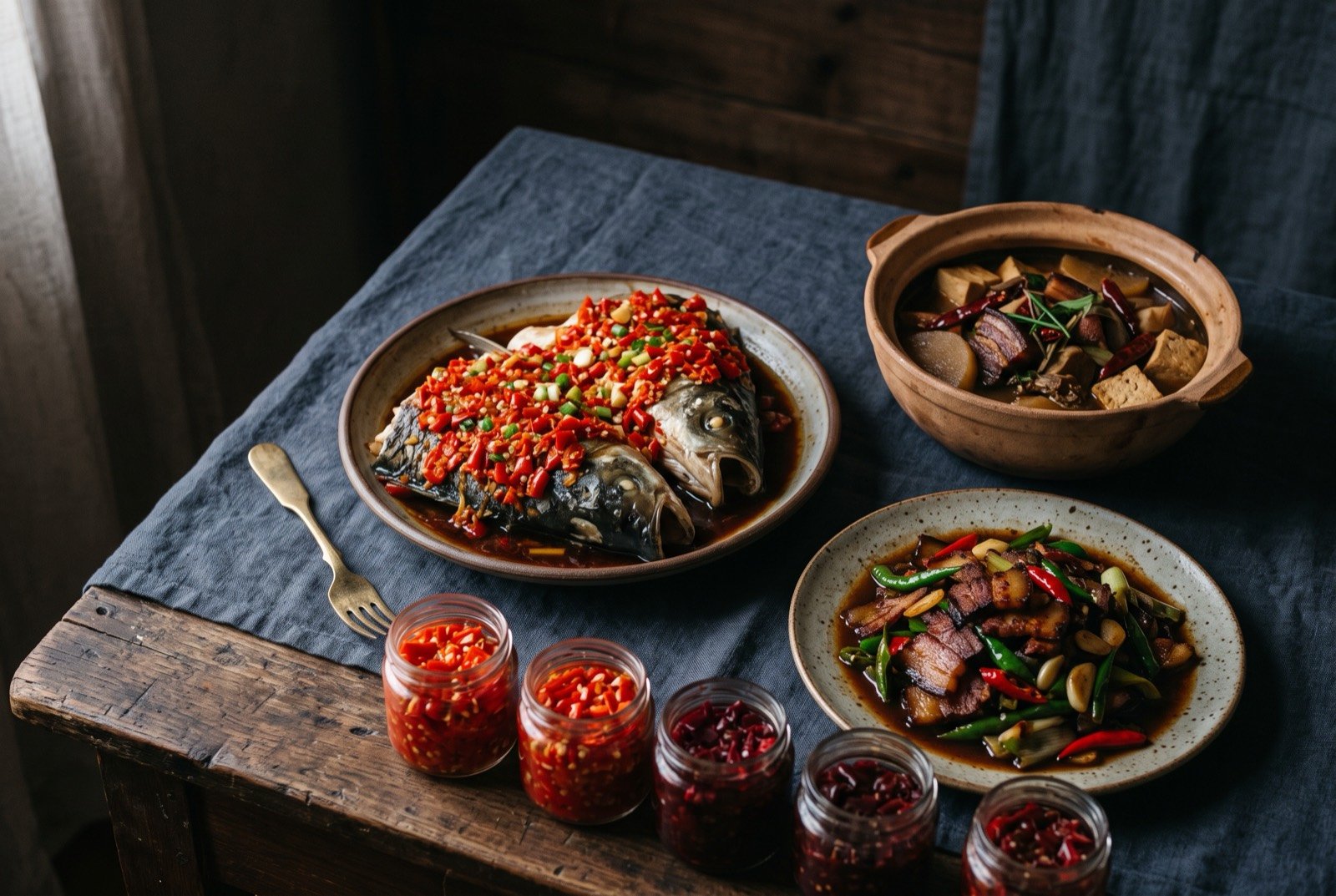
Hunan and Sichuan share a Qing-dynasty chilli habit and nothing else. Sichuan built a numbing, oil-carried heat on fermented broad bean paste and Sichuan pepper; Hunan built something sharper and plainer: fresh and salt-fermented chilli eaten as its own vegetable, a whole pantry of sour ferments standing in for a coastal salt supply the province never had, and meat preserved by weeks of slow, resinous wood smoke. Eastern Hunan is Han Chinese rice-and-fish heartland; Xiangxi in the west is a folded mountain country a single Tujia clan ruled in its own right for 818 years, and its Tujia and Miao households built their own sour, smoked table out of a genuine absence of salt eastern Hunan never had to solve. Both are told here, separately and then side by side, and every dish as tradition built it, then what a modern chef would change: once as tradition built it, sour, smoked, fermented, direct, and once rebuilt with modernist technique that treats duojiao ageing, cold-smoke temperature and steaming time as the controllable variables they chemically are.
Sources and review · What this chapter does not assert · How we research · Spotted something wrong?
A Sense of Place
The lake that names the province, and the fish it never stopped eating
Hunan means, literally, "south of the lake": Dongting Lake, once part of the ancient Yunmeng Marsh and, at its historical peak, China's largest freshwater lake, at around 40,000 square kilometres. The lake and its surrounding plain still carry more than 107 fish species, roughly a tenth of every freshwater fish species recorded in China and just over half of Hunan's own. Hunan's own press describes the Dongting basin plainly as "鱼米之乡", the land of fish and rice, naming rice paddy and freshwater fishery as the founding ecology, pork raising the third leg of the stool. No source this brief could reach quantifies that economy before the twentieth century; it is a qualitative, repeated frame, not a set of historical statistics, and this chapter treats it that way rather than dressing it up with invented numbers.
The oldest hard evidence for how this ecology got cooked comes from underground. The Mawangdui Han tomb, excavated in Changsha in 1972 and dated to over 2,100 years ago, yielded butchered animal bones and bamboo-slip recipe records naming more than a dozen techniques, stewing, grilling, pan-frying, simmering, steaming, curing, roasting, and a seasoning list running to sauces, salt, vinegar, rice-wine ferment, sugar, honey, ginger, cassia bark and Sichuan pepper. By the Western Han, Hunan cooking already showed three regional substyles: the Xiang river corridor, the Dongting Lake region, and the western mountains, a three-way split that has held, in its broad shape, for two thousand years. What Mawangdui does not show is chilli, and this matters more than it might seem to: the tomb predates chilli's arrival in China by roughly 1,700 years. Whatever else is true of Hunan's cooking, "an ancient, unbroken hot cuisine" is not a claim the archaeology supports. What survived from the Han is technique and a genuinely broad seasoning vocabulary, not the flavour system that defines the province today.
That flavour system is a Qing invention, and a comparatively recent one. Chilli reached Hunan via Guangdong's coast, first known locally as "海椒", sea pepper. County gazetteers put Shaoyang first to record its cultivation; Huaihua's records date real adoption to the Qianlong reign, 1736 to 1795; by the Jiaqing reign, 1796 to 1820, most of the province had it under cultivation. By the early twentieth century, chilli-eating had spread across the whole middle-to-upper Yangtze, rural Sichuan, Yunnan, Hunan, Hubei and Jiangxi all near-universally chilli-eating by then. Sichuan's own chilli adoption ran the same course over the same century, and no source this brief could find puts one province meaningfully ahead of the other. The two cuisines diverge not in when they got chilli but in what each already had in place to receive it: Sichuan had a mature broad-bean fermentation tradition ready to absorb it into a compound paste; Hunan had, in the east, an established habit of standalone salt-fermented preserves, and, in the west, a mountain economy already organised around sourness as the cheapest available seasoning. Chilli slotted into two different systems and came out sounding like two different cuisines.
Before chilli arrived at all, and after it did, Changsha kept building a second, quieter tradition alongside the sour-hot home table: an elite, chef-driven cuisine that has nothing to do with heat as its organising idea. Tan Yankai, a Hunan-born statesman who rose to head the Republic of China's Executive Yuan, employed a chef named Cao Jingchen whose refinements for Tan's household, careful ingredient selection, red-braising and clear-stewing, deliberately restrained seasoning to let the ingredient itself carry the dish, became known as Zu'an cuisine after Tan's courtesy name. It postdates chilli's adoption by well over a century and sits, by design, at the opposite end of Hunan's own flavour spectrum from duojiao yutou. This chapter treats both currents as equally Hunanese, because they are: the loud, direct, chilli-forward home cooking that dominates every list of Hunan's famous dishes, and the quiet, technique-driven Changsha lineage that produced the province's only sustained tradition of formal, restaurant-grade refinement before Michelin ever considered the place.
The mountain the Han never fully reached
Xiangxi sits at the meeting point of Hunan, Hubei, Chongqing and Guizhou, in the Wuling mountains, an upland world of steep terraced fields, the structural opposite of Dongting's flat paddy-and-fish plain. Before the Tang dynasty, agriculture here was predominantly dry-field, much of it slash-and-burn, not wet-rice paddy, and that difference in what the land could grow, maize, terraced glutinous rice, dry grains rather than an abundant fresh fish supply, still shapes what a Xiangxi kitchen reaches for today.
The reason Xiangxi built its own food world rather than absorbing Han Hunan's is political, and it is unusually well documented. Beginning in the Yuan dynasty, the tusi system installed centrally appointed hereditary chieftains as both political rulers and the largest feudal landlords across Tujia territory, with commoners in direct personal subordination to them. The Peng clan ruled Yongshun, inside Xiangxi, for 818 years, from 910 CE to 1728, when the Qing "gaitu guiliu" reform finally abolished hereditary tusi rule in favour of centrally rotated officials. Nearly eight centuries of genuine self-governance, largely outside the reach of Han Chinese state administration and, with it, Han Chinese state cuisine, is the clearest structural reason Xiangxi's food developed on its own track for as long as it did.
What it developed without, as much as what it developed with, is the second key to reading this half of the province honestly. Inland Hunan and Hubei had almost no salt production of their own; what reached Xiangxi travelled overland along the "Sichuan salt relieves Chu" trade routes, mostly from Chongqing's Pengshui saltworks, via Enshi and Lichuan in Hubei, before it reached Youyang, Longshan, Baojing, Yongshun and Guzhang. A Miao proverb states the consequence directly: "if you don't eat sour for three days, you'll walk crooked." A parallel Tujia proverb, "chilli as salt, hézha for the new year," names the same economics from the other ethnicity and ties it to two of the region's own signature foods. This is a sharper, more specific story than "mountain people like it spicy": sourness and chilli both did real, load-bearing economic work here, as salt substitutes and as preservation aids, in a place where salt itself was a genuine luxury good carried in on someone's back.
A table of peoples, logic and dishes
| Place | Defining logic | The dishes that carry it |
|---|---|---|
| Changsha and the Xiang corridor | direct, fresh-and-fermented chilli heat, "酸辣" not "麻辣" | duojiao yutou, xiaochao rou, chou doufu |
| Dongting Lake basin | rice, freshwater fish, pork, the province's founding "鱼米之乡" economy | fish-forward dishes, the ecological base every eastern dish sits on |
| The Zu'an lineage, Changsha | chef-driven restraint, red-braising and clear-stewing, seasoning to reveal not overwhelm | Zu'an tofu, Zu'an-style braised dishes, the elite counter-current to home cooking |
| Anhua and the eastern smoke belt | long, cold, hardwood-smoked pork, months of maturation | larou, and every dish that leans on it |
| Xiangxi, Tujia | tusi-era communal cooking, a whole animal or preserve combined in one pot | sanxiaguo, xuebaya-adjacent duck dishes, sour meat |
| Xiangxi, Miao | soy and greens cooked to a phase change rather than curdled, festival-marked sour and fermented foods | caidoufu, zhuiniu's ritual foods, she fan |
The History in Layers
The legends this chapter will not repeat as history
Hunan's most famous dishes carry founding myths with the shape of folklore: a precise date, a colourful mishap, a grateful diner, no primary source anywhere behind them. Checking each one against Chinese trade press and local government's own archival material, rather than repeating the story because it is a good story, turns up the same pattern three times over.
Duojiao yutou's popular origin tale has a Qing scholar, fleeing persecution, fed a chopped-chilli fish head by a poor host family too broke for a proper meal, and loving it enough to have his own chef refine it once the danger passed. A China Cuisine Association investigation into the dish's real history places its actual popularisation not in the Qing at all but in Changsha restaurants between the late 1990s and 2001, naming a specific restaurant, the Bodhisattva Tree Restaurant, and a specific head chef, credited with a "revolution" in fermented-chilli fish head that gave the dish its modern form. Dong'an chicken's founding story is even more precisely dated and equally unsupported: a 290 CE banquet at the founding of Yingyang county, a chef substituting aged vinegar for wine under time pressure, and a chicken dish so unexpectedly good it stuck. The county government's own telling cites nothing beyond "as the story goes." What actually is documented, and solidly, is the dish's appearance at the banquet Zhou Enlai hosted for Richard Nixon in Beijing on 21 February 1972, which cemented its status as a national banquet dish, a genuine hinge date nearly seventeen centuries later than the legend claims.
The most consequential Hunan legend of all belongs to a dish that is not really Hunanese at all. General Tso's chicken was invented in Taiwan in 1952, by chef Peng Chang-kuei, for a banquet honouring US Admiral Arthur Radford. Peng, wanting a name with some connection to his own home province, attached it to Qing general Zuo Zongtang, with whom the dish has no culinary link whatsoever; Peng brought it to Manhattan in 1973, where Henry Kissinger's patronage helped make it famous. Peng himself was trained under Cao Jingchen, the same chef behind Zu'an cuisine, so Peng is a genuine thread in the Changsha elite-cuisine lineage even as his own dish is not. When Fuchsia Dunlop travelled to Hunan in 2003 specifically to research it, nobody there had heard of it and no restaurant served it. It does not exist as a Hunan dish in Hunan, and its enormous success abroad has spent decades standing in for a cuisine it has almost nothing to do with.
Two households sharing a name they mean differently
The dish that most cleanly complicates any tidy "Hunan is sour, Sichuan is numbing" summary is Changsha's own: 麻辣子鸡, mala ziji, numb-hot young chicken, credited as the signature dish of the century-old Changsha restaurant Yulou Dong, first created in the Tongzhi reign, 1862 to 1874, well before Sichuan's own mala system had become the shorthand for Chinese chilli heat that it is today. Sichuan pepper has a genuinely old place in some Changsha cooking, visible as far back as the Mawangdui seasoning list itself. The honest distinction this chapter draws is not that Sichuan pepper is absent from Hunan, it plainly is not, but that it is not the organising principle here. In Sichuan, fermented broad bean paste and Sichuan pepper together are the load-bearing structure of the whole cuisine. In Hunan, chilli, fermented and fresh, plus vinegar and wood smoke, carries that structural weight, and Sichuan pepper turns up as a supporting aromatic even in a 160-year-old dish that literally has "mala" in its name.
A second correction runs the other way, against Hunan's own reputation for a dish widely assumed to be its invention. Ganguo, dry-pot service, cooking pre-blanched ingredients in far less liquid than a hotpot and then reducing the sauce hard in the wok with no starch thickener, is now everywhere on Hunan restaurant menus, dry-pot rabbit, dry-pot chicken, dry-pot bacon. The Chinese-language record on where it started weights toward Sichuan, Mianyang or Deyang specifically, popularising nationally from around 2000. This chapter presents ganguo as a format Hunan cooking adopted fast and made thoroughly its own through its own chopped-chilli seasoning base, not as a home-grown technique with deep roots, because the sourcing does not support the stronger claim.
The dish a chairman's schoolboy fondness turned into a province's calling card
毛氏红烧肉, Mao's braised pork, is the one Hunan legend in this chapter that survives checking almost intact, because its documentation runs through named institutions rather than folk memory. In 1914 Mao Zedong entered the First Normal School of Hunan, where classmates recalled a weekly Saturday treat of braised pork made with Xiangtan soy sauce, rock sugar, wine and star anise, the origin of a fondness rather than an invention. The dish's real point of technical distinction, caramelised sugar colour in place of soy sauce, is dated to later life: Mao is said to have stopped eating soy sauce after seeing unsanitary conditions in a production workshop, and his Beijing chef Cheng Ruming is credited with solving the resulting colouring problem with sugar and salt alone. Shaoshan Hotel researched and standardised the modern restaurant version by interviewing chefs who had actually cooked for Mao. Chinese state and provincial media celebrate the association openly rather than downplaying it, formally naming the dish one of Hunan's ten classic dishes in 2018 and marketing it at Shaoshan as "a mouthful that resolves homesickness." The story has drifted since into folk theatre, adapted into a piece of Hunan opera, which is itself worth noting: it now functions partly as legend performed alongside its factual historical core, not as a single fixed account, and this chapter presents the school-days fondness and the sugar-for-soy substitution as reasonably well corroborated while treating the more granular banquet anecdotes as closer to celebrated folklore.
A ritual suppressed, and the one that took its place
Xiangxi's Miao communities are routinely, and wrongly, folded into a single undifferentiated "Miao" identity in English-language and even careless Chinese-language writing, and nowhere does that flattening matter more than in festival food. The Miao language itself divides into three major, largely mutually unintelligible dialects, Xiangxi, Qiandong (Guizhou) and Chuan-Qian-Dian, despite sharing well over 60 percent root vocabulary; Xiangxi's own Miao self-identify as "Ghu Xiong" or "Gho Xong", not the "Hmong" designations used further west and south. The Sisters' Meal Festival and its celebrated five-colour glutinous rice, frequently cited in English as generic "Miao" heritage, belongs specifically to Qiandongnan, Guizhou, tied to that region's own courtship customs; nothing in the sourcing this brief could reach places it in Xiangxi, and one AI-generated search summary that asserted otherwise traced back, on inspection, entirely to Guizhou government and provincial sources, committing exactly the error this chapter is trying to avoid.
Xiangxi's own equivalent is a different, and better-documented, ritual: zhuiniu, "eating the ox", the region's most solemn ancestor-sacrifice rite, led by a Miao shaman over four days and three nights, the slaughtered ox's meat divided among paternal-uncle-line kin, followed by drum-dancing and antiphonal singing through the night. Xiangxi Miao did once practise a version closer to Guizhou's guzang, documented as far back as the Kangxi era, but Qing authorities suppressed it after the Jiajiaqing-era Miao uprisings specifically because large Miao gatherings read as a security risk; by then Xiangxi Miao had stopped playing reed pipes and performing the older ritual, and zhuiniu diverged into its own distinct form. This is a genuinely more interesting, and more honest, story than either "same ritual as Guizhou" or a generic "ethnic minority festival": a real shared root, a real documented reason the two traditions split, a distinct present-day Xiangxi form built on top of state suppression rather than natural drift.
The modern moment, arriving but not yet arrived
As of this chapter's research, in September 2026, Hunan's most consequential culinary news of the decade is still unfolding rather than settled. Michelin's China team made its first-ever scouting visit to the province in February 2025, and on 27 May 2026 formally announced Hunan's first provincial guide, covering Changsha, Hengyang and Yiyang, the fourth Chinese provincial guide after Fujian, Jiangsu and Zhejiang and the first anywhere in central China. Michelin's own director framed Hunan's cuisine as "deep-rooted and vividly flavoured, both inclusive and distinctive." The actual restaurant list and any star awards had not been published at the time of writing, with multiple Hunan outlets confirming a second-half-of-2026 release; the provincial government has announced a cash incentive of up to 200,000 RMB for the first restaurants to win a star, itself a plain admission that none exist yet. Peng Wenjie, director of the Xiang Cuisine Research Institute at Changsha Commerce and Tourism Vocational Technical College, offers the right frame for a cuisine watching this arrive: "Michelin is a mirror, not a ruler," he argues, reflecting Hunan's capacity for internationally legible refinement without defining the cuisine's own standard, which he locates instead in the everyday chopsticks of ordinary Changsha diners. A follow-up piece pushes back harder still: most working Xiang chefs earn only a few thousand RMB a month, the Michelin effect will likely reach under one percent of them, and what most Hunan diners actually go to a Xiang restaurant for, good value, a working kitchen's atmosphere, bold aromatic heat in generous portions, sits some distance from what a Michelin inspector evaluates. This chapter treats Michelin's arrival as real, live and unfinished, and names no specific Changsha restaurant as starred, because none is, yet.
The Flavour Arsenal
Duojiao (剁椒), chopped fermented chilli, is Hunan's single most load-bearing ingredient, and the clearest marker of the whole cuisine's logic against Sichuan's. Fresh red chillies are washed, dried, destemmed, chopped and mixed with salt at roughly a 10:1 chilli-to-salt ratio by weight, packed into a jar, sometimes with a splash of baijiu as a sterilising step, and left to ferment anywhere from one to three weeks depending on desired intensity, longer for a more developed sourness. Duojiao sits in the same family, by fermentation logic, as soy sauce, fermented tofu and fish sauce, a standalone product built on microbial time, unlike Sichuan's doubanjiang, a compound paste of fermented broad bean, chilli, flour and salt that behaves more like a dish component than a pure ferment. Sichuan households keep pickled whole chillies; Guizhou favours a lees-fermented chilli; Hunan households, near-universally, keep duojiao, and the best versions blend chillies fermented for different lengths of time, a young jar for brightness, a jar aged three years or more for a mellowed, "probiotic-stripped" sourness that Hunan heritage sources describe explicitly.
Zhangshu Gang chilli (樟树港辣椒), the single most prized cultivar behind the best duojiao, is a genuinely terroir-marked product: recorded as arriving in Xiangyin county around the 1820s to 1850s, self-selected and self-propagated by Zhangshu town growers for over 200 years, and carrying a real historical link to Qing general Zuo Zongtang, who farmed nearby for fourteen years and reportedly ate it daily, quite unlike the invented "General Tso's chicken" connection to the same man. It received national Geographical Indication status in 2018, is prized for staying crisp rather than collapsing when stir-fried, and has sold at up to 288 yuan a jin at peak scarcity, earning it the local nickname "the Hermès of chillies." Hunan sources describe it as explicitly terroir-locked, unreproducible outside its home ground, and this chapter treats that as a genuine ceiling rather than something to fake past.
Larou (腊肉), Hunan's smoked and cured pork, is dry-cured with salt and spices, Sichuan pepper, star anise, cassia, cloves, for roughly a week, then hung and smoked over hardwood, historically tea-oil tree or Chinese bayberry wood in the east, cypress-finished pine or China fir in Xiangxi, at low temperature for 24 hours or more, followed by three to four months of hanging maturation. Both halves of the province share more of this vocabulary than a clean east-west split would suggest, and this chapter does not pretend otherwise: Xiangxi sources claim the cypress-branch finish as their own distinguishing touch, while Anhua county in central Hunan has built a documented industry, valued over a billion yuan in 2022, around a paper-wrapping innovation that gives a golden rather than blackened result.
Liuyang douchi (浏阳豆豉), fermented black beans, is the best-documented named ferment in the province's pantry, its history traced to the mid-Tang dynasty and its production presented as Qing imperial tribute; by 1885 Liuyang ran 58 workshops producing 40,000 dan a year, traded as far as Tianjin and Hong Kong. Production runs to nearly twenty manual steps and is restricted to the window between Dragon Boat Festival and the eleventh lunar month, because the process depends on sunlight exposure to hold its flavour stable.
Rice vinegar, used with real structural weight rather than as a background note, particularly in Dong'an chicken, which calls specifically for Dong'an-produced rice vinegar rather than any generic bottle. Changsha's own vinegar tradition centres on Yuhe vinegar, founded in 1649 and historically spoken of alongside Shanxi and Zhenjiang vinegar as one of China's name vinegars, though no distinct, nationally branded "Hunan vinegar" category comparable to those two exists that this research could confirm.
Hézha and caidoufu's soybean base, unfiltered soy milk and pulp, cooked together rather than separated into curds and whey the way tofu is made, is Xiangxi's own answer to a grain-poor mountain economy: a whole-bean protein source that stretches further than pressed tofu, born specifically as a famine and scarcity food in the land-poor Wuling mountains, carried across both Tujia (hézha) and Fenghuang Miao (caidoufu) households under two different names for what is, underneath, one technique.
Sour vegetables, sour meat and Xiangxi's own preserved larder. Sour long beans and sour bamboo shoot sit in eastern Hunan's pantry as everyday accompaniments, though this brief could not confirm them as distinctively Hunanese rather than common across southern China generally. Xiangxi's own version runs further: household acid-vegetable jars are near-universal among Tujia, "hardly a meal without pickled vegetables," and sour meat, fresh pork, beef or historically dog, salted, coated in fried rice or cornmeal, charred over embers and packed to ferment, is described as a delicacy genuinely unique to the Tujia and Miao of this one mountain region.
The Technique Ladder
Rung 1. Ferment the chilli, don't just chop it
Duojiao's whole character depends on treating fermentation duration as a real variable rather than a fixed step. Lactic acid bacteria act slowly in a sealed jar, stripping the sharp, raw heat of fresh chilli and drawing out a mellower, aromatic sourness over weeks; salt at roughly a 10:1 ratio to chilli suppresses spoilage organisms while still allowing the lactic bacteria to establish dominance. A young jar, one to two weeks old, tastes bright and direct; a jar aged a year or more tastes rounder, deeper, less aggressively hot for the same chilli. Top Changsha kitchens are documented blending chillies of several different ages, at least one aged three years or more, into a single duojiao base, precisely because no single fermentation length gives the full flavour range on its own.
What a cook does with this rung. Run parallel jars of the same chilli at staggered ages rather than one all-purpose batch: a young jar for brightness, a mid-aged jar at several months, a genuinely long-running culture kept going for a year-plus, then blend by ratio per dish. A stable, temperature-logged cupboard or proving drawer controls this fermentation far more precisely than a windowsill ever could, and a chinois lets the clear, intensely sour-hot ferment liquor be drawn off separately from the pulp for use as its own seasoning liquid.
Rung 2. Smoke cold, cure slow
Larou's whole point is achieved before any heat from a stove touches it. Cold smoke, held below roughly 30°C, deposits the phenolic and carbonyl compounds that build genuine smoke complexity onto the meat's surface slowly, without cooking the fat or the flesh; a hot smoke, or a liquid-smoke shortcut, gives colour and a surface aroma without ever building the layered depth that months of maturation afterwards then develop through slow enzymatic breakdown. Xiangxi sources are specific that layering aromatics through the process, throwing pine cones, tea-seed husks and citrus peel onto the fire pit at intervals rather than loading the smoker once, stages the compound deposition rather than saturating the surface early and coasting for the rest of the smoke.
What a cook does with this rung. A Big Green Egg run at true cold-smoke temperature, fitted with a dedicated cold-smoke generator so the charcoal itself barely combusts, is a genuinely closer match to this process than most UK attempts at "Chinese bacon." Add aromatics in stages rather than all at once, and treat the multi-week open-air hanging stage a British kitchen cannot safely replicate outdoors as a job for the dehydrator, held at a controlled low humidity and heat, rather than skipped.
Rung 3. Steam inside a sealed, timed window
Duojiao yutou's steaming is not "steam it until it looks done", it is a fixed, size-scaled window: a small fish head, around 250g, wants 10 minutes; a medium head, around 500g, 11 minutes; a large one, 750g or more, 12 minutes, at a steady rolling boil, the lid never lifted mid-steam, since losing the steam envelope even briefly toughens the flesh. Because the fermented chilli base sits directly on the fish for the entire steam, its acidity and capsaicin migrate into the flesh precisely during this window, which is why the timing specificity matters more here than in most steamed-fish technique generally.
What a cook does with this rung. This is functionally a wet, high-temperature, fixed-short-window problem, and a combi-steam oven, or a Big Green Egg fitted with a water pan and run as a steamer, holds that constant steam envelope far more reliably than a domestic wok-and-bamboo-steamer setup whose lid gets lifted to check.
Rung 4. Colour by caramelised sugar, never by soy
Mao's braised pork's real technical distinction from ordinary Hunan hongshao rou is a substitution, not an addition: caramelised sugar and salt do the colouring and rounding work that soy sauce does everywhere else in Chinese braising. Sugar melted in warm oil until it foams and darkens, the meat added the instant the bubbles start to shrink, builds a cleaner, more purely sweet-caramel colour and flavour base than soy sauce's fermented, salty-savoury one, because the reaction is straightforward caramelisation rather than the Maillard browning soy sauce's amino acids and sugars would otherwise drive alongside it.
What a cook does with this rung. Judge the sugar entirely by colour and the size of the bubbles, never a timer, and resist the reflex to add soy sauce "for depth"; the whole point of this particular red-braise is that it does not need it.
Rung 5. Reduce the vinegar hard and late
Dong'an chicken's sourness is structural, not a garnish splash. Rice vinegar goes in only after the chicken, garlic, ginger and chilli are already cooking hard and fast in hot fat, and the pan is then reduced until nearly dry, concentrating the vinegar's acidity rather than boiling its more volatile aromatic compounds away over a long simmer the way an earlier addition would. The result balances sour, hot, salty, savoury and tender in a single short, fast final stage rather than a long braise.
What a cook does with this rung. Cook the chicken to a precise, even doneness first and separately, a sous vide bath does this more reliably than the traditional part-boil ever could, then treat the vinegar reduction as its own short, high-heat finishing step built purely to glaze and season the already-cooked meat.
Rung 6. Sear dry first, season second
Xiaochao rou's whole character comes from a specific order of operations: fatty pork belly is seared hard in a dry-ish pan first, rendering its own fat and building a "tiger-skin" char on the surface, before the chilli, garlic and fermented black beans ever go in. Add the aromatics too early and they burn before the pork has rendered; sear the pork properly first and the chilli, added after, cooks in rendered fat and clinging char rather than raw oil. The same order-of-operations logic governs Changsha stinky tofu's deep-fry (dry and crisp first, chilli oil and soy after) and Xiangxi sour meat's ember-char (the rice-coated pork is charred over embers before it is packed to ferment, building flavour the fermentation then deepens rather than creates from nothing).
What a cook does with this rung. Never crowd the pan or add aromatics before the protein has properly rendered and coloured; the char is the flavour, not a step to rush past on the way to the sauce.
Ferment or Preserve Bench
Duojiao (剁椒), covered fully as Rung 1 and Dish 1 above, is the volume's central, most-used ferment: fresh red chilli, salt at roughly 10:1 by weight, one to three weeks in a sealed jar, longer for a deeper, mellower result.
Larou (腊肉), covered fully as Rung 2 and Dish 2, a dry salt cure of roughly a week followed by cold smoke over resinous wood for 24 hours or more and three to four months of hanging maturation. This chapter's honest position, shared by both halves of the province's own vocabulary for it, is that eastern Hunan and Xiangxi share more of this technique than a clean regional split would suggest, and it presents larou that way rather than inventing a firmer distinction than the sourcing supports.
Liuyang douchi (浏阳豆豉), fermented black beans, the province's other major named ferment, running to nearly twenty manual steps across mould-inoculation, brining, sun-drying and ripening, restricted to the window between Dragon Boat Festival and the eleventh lunar month because it depends on sunlight exposure. This chapter treats douchi as a bought ingredient for a UK kitchen, widely available under several Chinese-supermarket brands, rather than a home ferment: the traditional process's dependence on sustained natural sunlight makes it a poor candidate for indoor reproduction.
Suan rou (酸肉), Xiangxi's fermented, ember-charred pork or beef, covered fully as Dish 9, ten days to a fortnight in a sealed jar after charring and cornmeal-coating. Genuinely unique to this one mountain region among everything else in this chapter, and, per the sourcing behind it, the clearest single example of a Xiangxi ferment this chapter could document with real, usable timings rather than only a general description.
Sourcing in Britain
Duojiao. The one solid, currently-stocked, genuinely Hunan-labelled duojiao found in the UK is Yep Kitchen's Hunan Salted Chillies (£8.50, 160g, via Sous Chef and others): chilli, baijiu, sea salt, ginger, garlic, cane sugar, a properly fermented product. Say plainly to the reader that this is a UK-made small-batch product from a brand whose flagship range and founder narrative centre on Sichuan, not an import from Hunan itself, the best available approximation rather than the genuine article shipped from the province. Avoid Longdan's TANTAN XIANG chopped chilli and similar generic jars: heavily preserved with flavour enhancers and acidity regulators, carrying no Hunan claim on the label, and exactly the flattened industrial version this chapter warns against. A reader serious about the real thing should ferment their own (Rung 1, above): fresh cayenne or bird's-eye chillies from an ordinary UK greengrocer approximate the thin flesh and clean heat of Hunan's own cultivars reasonably well; Chinese Chaotian Chilli Seeds (£2.65 for 10, via ukchilliseeds.co.uk) are a realistic UK-grown option, thin-walled and clean-heated, though a genuinely different, more generic cultivar from the prized, terroir-locked Zhangshu Gang chilli, for which no UK seed supplier exists.
Larou. No genuine larou is sold in UK Chinese supermarkets, and this is not a gap to be patiently worked around: since April 2025, personal import of meat products from outside a short list of low-risk countries has been banned into Great Britain, China not among them, with fines of up to £5,000 for a seized parcel. Do not present mail-order Chinese larou as a real option. What is stocked, lap cheong wind-dried sausage, is a different product, sausage rather than cured belly, and should not be conflated with it. The honest route is home curing and smoking on the Big Green Egg (Rung 2, above), using a ProQ Cold Smoke Generator, a genuine, currently available UK product via Sous Chef and others, run in several long, low sessions over two to three days rather than a single short cold smoke.
Vinegar. No distinct, named "Hunan vinegar" tradition comparable to Zhenjiang or Shanxi's could be confirmed, and this should be stated as a genuine research gap rather than a settled absence. Use a light Chinese rice vinegar, Lee Kum Kee's is reliable and widely stocked, never the dark, aged Chinkiang black vinegar, which pulls the whole flavour register toward a completely different, more mellow, Jiangsu-style sweetness.
Eating it before cooking it. Fiery Flavors 烹湘味, Rotherhithe, London SE16, is the one clearly self-identified Hunanese specialist restaurant this research found in Britain, its own menu naming Hunan-style steamed sea bass with fresh chopped chilli and dry-fried radish with cured meat; Time Out gives it four stars. Taste of China, Bloomsbury, is genuinely Hunan-branded with a real, if mixed, reputation. Avoid presenting the long-running Belgravia restaurant simply called "Hunan" as an authentic single-region reference point: its own site describes the food as spanning Taiwan, Hunan and Sichuan, a well-regarded pan-regional restaurant borrowing the province's name rather than a Xiang cuisine specialist.
Kit. The Big Green Egg's real job here is the larou smoke, via a cold smoke generator, and secondarily a steamer role for duojiao yutou fitted with a water pan; a domestic wok burner beats it for genuine stir-frying. The dehydrator dries duojiao surplus into flake for the spice grinder and stands in for larou's open-air hanging stage. The high-power blender makes duojiao at scale and can smooth a finished ferment into a sauce base. The chinois earns its place straining a duojiao-based sauce for cleaner plating, the modernist thread running through several dishes above. The spice grinder handles dried chilli and Sichuan pepper in the small, supporting quantities this cuisine actually uses it in, not the load-bearing role it plays in Sichuan cooking next door.
Ranked, the decisions that decide great from grim
- The chilli product itself, a genuine ferment over a preservative-laden jar.
- Fermenting a home duojiao rather than accepting how thin the UK's jarred options genuinely are.
- Never reaching for a Sichuan product, doubanjiang, Sichuan pepper oil, Lao Gan Ma-style crisp, as a Hunan substitute; the two cuisines are not interchangeable and a Sichuan swap will read as numbing rather than sour.
- The smoke on the pork, proper and long rather than a quick hot-smoke or plain shop bacon standing in for it.
- The vinegar register, light and bright rather than the more commonly stocked dark Chinkiang bottle.
Voices and Sources
Fuchsia Dunlop's Revolutionary Chinese Cookbook: Recipes from Hunan Province (2006) is the standing English-language reference for this cuisine, and the book behind the single most useful piece of myth-busting fieldwork in this chapter: her 2003 research trip to Hunan, undertaken specifically to trace General Tso's chicken, and finding no restaurant there had heard of it. A reader wanting a deeper English-language treatment of the tradition-side dishes above should start with her.
Peng Wenjie, director of the Xiang Cuisine Research Institute at Changsha Commerce and Tourism Vocational Technical College, gives this chapter its clearest statement of how a living tradition should hold Michelin's arrival: a mirror, not a ruler.
Cao Jingchen, chef to Tan Yankai and the founder, with him, of Zu'an cuisine, and his own student Peng Chang-kuei, later the inventor of General Tso's chicken in Taiwan, are named together here deliberately: one lineage, two very different legacies, the elite Changsha tradition and the invented diaspora dish that has nothing to do with the province it claims to honour.
企鹅吃喝指南 (Penguin Food & Drink Guide), generally regarded as China's most credible independent food-critic outlet, is the source behind this chapter's clearest account of what actually separates refined Xiang cooking from home cooking: knife work taken to an extreme, and stock-building labour no casual kitchen will do.
The National Ethnic Affairs Commission and the national and Guizhou intangible-cultural-heritage databases (ihchina.cn) are named here because they, not a single Tujia or Miao food writer, carry the bulk of this chapter's Xiangxi material. That absence is worth stating plainly rather than passing over: minority-community first-person food writing on Xiangxi specifically proved thin or hard to find online, distinctly thinner than what exists for Han Changsha cuisine, and this chapter has not manufactured a more balanced source list than actually exists.
Things this chapter has deliberately not asserted
- That General Tso's chicken is a real Hunan dish. It is a 1952 Taiwan invention; nobody in Hunan had heard of it when Fuchsia Dunlop went looking in 2003.
- That duojiao yutou or Dong'an chicken have continuous histories running back to the Qing dynasty or to 290 CE. Both founding legends are folk stories with no primary source behind them; both dishes' real, documentable histories are considerably more recent.
- That ganguo, dry-pot service, is a Hunan invention. Chinese-language sourcing weights its origin toward Sichuan; this chapter presents it as a format Hunan cuisine adopted and made its own, not an indigenous technique with deep roots.
- That Hunan's chilli-forward identity is an ancient, unbroken tradition. Chilli arrived roughly 200 to 250 years ago; the genuinely ancient, Han-dynasty layer of Hunan cooking, documented at Mawangdui, predates it by around 1,700 years and shows no chilli at all.
- That Hunan's heat is simply a milder version of Sichuan's mala. The two systems are organised around different load-bearing elements, chilli, ferment and smoke in Hunan, fermented broad bean paste and Sichuan pepper in Sichuan, even though Sichuan pepper has a real, old, secondary place in some Changsha dishes.
- That the Miao Sisters' Meal Festival and its five-colour rice belong to Xiangxi. They are a Qiandongnan, Guizhou tradition; this chapter has not repeated an error found, on inspection, to trace entirely to Guizhou sources.
- That guzang is Xiangxi's own ancestor-sacrifice ritual. Xiangxi's actual, distinct equivalent is zhuiniu, with its own documented history of Qing-era suppression.
- A clean technical line between eastern Hunan's and Xiangxi's larou smoking methods. Both share too much wood and technique vocabulary, pine, cypress, tea-oil wood, bayberry, for this chapter to assert a hard regional split.
- A Xiangxi-specific, step-by-step fermentation method for sour soup or sour fish. The detailed technique this chapter could find is documented Guizhou Miao practice; Xiangxi's own version shares the same salt-scarcity logic but was not independently verified step by step.
- A fixed commercial ratio for sanxiaguo, caidoufu or suan rou. Chinese sourcing gives history, ingredients and method in real detail for all three, but no source consulted supplies a canonical recipe, and this chapter has not invented one to appear more precise than the tradition itself is.
- That any UK stockist of genuine Hunan larou, a Zhangshu Gang chilli seed supplier, or a distinct Hunan vinegar brand definitely does not exist. This chapter states plainly that none was found in its own research, a different and more honest claim than asserting none exists anywhere.
Ferment the chilli, don't just chop it
Duojiao's whole character depends on treating fermentation duration as a real variable rather than a fixed step.
Smoke cold, cure slow
Larou's whole point is achieved before any heat from a stove touches it.
Steam inside a sealed, timed window
Duojiao yutou's steaming is not "steam it until it looks done", it is a fixed, size-scaled window: a small fish head, around 250g, wants 10 minutes; a medium...
Colour by caramelised sugar, never by soy
Mao's braised pork's real technical distinction from ordinary Hunan hongshao rou is a substitution, not an addition: caramelised sugar and salt do the...
Reduce the vinegar hard and late
Dong'an chicken's sourness is structural, not a garnish splash.
Sear dry first, season second
Xiaochao rou's whole character comes from a specific order of operations: fatty pork belly is seared hard in a dry-ish pan first, rendering its own fat and...
The dishes
- Duojiao yutou Changsha
- Larou with garlic stems Anhua and Xiangxi
- Xiaochao rou Hunan, everywhere
- Mao shi hongshaorou Changsha, via Shaoshan
- Dong'an ziji Dong'an
- Chou doufu Changsha
- Sanxiaguo Xiangxi
- Caidoufu Fenghuang, Xiangxi
- Suan rou Xiangxi
Sources and review
- Reviewed
- Not yet reviewed from inside the tradition
- Cooked
- Not yet cooked and reported
Where this volume comes from
3 research briefs on file for this volume, researched to the rules on How we research. Published 5 September 2026. Last changed 8 September 2026.
The brief's own account of its sources
Together the two passes behind this brief ran roughly 59 searches (approximately 35 for eastern Hunan, all Mandarin; approximately 24 for Xiangxi, 21 Mandarin and 3 English used specifically to check how Western sources describe or fail to describe Xiangxi food). No English-language queries were used for any factual claim about eastern Hunan; the Xiangxi pass's English searches were used only to characterise the flattening problem in Part Two, section 3, never as a source for a Xiangxi-specific fact.