Asia · Volume 27
The Northeast, Dongbei: Liaoning, Jilin and Heilongjiang
The Iron Pot, the Frozen Pear and the Railway’s Own Sausage
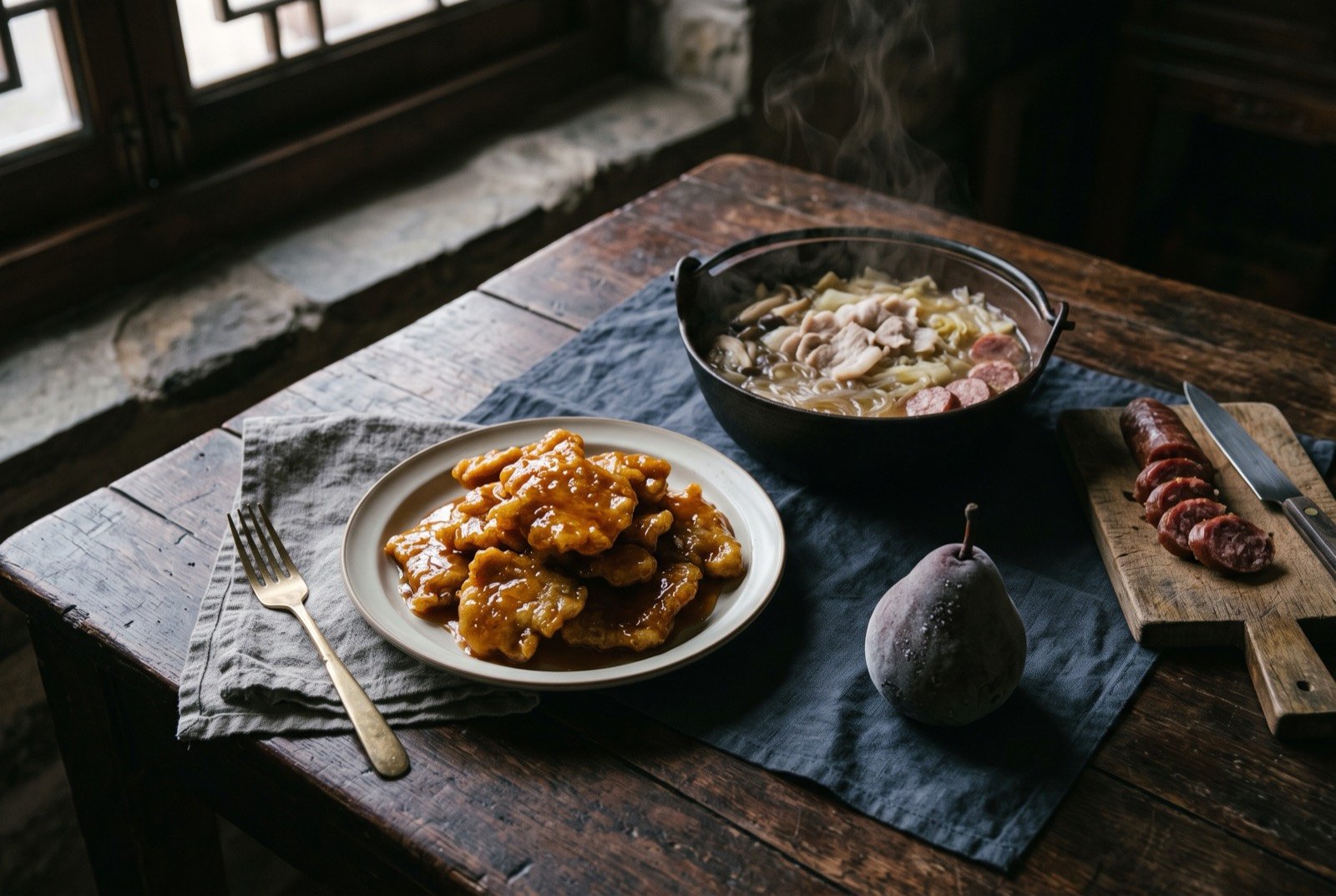
Liaoning, Jilin and Heilongjiang, taken seriously. Not one Dongbei cuisine but three layered food worlds: a Manchu-heritage interior of iron-pot stews and salt-fermented cabbage, Harbin's own localised Russian sausage and bread, and Yanbian's Korean-Chinese rice and buckwheat world, held together only by a winter long enough that fermenting, freezing, smoking and salting are not flourishes here but how anyone eats in February at all, and every dish as tradition built it, then what a modern chef would change.
Sources and review · What this chapter does not assert · How we research · Spotted something wrong?
A Sense of Place
Northeast China does not eat rice, and that single fact is the clearest way into how this cuisine actually works. Across the whole of Liaoning, Jilin and Heilongjiang, the working grain economy is wheat, soybean, corn, sorghum and millet, not the rice that organises most of the rest of China south of here. Corn has over three hundred years of cultivation history in Heilongjiang specifically, needing an accumulated growing-season temperature above 2,400°C, which concentrates it on the central southern Songliao plain and the Sanjiang plain. Sorghum arrived later and expanded hardest in the early Republican period, driven specifically by demand for baijiu distilling. Rice, when it does appear here, is a genuinely late and ethnically specific import, not a native Manchu or Han crop: Korean farmers brought paddy agriculture north across the Tumen River from the 1850s onward, with the first successful paddies recorded in 1848 in Jilin's Hunjiang valley and 1875 in Liaoning's Huanren county, on reclaimed swampland. By 1934, ethnic Koreans, at 3.3 per cent of the Northeast's population, were growing 90.1 per cent of its rice, having pushed paddy cultivation past 50°N along the Heilongjiang river by 1933, a feat one Chinese source calls "breaking the world precedent" for rice grown that far north. Rice belongs to a distinct, later, Yanbian-concentrated chapter of this region's food history, not to the wheat, soy, corn, sorghum and millet complex that is the actual indigenous base of Manchu and Han-settler farming here, and this chapter treats it that way throughout.
That distinction matters because it is the cleanest way to separate this volume's three real layers, which sit on top of the same cold-climate ecology without ever quite merging.
The Manchu-heritage interior, Liaoning and Jilin's farming and hunting heartland, is where guobaorou, suan cai pickled cabbage cookery, the tiedun iron-pot-and-cornbread technique and da jiang soybean paste all trace back to. This is the historic Manchu homeland, "between the White Mountain and the Black Water," Changbai Shan and the Heilongjiang and Songhua river system, where the Jurchen, the Manchu's direct ancestors, lived for centuries as hunters, fishers and gatherers before farming became dominant, and where the Qing court's own kitchen drew tribute goods directly from the land, a link this chapter can trace to a specific government office rather than assert as vague ancestry (see The History in Layers).
Heilongjiang and Harbin's Russian layer is a different thing entirely, and a much more recent one: a genuine, documented settler community, brought by a railway an empire built through someone else's country, that left behind a red sausage, a giant loaf of bread and a handful of buildings, then mostly left. This is not an inherited foreign garnish on Chinese food. It is Harbin's own adapted, localised version of Russian technique, made by Chinese hands for a century now, which is exactly the kind of localisation this atlas's animating argument is built on.
Yanbian's Korean layer, concentrated in the Yanbian Korean Autonomous Prefecture in eastern Jilin, is a third and entirely separate thing again: an ethnic Korean farming and fishing community whose food, cold buckwheat noodles above all, has its own lineage running back to the Korean peninsula rather than to either the Manchu interior or the Russian city. This chapter treats it as what it plainly is, a genuine third layer inside the same three provinces, not a footnote to the other two, while naming its home in the Korean peninsula's own cuisine directly (see AS-55, The Korean Peninsula).
A fourth, narrower thread sits at the coast rather than in the interior: Liaoning's Liaohe estuary and Bohai Bay fishing tradition, Panjin's river crab and Dandong's yellow clams, which is where this chapter's one documented case of restaurant-level elevation actually happened (see The Modernist Elevation, below). It is a real and distinct thing from the guobaorou-and-suan-cai repertoire most people mean by "Dongbei food," and this chapter says so plainly rather than letting one Michelin star stand in for a whole cuisine it does not represent.
One further boundary is worth drawing clearly rather than blurring. Inner Mongolia, the Chinese autonomous region, is not part of this volume. Its pastoral, dairy-and-mutton core belongs properly with Central Asia and the steppe (see AS-57, Kazakhstan, Kyrgyzstan and Turkmenistan), and only its eastern, Han-settled border areas lightly touch the world this chapter describes. And while this chapter shares a wheat-based grain base with the North China Plain to its south (AS-26), the two cuisines diverge on different logic entirely: AS-26's grammar is the Qing imperial court's own formal Lu-cuisine banquet tradition, clear stocks, precise knife work, hung-oven roasting. This chapter's grammar is a hunter-fisher people's deep-time relationship with cold, preservation and a single winter-long pot, a difference of first principles rather than of degree, even where both regions eat from the same wheat field.
A table of peoples, logic and dishes
| Layer | Defining logic | Carried by |
|---|---|---|
| Manchu-heritage interior (Liaoning, Jilin) | Cold-climate hunter-fisher-into-farmer economy; wheat, soy, corn and sorghum; salt fermentation and one-pot slow stewing as the winter default | Guobaorou, suan cai stews and dumplings, di san xian, zhu rou dun fentiao, tiedun, da jiang |
| Heilongjiang and Harbin, the Russian layer | Chinese Eastern Railway settlement, 1898 to the 1930s; European curing, smoking and baking technique, localised by Chinese owners after 1953 | Hongchang, dalieba |
| Yanbian, the Korean layer (eastern Jilin) | Korean peninsula migration from the 1850s onward; the only rice-growing, buckwheat-eating pocket of the whole region | Yanbian lengmian |
| Liaoning's coast, Liaohe estuary and Bohai Bay | A fishing economy, not a farming one; the region's one documented route to restaurant-level elevation | Sauerkraut and sea cucumber soup, river crab tofu, "boat cuisine" (see The Modernist Elevation) |
The History in Layers
Before there was a Qing dynasty, there was a hunting and fishing people whose ancestors' own name for hotpot, "野意火锅," wild-game hotpot, survives in Chinese food writing today. The Manchu's ancestors, the Sushen, Yilou, Wuji and Mohe peoples and then the Jurchen, lived primarily by hunting, fishing and gathering in the Changbai Shan and Heilongjiang river system before agriculture became dominant, and pork became their most preferred meat only once pig-raising took hold. Chinese sources credit the Jurchen with an early form of hotpot going back over a thousand years: hunters building fires in the field, setting clay pots over them, and cooking sliced deer or roe deer in chicken broth, a practice that moved to copper pots over charcoal as settled life stabilised, and was enjoyed across social classes by the Qing period, especially in winter. Manchu roasting, applied broadly to any bird or beast taken in the hunt, roast suckling pig, hanging-oven duck, roast pheasant, roast quail, is worth distinguishing clearly from the whole-roast-lamb tradition of Mongol and Uyghur hospitality, which belongs to a different world entirely (see AS-57) and has no documented tie to Liaoning or Jilin folk practice.
The Qing court's own kitchen is traceable to this region's ecology through a specific government office, not only through inherited reputation. The Dasheng Wula Superintendency, seated at Wula town near Jilin city from 1653 to 1907, existed for one purpose: gathering imperial tribute from the Changbai Shan and Songhua river drainage. Freshwater pearls, wild ginseng, kaluga and Amur sturgeon, perch, mountain chives, barnyard-millet rice, pine nuts and honey, over a hundred tribute categories in total, delivered on monthly, annual and imperial-birthday schedules. At its height the office controlled five estate villages, twenty two hunting and gathering grounds, sixty four pearl-diving river mouths and more than four thousand tribute-hunters. This is as close as the documentary record gets to proving that "Qing court cuisine" was, quite literally, fed by this region's own rivers and forests, not merely descended from it in spirit. Da jiang, the fermented soybean paste that still anchors the interior's everyday table, carries the same lineage: soybean paste-making by the Manchu's ancestors is traced to the Mohe people of the Sui-Tang period, continued by the Jurchen of the Liao-Jin period, and formalised under the Qing when the imperial kitchen's Wine and Vinegar Bureau was tasked with paste production and, in 1653, the court formally appointed sixteen dedicated paste-makers.
Dongli, the frozen pear that closes this chapter's dish list, is older than the Manchu presence here at all. The practice is traced to the Khitan people of the Liao dynasty, recorded by the Northern Song scholar-official Pang Yuanying in his text Wenchang Zalu after travelling in Liao territory: pears left outdoors after the autumn harvest, covered with accumulated snow, then dug out and thawed as needed. By the Qing, frozen pears were an imperial tribute item in their own right, and the eating method, bite in, then suck, never cut or peeled, has stayed unchanged for roughly a thousand years, a genuine point of local identity: one source describes modern attempts to peel or slice a frozen pear before eating it as something that offends Northeast sensibility outright.
Guobaorou, the dish most people outside China now associate with this whole region, has a real, locatable birth: Harbin, not Liaoning or Jilin, and a real, though partly embellished, origin story. Zheng Xingwen, a Han bannerman trained at Beijing's Prince Gong Mansion, became head chef to Du Xueying, the first Daotai of Harbin's Binjiang Daotai's office, around 1907, and adapted a savoury, dry-fried Beijing-Shandong pork dish into a sweet-sour version to suit the office's Russian and other foreign diplomatic guests, first calling it guobaorou, "pot-burst meat." The dish's practice in something close to its modern form is independently confirmed by a genuine early-1900s document, the Guanpin Shanpu manuscript, analysed by the food historian Zhao Rongguang, who records it as "thick-sliced lean meat, coated in a thick batter, alternately fried crisp over low and high heat, finished by flash-cooking in a sweet hawthorn sauce." What the documentary record does not confirm is two specific, widely repeated embellishments: that the modern name came from Zheng's Russian wife mispronouncing the character 爆 as 包, which a more careful Chinese source flags as doubtful, citing a 1926 Shenyang account that still used the older name; and that Zheng personally invented the tomato-sauce Shenyang variant at the 1911 International Plague Prevention Conference, an attribution the actual physician who led that conference's response, Wu Lien-teh, states in his own memoir he cannot confirm, naming a different, German-contracted kitchen instead and writing plainly, "it is not known whether this was Zheng Xingwen." Zhao's own reading of why the dish took the shape it did is worth carrying forward directly: not one man's accommodation of one wife's taste, but, in his words, "the historical convergence of Asian and European palates of that era."
A railway an empire built through someone else's country brought the second layer, and it happened fast. Russia began building the Chinese Eastern Railway through Manchuria from 1898, choosing a site between the Songhua and Ashi rivers that became Harbin. Population figures for the construction years vary sharply between sources, worth stating as genuinely contested rather than picking one number: Chinese sources give roughly 14,000 Russian colonists by 1899, rising to 43,500 by 1914; an independent Russian academic source gives a May 1903 census total of 44,576 residents, 28,338 Chinese and 15,576 Russian, rising to roughly 40,000 Russian émigrés among 59,677 total residents by 1911. The 1917 Bolshevik Revolution and the civil war that followed drove a second, much larger wave, military personnel, nobility, clergy and civilians fleeing Soviet territory, making Harbin, by most accounts, the largest Russian population centre outside Russia itself; peak figures again disagree, from roughly 120,000 to as many as 250,000 by the early 1920s depending on the source. In September 1920, China terminated Russian consular status and extraterritorial rights, leaving this population formally stateless until the Soviet Union began issuing citizenship documents to émigrés later in the decade.
The decline was not one departure but at least four, each with its own cause, over roughly forty years. In 1935 the Soviet Union sold its stake in the railway to Japanese-controlled Manchukuo, triggering the withdrawal of Soviet railway staff and roughly 30,000 repatriations; those who returned to the USSR during Stalin's 1937 Great Purge often faced arrest as suspected spies. Soviet occupation in 1945 and the People's Republic's founding in 1949 pushed out most remaining White Russians. An organised mass repatriation in 1954 to 1955, following the 1950 Sino-Soviet Treaty of Friendship, moved roughly 20,000 Soviet citizens from the Northeast. And a later trickle followed the Sino-Soviet split from the late 1950s onward. By the mid-1960s, Chinese sources put the remaining Russian resident community at roughly 900. One detail from this decline is worth keeping as a concrete anchor, because it shows food terminology tracking geopolitics directly rather than evolving taste: in 1964, as Sino-Soviet relations soured, Heilongjiang's provincial food authority abolished the transliterated Russian names of ten European-style products then in use, including hongchang's own original name, 里道斯 (a Russian-language transliteration, introduced via Ivan Churin's 1909 sausage workshop, of a Lithuanian-sausage-adjacent term, not, as this chapter's own research first hypothesised and then had to abandon, a reference to the Belarusian town of Lida). Because the sausage was dark red, it was renamed 红肠, red sausage, the name it has carried ever since; the original name resurfaced only in 1997, and the firm that had first used it did not secure its own trademark back until 2003.
A third migration, unconnected to either of the first two, built the region's Korean layer. Ethnic Korean farmers began crossing the Tumen River into Northeast China's wastelands from the 1850s onward, driven by famine, natural disaster and, later, Japanese imperial rule on the peninsula, a movement that is the direct origin of today's Chinese Korean ethnic community, formally recognised in the Yanbian Korean Autonomous Prefecture from 1952. Yanji cold noodles, this chapter's Yanbian lengmian, are dated by Chinese sources to the 1920s, developed partly to solve the practical problem of food spoiling in summer heat, and are now listed on Jilin province's own intangible cultural heritage register.
The most recent layer is a legal one, and it explains a real gap in what this chapter can responsibly recommend cooking. China's 1988 Wildlife Protection Law made illegal a whole tier of ingredients that high Dongbei and Manchu banquet cookery had drawn on for centuries: bear paw, deer antler and velvet, and hazel grouse among them. The dish now known as 小鸡炖蘑菇, chicken braised with mushrooms, was originally 蘑菇炖飞龙, mushroom-braised hazel grouse, renamed and reformulated after the ban, farmed chicken standing in for the protected bird. This chapter follows the same substitution the region's own cooks were forced into, and does not offer a recipe for anything the 1988 law, or UK wildlife and import law, would make illegal to cook here regardless.
The modern moment is genuinely thin, and this chapter says so rather than dressing it up. As of early 2026, Liaoning cuisine has only just entered the Black Pearl Guide, China's own serious restaurant-recognition system, with two unnamed Shenyang restaurants awarded one pearl each in the January 2026 guide, reporting on the announcement explicitly framing Shenyang as merely "the starting point" for the guide's exploration of the Northeast, meaning Heilongjiang and Jilin remain entirely unrecognised. Michelin has never issued a guide for any Northeastern city, and ran exactly one pop-up food festival in Shenyang, in September 2024, with no Liaoning or Dongbei dish represented among the visiting chefs. The one real exception, 止观小馆, Zhiguan Xiaoguan, a Michelin-starred Beijing restaurant cooking Liaohe estuary coastal cuisine, is covered in full below. The honest diagnosis of why the wider cuisine has never scaled into a national brand, offered directly by Chinese food journalism rather than imposed from outside, sits alongside a genuinely good, independently arrived at local articulation of this atlas's own thesis: that Dongbei home technique, pork-skin aspic as gelification, freeze-thaw fruit as a cold-climate cryo-technique, hand-whipped egg foam as espuma, is already, in one Chinese food writer's own words, "the ancestor of molecular gastronomy." Both threads are treated in full below, under The Modernist Elevation.
The Flavour Arsenal
Suan cai, and what it is not
Suan cai (酸菜) is whole or large-cut napa cabbage, salt-fermented for weeks in a cold climate, and it is worth being precise about what it is not: not Korean kimchi, which carries chilli, gochugaru and often fermented seafood; not German sauerkraut, which uses white cabbage rather than napa and a different, drier lactobacillus culture. It is the single most defining ingredient of this cuisine's identity, the way a specific fermented paste or spice blend anchors other volumes of this atlas, and no other pickled vegetable in this region carries the same weight.
Da jiang, the interior's own soybean paste
Da jiang (大酱) is a whole-soybean fermented paste, distinct from Sichuan's broad-bean, chilli-hot doubanjiang and from Korean doenjang's meju-brick method, though da jiang and doenjang are close cousins given the shared Manchurian-Korean border history. Traditionally made outdoors in large earthenware jars, it is central to the region's everyday dip-in-paste table, jidan jiang (egg and soybean paste dip), sugar-pickled garlic, and raw and blanched vegetables eaten alongside it, a habit closer in spirit to a British kitchen's own relationship with a good chutney than to a special-occasion condiment.
The grain base: wheat, soybean, corn, sorghum, millet, and rice as the exception
Corn, worked into cornmeal for the tiedun technique's griddle-baked flatbread and into everyday porridge, has over three centuries of cultivation here. Soybean, alongside its role in da jiang, is the region's other defining crop, China's highest-yield soybean zone, with a cultivation history reaching back roughly two thousand years. Sorghum's expansion tracks baijiu demand more than the table itself. Wheat carries potato starch's own everyday partner role in the kitchen (see below) as much as it carries bread. Rice, as established above, belongs specifically to Yanbian's Korean-settled paddies, not to the interior's own farming logic.
The Changbai Shan wild larder
Wild ginseng, sable pelts and deer antler are named as the historic "Three Treasures of the Northeast," alongside a wider forest larder of fern and osmunda fiddleheads, wood-ear fungus, hazelnuts and pine nuts, the last a genuinely different species, Pinus koraiensis, from the Mediterranean stone pine (Pinus pinea) sold as pine nuts in Britain, real pine nuts, botanically a different tree. Wild mushrooms and forest game were, and to some extent still are, this region's own version of what truffle or game are to a European forest larder, though the 1988 wildlife law has closed off the most storied end of that game (see The History in Layers).
The rivers, and freezing as a working preservation method
The Songhua river system supports over forty million kilograms of fish annually, and a traditional saying names the range: "three flower-fish, five luo-fish, eighteen small fish, seventy-two miscellaneous fish." Burbot, the only freshwater member of the cod family and a genuinely distinctive cold-water species found only in the Heilongjiang, Songhua, Ussuri and Yalu rivers, is prized for a rich flavour without greasiness. Winter cold, reported as low as minus 30°C in Heilongjiang, freezes freshly caught fish almost immediately, making natural deep-freezing a routine preservation method here, the same logic that produces dongli.
Potato starch, and the fentiao versus fensi confusion worth knowing before you shop
Potato starch, not corn or wheat starch, is what gives guobaorou's batter its characteristic light, crackling, almost hollow-shelled crust, and this is treated as non-negotiable rather than a matter of preference. Separately, 粉丝 (fensi, thin mung bean thread noodles, the kind most easily bought online in Britain) and 粉条 (fentiao, thicker noodles traditionally made from sweet potato starch) are related but genuinely different products, and this region's stewed dishes specifically want the thicker fentiao, not the thin glass noodle most UK retailers stock and label loosely as "mung bean vermicelli" (see Sourcing in Britain).
The Technique Ladder
Six rungs, each doing real, explicable work.
Rung 1. Ferment suan cai as controlled cold science, not folk luck
Layer whole, sun- or air-dried napa cabbage with salt at roughly 1.5 per cent by weight (750g salt to 100 jin, 50kg, of cabbage in cold Northeast conditions, rising to around 2.5 per cent in warmer climates), weight the cabbage under a clean stone, submerge fully in cold water within about eight hours, seal, and hold at 2 to 8°C for at least a month. The temperature ceiling is not a suggestion: too warm and the finished cabbage loses its crisp texture entirely. The timing floor is a genuine food-safety fact worth carrying into a British kitchen rather than treating as folklore: nitrite levels in the fermenting cabbage rise through the first week, peak around day seven, then decline, so suan cai eaten before roughly thirty days' fermentation carries a real nitrite exposure risk alongside being underdeveloped in flavour. A precisely temperature-controlled fermentation chamber, a wine fridge or a dedicated ferment box, lets a home cook both verify this window and hold it more consistently than an ungauged cold veranda ever could.
Rung 2. Double-fry, then build the glaze as a separate reduction, never a slurry
Guobaorou's batter is potato starch worked into thin-sliced pork by hand until the mixture shows real resistance, a thick, cohesive coating rather than a tempura-style batter. The first fry, at roughly 190 to 200°C, sets the shape and seals the crust while the interior stays moist; the oil is then reheated and a brief second fry, back up to around 200°C, produces the final audible-crisp shell, a textbook double fry directly transferable to a British kitchen with a probe thermometer and a deep pan. The single most technically important point, and the one most worth carrying into a home kitchen, is that the sugar-vinegar sauce is never simply poured over the fried pork the way a cornstarch-thickened Chinese stir-fry sauce usually is. It is reduced separately, in its own pan, until syrupy and concentrated, before the fried pork is tossed through it briefly, precisely so the crisp coating does not have time to absorb excess liquid and go soft. This is exactly the logic of a modern double-fried-chicken glaze, arrived at independently, in Harbin, over a century ago.
Rung 3. Combine griddle and stew in one pot, one fire
Tiedun's defining move, cornbread discs pressed directly onto the inner wall of a large iron pot above a simmering stew, cooks the bread by a combination of steam rising off the stew below and direct contact heat from the hot pot wall, described in Chinese as "bread stuck on top, stew below." A little wheat flour worked into the cornmeal dough improves its extensibility so it holds against the vertical hot surface rather than sliding off. This is fuel-efficient, one-pot cooking born of practical necessity, not a fine-dining flourish, and it traces to two real, separate histories converging: Manchu hunting-era hanging-pot field cooking, and the Shandong and Hebei settler stewing habits carried north during the late Qing and Republican-era "passing through the Pass to the East" migration.
Rung 4. Cure, poach, then smoke a cured sausage twice
Hongchang's process runs cure, mix filling, stuff into casing tied off roughly every 20cm, poach at around 80°C, ten to fifteen minutes for a sheep casing and twenty to thirty for pig, then smoke over hardwood, first for over an hour, then a second, longer pass at low temperature over embers, sometimes ten hours or more, that further dries the surface and deepens the roasted-hardwood aroma. Smoking is described directly in Chinese technical writing as "the soul" of authentic Harbin red sausage, and the fact that experienced smokehouse operators adjust the wood's physical stacking in response to small shifts in season and humidity is worth taking seriously: this is a live, judgement-based craft, not a fixed recipe, and a home version on a controlled smoker has a real advantage over an open-air one in holding the low, steady temperature this technique actually needs.
Rung 5. Triple-ferment a hop-leavened dough for a genuinely different crumb
Dalieba is leavened with a self-cultivated hop-flower liquid starter, not commercial yeast or a standard sourdough culture, fermented in three separate stages over roughly sixteen hours total before baking in a hardwood-fired oven. The result is a slightly charred, crisp crust over a soft, faintly sour crumb, and despite its Russian ancestry, the dough itself is wheat-based, not rye, Harbin's own local adaptation of a foreign technique to locally available grain rather than a preserved import, exactly the pattern this atlas keeps finding once it looks closely at any borrowed technique.
Rung 6. Freeze and thaw deliberately, as a real technique, not an accident of climate
Dongli, whole pears left to freeze solid outdoors through the Manchurian winter, then thawed and eaten by hand, converts starches and changes texture into something soft, dark and intensely sweet-sour, achieved through genuine outdoor cold and repeated freeze-thaw cycling rather than any added ingredient. A Chinese food-journalism piece makes the comparison directly and worth repeating here: this is functionally the same idea as a modernist kitchen's liquid-nitrogen cryogenic work, arrived at through weather rather than through equipment, alongside a whole further register of the same logic, pork-skin aspic as gelification, a starch-and-water street food called mènzi as a hydrocolloid set, whipped egg-white-and-red-bean paste as an espuma achieved by hand rather than a siphon. A domestic chest freezer genuinely reproduces the mechanism, if not the exact cultivar, and this chapter's own closing dish takes that seriously rather than treating it as a curiosity.
The Modernist Elevation
This is, honestly, a thin thread, and this chapter says so rather than dressing it up. There is no visible cluster of chefs doing sous vide or spherification on guobaorou, suan cai or hongchang anywhere in China, and none was found in Britain either.
The one real exception sits at the coast, not the interior. 止观小馆, Zhiguan Xiaoguan, a Beijing restaurant run by chef Chang Longshan, a Benxi, Liaoning native, has held a Michelin star for five consecutive years, widely called, though not independently verified against a full global database, the world's only Michelin-starred Northeastern Chinese restaurant. It cooks Liaohe estuary and Bohai Bay coastal Liaoning cuisine specifically, sauerkraut and sea cucumber soup, finished tableside for temperature control; twelve local river crabs reduced and worked into an egg-custard tofu, crab essence set into a refined, individually plated dish rather than served as a shared pile of shells, a technique directly analogous to a modern crab bisque reduced and set under controlled low heat; and a "boat cuisine" category built on the practice of Liaohe fishermen cooking their own catch aboard ship. This is real, documented restaurant-level technique, and it is worth being explicit that it belongs to a narrower, coastal Liaoning tradition than the guobaorou-and-suan-cai interior repertoire this chapter is mostly about, which has no comparable elevation anywhere in the sources this chapter's research could find.
The honest diagnosis of why the wider cuisine has never scaled into a national restaurant brand is worth repeating directly, because it is specific rather than vague. Chinese food journalism names a genuine "double-low" commercial trap, low average ticket price and low table turnover, since slow-cooked stews do not turn tables fast; unglamorous dish names and dark colours, pig-slaughtering dish and blood sausage among them, working against a social-media-driven dining culture; and, most tellingly for this atlas's own rules on what a recipe can responsibly ask a reader to cook, a genuine loss of ingredients: a Dongbei recipe book from thirty or forty years ago reads, in one Chinese writer's own words, "like a catalogue of nationally protected rare animals," bear paw, deer antler and hazel grouse among them, all made illegal by China's own 1988 Wildlife Protection Law (see The History in Layers). The one named national chain to come out of this region, 山河屯铁锅炖, succeeded on cheap, cheerful value rather than elevation, the opposite direction from Zhiguan Xiaoguan's route.
A second, genuinely good local framing device is worth carrying through this whole chapter rather than treating as a passing curiosity. A piece of Chinese food journalism argues directly that Dongbei home technique is already, functionally, the ancestor of molecular gastronomy: pork-skin aspic as gelification, sun-dried vegetables as an indigenous form of industrial dehydration, caramelised sweet potato with pulled sugar threads as controlled sugar isomerisation, and freeze-thaw-cycled fruit, this chapter's own dongli among them, as a genuine cryogenic technique achieved through weather rather than liquid nitrogen. This chapter treats that framing as sound and worth taking seriously, not as an outside imposition but as a real, independently arrived at Chinese articulation of the exact argument this whole atlas makes: that a technique's dignity does not depend on which kitchen wrote it down first.
The Ferment and Preserve Bench
Da jiang, the interior's own soybean paste. Boil whole soybeans until soft, mash and form into blocks, and let them sit somewhere warm indoors through the winter, developing a coat of mould as they ferment slowly. Around the eighteenth day of the fourth lunar month the following spring, brush the blocks clean, break into small pieces, and pack into a crock with salt in alternating layers, top up with clean water, then leave in the sun, stirring and beating regularly, until it develops into a thick, deeply savoury paste. This is a genuine plan-ahead project, months rather than weeks, and the dehydrator is a real help for the block-drying stage specifically.
Sugar-pickled garlic (糖蒜), part of the same dip-in-paste table as da jiang. Peel fresh, new-season garlic bulbs, soak in lightly salted water for 24 hours, then air-dry about 3 hours. Boil a brine of sugar, soy sauce, rice vinegar and salt, roughly 10 parts garlic to 4 parts sugar to 3 parts rice vinegar by weight, cool it, stir in a little honey, then pack the garlic into a jar, cover fully with the brine, and seal. Colour begins to change within 3 to 5 days; rest a full month before eating.
Dried vegetables, the interior's own winter storecupboard. Dried potato, long bean, cabbage, aubergine and cucumber, sun-dried through the autumn glut for months of winter storage, are this region's own version of the dehydration this reader's own kitchen already does by machine rather than by season. A dehydrator set low and slow reproduces the effect faithfully, and reconstituted dried vegetables carry a concentrated, slightly sweeter flavour worth using deliberately in a winter stew rather than only as a fresh-vegetable stand-in.
Sourcing in Britain
Verified September 2026.
The ranked list: what decides great from grim
- Suan cai. The single most load-bearing ingredient in this cuisine's identity. What is actually easy to buy online in Britain, Sichuan ya cai, is sweetened, finely minced and a genuinely different texture and flavour; using it in place of proper whole-leaf suan cai trades sour-savoury depth for a sweet-salty mince and changes the dish's whole character. Homemade, simple lactic fermentation well within this reader's reach, is the honest first recommendation, not a fallback.
- Da jiang. No UK retailer, Chinese or otherwise, was found stocking a genuine Dongbei da jiang under that name, a real gap rather than an under-searched one. Doubanjiang is chilli-hot and broad-bean based; doenjang is the closer relative by ingredient but a different, often saltier ferment. Homemade, given the reader's dehydrator for the meju-style drying stage and time for the fermentation itself, is the honest route; doenjang is the least-wrong shelf substitute for a first attempt while a homemade batch matures.
- Dongli, or rather its honest absence. Not because it appears in many recipes, but because it is the clearest single case in this chapter of something that cannot be bought in the UK in any form and can only be approximated by freezing a related but different fruit.
A pleasant surprise, worth naming as such: hongchang's casings and curing salt are genuinely well solved in Britain, not through any Chinese grocer but through the general British home-charcuterie trade. Weschenfelder, a well-established, multi-generation firm, sells natural hog casings and Cure No.1 in retail packs; Home Curing UK, trading as Surfy's Home Curing Supplies, produces its own Prague Powder No.1 and No.2. Cold-smoking equipment matched to this reader's Big Green Egg is equally well solved: ProQ Smokers and Sous Chef UK both sell cold-smoke generators, and alder, beech and oak, the woods a genuine Harbin sausage technical reference specifically names, are all readily available UK smoking woods.
Named shops and honest gaps
Potato starch, light and dark soy sauce, Chinese black vinegar (Zhenjiang vinegar, worth naming honestly as a pan-Chinese pantry staple rather than a Dongbei one, since it is national rather than regional), pine nuts and garlic are all straightforwardly available at any of the UK's large Chinese supermarket chains, Wing Yip, Hoo Hing, SeeWoo, Loon Fung, New Loon Moon and Wai Yee Hong among them, or through online specialists including Sous Chef UK and Wah Hing.
Fentiao versus fensi is worth checking carefully rather than trusting the first online listing: most UK-shipping retailers stock thin mung bean fensi, and the thicker sweet-potato fentiao these dishes actually want is a genuine, standard product on the shelf of any large Chinese supermarket, but was not pinned down to a specific verified online listing in this chapter's own research.
Dried Changbai Shan-specific mushrooms and the true Manchurian pine (Pinus koraiensis) both have widely available cousins in Britain, generic Yunnan dried porcini and morel, ordinary UK pine nuts, but not the specific origin species; this chapter names that honestly rather than implying a like-for-like match.
Dalieba as a finished, shop-bought loaf was not found at any UK bakery under that name. Karaway Bakery, at Westfield Stratford City, sells genuine Russian Borodinsky, a real, nameable, nearby-in-spirit product, but it is a smaller, darker, coriander-and-molasses loaf, a different bread, and this chapter does not present it as dalieba. Shipton Mill's dark and light rye flours, blended with strong white bread flour as this chapter's own recipe above does, are the honest route to the real thing.
Rye flour for that same recipe, Shipton Mill's Organic Dark Rye and lighter Rye Type 997, is available direct or through resellers Ratton Pantry and Bakers Street.
Fresh Asian and nashi pears, the honest dongli approximation, are stocked as a mainstream product by Tesco, and imported weekly by specialists including Fine Food Specialist and Thai Food Online.
Voices and Sources
From inside the tradition
- Zheng Xingwen, head chef to Harbin's first Daotai, and his great-grandson Zheng Shuguo, the current, formally recognised provincial intangible-cultural-heritage transmitter for guobaorou at Lao Chu Jia, the Harbin restaurant tracing its lineage directly back to the dish's own invention.
- Zhao Rongguang, the food historian whose analysis of the Guanpin Shanpu manuscript is this chapter's strongest single piece of documentary evidence for guobaorou's real, early-twentieth-century practice, and whose own framing, that the dish was "the historical convergence of Asian and European palates," this chapter has drawn on directly rather than the folk mispronunciation story more commonly repeated.
- Chang Longshan, chef of 止观小馆, Zhiguan Xiaoguan, Beijing, a Benxi, Liaoning native whose own stated philosophy, "a niche cuisine must commit to inward exploration; only dishes with real roots have lasting vitality," is the clearest documented articulation anywhere in this chapter's research of what elevating this cuisine responsibly might actually mean.
- Liu Jingxian, a Liaoning-cuisine grandmaster and winner of China's first national cooking competition in 1983, named here as the historical high end of Liaoning banquet cookery, though his own signature dishes, orchid-shaped bear paw among them, rely on ingredients the 1988 wildlife law has since made illegal and this chapter does not reproduce.
The gap, named rather than papered over
No English-language cookbook dedicated specifically to Dongbei or Northeastern Chinese cuisine was found anywhere in this chapter's research, in sharp contrast to Sichuan, Cantonese or Shanghainese food, each of which has at least one widely respected English-language author. My Old Place, in London's East End, and Sanbao Chinese Kitchen, in Hammersmith, are the two UK restaurants this chapter's own research could confirm cook genuine Dongbei home-style dishes, both consistently described as casual, diaspora-facing places rather than anything approaching fine dining, and this chapter treats that plainly rather than dressing either up as more than it is. A reader wanting to eat this cuisine properly in Britain before cooking it currently has nowhere better to start.
Things this chapter has deliberately not asserted
- That guobaorou's modern name came from Zheng Xingwen's Russian wife mishearing 爆 as 包. This is the most widely repeated version of the story in Chinese popular media, but a more careful source, citing a 1926 Shenyang account that still used the dish's older name, explicitly questions it, and this chapter has not treated it as settled.
- That Zheng Xingwen personally invented the tomato-sauce Shenyang variant at the 1911 International Plague Prevention Conference. The physician who actually led that conference's response, Wu Lien-teh, names a different, German-contracted kitchen in his own memoir and states plainly it is not known whether Zheng was involved.
- That hongchang's transliterated original name, 里道斯, derives from the Belarusian town of Lida. This etymology was this chapter's own working hypothesis at the start of research; it was not found in any Chinese or Russian source consulted, and the confirmed explanation is simply "a Russian-language phonetic transliteration," unglossed further.
- That potatoes reached Heilongjiang specifically via Harbin's Russian settler community. What is documented instead is a much older, unrelated Ming-dynasty overland trade route linking Russia to potatoes' arrival in China as a whole, centuries before Harbin existed.
- That jidan jiang (egg and soybean paste dip) or dongbei da lengpan (the cold mixed platter) carry any specific Russian influence. Nothing found in this chapter's research supports that link; both are treated here as general Northeast dishes, most plausibly Manchu-descended given the wider dip-in-paste table they belong to.
- That precise population figures exist for Harbin's Russian community at any given date. Chinese, Russian and English-language sources each give different figures for roughly the same moments, and this chapter has presented the range as genuinely contested rather than settling on one number.
- That "止观小馆 is the world's only Michelin-starred Northeastern Chinese restaurant" is a verified, independently checked fact. It is the restaurant's own framing, repeated uncritically across Chinese food media; no rival claimant was found anywhere in this chapter's research, which makes it very likely true, but it remains an unverified superlative rather than a confirmed one.
- That Manchu court chefs' historical hunting and game-preservation technique can be traced in detail into today's Dongbei smoking and curing practice. The fact that Manchu court chefs dispersed into private restaurant practice after the Qing's fall is asserted in Chinese sources, but real, technically detailed evidence of exactly how historical Manchu preservation method shaped today's hongchang or blood-sausage technique was not found, and this chapter has not claimed a direct lineage it cannot show.
Ferment suan cai as controlled cold science, not folk luck
Layer whole, sun- or air-dried napa cabbage with salt at roughly 1.5 per cent by weight (750g salt to 100 jin, 50kg, of cabbage in cold Northeast conditions...
Double-fry, then build the glaze as a separate reduction, never a slurry
Guobaorou's batter is potato starch worked into thin-sliced pork by hand until the mixture shows real resistance, a thick, cohesive coating rather than a...
Combine griddle and stew in one pot, one fire
Tiedun's defining move, cornbread discs pressed directly onto the inner wall of a large iron pot above a simmering stew, cooks the bread by a combination of...
Cure, poach, then smoke a cured sausage twice
Hongchang's process runs cure, mix filling, stuff into casing tied off roughly every 20cm, poach at around 80°C, ten to fifteen minutes for a sheep casing and...
Triple-ferment a hop-leavened dough for a genuinely different crumb
Dalieba is leavened with a self-cultivated hop-flower liquid starter, not commercial yeast or a standard sourdough culture, fermented in three separate stages...
Freeze and thaw deliberately, as a real technique, not an accident of climate
Dongli, whole pears left to freeze solid outdoors through the Manchurian winter, then thawed and eaten by hand, converts starches and changes texture into...
The dishes
- Guobaorou Harbin
- Suan Cai Dun Bai Rou Xuechang Liaoning and Jilin
- Di San Xian Liaoning and Jilin
- Zhu Rou Dun Fentiao Liaoning and Jilin
- Tiedun Liaoning and Jilin
- Suan Cai Jiaozi Liaoning and Jilin
- Hongchang Harbin
- Dalieba Harbin
- Yanbian Lengmian Yanbian
- Dongli The Northeast
Sources and review
- Reviewed
- Not yet reviewed from inside the tradition
- Cooked
- Not yet cooked and reported
Where this volume comes from
3 research briefs on file for this volume, researched to the rules on How we research. Published 4 September 2026. Last changed 8 September 2026.
The brief's own account of its sources
Rough split: of roughly 30 distinct sources actually cited above (excluding duplicate hits for the same fact), the very large majority, on the order of 85 to 90%, are Chinese-language. Within that Chinese-language set, quality is uneven: A meaningful minority are strong: national/regional press and heritage-press outlets (澎湃新闻/thepaper.cn, 中国作家网, 新华网, 中新网, 北京日报/京报网, 川观新闻), a provincial government heritage page (宽城满族自治县人民政府), a named food-history scholar's documented research (Zhao Rongguang / 赵荣光 on 官品膳谱), and one peer-reviewed ichthyology journal PDF (Dalian Ocean University).