Asia · Volume 29
Jiangnan: Jiangsu, Zhejiang, Shanghai and Anhui
The Delta, the Salt Road and the Mountain Behind It
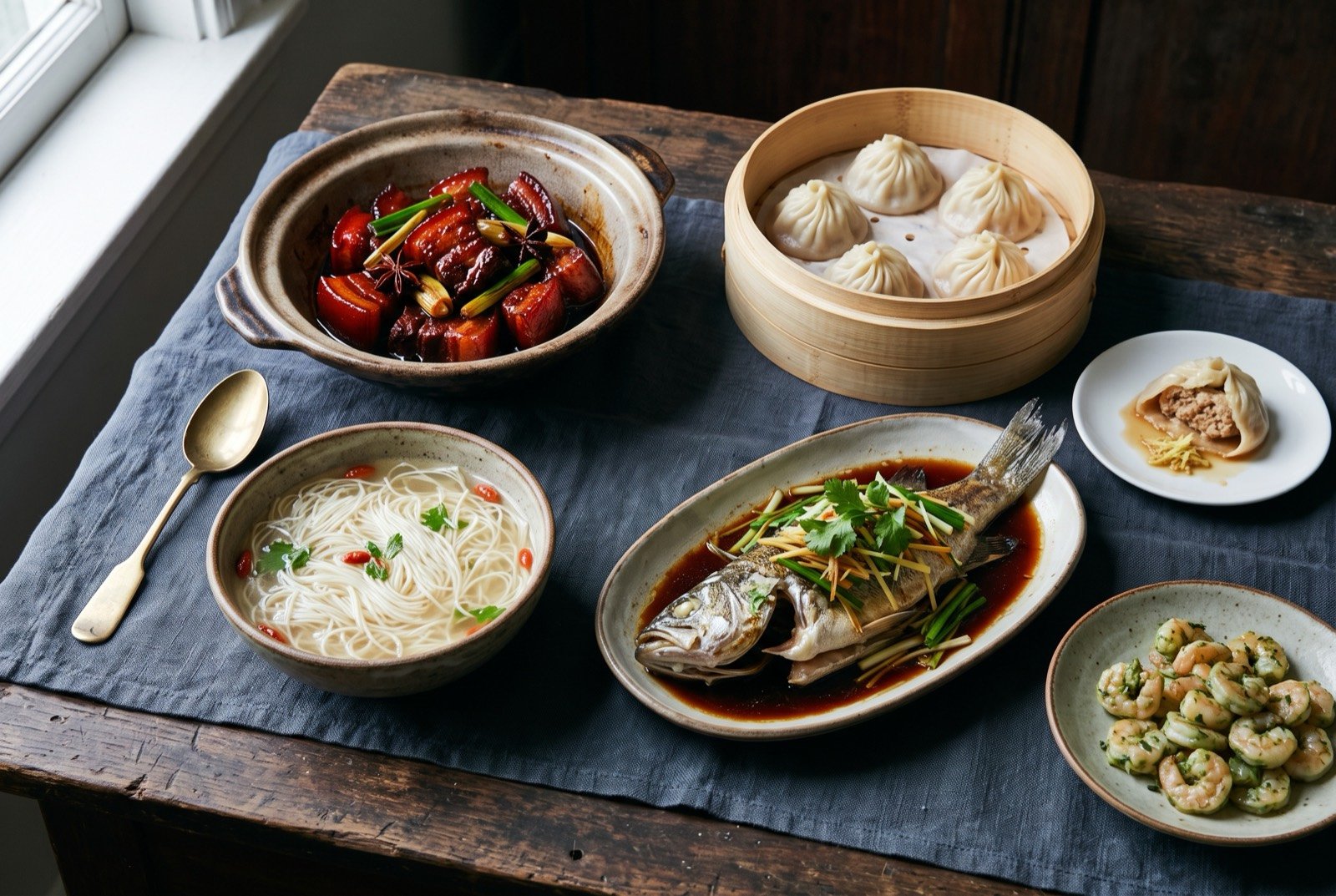
Jiangsu, Zhejiang, Shanghai and Anhui, taken seriously. Not a single delta cuisine but a chain of distinct ecologies, salt-merchant wealth and a mountain counter-tradition behind it, and every dish as tradition built it, then what a modern chef would change that, in this volume more than most, the tradition itself is already busy building.
Sources and review · What this chapter does not assert · How we research · Spotted something wrong?
A Sense of Place
Four provinces, and only one of them agrees to be reduced to a single word. Jiangsu and Zhejiang are a rice-and-freshwater-fish delta built by the Yangtze and held together by a canal the state dug for tax grain and salt, not for cooking, though cooking is what the money it moved eventually bought. Shanghai is the youngest of the four by centuries, a market town that only became a city because foreign gunboats made it one in 1843, and it spent the following hundred years eating everyone else's cuisine before it had one of its own to call benbang, "this gang's cooking." Anhui does not belong to the delta at all. It sits behind it, in mountains too poor to farm, and its food runs on salt, fermentation and a merchant class so wealthy it briefly outspent the other three combined, without ever growing rice the way they did. Every restaurant technique in these cuisines has an indigenous ancestor, the claim this atlas returns to in every volume, and Jiangnan is where that ancestor is not folklore but paperwork: a Qing scholar's marginal note naming the monk who invented hair-thin tofu, a 1920 restaurant ledger naming the chef who first wrapped a clay-baked chicken in lotus leaf, a 2025 news report naming the exact number of pin-bones a Michelin two-star kitchen picks out of a single carp. Every dish given twice: once as tradition built it, once rebuilt with modernist technique that, in this volume more than most, the tradition itself is already busy building.
The delta that built the wealth, and the canal that spent it
Jiangsu and Zhejiang together are the Yangtze delta: flat, criss-crossed by rivers and lakes, a growing season and water table that made wet-rice agriculture and freshwater aquaculture (fish, crab, eel, snail) the base of the diet for over a thousand years. Jiangsu's own culinary heritage summary describes the province's food as built on skilled handling of freshwater fish, lake crab and vegetables, with fine knife work and clear seasonal distinction as the defining technical signature. None of this by itself explains why this particular delta produced china's most refined banquet cooking rather than merely its most abundant one. That took the Grand Canal.
The canal carried grain, salt, silk and porcelain the length of the empire, and it built three cities on the way: Yangzhou and Huai'an as the great salt-transport hub and river-management seat, Suzhou as a merchant capital wealthy enough that Ming-dynasty land values there were the highest in the country. Jiangsu's own provincial taxation authority states plainly that in the Ming and Qing the province contributed roughly a tenth of the whole empire's grain tax revenue. Merchant guild halls (会馆) from as far as Fujian and Jiangxi stood in Suzhou by the late sixteenth century, trading sugar, tea, cloth and jewellery.
The Lianghuai salt monopoly (两淮盐业) is the clearest, most direct link between money and cuisine anywhere in this volume. Yangzhou was the great southern salt-transport hub; Jiangsu's own provincial heritage press calls Huai salt Huaiyang cuisine's "behind the scenes hero." During the Qianlong era, salt merchants worth "hundreds of thousands of taels of silver" were unremarkable, and those worth "tens of millions" were common. Those merchants, and the river-management officials who lived alongside them in Yangzhou and Huai'an, competed in banquet extravagance, importing exotic ingredients along the canal and stimulating chefs to formalise technique into what became, by the Qing, one of China's traditional four great cuisines: Huaiyang, alongside Lu (Shandong), Chuan (Sichuan) and Yue (Cantonese). Huaiyang chefs prepared the closing banquet of the first plenary session of the Chinese People's Political Consultative Conference on 30 September 1949, at Zhongnanhai, and for the following two to three decades most major Chinese state banquets were built around Huaiyang cuisine. It remains a major component of state banquets today. Jiangsu sources count over 1,300 classic Huaiyang dishes still catalogued.
Shanghai is the delta's youngest city by centuries, and its food identity is younger still. The "century-old fishing village" framing common in English is an oversimplification Chinese scholarship has pushed back on directly: Shanghai grew from a Song-dynasty market town into an official trading port well before the 1843 Treaty of Nanjing made it one of five treaty ports. What genuinely changed in 1843 was scale and demographic mixing, not Shanghai's existence. Migrants and restaurateurs from Anhui, Suzhou-Wuxi and Ningbo all opened restaurants in the boomtown, and against that competitive backdrop "本帮菜", literally "this gang's cuisine", named to distinguish it from the incoming regional styles, crystallised as its own identity from informal food stalls near the City God Temple. Suzhou and Yangzhou's Huaiyang tradition is older, more codified and imperially patronised, built on salt-merchant wealth centuries before Shanghai mattered. Shanghai's benbang cuisine is a nineteenth and twentieth century synthesis that became internationally famous, and functionally interchangeable with "Shanghai food" in most people's minds, precisely because Shanghai itself became China's dominant city. What most people abroad mean by "Jiangnan cooking" is benbang red-braising; the older, more technically demanding Huaiyang tradition it grew out of is comparatively invisible outside China. This chapter tries not to reproduce that asymmetry silently.
When the court moved south: Hangzhou and West Lake
Zhejiang's own centre of gravity is Hangzhou, and Hangzhou's food history has a precise hinge date. When Lin'an, today's Hangzhou, became the Southern Song capital in 1127 after the fall of Kaifeng to the Jin, it absorbed Northern chefs and Northern court taste alongside the existing Jiangnan lake-and-canal larder. A Zhejiang provincial cultural account describes the result directly: Lin'an as a bustling capital drew "famous chefs from north and south," and Hangzhou cuisine reached its first peak through a fusion the trade still calls "southern ingredients, northern cooking" (南料北烹). The city's cooking carries a durable internal split to this day: a "lake school" (湖上派) of fish, shrimp and fowl, favouring raw stir-frying, clear stewing and quick-oil finishing, prizing clarity and original flavour; and a "city school" (城厢派), more meat, more steaming and braising, lighter starch-thickening. Hangzhou cuisine explicitly absorbed elements of Huaiyang, Hui (Anhui) and Henan cuisine on top of that. The "clean, elegant, lightly sweet" Hangzhou style most Western readers have heard of is itself a product of thirteenth-century migration and fusion, not an unbroken local development. West Lake itself carries a literary weight most lakes never acquire: the "West Lake Ten Scenes" (西湖十景), the set of named viewpoints still used today, first appears in Southern Song geographical and painting literature, a cultural convention laid over a physical lake rather than a naive list of pretty views.
Zhejiang is not only Hangzhou. Ningbo, on a long coastline studded with over 300 islands close to the Zhoushan fishing grounds, runs a genuinely distinct coastal sub-tradition, not Hangzhou cooking done near the sea: a "salty, fresh" (咸、鲜) palate built on steaming, roasting and stewing, more robust and ingredient-forward than Hangzhou's quick oil-flashing refinement. This chapter keeps that distinction visible rather than letting "Zhejiang food" collapse into "Hangzhou food."
The mountain behind the delta: Anhui and Huizhou
Anhui does not share the other three provinces' rice-and-fish ecology at all, and this volume treats it, deliberately, as a counter-tradition rather than a regional variant. What is called "Anhui cuisine" (徽菜) is really Huizhou cuisine, named for the historical prefecture of Huizhou (徽州), which does not map onto the modern province: it comprised what is now Huangshan City in Anhui, plus Wuyuan county (now Jiangxi) and Jixi county (now Xuancheng, Anhui). Hui cuisine is repeatedly and explicitly named as one of China's eight great culinary traditions in its own right, not a subset of Jiangnan lowland cooking, and in the Ming and Qing it briefly ranked first among all eight. Huizhou sits at the meeting point of two climate zones with high rainfall, giving an unusually rich mountain larder: Huangshan alone is recorded as home to over 1,470 edible plant species, and Hui cuisine's whole logic runs on wild mountain foraging (bamboo shoots, wild mushrooms, stone chicken, a mountain frog prized as a delicacy) and, distinctively, on fermentation and curing rather than the sugar-forward finish of the delta below it.
The Huishang (徽商), the Huizhou merchants, are the reason this poor mountain region produced a genuinely refined cuisine rather than only a rustic one. Huizhou's terrain could not support its population by farming alone, forcing a shift, proverbially, to "seven in ten made their living by trade, three in ten farmed." Those merchants, wealthy from tea, timber and salt, reached their golden age from the late Ming through the Qianlong era, when Huizhou's merchant numbers, geographic reach and capital strength led all merchant groups in China. Wealthy across the country but sentimentally attached to home-region flavours, they ate and entertained lavishly: at their Republican-era peak, Shanghai alone had more than 500 Hui restaurants. One Chinese account of Shanghai's food history states plainly that in the 1920s, what dominated Shanghai's food trade was neither northern restaurants, nor Suzhou-Wuxi restaurants, nor Sichuan restaurants, but Huizhou restaurants. Anhui cooking is part of Shanghai's own culinary formation, not simply an adjacent tradition, and this chapter treats that as a structural fact rather than a footnote. The same historical population produced both an intensely refined, expense-no-object banquet cuisine funded by merchant wealth, and a rustic, ingredient-driven, fermentation-and-curing mountain cuisine born of genuinely food-insecure highland terrain. Hui cuisine today carries both registers at once, sometimes within a single dish.
A table of peoples, logic and dishes
| Place | Defining logic | The dishes that carry it |
|---|---|---|
| Shanghai | 浓油赤酱, thick oil red sauce, benbang red-braising | hongshao rou, drunken chicken, Shanghai smoked fish, xiaolongbao |
| Suzhou and Yangzhou | Huaiyang banquet refinement, salt-merchant wealth, extreme knife work | wensi tofu, lion's head meatballs, squirrel fish, dried tofu strips |
| Nanjing and Zhenjiang | duck, vinegar and pork terrine, a river city's own repertoire | salted duck, Zhenjiang vinegar, pork terrine |
| Hangzhou and West Lake | lake-and-garden refinement, Southern Song court fusion | Dongpo pork, West Lake vinegar fish, Longjing shrimp |
| Ningbo | coastal, "salty fresh," robust and ingredient-forward | snow-vegetable yellow croaker soup, pot-braised eel |
| Huizhou (Anhui) | mountain foraging, fermentation and curing, merchant-funded banquet | stinky mandarin fish, mao doufu, Yipin Guo, cured ham |
The History in Layers
The dishes this volume had to arbitrate
A single dish crossing four provinces means competing claims are not an edge case here, they are the normal condition, and this chapter follows the atlas's standing rule: attribute, don't adjudicate, except where the documentary record genuinely settles something. Three cases were checked directly against the sources rather than assumed.
Dongpo pork belongs to Zhejiang, not Jiangsu, though it is served everywhere in the region. Su Shi, the poet and official known as Su Dongpo, invented the technique of slow-braising pork with rice wine, rock sugar and soy sauce while exiled and impoverished in Huangzhou, in modern Hubei, in 1080, when local pork was cheap as dirt; his poem "Ode to Pork" gives the method almost verbatim, "low flame, little water... when the timing is right it becomes wonderful of its own accord." The dish only became a Hangzhou, and so Zhejiang, dish in 1089, when Su Shi, by then prefect of Hangzhou, dredged West Lake using conscripted labour; in thanks, local people sent him pork and wine, which he had cut, braised and distributed back to the workers. Hubei invented the method; Hangzhou claimed the dish.
Beggar's chicken belongs to Jiangsu, specifically to Changshu, not to Hangzhou, despite now being strongly associated with Hangzhou banquet cooking. The origin story is a beggar near Mount Yushan in Changshu with a chicken but no cookware, gutting it, leaving the feathers on, coating it in mud and roasting it whole in a bonfire; when the dried shell cracked open, the feathers came away with it. A named Changshu restaurant, Shanjingyuan, formalised the dish in 1920. Chinese news reporting is explicit that the dish only reached Zhejiang in the early 1950s, when a Changshu chef who made it was transferred to a Hangzhou hotel catering to foreign guests, and it is from that single transfer that Hangzhou's now-dominant association dates. This chapter states it plainly: this is a Jiangsu dish adopted into the Hangzhou repertoire within living memory, not an ancient Zhejiang tradition.
Squirrel fish belongs to Suzhou. Zhejiang has no documented claim to it at all; the dish traces to Suzhou's Songhelou restaurant, mandarin fish deboned, scored, fried and finished in sweet-sour sauce so the fried fish resembles a squirrel. The interesting cross-regional point this volume can make honestly is that the same species, mandarin fish, is Jiangsu's most famous fresh-fried dish, and, in Anhui, its most famous fermented one.
Two further disputes are genuinely unresolved rather than resolved here, and this chapter names both sides rather than picking one. Shanghai smoked fish's origin is contested between an Anhui account (the dish reaching Suzhou via Huizhou cuisine, Shanghai learning it from Suzhou cooks) and a northern-Jiangsu account (a preservation technique for fried fish, spreading south from Subei). Yangzhou fried rice's Sui-dynasty "birth certificate", the legend that Emperor Yang of Sui's chef invented an egg-fried-rice technique later refined by his uncle, the Duke of Yue, is repeated everywhere and undercut by the same Chinese sources that report it: the surviving text naming the dish records no method at all, and stir-frying as a technique is understood to have been extremely rare before the Tang, centuries after the Sui. Worth knowing, and worth doubting in the same sentence. Also worth knowing: the dish sold internationally, and even across much of China, as "Yangzhou fried rice" bears little relationship to Yangzhou's actual table. Sit down to a proper Yangzhou breakfast-tea service or a real Huaiyang banquet, and fried rice is not something you would be served with any regularity. It is not a centrepiece of the tradition it is named for, and this chapter treats it as a history worth telling rather than a dish worth cooking as one.
The Grand Canal's afterlife, in one thread: the soup dumpling
Follow xiaolongbao back far enough and it stops belonging to any one city. The small-steamed-bun form traces to the Northern Song, carried south by refugees after the Jingkang Incident and localised right across Jiangnan; some form of it is traditional to Changzhou, Wuxi, Suzhou, Nanjing, Shanghai, Hangzhou, Ningbo and Jiaxing alike. Two institutional claims sit at the front of that spread. Nanxiang's is the one the world knows: 1871, Huang Mingxian, proprietor of the Rihuaxuan snack shop in Nanxiang town, now Shanghai's Jiading district, reworking an existing large steamed bun into "heavier filling, thinner skin, big made small." Huai'an's Wenlou restaurant's claim is older and less known: founded 1817, with its own separately documented path for a crab-roe soup bun, evolving from a raw dumpling through a leavened bun to its present unleavened, water-kneaded, aspic-filled form across two generations of one family. Nanxiang's version is commercially dominant today for the same reason benbang cooking generally is: Shanghai became the dominant city. Huai'an's earlier pedigree is real, documented, and not folklore invented to compete. The honest Chinese phrase for the whole region's relationship to this dish is "十里不同包", a different bun every ten li.
The living tradition, standardising itself in real time
This is not a closed history. In April 2026 the Michelin Guide released its first regional edition covering Shanghai, Jiangsu and Zhejiang together rather than as separate city guides, 409 restaurants across the three provinces, deliberately extended into Changzhou, Wenzhou and Taizhou "to present a richer, more expansive portrait of the Jiangnan culinary landscape." Michelin's inspectors are now treating Jiangnan as one culinary region rather than three administrative ones: exactly this atlas's own argument, arrived at independently by a very different kind of institution. The guide's new Mentor Chef Award went to Yu Bin of Jie Xiang Lou in Hangzhou, newly promoted to two stars, cited for "preserving the essence of Jiangnan flavours while incorporating modern culinary techniques." Chinese food press covering Hangzhou's own cuisine authorities describes a formal standardisation drive underway right now: West Lake Fish, Longjing Shrimp and Dongpo Pork's preparation is being measured in grams and millilitres for the first time, replacing instructions historically given as "a little" and "about." This chapter's Technique Ladder, below, is largely a translation of what that standardisation drive is already doing.
The Flavour Arsenal
Shaoxing wine (绍兴黄酒), huangjiu made correctly only from glutinous rice, wheat and water from Jianhu Lake in Shaoxing, Zhejiang, is this volume's single most load-bearing ingredient: braising liquid, marinade, cure and, in the drunken dishes, the dish itself. Four graded styles exist by residual sugar, 元红 (dry), 加饭/花雕 (the everyday style, what almost every recipe means by "Shaoxing wine"), 善酿 (half-sweet) and 香雪 (sweet); "hua diao" on a UK label is jiafan style and is correct. Genuine Shaoxing behaves entirely differently on protein from Japanese mirin, which is sweeter, lower in alcohol and tightens rather than tenderises meat; where Shaoxing genuinely cannot be found, a dry sherry is the better substitute, not mirin.
Zhenjiang vinegar (镇江香醋), black rice vinegar from glutinous rice and wheat bran, solid-state fermented and aged in earthenware, is the vinegar this volume means by default whenever a recipe calls for black vinegar. Grade matters more than most cooks assume: a standard bottling and a genuine three-year-aged bottling from the same producer are meaningfully different, darker, fuller-bodied, more natural tasting in the aged version.
Rock sugar (冰糖), specifically the yellow, less refined kind rather than white, is what makes Jiangnan's sweet-savoury balance possible without tasting of raw sugar: it melts slowly into a braise with a gentle caramel edge rather than a sharp, flat sweetness.
Hairy crab (大闸蟹, dazha xie) is this volume's single most famous ingredient and the one most honestly named as unobtainable in a British kitchen; see Sourcing, below, for why. It is worth understanding even where it cannot be cooked. Its prized internal components are sex-linked and routinely garbled in English writing: 蟹黄, roe, orange-red and granular, is the female's ovary and hepatopancreas; 蟹膏, paste, pale and jelly-like raw, turning glutinous and rich on steaming, is the male's accessory reproductive gland. Males mature roughly a month later than females, so the season staggers: females from late September, males into October and November. "Holding the pincer while admiring chrysanthemums" (持螯赏菊) is a genuine literati tradition tied to the Double Ninth Festival, not a marketing phrase.
Mandarin fish (鳜鱼, guiyu), a freshwater species with no UK aquaculture or import channel found in this research, is Jiangsu's most famous fresh-fried fish (squirrel fish) and Anhui's most famous fermented one (stinky mandarin fish, below). Sea bass is the honest UK substitute for the fresh-fried treatments: comparably clean, sweet flesh, holds its shape when poached.
Jinhua and Huizhou ham, dry-cured pork legs cured for eight to ten months or more, are used across this cuisine less as a sliced eating meat than as a seasoning ham, the way Spanish jamón or Italian prosciutto season a stock or a braise. Neither is legally importable into Britain, for the same reason essentially all raw Chinese pork and cured meat products are not: post-Brexit rules banning personal and postal import of meat products from outside a short list of low-risk countries, tightened further in 2024 to 2025 for African swine fever biosecurity reasons. Jamón serrano, air-dried and salt-cured over a very similar nine to twelve months, is the standard, well-precedented substitute in English-language Chinese cookbook writing generally, and this chapter treats it the same way.
Longjing tea (龙井茶), used to drink and, in one dish below, as a genuine cooking ingredient, not a garnish. Longjing is among the most widely counterfeited teas in the world; genuine West Lake Longjing carries an official, QR-coded anti-counterfeiting origin label, and pre-Qingming ("明前") harvest is a real, dated, graded commercial category, not marketing language.
Lotus root, water chestnut and bamboo shoots, the delta's three structural vegetables, are honestly a mixed picture in Britain: water chestnut is essentially tinned-only here; bamboo shoots are seasonal even in China and frozen or tinned is standard practice even there outside the brief spring window; fresh lotus root is genuinely findable, imported weekly by at least one UK specialist, though supply in an ordinary Chinatown greengrocer varies.
Osmanthus (桂花), dried and steeped, or made into syrup, flavours the sweet bench, tangyuan and jellies especially, and needs no specialist sourcing beyond a reputable Chinese grocer.
The Technique Ladder
Rung 1. Read the sugar by colour, and let the sauce thicken itself
Benbang red-braising's whole character is summed up in four characters, 浓油赤酱, thick oil, red sauce, and the specific, checkable claim underneath the phrase is that a proper hongshao braise takes almost no seasoning beyond wine, soy sauce and sugar: "apart from wine, soy sauce and sugar, no other seasoning is added at all, it depends entirely on skill with heat." The colour comes from 糖色 (sugar colour): rock or caster sugar melted in warm, not hot, oil until it foams and darkens rapidly, the meat going in the instant the bubbles start to shrink, since carryover heat keeps darkening sugar for several seconds even off direct contact with the pan. The texture comes from something more specific still, and it is the single most useful technical fact in this chapter: Shanghai braises reduce to a self-forming glaze without any added starch at all, 自来芡, "sauce that thickens itself." As the liquid reduces under high heat at the end of cooking, the meat, aromatics and seasoning emulsify purely through reduction and the gelatine released from the pork skin, no cornflour, no arrowroot. A commercial kitchen working at speed cannot run a multi-hour reduction per order, so the standard shortcut is a fast, cornflour-thickened sauce poured over pre-fried meat, and that single substitution is arguably the actual mechanical reason a rushed "Chinese braise" tastes gluey and one-note rather than glossy and layered.
What a cook does with this rung. Never reach for cornflour in a genuine hongshao braise. Judge the sugar entirely by colour and the sound and size of the bubbles, and judge the finished sauce's readiness by whether it coats a spoon and holds a sheen, not by a clock. No source consulted gives one canonical wine-soy-sugar ratio, and this chapter does not invent one: that vagueness is true to the tradition, which is judged by eye, not standardised by recipe.
Rung 2. Cut for structure, not for size
Wensi tofu's threads, finer than matchsticks, several thousand from a single block of soft tofu, are not a garnish flourish, they are a genuine, documented ten-year skill: a chef of over twenty years' standing is quoted that three years is not enough time to learn to cut tofu properly, it takes at least ten, with a minimum of 88 horizontal and 188 vertical cuts on a single block. The threads separate cleanly in stock and billow like ink in water precisely because the cuts are even enough that no thread is thicker than its neighbour; an uneven cut collapses the whole effect the moment it hits hot liquid.
What a cook does with this rung. Chill the tofu firm before cutting, use the sharpest blade in the kitchen, and accept that this dish rewards patience measured in the cut count, not the clock. A dedicated Chinese vegetable cleaver, thin-bladed and generously tall for a stable rocking cut, genuinely helps here over a Western chef's knife, though sharpness matters more than the knife's country of origin.
Rung 3. Build the aspic, don't fake it
Xiaolongbao's soup is not sealed in by clever pleating, it is a phase change. The filling includes a solid, cold aspic (皮冻), stock from aged hen and pork skin simmered over ten hours, then set and ground into granules, folded through the meat filling at roughly 40 percent of the filling by weight. It only becomes liquid once the dumpling is fully cooked and about to be eaten. The pleating, a documented minimum of 14 per dumpling, is a functional requirement, not decoration: it stops dough bunching thickly at the top and lets an 8-gram wrapper hold a 14-gram portion of filling without tearing. The stated quality-control standard at Shanghai's most famous xiaolongbao kitchen is precise: when a chopstick breaks the set aspic, the liquid released should exactly fill a soup spoon, no more, no less, or the batch is rejected.
What a cook does with this rung. Never substitute powdered gelatine dissolved in a fast stock for a properly rendered ten-hour bone-and-skin aspic; it is the difference between a thin, characterless commercial dumpling and the real thing, and it is the actual reason a badly made soup dumpling either leaks immediately or contains almost no soup at all.
Rung 4. Poach pale, and dress hot at the table
West Lake vinegar fish and Longjing shrimp share a discipline most Western versions of Chinese fish cookery skip entirely: the protein is cooked gently and separately from its sauce, never fried, and the sauce is built and finished apart, poured or tossed through only at the very last moment. The fish for West Lake vinegar fish is butterflied and gently poached or steamed around 90°C, never deep-fried; the glossy, dark vinegar-soy-sugar sauce, finished with minced ginger, is poured hot over the pale, tender flesh at the table, which is what keeps the two in such visible contrast. Longjing shrimp goes further: the shrimp is "oil-passed" at low-to-medium temperature for barely 15 seconds, just until jade-white, and only then does brewed Longjing tea, leaves and liquid both, hit a very hot wok with the shrimp for a fast final toss, so the tea perfumes rather than cooks the flesh.
What a cook does with this rung. Resist the instinct to fry the fish or the shrimp for colour or crunch; the dish's whole point is a pale, delicate protein under a sauce or aromatic that does all the work. A chinois earns its keep straining the vinegar sauce to a genuine gloss before it goes anywhere near the fish.
Rung 5. Cure in wine, but never trust alcohol alone
Drunken dishes and Nanjing's salted duck both cure with liquid, and both demand real discipline for a different reason. Zuiji, drunken chicken, is poached or steamed through completely first, then plunged into cold water to firm the skin, and only then marinated in a brine roughly 1:1 wine to stock; the safe, cooked-first method. Zuixia, drunken shrimp, and raw-drunk crab (生醉) submerge the live animal directly in wine, and this is where the discipline actually matters: Chinese food-safety sources state plainly that alcohol, vinegar and mustard do not kill the parasite cysts, particularly liver and lung flukes, that raw or "drunk" freshwater crab and shrimp preparations are a documented vector for, and that liver-fluke infection carries materially elevated cirrhosis and liver-cancer risk. This is a real, mainstream regional practice, not a fringe one, but any recipe adapted for a UK kitchen in this chapter uses the cooked-then-marinated method throughout. Nanjing salted duck runs the same wet-cure logic to a gentler end: dry-salt with hot-fried salt, then a clear re-brine, then a bare simmer, never a rolling boil, for around 20 minutes, the mnemonic "rub with hot salt, re-brine in clear brine, dry it thoroughly, simmer it fully."
What a cook does with this rung. Treat alcohol as a flavouring and firming agent, never a coooking or sterilising one; anywhere this chapter calls for a live or raw marinade, it means poach first.
Rung 6. Ferment under control, monitored, not by feel
Anhui's stinky mandarin fish began as an accident: fish merchants packing live mandarin fish in barrels with light brine for a seven- or eight-day mountain journey found the fish had begun fermenting mildly by the time it arrived, and kept doing it on purpose. The traditional method still runs on craft cues, gill colour, scale adhesion, smell, but the food-science literature has actually measured the working parameters: low salt, 4 to 8 percent, anaerobic conditions, generally not exceeding eight days. That range is a real, usable protocol for a monitored home ferment, even though Chinese food-science studies themselves have not converged on which bacterial species actually dominates the process, a genuine open question inside the science, not a gap in this chapter's research.
What a cook does with this rung. Run this as a controlled, monitored ferment, weighed salt percentage, a sealed anaerobic container, a fixed time window checked daily by smell and by the fish's gills, not an open-ended "leave it until it smells right." The dehydrator this reader owns, run with its heating element off, is a genuinely useful enclosed, airflow-controlled space for holding the fermentation temperature steady.
The Ferment and Preserve Bench
Shaoxing wine (绍兴黄酒)
Huangjiu fermented from glutinous rice, water and a wheat-based yeast starter, is the base fermentation this entire volume runs on, both as a cooking ingredient and, in the drunken dishes, as the curing medium itself.
Zhenjiang vinegar (镇江香醋)
A solid-state layered acetic fermentation: glutinous rice ferments to a wine base, acetic acid bacteria are added, the base ferments roughly three weeks, then ages a minimum of six months, commercial premium grades to five years, sealed in ceramic jars with a toasted-rice colouring step for the dark colour.
Mao doufu (毛豆腐)
Anhui's furry fermented tofu, is inoculated with Mucor mould, principally Mucor sufu, and held at 15 to 25°C for three to five days while a dense, even white fur grows across the surface, breaking the tofu's protein down into the free amino acids responsible for its umami and cheese-like texture. A genuine, small thread connects this Anhui speciality back to Zhejiang: the type strain, Mucor sufu, was first isolated and taxonomically named in 1928 from a fermented-tofu workshop in Shaoxing, Zhejiang, even though mao doufu itself is unambiguously Anhui's own dish. This chapter names mao doufu honestly as achievable in principle, a UK dehydrator with its element off solves the temperature-control problem that usually defeats home fermenters, but genuinely hard in practice: no UK supplier of a mao-doufu-specific Mucor starter culture was found in this research. Present it as a dish to understand, and to attempt only if a reader tracks down a fermentation-supply source this book could not verify.
Chou guiyu's fermentation
Covered fully as Dish 10 above and Rung 6, runs to the same low-salt, anaerobic logic as the other two, but on protein rather than a liquid or a curd, and is the volume's clearest demonstration that a fermentation this chapter cannot fully authenticate is still worth attempting honestly, logged and monitored, rather than either faked or abandoned.
Zaolu (糟卤), wine-lees brine
Made from aged fermentation lees rather than fresh Shaoxing wine, is the traditional base for the drunken dishes and cold zao preparations this chapter has handled with the cooked-first substitution throughout. No UK stockist of it, under any named brand, could be verified in this research; a home cook wanting the real thing would need to reduce a good aged Shaoxing wine with a little of its own sediment as a chemically reasonable, though not traditionally verified, approximation.
Sourcing in Britain
Verified September 2026. Where a supplier could not be fully confirmed, that is said rather than smoothed over.
Shaoxing wine
Pagoda's standard "hua tiao" bottling is the everyday default, stocked at every serious Chinese grocer and via Amazon UK. For anything where the wine is a headline flavour rather than a background note, drunken chicken above all, Sous Chef's Pagoda 10 Year Aged (£16.25, 500ml) or The Whisky Exchange's Gu Yue Long Shan 20 Year Old are worth the premium: both genuinely traceable, branded products bought through serious retailers rather than an anonymous supermarket bottle. Avoid anything labelled "Shaoxing cooking wine" rather than plainly "Shaoxing wine": these typically carry added salt so the product can be sold as a seasoning rather than an alcoholic drink, and will throw off any recipe's seasoning balance. Mirin is not a substitute; a dry sherry is, where genuine Shaoxing genuinely cannot be found.
Zhenjiang vinegar
Gold Plum and Hengshun are both reliable, UK-available brands; Hengxin Oriental Supermarket specifically stocks Hengshun's 3-year-aged grade at £3.99, worth asking for by name over an unlabelled bottle for very little extra cost. Balsamic vinegar is a genuinely contested substitute, not a settled one: acceptable in small quantities in a sweet-sour base, wrong as a standalone dipping condiment; with genuine Chinkiang vinegar this cheap and this available, the substitution should rarely be needed.
Rock sugar
No gap: yellow (not white) rock sugar is stocked under several reliable brands (South Word, Yangtse River, Pearl River Bridge among them) at every UK Asian grocer, roughly £2 to £3 a pack.
Longjing tea
Genuine West Lake Longjing carries a QR-coded origin label; buy from a specialist tea retailer who can show or reference it (Lapsang Store, Morima Tea, Lulu Teaware and Hence Tea all stock dated, named-origin pre-Qingming Longjing) rather than trusting a supermarket green tea sold under the name.
Hairy crab: the honest wall
Chinese mitten crab is an established invasive species in the Thames and has been for over 70 years, which might suggest a free local source. It is not one. There is no legal fishery for the species in Britain; if caught as bycatch it cannot legally be sold live for human consumption, and Schedule 9 of the Wildlife and Countryside Act 1981 makes it an offence to release or allow one to escape at all. No UK retailer selling live or frozen genuine dazha xie was found in this research. This dish cannot be a real recipe for a UK kitchen, and this chapter has not pretended otherwise. British brown crab, potted or dressed, is the closest thing available in Britain, but it is a different animal with a different roe character, and this chapter does not blur that line.
Mandarin fish
No UK stockist, fresh, frozen or pre-fermented, was found. Sea bass is the honest substitute used throughout this chapter, holding its shape and offering comparably clean, sweet flesh.
Jinhua and Huizhou ham
Not legally importable, full stop, under the UK's post-Brexit meat-import restrictions tightened further for African swine fever biosecurity reasons. Jamón serrano, cured over a very similar process, is the standard, well-precedented substitute, not a compromise.
Lotus root, water chestnut, bamboo shoots
Water chestnut is tinned-only here; bamboo shoots come frozen or tinned, standard practice even in China outside a brief spring window. Fresh lotus root is genuinely findable: Thai Food Online imports it weekly (Thai-grown rather than Chinese, which does not affect its use in this cuisine).
Kit
A 10-inch two-tier bamboo steamer, sized so xiaolongbao don't touch, is a standard stock item at any Chinese grocer. A dedicated Chinese vegetable cleaver, from Tradewinds Oriental Shop or House of Knives, genuinely helps with wensi tofu's knife work, though the reader's existing sharpest blade is entirely adequate if properly honed. Sous Chef sells a genuine Chinese clay pot for general braising, correctly used from a cold start to avoid thermal shock. For beggar's chicken specifically, the reader's Big Green Egg, run indirect with a ConvEGGtor, is arguably a better substitute for the traditional clay casing than an attempt at the clay itself.
The ranked list, the ingredients that decide great from grim
- Genuine aged Shaoxing wine, never salted "cooking wine."
- A named, graded Zhenjiang vinegar (Hengshun 3-year, specifically) over an anonymous bottle.
- Yellow rock sugar, never white.
- Verifiably genuine, pre-Qingming Longjing tea for Dish 9.
- Jamón serrano, honestly presented as a substitute, never as "the real thing" for the ham dishes.
- Sea bass, honestly presented the same way, for the mandarin fish dishes.
- Fresh lotus root sourced specifically, not defaulted to tinned water chestnut's texture out of convenience.
Voices and Sources
- Fuchsia Dunlop's Land of Fish and Rice: Recipes from the Culinary Heart of China (2016) is the standing English-language reference for exactly this region, framed around Jiangnan with Shanghai as its gateway, and the reader wanting a deeper English-language treatment of the tradition-side dishes in this chapter should start there. This chapter could not directly verify her own website's substitution guidance during research (repeated fetch failures), and states that gap honestly rather than asserting her wording as confirmed.
- Yu Bin, of Jie Xiang Lou, Hangzhou, the Michelin Guide's first Mentor Chef Award recipient in its new combined Shanghai-Jiangsu-Zhejiang edition (April 2026), is the clearest living figurehead this research found for modernised Jiangnan technique: not fusion, but tighter, better-documented control of the same technique set.
- Hou Xinqing, the "Huaiyang knife master," trained under National Master Chef Zhou Xiaoyan, gives this chapter's clearest single statement of its own animating idea, in his own words: "inherit without clinging to the old, innovate without forgetting the root."
- Fuchun Teahouse, Yangzhou, founded 1885, "First House of Huaiyang Cuisine," and Lou Wai Lou, Hangzhou, founded 1848 on Gushan by West Lake, are both real, continuously operating restaurants, not historical footnotes; ten of Hangzhou's 36 official 1956 signature dishes originated at the latter.
- Nanxiang Mantou Dian, Shanghai, and its sixth-generation xiaolongbao master Li Jiangang, who formally codified the shop's production standard in 2000, are the clearest documented account this research found of what real craft discipline in this cuisine actually looks like at the level of grams and pleat counts.
- Gao Yuejin and Lu Renqun, named Hui cuisine masters recognised specifically for the region's stinky mandarin fish tradition, and Jixi county, officially "China's Hometown of Hui Cuisine," are named here so Anhui's living practitioners are not left anonymous in a chapter that otherwise leans heavily on written and archival sourcing for its history.
Things this chapter has deliberately not asserted
- A single canonical wine-soy-sugar ratio for hongshao braising. No source consulted gives one; the tradition itself is judged by colour and reduction state, not a fixed recipe, and this chapter has not invented one to seem more precise than the cuisine actually is.
- Yangzhou fried rice's Sui-dynasty origin as settled fact. The Chinese sources reporting the legend flag its own weakness: the surviving text names the dish with no method attached, and stir-frying is understood to have been rare before the Tang, centuries later.
- Which side of the Anhui-versus-Subei dispute over Shanghai smoked fish's origin is correct. Both accounts are real, documented and unresolved in Chinese food writing; this chapter reports both and adjudicates neither.
- A precise chemical mechanism for how alcohol "cooks" raw shrimp in zuixia. Chinese sources describe the effect qualitatively; no food-science-grade explanation of the protein chemistry was found, and this chapter has not manufactured one.
- Which bacterial species dominates stinky mandarin fish's fermentation. Chinese peer-reviewed food-science literature itself disagrees between studies; this chapter presents that as a genuine, live scientific question rather than picking a side to sound authoritative.
- A hard technical distinction between "Jinhua ham" and "Huizhou ham" as two separately specified products. The two traditions are genuinely entangled in the sources this chapter could reach, and a clean split was not found.
- That any UK Mucor culture supplier for mao doufu, or any UK stockist of zaolu or fresh mandarin fish, definitely does not exist. This chapter states plainly that none was found in its own research, which is a different, more honest claim than stating none exists.
- Fuchsia Dunlop's exact substitution wording as directly verified. Her own site could not be successfully fetched during this research; her guidance is reported here via corroborated secondary citation, flagged as such, not as a confirmed primary quote.
Read the sugar by colour, and let the sauce thicken itself
Benbang red-braising's whole character is summed up in four characters, 浓油赤酱, thick oil, red sauce, and the specific, checkable claim underneath the phrase is...
Cut for structure, not for size
Wensi tofu's threads, finer than matchsticks, several thousand from a single block of soft tofu, are not a garnish flourish, they are a genuine, documented...
Build the aspic, don't fake it
Xiaolongbao's soup is not sealed in by clever pleating, it is a phase change.
Poach pale, and dress hot at the table
West Lake vinegar fish and Longjing shrimp share a discipline most Western versions of Chinese fish cookery skip entirely: the protein is cooked gently and...
Cure in wine, but never trust alcohol alone
Drunken dishes and Nanjing's salted duck both cure with liquid, and both demand real discipline for a different reason.
Ferment under control, monitored, not by feel
Anhui's stinky mandarin fish began as an accident: fish merchants packing live mandarin fish in barrels with light brine for a seven- or eight-day mountain...
The dishes
- Hongshao rou, red-braised pork belly Shanghai
- Xiaolongbao, Shanghai soup dumplings Shanghai
- Wensi tofu, hair-thin tofu soup Yangzhou
- Shizitou, lion's head meatballs Yangzhou
- Yanshui ya, Nanjing salted duck Nanjing
- Jiaohuaji, beggar's chicken Changshu, Jiangsu
- Dongpo rou, Dongpo pork Hangzhou
- Xihu cuyu, West Lake vinegar fish Hangzhou
- Longjing xiaren, Longjing tea shrimp Hangzhou
- Chou guiyu, Anhui stinky mandarin fish Huizhou
- Yipin Guo, the one-pot banquet hotpot Huizhou
Sources and review
- Reviewed
- Not yet reviewed from inside the tradition
- Cooked
- Not yet cooked and reported
Where this volume comes from
3 research briefs on file for this volume, researched to the rules on How we research. Published 4 September 2026. Last changed 8 September 2026.
The brief's own account of its sources
Balance of sourcing. Across both research passes, roughly 55 distinct sources were used from around 45 Mandarin-language search queries plus several direct page fetches. An estimated 90 percent or more of citations are Chinese-language, in-tradition sources: provincial and municipal government heritage and cultural pages (Jiangsu, Changshu, Nanjing, Huai'an, Jixi, Huangshan, Hangzhou); Chinese Wikipedia (used for consolidated overviews, cross-checked where possible); serious Chinese food journalism (The Paper/澎湃, 新民周刊, 文汇报, 中国江苏网, 中新网, 新华日报, 三联生活周刊/Lifeweek, 浙江宣传); Chinese food-safety and