The Sinosphere · Volume 29, The Delta, the Salt Road and the Mountain Behind It
Chou guiyu, Anhui stinky mandarin fish
Huizhou
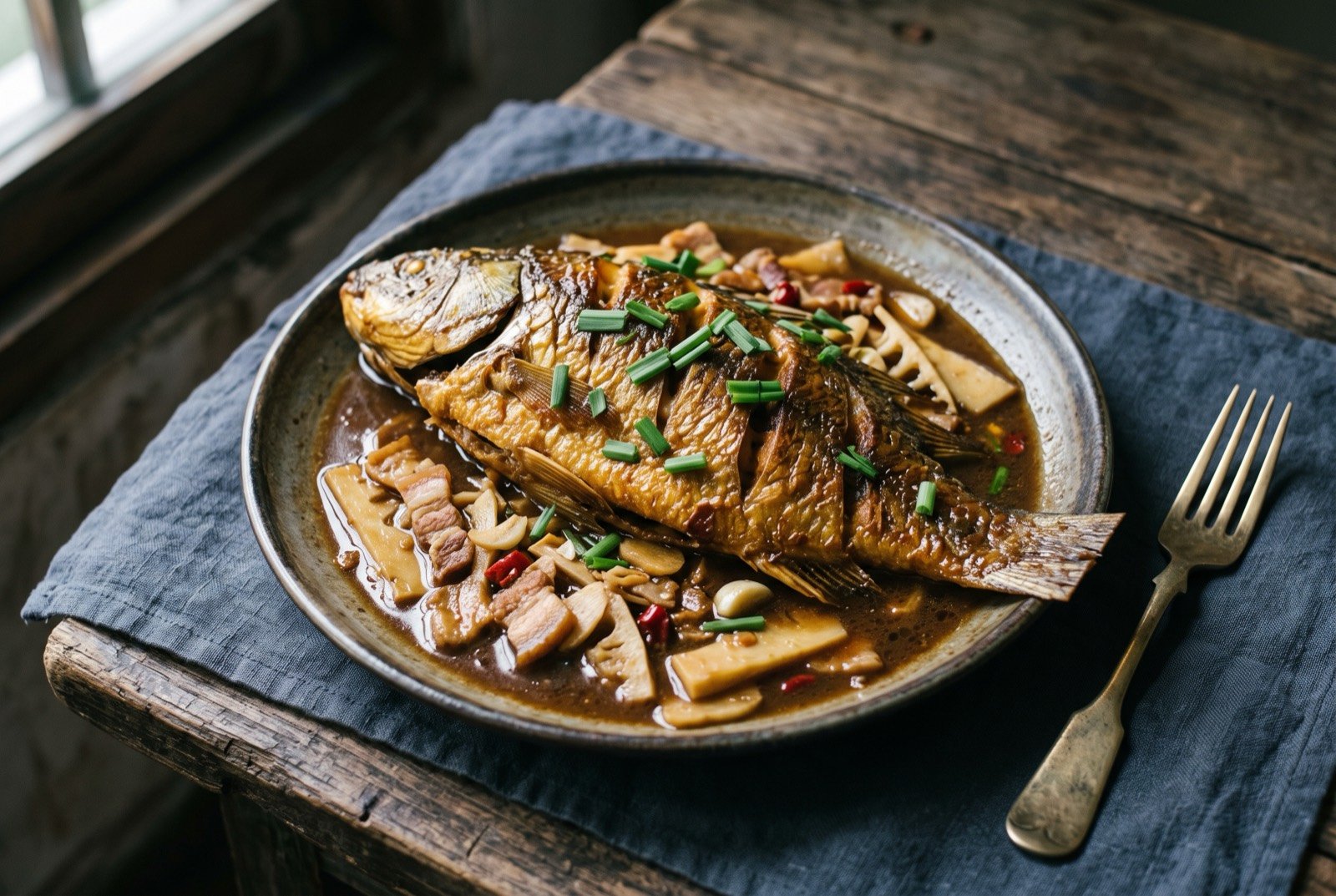
An illustration of the dish, not a photograph of it cooked.
- Time
- 40 minutes
- Reviewed
- Not yet reviewed from inside the tradition
- Cooked
- Not yet cooked and reported
Huizhou. An accident of a seven-day mountain transport route, kept on purpose ever since.
As tradition built it
Tradition, adapted as a monitored home ferment
Serves 4. Ferment up to 8 days, cook 40 minutes.
Ingredients
- 1 whole sea bass (substituting for mandarin fish, unobtainable in the UK), gutted and scaled
- 4 to 8% of the fish's weight fine salt, weighed to 4 to 8% of the fish's weight
- 200 g pork, sliced, 2 spring bamboo shoots, sliced sliced pork, bamboo shoots
- 3 tbsp soy sauce, 2 tbsp Shaoxing wine, 1 tbsp sugar, 3 slices ginger, stock enough to come halfway up the fish soy sauce, Shaoxing wine, sugar, ginger, stock
- a small handful, chopped garlic chives, to finish
- 1 tsp, mixed with 1 tbsp water cornstarch, for the finishing slurry
Method
- Weigh the gutted fish, and calculate salt at 4 to 8 percent of that weight. Rub the salt thoroughly over and inside the fish.
- Pack the fish into a sealed, anaerobic container (a vacuum bag or a tightly sealed non-reactive vessel with the air pressed out), and hold at a cool, stable temperature, using a dehydrator with its heating element off as a controlled, airflow-managed space if the kitchen itself is not reliably cool.
- Check daily by smell and by the flesh's firmness. Do not exceed 8 days. The fish is ready when a mild, distinct aroma has developed but the flesh is still firm and the smell has not turned to outright decay.
- Rinse the fermented fish, score diagonally on both sides, and pan-fry until both sides turn light golden.
- Add sliced pork and bamboo shoots, with soy sauce, rice wine, sugar, ginger and a little stock. Bring to the boil, then simmer on low heat for around 40 minutes until the sauce reduces.
- Finish with garlic chives, a light cornstarch slurry to thicken, and a final drizzle of lard.
Notes
A note on this recipe's honesty: the exact traditional fermentation culture has not been replicated here; this is a controlled, food-safety-conscious adaptation using the salt percentage and timing parameters documented in Chinese food-science literature, not a claim to reproduce Huizhou's own microflora exactly.
What a modern chef changes
The ferment itself, monitored rather than judged by feel.
Rung 6
Method
- Log the salt percentage, the container's internal temperature and the day-by-day smell and firmness change, treating the ferment as a documented process rather than a folk instinct, exactly as this chapter's Rung 6 asks.
- Hold the ferment in a dedicated, temperature-logged chamber (the dehydrator, unheated, with a simple thermometer inside) rather than an ambient kitchen corner, for real reproducibility between attempts.
- State plainly to anyone eating it that this is an adapted, monitored fermentation, not a reproduction of Huizhou's traditional microflora: the honesty this chapter insists on elsewhere applies to this dish's method as much as to its sourcing.