Asia · Volume 28
The Northwest Wheat-Noodle and Hui Muslim World: Shaanxi, Shanxi, Gansu, Ningxia and Qinghai
The Pulled Noodle, the Vinegar Jar and the Corridor That Carried Islam East
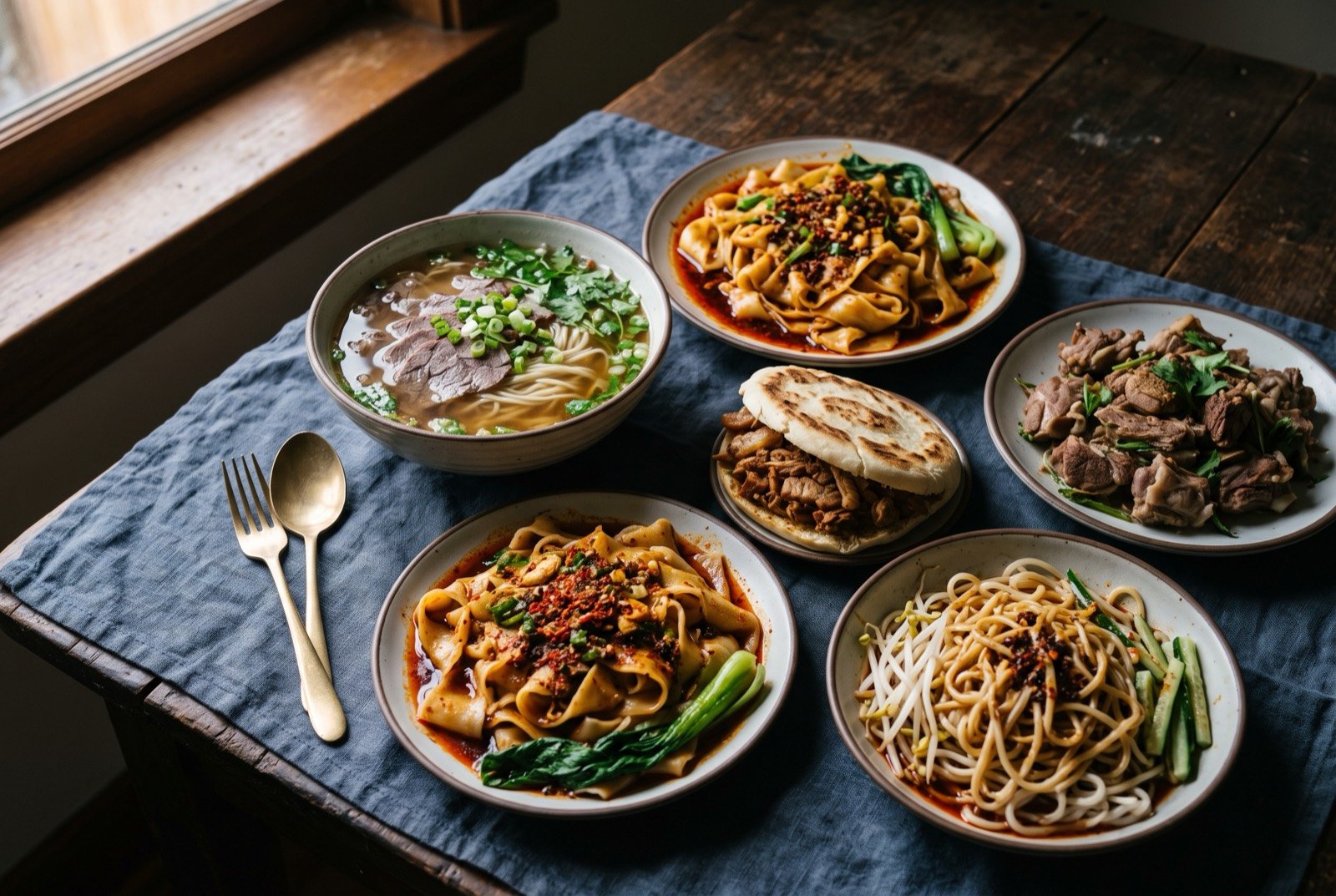
Shaanxi, Shanxi, Gansu, Ningxia and Qinghai, taken seriously. Not one Chinese noodle province behind another, but a loess-and-wheat world split by a fault line that has nothing to do with province boundaries, Islam, where the Silk Road's Hexi Corridor carried Arab and Persian traders permanently into China's oldest wheat belt and grew a genuinely new Hui Muslim foodway around them, and every dish as tradition built it, then what a modern chef would change.
Sources and review · What this chapter does not assert · How we research · Spotted something wrong?
A Sense of Place
Xi'an sits at the eastern end of the Guanzhong plain (关中平原), a loess-soil basin cradling the Wei river, ringed by the Qinling mountains to the south and the Loess Plateau proper to the north. This is one of the oldest continuously farmed wheat landscapes on earth, and it built the region's oldest capital, Chang'an, on top of it: ten dynasties ruled from here through the Han and Tang. It is wheat and millet country in the plainest possible sense, meaning the staple food is never rice, it is noodles, flatbread and steamed bun, and every technique this chapter describes exists because of that one fact.
West of Xi'an, Gansu's Hexi Corridor (河西走廊) is the reason any of this connects to the wider world at all: a narrow strip roughly 1,100 kilometres long, squeezed between the Qilian mountains and the Mongolian plateau's desert fringe, running from Wushaoling pass to the Jade Gate at Dunhuang. Han Emperor Wu formally organised it into the Four Commanderies of Hexi from 121 BCE for an explicitly strategic reason: to cut the link between steppe nomads to the north and Tibetan-plateau nomads to the south, and to secure a trade route west. That route is why Lanzhou, where the Yellow River cuts directly through a Chinese provincial capital, the only one it does, became the great inland hinge between the Central Plains and Central Asia rather than a rice-growing river town.
Ningxia and Qinghai sit further out along that same corridor, and each does something structurally different with it. Ningxia is not simply a province with a large Hui population, the way Gansu or Shaanxi are: it is China's only province-level autonomous region named for and administratively organised around Hui identity, established in 1958 on the strength of a founding population that was already 32 per cent Hui. Its heartland is an irrigation miracle rather than a rainfall economy: the Yellow River, fed through fourteen ancient canals dug from the Qin dynasty onward, turned a desert plain into what the region's own government still calls, with real historical grounding, "the land of abundance north of the passes" (塞上江南). Immediately beside that intensively irrigated plain sits Yanchi county's dry desert steppe, carrying wild liquorice, astragalus and other medicinal forage plants, which is the reason Ningxia's food identity rests equally on wheat-and-rice agriculture and on a lamb of genuinely unusual reputation.
Qinghai is the volume's outlier, and honestly so: most of its territory sits on the Qinghai-Tibet plateau at an average elevation above 3,000 metres, too high and too cold for wheat at all. Its food culture survives at the literal edge of that limit, in the low-lying Hehuang valley around Xining, a pocket that holds barely 3.5 per cent of the province's water but well over half its population and farmland. Above that valley, barley, specifically hulless qingke (青稞), takes over as the true staple, roasted into tsampa and drunk as butter tea, a habit shared not only by Qinghai's Tibetan population but, less obviously, by Hui communities living at the same altitude. Shanxi, finally, sits east of all this on its own stretch of loess plateau, sharing the wheat-and-noodle logic but defined less by Silk Road religion than by an unusually alkaline water table and a dry, monsoon-shielded climate, both of which this chapter's sourcing found genuinely explain, rather than merely excuse, why Shanxi people are famous for drinking vinegar the way other regions drink tea.
The peoples who work this ecology are not simply "Han" and "Hui." The Hui themselves are worth defining precisely, because the definition changes what this chapter can honestly claim: unlike most of China's other recognised minorities, they are not set apart by a separate language, they speak Chinese, generally the local dialect, but by Sunni Islam and by descent from Tang- and Yuan-era Arab, Persian and Central Asian settlers who intermarried into the Han population over roughly a millennium. Sitting alongside them, and worth naming rather than folding into "Hui" generally, are three further Muslim or plateau minorities this chapter treats with real specificity: the Dongxiang, a Mongolic-speaking Muslim people formed in the fourteenth century from Yuan-era Central Asian settlers and Mongols; the Salar, a Turkic-speaking Muslim people whose own migration legend traces them from Samarkand to Qinghai's Xunhua county via the Yuan dynasty; and the Tu, Qinghai's other minority unique to the province, whose food culture, hand-grabbed pork included, marks them out as genuinely not Muslim, a useful contrast to their Hui and Salar neighbours.
Table: peoples, ecology and defining logic
| People or place | Ecology | Defining logic | Dishes that carry it |
|---|---|---|---|
| Han, Shaanxi (Guanzhong) | Wei river loess plain | Wheat and millet, no rice; a Han noodle-and-flatbread repertoire that predates and sits alongside the Hui one | Biangbiang mian, liangpi, saozi noodles, guokui |
| Hui, Shaanxi and Gansu | Xi'an's Muslim Quarter; Linxia, "China's Little Mecca" | Sunni Islam, defined by religion not language; the qingzhen (halal) framework governing slaughter, kitchen separation and restaurant signage | Lanzhou lamian, yangrou paomo, beef and lamb roujiamo |
| Dongxiang and Salar, Gansu and Qinghai | Linxia uplands (Dongxiang); Xunhua county on the Qinghai border (Salar) | Muslim, but ethnically and linguistically distinct from the Hui, Dongxiang Mongolic-speaking, Salar Turkic-speaking | Salar dry-tossed noodles, sanzi, bilimaihai |
| Hui, Ningxia | The only province-level Hui homeland, established 1958 | A genuinely Hui-organised polity, not a Hui minority inside a Han-majority province; irrigated wheat and rice beside desert-steppe lamb pastoralism | Shouzhua yangrou, qingzhen whole roast lamb, goji lamb stew |
| Tibetan, Tu and Hui, Qinghai | The Hehuang valley, low and farmable; the high plateau above it | Barley (qingke) and butter tea where wheat gives out, a habit crossing ethnic and religious lines at altitude | Tsampa, Salar noodles, Huzhu qingke jiu |
| Han, Shanxi | Loess plateau, monsoon-shielded, alkaline water table | Vinegar as a structural condiment, not a garnish; knife-shaved rather than hand-pulled noodle technique | Daoxiaomian, vinegar-dressed cold noodles |
The History in Layers
The deepest, oldest claim made about this region's noodle culture turns out not to survive checking, and the chapter states that plainly rather than repeating it. The world's oldest known noodle, excavated in 2002 at the Lajia site in Minhe county, Qinghai, and published in Nature in 2005, is roughly 4,000 years old, but residue analysis confirms it is made from foxtail and broomcorn millet, not wheat, and it has no demonstrated technical link to hand-pulling. It is genuinely useful evidence that noodle-format food is very old in the upper Yellow River region; it is not evidence that Lanzhou-style wheat pulling is 4,000 years old, whatever popular food writing repeats. Chinese noodle culture as a wheat staple is generally attested from the Han dynasty, roughly 2,000 years ago; the specific hand-pulled technique, lamian as a named, described method, is much harder to date precisely, and this chapter does not assign it a founding century.
What can be dated precisely is the road that made this region what it is. Chang'an was the Silk Road's eastern terminus through the Han and Tang, and the Hexi Corridor was its literal physical spine inside China, secured by Han military commanderies for exactly that purpose. Along it came wheat technique, sesame and, many centuries later, chilli; its most consequential effect on this volume, though, is not culinary at all, it is demographic. It is the road Muslim traders walked to settle permanently in China. Islam is generally dated into the country from 651 CE, Tang Gaozong's reign, when Arab and Persian merchants began arriving and settling in Chang'an alongside the other great port and canal cities; Chang'an's own historic Muslim quarter, Huifang, traces partly to the Tang's walled residential-ward system, with Muslim traders clustering around mosques for religious and communal convenience from that period onward. The single largest wave of settlement, though, and the one that most shaped the Hui as a recognisably distinct ethnic group, came two centuries later under the Yuan, when large numbers of Semu ren, the Mongol administration's privileged catch-all category for Central and West Asian peoples, many of them soldiers, officials and artisans, settled across the north and intermarried with local Han, Uyghur and Mongol populations. It is this Yuan-era wave, layered onto the older Tang-era merchant settlements, that produced the Hui by the Ming: a people defined by faith, speaking the language of the place they had settled in, not a people who arrived speaking Arabic and kept it.
The single hardest piece of history in this chapter, and the one it will not soften, is the Dungan Revolt (同治陕甘回乱), 1862 to 1873. It broke out in Shaanxi amid the still-unfinished Taiping Rebellion, combining Han-Hui communal violence, grievance against Qing taxation, and a genuine sectarian split within Chinese Islam itself between old and new Sufi teaching orders, and it spread into Gansu. Qing suppression, under General Zuo Zongtang, took over a decade, and the demographic cost, independently documented from multiple Chinese academic sources including Fudan University's Yugong historical geography research centre, is extreme: Gansu's population fell from roughly 19 million in 1861 to about 4.955 million by 1880, a loss on the order of 14 million within one province; Shaanxi alone lost an estimated 6 million or more; the total across the affected northwest is put at over 20 million. After the fighting stopped, Zuo's policy was explicit forced dispersal, not mercy dressed up as one: Hezhou's Hui were moved east into what is now Ningxia, Xining's Hui resettled around Pingliang, Suzhou's Hui moved to Yuzhong near Lanzhou. This is the reason Shaanxi's Hui population is comparatively small today, Gansu's larger, and Ningxia's largest of all, large enough to justify statehood in 1958: the demographic map of Hui settlement across the northwest is not simply where Silk Road traders first put down roots, it is substantially a map redrawn by nineteenth-century war and forced resettlement, and this chapter treats that connection as load-bearing history rather than a footnote.
Ningxia carries one further historical layer none of its neighbours in this volume share: from the eleventh to thirteenth centuries, it was the heartland of the Western Xia (西夏) empire, founded by the Tangut, an originally pastoral people whose capital, Xingqing, sits exactly where Yinchuan sits now. Chinese sources describe Western Xia's economy as one of genuine balance between farming and herding, barley, rice, legumes and qingke all named as staples, which means Ningxia's mixed wheat-and-lamb food identity has a documented political precedent nearly a thousand years older than the modern autonomous region. No primary Tangut-language culinary source survives to say what that state actually cooked; the macro-economic description is what the record supports, and this chapter goes no further than that.
Qinghai's own distinct thread belongs to the Salar, a people with perhaps the most specific migration legend in this whole atlas: an ancestor named Gaolemo, in conflict with a ruler, is said to have led his people east out of Samarkand carrying a white camel loaded with water, soil and a Qur'an, settling eventually in Xunhua after a Yuan-era journey historians place in the thirteenth or fourteenth century. Over roughly seven centuries the Salar intermarried with and partly absorbed their Tibetan, Hui, Han and Mongol neighbours, forming today's distinct, Turkic-speaking, Muslim community, genuinely separate from both the Hui and from Qinghai's Tibetan population.
The modern moment is a tourism and franchise story more than a colonial one. Xi'an's historic Muslim Quarter was formally redeveloped as a paved tourist street in 1992 and 1993 and is now one of the city's dominant food-tourism destinations. Lanzhou beef noodles spread nationally in phases: scattered independent shops before Reform and Opening, a competing-brand boom through the 1990s, organised franchise expansion from the state-linked Lanzhou Jinding company from the late 1990s, then genuine international spread from the early 2000s, aided by Belt and Road promotion. There are reportedly over 60,000 beef noodle shops in China today, and Japanese entrepreneurs have travelled to Lanzhou specifically to learn the technique before opening branches of the Lanzhou brand Mazi Lu in Tokyo. In June 2021 Lanzhou beef noodle-making technique was inscribed on China's national Intangible Cultural Heritage list; more strikingly still, in late 2024 the Lanzhou Beef Noodle Industry Association formally codified the dish's five-part standard, one clear, two white, three red, four green, five yellow, into an enforceable municipal regulation, effective March 2025. What had been oral trade convention for the better part of two centuries only became law within the last two years, which is itself a small, telling piece of this region's very recent history.
The Flavour Arsenal
Seeds, pods and the chilli question
| Ingredient | What it does |
|---|---|
| Qin pepper (秦椒) | Shaanxi and Gansu's own chilli, grown under geographical-indication protection around Guanzhong and Tianshui: long, slender, evenly wrinkled, glossy even dried, "fragrant but not fierce," high in aroma and red pigment but comparatively mild in heat. This is the chilli behind youpo chemian's bright oil, not Sichuan's better-known Erjingtiao |
| Erjingtiao (二荆条), for comparison | Sichuan's own chilli, fresher and slightly sweeter, built to survive doubanjiang fermentation and stir-frying, and often paired with Sichuan pepper for a numbing-spicy profile this region's own chilli oil does not chase; the point is not that one is better, it is that they are doing different jobs |
| Cumin (孜然) | The Silk Road's clearest surviving spice marker, heaviest on grilled lamb rather than the noodle dishes themselves, best bought whole and ground fresh, since pre-ground cumin loses most of its aroma within weeks |
| Sichuan pepper (花椒) | Present across the region's broths and marinades, especially in Lanzhou's spice package and Ningxia's hand-grabbed lamb, though numbing heat is not this region's defining register the way it is Sichuan's |
Ferments and the region's one great preserved condiment
| Ingredient | What it does |
|---|---|
| Shanxi laochencu (山西老陈醋) | China's most significant vinegar tradition and this region's true structural preserve, treated fully in the Ferment Bench below |
| Penghui (蓬灰) | Not a ferment but a mineral preparation with the same function, an alkaline ash traditionally burned from a Gobi desert saltwort plant, dissolved and worked into lamian dough, where its alkalinity strengthens the gluten network and gives the cooked noodle its pale yellow colour and springy bite |
Leaves and everyday aromatics
| Ingredient | What it does |
|---|---|
| Garlic sprouts (蒜苗) and Chinese chives (韭菜) | The standard sharp green finishing note across nearly every noodle dish in this chapter, chopped fine and scattered raw or barely wilted at the very end against fatty, aromatic bases; chives specifically are the entire point of jiu cai hezi and have been cultivated in China for roughly 3,000 years |
| Coriander | Named repeatedly and specifically in Ningxia sources as non-negotiable on lamb offal: "a bowl of lamb offal without coriander has no soul" |
Starches and staples
| Ingredient | What it does |
|---|---|
| High-protein wheat flour | The basis of every hand-pulled and knife-shaved noodle in this chapter; glutinous proteins hydrate and cross-link into an elastic network under kneading, and resting lets that network relax into a workable sheet, the entire chemical basis of the technique ladder below |
| Mung bean starch, a correction | Liangpi is popularly assumed to be a mung-bean dish and mostly is not: the reference version is either rice-based (mipi) or made by washing wheat dough for its starch (mianpi), with mung bean starch appearing only as a minority texture-strengthening additive in some recipes, not the primary starch |
| Qingke (青稞), highland barley | Where wheat gives out above roughly 2,500 metres in Qinghai, the staple that takes over, roasted into tsampa and distilled, in Huzhu county, into a genuinely significant clear-aroma spirit |
| Rapeseed oil (菜籽油) | A real, altitude-specific Qinghai cooking fat: the province's high-elevation rapeseed develops an unusually high count of aroma compounds under large diurnal temperature swings, giving the pressed oil a markedly more fragrant character than lowland rapeseed oil |
| Goji/wolfberry (枸杞) | Ningxia's true agricultural signature, centred on Zhongning county; used in lamb cookery as a late aromatic and colour note rather than a long-simmered flavour base, added in the final minutes so it does not overcook into mush |
The Technique Ladder
Rung 1. Gluten development and the three-light rest
Every noodle technique in this chapter starts from the same chemistry: wheat's glutenin and gliadin proteins hydrate, swell and bond via disulphide cross-links into gluten's elastic network as water is worked into flour. Kneading to a smooth, glossy "three-light" state, dough smooth, hands clean, board clean, is the visual and tactile check that this network has developed enough to survive the specific stress each technique below puts it under; resting afterwards lets water fully penetrate the flour and lets the network relax into a workable sheet rather than a stubborn, springy lump.
Rung 2. The alkali (peng hui) that makes hand-pulling possible
Salt strengthens gluten; alkali strengthens it further, and it is the alkali, traditionally penghui, burned Gobi desert plant ash, that makes lamian's specific stretch-without-tearing possible. The traditional formula is remembered as "three waters, three ashes, eighty-one kneads" (三水三灰,八十一揉), repeated passes of water and alkali worked through the dough until fully distributed, with quantities adjusted seasonally under the trade saying "winter winter, summer summer." Judging readiness is entirely tactile, there is no universal numeric spec: a puller feels whether the dough stretches smoothly or springs back stubbornly, and that judgement, not the pulling motion itself, is what separates a real Lanzhou noodle master from someone doing a passable five-second demonstration.
Rung 3. Hand-pulling (lamian): the same dough, nine geometries
A rested dough baton is portioned, then each portion is pinched, stretched, doubled and slapped repeatedly against the board, both elongating the strand and further aligning the gluten, before the ends are separated into one continuous strand straight into boiling water. What makes Lanzhou pulling a genuine technical ladder rather than one fixed shape is that the same dough, worked with more or fewer folds, produces a named range running from hair-thin (毛细) through several intermediate round widths to a flat family from chive-leaf-width up to an extra-wide, biangbiang-scale ribbon, plus a triangular-prism specialty cut, chosen by the diner at the counter rather than fixed by recipe.
Rung 4. Knife-shaving (daoxiaomian): a stiffer dough, worked in the air
Where lamian is stretched, Shanxi's daoxiaomian is shaved: a noticeably stiffer dough, roughly 40 to 48 per cent hydration against lamian's 50-plus, is rested in a "three knead, three rest" cycle, then held in one hand while a curved blade in the other shaves strips directly off the block into the boiling pot, no board, the whole thing worked in mid-air over the pot. The craft mnemonic states the discipline precisely: the blade never leaves the dough, the dough never leaves the blade, the arm stays straight and level, hand and eye track one line. A genuinely skilled shaver can produce roughly 200 strokes a minute, each strip landing at almost exactly six cun, about 20 centimetres, in length.
Rung 5. Hand-tearing and the slap (biangbiang/kuadaimian): the belt noodle
A third, mechanically distinct approach again: the rested, oiled dough is flattened by hand to roughly two fingers' width, then stretched by alternating pulls and deliberate slaps against the board, the literal source of the "biang, biang" sound the dish is named for. A single strand can run close to a metre long and fill one bowl on its own. For a narrower noodle, a chopstick-width groove is pressed down the flattened dough's centre before stretching, then torn apart along that line, yielding two strips from one baton.
Rung 6. Blooming chilli oil (youpo): heat as the final technique
The finishing move common to youpo chemian, saozi noodles and much of this region's table: finely ground chilli, never coarse flakes, is topped with garlic and scallion, and oil heated to roughly 70 per cent of its smoking point, craft sources give a working range from 150 to 170 degrees, is poured directly over to bloom it, hot enough to sizzle and release aroma instantly without scorching the chilli black. Getting this wrong in either direction, oil too cool or too hot, is the single most common way this region's food goes from vivid to either flat or bitter in a home kitchen.
The Ferment or Preserve Bench
This is a narrower bench than several other volumes in this atlas carry, and that is worth stating honestly rather than papering over with invented pickles: this region's food culture is not built on a deep fermentation tradition the way, say, a Korean or a fermented-fish Southeast Asian volume is. What it has instead is one genuinely world-class fermented product, treated with the seriousness it deserves.
1. Shanxi laochencu (山西老陈醋)
Protected under a national geographical-indication standard specifying its raw materials, sorghum and wheat bran as principal grains, rice husk and grain husk as auxiliary material, a naturally fermented daqu starter made from barley and peas, no rice anywhere in the process. Production runs five named stages: steam, ferment, smoke, leach, age. The signature step is smoke-steeping, half the mature acetic mash placed in an urn and smoked over a low charcoal fire in an underground pit-style kiln at 80 to 90 degrees, the vats turned daily, the mash's colour shifting from yellow through brown to blackish-brown over five or six days, a step no other major Chinese vinegar tradition uses, and the reason laochencu tastes nothing like the sweeter, rice-based Zhenjiang vinegar most British kitchens already own. Ageing follows, sun-exposed and, traditionally, ice-skimmed in winter to concentrate it, with a minimum legal ageing period of twelve months. Buy it by checking the ingredient list, not the front label: if rice appears anywhere on it, it is not real Shanxi vinegar, whatever the label claims.
2. Huzhu qingke jiu
Qinghai's Tu county of Huzhu carries a second, smaller fermented tradition worth naming alongside it, though it produces a spirit rather than a condiment: qingke jiu, a clear-aroma baijiu made from highland barley alone, distilled through a four-round, state-recognised "clear-steam clear-ferment" method across a full year. It belongs in this chapter as evidence of the same loess-and-plateau grain culture producing a genuinely different fermented product at its other, higher edge, not as an ingredient this book's recipes call for.
Sourcing in Britain
The one decision that matters more than any other in this chapter is buying the right vinegar. Two genuinely different Chinese black vinegars circulate in Britain and English-language retail blurs them constantly. Zhenjiang, or Chinkiang, vinegar, glutinous rice and wheat bran, sweeter and glossier, is the export-dominant style most UK shoppers find by default, widely available including at Sous Chef. Shanxi laochencu, sorghum, barley and peas, no rice, aged and smoked, is what this chapter's dishes actually call for, and it is genuinely buyable in Britain under the Shuita (水塔) brand, both a two-year and a five-year aged version, from Tuk Tuk Mart and Starry Mart, with the correct grain bill confirmed on the label. Chinkiang is an acceptable but flavour-different fallback if the real thing cannot be sourced in time, not a straight swap.
For the lamb, no British butcher sells anything approximating Ningxia's desert-grazed, liquorice-and-scrub-fed tan sheep, understandably, since that is a terroir claim with no domestic equivalent. British saltmarsh lamb, from Romney Marsh, the Gower or the Solway, grazing similarly mineral-rich, halophytic coastal vegetation, is the nearest flavour-logic analogue this research found, an honest analogy rather than a verified equivalence. Buy it bone-in and whole where possible, since paomo and hand-grabbed lamb are broth and whole-animal dishes at heart: UK-wide halal butchers Healthy Halal and eFoods Direct both supply whole or half lamb to order and are the right call over a supermarket halal counter's pre-portioned cuts.
For hand-pulling lamian, genuine penghui is not realistically sourceable in Britain, or in China outside artisanal producers any more. Mee Chun Lye Water, sold by Sous Chef, is a genuine kansui-type alkaline product and the most direct off-the-shelf substitute; oven-baked bicarbonate of soda, roughly an hour at 120 degrees, works as a from-scratch alternative. Mung bean starch for liangpi is genuinely sold, by name, as Pine Brand mung bean starch at Wai Yee Hong and Melbury and Appleton, distinct from the mung bean vermicelli some retailers mislabel as "starch sheets," worth checking carefully before buying. Ningxia goji is easy: widely stocked, Zheng Feng brand among others, at multiple UK Asian grocers; watch for an unnaturally uniform, over-bright red with a sharp smell, a sign of heavy sulphur treatment rather than good sun-drying. Named Shaanxi and Gansu chilli cultivars cannot currently be bought in Britain; Sichuan dried chilli, from Sous Chef or UK eBay sellers, is the honest substitute, and it matters less than getting the whole-spice aromatics right, star anise, cassia, bay, and sand ginger where it can be found, which is a genuine "search until you find one supplier" ingredient rather than a Wing Yip staple. For a proper cleaver, suited equally to biangbiang's cutting and to a home approximation of daoxiaomian, Chinese Cleavers UK imports authentic CCK carbon steel blades from Hong Kong.
Ranked plainly: the vinegar decides more than anything else in this chapter; bone-in halal lamb from a proper butcher beats supermarket cuts by a wide margin for the broth dishes; and freshly toasted, freshly ground whole cumin, using kit the reader already owns, does more for flavour than any single sourcing decision beyond the vinegar and the lamb.
Voices and Sources
The single strongest living voice for this cuisine anywhere in this research is Guirong Wei, chef-owner of Xi'an Impression, Master Wei and Dream Xi'an in London, trained in Xi'an from the age of thirteen, one of only four women in her culinary-school class, and featured in Netflix's Chef's Table: Noodles in 2024. Her own account of the craft, "wheat flour is the soul of Xi'an cuisine," and of intent, "every dish is made with heart and love," anchors this chapter's own claim that this cuisine's elevation is a matter of doing traditional things with more precision, not importing French method. In New York, Jason Wang and his father David Shi's journey from a 200-square-foot Flushing stall to the sit-down restaurant Biang! is the clearest tested case anywhere of this exact repertoire, biangbiang, roujiamo, liangpi, taken upmarket by the family that built the street-food original. Inside China, the Black Pearl Guide's listing of 长安荟·原味陕菜 in Xi'an, with dishes like an elevated roujiamo served alongside crab-shell-shaped flatbread, is the strongest evidence found of this exact dish vocabulary being formally recognised at critical level, though this research could not find a named chef behind it to quote directly, a real gap this chapter states rather than papers over. The Lanzhou Beef Noodle Industry Association's own 2024 and 2025 local standards, and the national Intangible Cultural Heritage recognition of Ma Guoqiang's hand-grabbed lamb technique, are the closest this chapter gets to an institutional voice speaking for the tradition itself. In Britain, JWD Lamian, Yipinju Lanzhou Noodle Bar in Southampton and Li Ji in Sheffield extend the Hui halal noodle-shop tradition into UK cities beyond London, and Hyphen, a British Muslim publication, is worth citing specifically for framing that scene correctly, as Hui food carried by Hui migrants, not generic Chinese food. Academically, Fudan University's Yugong historical geography research centre and Ningxia University's Institute of Xixia Studies underpin the demographic and Western Xia history above; China's own State Ethnic Affairs Commission and national Intangible Cultural Heritage database were the primary sources for the Hui, Dongxiang, Salar and Tu material throughout.
Things this chapter has deliberately not asserted
- That Lanzhou hand-pulling is 4,000 years old, or has any demonstrated link to the Lajia millet noodle. The noodle is real and remarkable; it is not wheat, and it is not lamian's ancestor.
- A founding century for lamian as a named, described technique. The evidence supports Han-dynasty wheat noodle culture generally, not a precise date for hand-pulling specifically.
- That liangpi is a mung-bean-starch dish. It is properly rice-based or wheat-starch-based, with mung bean starch as a minority additive at most.
- That hulatang is an indigenous Shaanxi dish. It is a Henan import, adapted locally, and the chapter says so rather than claiming false antiquity.
- A specific recipe for Gansu sanxi. Sourcing did not reach a confident, citable, in-tradition version distinct from the generic nationwide "three-fresh" dish family, so it is not included here.
- That shouzhua yangrou's "nearly a thousand years" of history is independently dated. It is the standard claim in Ningxia's own tourism material, repeated here as that claim, not as verified fact.
- That Ningxia's qingzhen whole roast lamb is tied to a specific named festival, Eid included. It is celebration and guest-honour food generally; no source pinned it to one occasion.
- Exact ratios for Ningxia's three-part dipping sauce or a description of its làhùhu snack. Both are named in sourcing and left undescribed there; this chapter does not invent quantities that were not found.
- That Shanxi laochencu's history runs "over 3,000 years." That figure is the standard industry claim, repeated across Chinese heritage material and English Wikipedia alike, with no independent primary verification found. What is solidly documented is the twelve-month minimum legal ageing period and the smoke-steeping process itself.
- Any Michelin recognition for Xi'an, Lanzhou or any Northwest Chinese city. None currently exists. The Black Pearl Guide, run by Meituan rather than Michelin, is the only serious critical apparatus covering the region.
- That any named chef, in China or in the diaspora, has explicitly argued in their own words for elevating this cuisine with sous vide, dehydrators or similar modern equipment. No such source was found anywhere in this research. The Elevation sections above are this chapter's own construction, built from documented traditional technique whose stated goals, protecting texture, precise heat control, controlled fermentation, already match what that equipment is for; they are not quotations from a chef who has already made this argument.
- That any UK restaurant currently specialises in Shanxi, Ningxia or Qinghai cuisine specifically. The UK diaspora scene this research found is entirely Xi'an/Shaanxi and Lanzhou/Gansu.
- A single UK retailer that curates this region's ingredients as a specialist category the way, for instance, a dedicated Sichuan retailer curates that cuisine's pantry. None exists; a British cook assembles this cuisine from general Chinese and Asian grocers plus a handful of specific brand-level finds named above.
Gluten development and the three-light rest
Every noodle technique in this chapter starts from the same chemistry: wheat's glutenin and gliadin proteins hydrate, swell and bond via disulphide cross-links...
The alkali (peng hui) that makes hand-pulling possible
Salt strengthens gluten; alkali strengthens it further, and it is the alkali, traditionally penghui, burned Gobi desert plant ash, that makes lamian's specific...
Hand-pulling (lamian): the same dough, nine geometries
A rested dough baton is portioned, then each portion is pinched, stretched, doubled and slapped repeatedly against the board, both elongating the strand and...
Knife-shaving (daoxiaomian): a stiffer dough, worked in the air
Where lamian is stretched, Shanxi's daoxiaomian is shaved: a noticeably stiffer dough, roughly 40 to 48 per cent hydration against lamian's 50-plus, is rested...
Hand-tearing and the slap (biangbiang/kuadaimian): the belt noodle
A third, mechanically distinct approach again: the rested, oiled dough is flattened by hand to roughly two fingers' width, then stretched by alternating pulls...
Blooming chilli oil (youpo): heat as the final technique
The finishing move common to youpo chemian, saozi noodles and much of this region's table: finely ground chilli, never coarse flakes, is topped with garlic and...
The dishes
- Lanzhou lamian (兰州牛肉拉面) Lanzhou, Gansu
- Yangrou paomo (羊肉泡馍) Xi'an, Shaanxi
- Roujiamo (肉夹馍/腊汁肉夹馍) Xi'an, Shaanxi
- Biangbiang mian, finished youpo-style (裤带面/油泼扯面) Shaanxi
- Liangpi (凉皮) Shaanxi
- Saozi noodles (岐山臊子面) Qishan county, Baoji prefecture, Shaanxi
- Ningxia shouzhua yangrou (手抓羊肉), hand-grabbed lamb Ningxia
- Ningxia qingzhen whole roast lamb (烤全羊) Ningxia
- Shanxi daoxiaomian (刀削面) with laochencu Shanxi
Sources and review
- Researched
- No outside sources linked
- Reviewed
- Not yet reviewed from inside the tradition
- Cooked
- Not yet cooked and reported
Where this volume comes from
3 research briefs on file for this volume, researched to the rules on How we research. Published 4 September 2026. Last changed 12 September 2026.
The brief's own account of its sources
Roughly 60 distinct searches were run across both research passes, the large majority in Mandarin. Split, roughly: the large majority of substantive factual claims in this brief are sourced to material published in China: provincial and county government sites (nx.gov.cn, qinghai.gov.cn, gansu.gov.cn portals, dofcom.nx.gov.cn, mzw.qinghai.gov.cn, huzhu.gov.cn, haidong.gov.cn), the State Ethnic Affairs Commission (neac.gov.cn), Xinhua and People's Daily regional bureaus, China's National Intangible Cultural Heritage database (ihchina.