Asia · Volume 30
Fujian and Chaoshan
The Red-Lees Jar, the Ten-Second Slice and a Coast Two Tongues Call Home
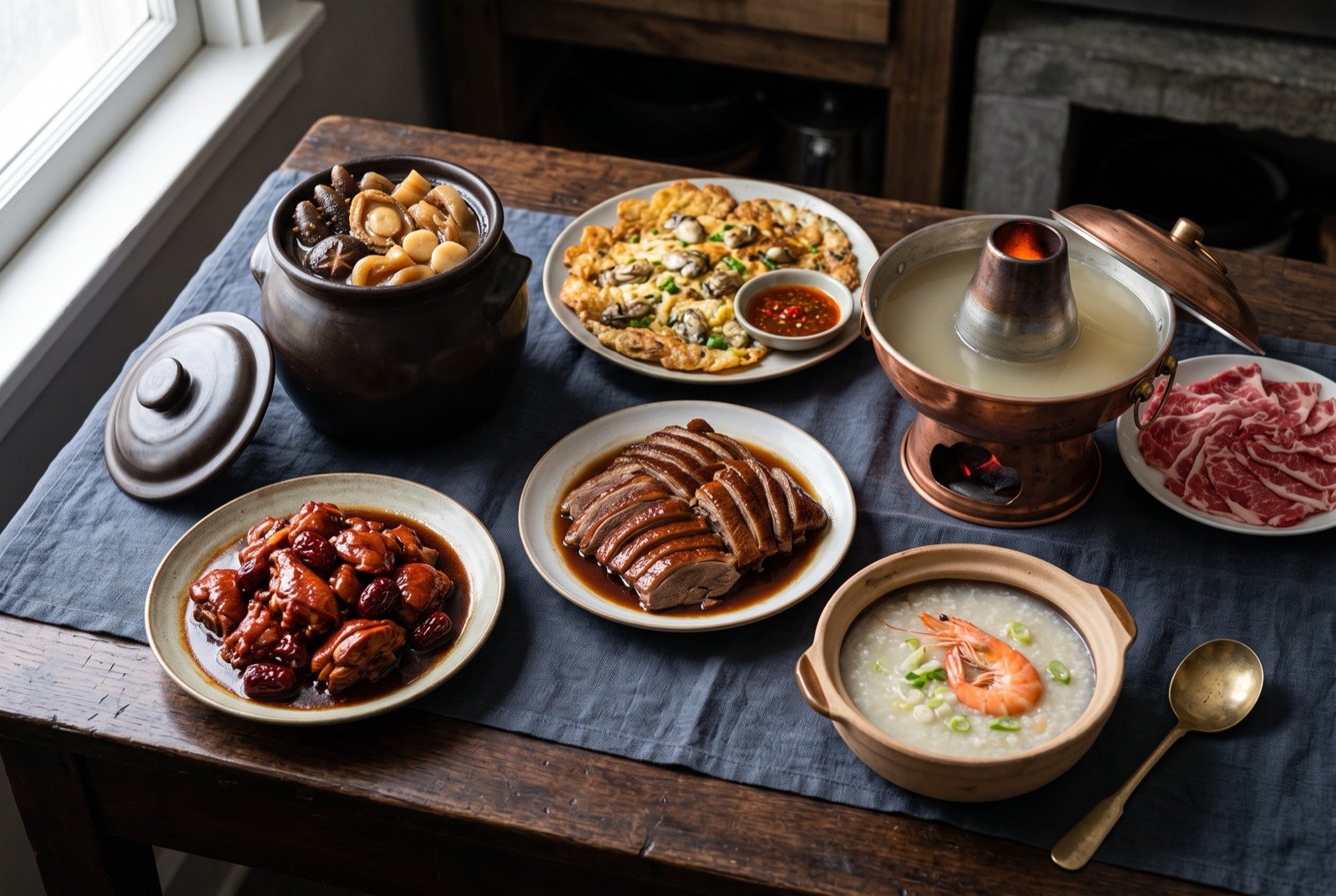
Fujian and Chaoshan share a nine hundred kilometre run of coast, from the Min river's mouth at Fuzhou down through Xiamen and Quanzhou to Chaozhou and Shantou at the Han river's mouth in eastern Guangdong, an administrative border that both traditions largely ignore. Hokkien-speaking Minnan in the north and Teochew-speaking Chaoshan in the south are close enough in dialect root to half understand each other and far enough apart in cuisine, in identity and in four centuries of separate development that a Teochew chef will tell you, plainly, why his food is not Fujian food, and every dish as tradition built it, then what a modern chef would change, though on this coast modernist technique sometimes turns out to already be sitting in the tradition, waiting to be named.
Sources and review · What this chapter does not assert · How we research · Spotted something wrong?
A Sense of Place
Two coasts, one sea, two tongues
Fujian is a wall of mountains with a narrow, drowned coastline squeezed against it: roughly 80 percent of the province's land is hill and mountain, leaving the historic Hokkien heartland of Quanzhou, Xiamen and Zhangzhou an acute, long-documented "person-land contradiction" (人地矛盾), too little arable coastal plain for the population it had to feed. That pressure, not restlessness, is the first cause of everything this chapter goes on to describe: a maritime economy built out of necessity, centuries before it became a trading empire. Chaoshan, at the southern end of this run, shares the ecology, a narrow coastal strip between mountain and sea, but not the same river system or the same imperial administrative history for most of its life; the Han river delta around Chaozhou and Shantou is its own small alluvial world, densely farmed, densely fished, and until modern road and rail, more easily reached by sea from Fujian than by land from the rest of Guangdong.
That geography explains proximity. It does not explain identity, and the identity question is this chapter's real subject, because English-language writing about Chinese food routinely flattens Chaoshan into "a kind of Cantonese cuisine" or folds it into Fujian on the strength of the shared word "Minnan." Neither is right, and Chaoshan's own scholars have spent real careers saying so. Lin Lunlun (林伦伦), a Chaozhou-born linguist and long-running columnist on the region's culture, argues that Teochew speech is not simply a communication tool but the marker of the Chaozhou ethnic group itself (潮州族群), a "living fossil" of archaic Chinese that formed in the Tang and Song and then matured, distinctly, through the Ming, so that centuries of separate development left it with phonology, vocabulary and grammar distinct from the Zhangzhou and Quanzhou speech of Fujian proper, not a Fujian dialect with the serial numbers filed off. The numbers back him: Chaoshan and Xiamen speech, by one linguistic comparison, share roughly 55 percent phonological common ground and differ on the other 45, and Teochew keeps a full eight tones where mainstream Hokkien has essentially seven. Jao Tsung-i (饶宗颐), the internationally recognised Chaozhou-born sinologist, went further still and founded an entire academic field, "Chaozhou studies" (潮州学), treating Chaozhou as a social and cultural concept in its own right rather than a bare administrative unit, on the same footing as any other regional culture-studies discipline in China. Zhang Xinmin (张新民), chairman of the Shantou Chaozhou Cuisine Research Association and food consultant to A Bite of China, has spent over two decades arguing for extracting Chaozhou cuisine specifically from the broader "Cantonese cuisine" classification it is still filed under in most official schemes, on the grounds that its defining logic is maritime, salt-making and fishing practice, not anything inherited from Fujian or borrowed from Guangzhou. This chapter follows that lead: Fujian and Chaoshan sit together here because they share a coast, a broad Minnan-family dialect root, and a real amount of cross-pollination (the Michelin-starred kitchen in Xiamen that cooks Chaoshan food, not Hokkien, is proof enough of that), not because they are one cuisine wearing two names.
A table of places, logic and dishes
| Place | Defining logic | The dishes that carry it |
|---|---|---|
| Fuzhou | qingdan (清淡), lightness and restraint, hongzao and shrimp oil doing the savoury work chilli does elsewhere | fotiaoqiang, hongzao chicken, hongzao eel, fish balls, oyster cake (蛎饼) |
| Xiamen and Zhangzhou (Minnan proper) | the maritime trading world, a coast that exported its own cooking wholesale | oyster omelette (蚵仔煎), popiah/runbing, shacha noodles, ginger duck |
| Quanzhou | the medieval port, Arab and Persian settlement, and a Hokkien diaspora that outgrew its home coast | tusundong, mianxianhu, Shenhu fish balls, handmade runbing wrappers |
| Chaozhou (the historic prefecture) | banquet refinement, the lu shui master stock, "meat cooked to look like vegetable" | braised goose, huguo cai, fish paste crafts, gongfu tea |
| Shantou and the Chaoshan coast | freshness above all, the sea treated as farmland | beef hotpot, beef balls, raw-marinated seafood, sandpot congee, da laang |
The History in Layers
Quanzhou: the port that outgrew its own coastline
Quanzhou, called Zayton or Citong (刺桐) by the Arab and Persian traders who worked it, was one of the most important nodes on the maritime Silk Road through the Song and Yuan dynasties, roughly the 10th to 14th centuries. The Northern Song ran a Maritime Trade Superintendency (市舶司) here for around four hundred years, and by the late Song the city had become the largest settlement of Arab and Persian merchants in the Far East; more than 50,000 of their descendants still live in Quanzhou today. In 2021 UNESCO inscribed "Quanzhou: Emporium of the World in Song-Yuan China" as a World Heritage Site. Separately, and worth keeping distinct rather than folding into the same anniversary, on 31 October 2025 UNESCO named Quanzhou to its Creative Cities Network as a "City of Gastronomy," the seventh Chinese city to hold the title, citing 628 local intangible cultural heritage items. World Heritage status and City of Gastronomy status are four years and a different UN mechanism apart; treat them as two separate honours, not one.
That medieval wealth explains the port. It does not by itself explain why this specific coast, rather than Fujian generally, produced one of the largest and most consequential Chinese diasporas in the world, and the sources are specific about the combination of causes: the acute land pressure described above; centuries of pre-existing shipbuilding and navigational know-how built up during the Song-Yuan boom, so that mass emigration built on an existing maritime economy rather than starting from nothing; monsoon currents that ran, in season, directly between Xiamen and the Nanyang in both directions, making Xiamen a natural node for the return trade; and, from 1842, Xiamen's status as one of the five treaty ports opened after the Treaty of Nanking, which cemented it as the departure point for a huge onward wave, roughly 525,000 people leaving Minnan for Southeast Asia via Xiamen between 1841 and 1875 alone. Colonial labour demand in Thailand, the Philippines, Malaya and the Dutch East Indies met that supply directly. The emigration itself was much older than the 19th-century mass wave: Chinese merchant communities were already dispersed along Southeast Asian coasts by the Tang and Song, and some Song-era merchants who over-wintered abroad were termed 住蕃, "staying among the foreigners," becoming permanent settlers with descendants centuries before anyone called it a diaspora.
What kept that diaspora fed on home food, and fed home on diaspora money, was qiaopi (侨批): the combined letter-and-remittance packets Hokkien migrants sent back, 批 being the Minnan word for "letter." Qiaopi carried more than cash: family letters, marriage documents, land deeds, genealogy fragments, folk medicine prescriptions, and lines as plain as "阿母,食饱未?", "Mother, have you eaten?" Because Minnan people emigrated earliest and in the largest numbers, the Xiamen-Zhangzhou-Quanzhou-Putian coast became the most qiaopi-dense region in China, an economic, emotional and culinary lifeline running in both directions at once. The Quanzhou municipal government's own gastronomy-bid documentation names specific, dated mechanisms by which that lifeline carried dishes rather than just money: Hokkien noodle traditions (福建面) becoming Filipino pancit lomi; Hokkien noodles meeting local curry and coconut milk to produce Penang's Har Mee; and a named case, Lee Wen-ti (李文地), a Yongchun migrant working in Klang, Malaysia, who is credited with combining home herbal duck-soup technique with pork bones and long simmering to invent bak kut teh. That last claim rests on a single government tourism source and has not been independently corroborated; this chapter names it as the officially preferred Quanzhou-side story, not settled fact.
Chaoshan: the coast Fujian sent south, and then argued was never quite Fujian at all
Chaoshan's own historical relationship to Fujian is close enough to look, at a glance, like a subset: most Chaozhou and Shantou families trace their ancestry to Fujian migration, and in the Tang dynasty Chaozhou was three times administered directly by Fujian rather than by Guangdong. Archaeologically, the ancient culture unearthed in Chaozhou reads closer to Minnan than to Cantonese Guangdong. And yet, as the linguistic and scholarly case above lays out, four to eight centuries of separate development since then produced a genuinely distinct dialect, a genuinely distinct identity, and, this chapter argues alongside Zhang Xinmin, a genuinely distinct cuisine. Chaozhou cuisine's own national intangible-heritage listing states the synthesis directly: Central Plains tradition, Fujian tradition, and local Chaoshan practice combined, not one cuisine simply relocated south.
That cuisine formalised itself with real institutional weight in living memory, not only in old gazetteers. Chaozhou cuisine's cooking technique (潮州菜烹饪技艺) reached Guangdong's provincial intangible-heritage list in 2009 and the national list on 10 June 2021, officially named as one of Guangdong cuisine's three schools alongside Cantonese and Hakka cooking, prized for seafood skill, a light hand with seasoning, and the specific technique of "meat cooked to look like vegetable" (below). The Chaozhou Municipal Regulation on the Inheritance and Industrial Promotion of Chaozhou Cuisine took legal effect on 1 May 2023, with a sister ordinance in Shantou on the same day, part of Guangdong's coordinated "1+N" provincial-municipal legislation for its own cuisine families. Hanshan Normal University in Chaozhou runs a dedicated Chaozhou Cuisine Research and Talent Cultivation Base, training chefs through formal named-master apprenticeship studios. None of this is folklore protecting itself after the fact; it is a living cuisine writing its own institutions in the twenty-first century, the same decade Michelin finally noticed it (see The Dishes, Twice, below, and the goose).
Three dishes this chapter had to check rather than repeat
The oyster omelette's Zheng Chenggong legend does not survive checking, and this chapter says so rather than repeating it. Popular Taiwanese tradition credits the Ming general Zheng Chenggong, known in the West as Koxinga, with inventing the dish in 1661 when his troops, landing at Lu'ermen to retake Taiwan from the Dutch, ran short of rations and improvised local oysters with sweet potato starch. Multiple Chinese-language sources label this explicitly as "民间传闻," folk hearsay, and note that the dish's earliest attested Taiwanese name was actually 煎食追, which does nothing to support the Koxinga story. The defensible claim, and the one this chapter makes, is simply that the dish already existed on the Minnan and Chaoshan home coast "since antiquity" as an everyday home dish, and travelled with Minnan settlers to Taiwan rather than being invented there under siege.
The runbing origin legend is worse than merely unproven: Quanzhou's own heritage documentation flags it as almost certainly false. The most repeated story credits the Ming official Cai Fuyi's wife with inventing the thin wheat wrapper so he could eat one-handed while transcribing court documents for 49 sleepless days. A Jinjiang municipal cultural-heritage source, writing about its own local dish, checks Cai Fuyi's actual recorded career and finds it ran smoothly, with no documented crisis remotely matching the story, and states plainly that the premise "lacks plausibility." The same source names the pattern this fits: attaching a beloved local dish's invention to a locally famous historical figure recurs constantly across Chinese regional food folklore, and is worth doubting on sight rather than repeating as charming colour. A better-supported lineage traces the dish instead from the ancient "spring plate" (春盘) custom into today's hot-filled wrap during the Qing, no wife or crisis required.
Huguo cai's own legend contains an anachronism this chapter can check directly. The popular story has the fleeing boy-emperor Zhao Bing, at the Southern Song's collapse before the Mongols, sheltering in a Chaoyang temple where monks feed him a wild-leaf-vegetable soup he praises and names "state-protecting vegetable." Some tellings specify sweet potato leaf (番薯叶) as the vegetable. That detail cannot be correct as told: sweet potato was not present anywhere in China during the Southern Song, only introduced from the Philippines by Spanish trading ships in the sixteenth-century Ming, roughly two and a half centuries after the story is set. If Chaoyang's monks really fed a fleeing emperor a leaf soup in 1279, it more plausibly used amaranth, spinach or water spinach, not a vegetable that would not exist in China for centuries. The soup itself, straw mushroom simmered gently with good stock, needs no legend to be worth cooking; this chapter keeps the dish and drops the anachronistic detail.
The Flavour Arsenal
Hongzao (红糟), red fermented rice lees, is Fuzhou's single most load-bearing ingredient and this volume's answer to the question every Sinosphere chapter eventually asks, what does the work chilli does elsewhere. It is the solid lees left once red-yeast rice wine (红曲酒) has been pressed and filtered off, the deep crimson colour produced entirely by the Monascus mould itself, not an added dye. Fuzhou cooks distinguish raw hongzao (生糟, kept lightly salted for storage) from cooked hongzao (熟糟, steamed or stir-fried before use), and pound it fine before cooking so colour and flavour disperse rather than sitting in lumps. Flavour intensifies after a full summer's heat, so the best hongzao is made in autumn or winter and then stored through at least one summer before it is judged ready.
Southern ginger (南姜), not a young or old ginger substitute but a genuinely different rhizome, carries a naturally smoky, roasted aromatic character plain ginger lacks, and Chaozhou goose recipes are explicit that it cannot be swapped for common ginger: it is what strips the bird's gaminess while deepening the braise.
Shacha sauce (沙茶酱) is claimed by both halves of this coast and belongs, honestly, to neither: it derives from Southeast Asian peanut satay, carried home by returning Fujian and Guangdong migrants (Xiamen's Chen Youxiang is the named entrepreneur credited with popularising it there) and toned down from the more intense Nanyang original for the milder home palate. Chaoshan style is fine-particled and strongly peanut-forward; the Taiwanese style that dominates Western Chinese groceries is coarser, anchovy-forward, and contains no peanuts at all, worth knowing before a reader assumes one jar does the job of both.
Dried oysters and dried scallops (蠔豉 and 瑤柱/干贝, conpoy), banquet-grade preserved seafood, run through both the Fuzhou and Chaoshan repertoires as depth-builders rather than centrepiece proteins. Quality shows in size, dryness and a clean savoury aroma rather than a fishy or ammonia note, the latter a sign of poor drying or storage.
Fish sauce/shrimp oil (虾油), Fuzhou's own version, provincial intangible heritage since 2009, is produced over roughly a year: salted small fish fermented in pottery jars arranged in a sun-facing hall, sterilised by day and dew-dampened by night, the smell turning gradually from raw fishiness into the finished product's characteristic savoury note. It stands in for plain salt or soy sauce across much of Fuzhou's qingdan repertoire.
Anxi tieguanyin oolong (安溪铁观音), created by Anxi tea farmers between 1725 and 1735, is drunk everywhere on this coast and, less widely known, sometimes cooked with directly: brewed strong and used as the braising liquid for tea-stewed chicken, or steamed with egg and rock sugar into a mild home remedy. Genuine modern tieguanyin is a lightly oxidised, greener, floral style, a real departure from the heavier roast most Western drinkers associate with the name.
Puning bean paste (普宁豆酱), a fermented yellow soybean paste traced to the Qing Daoguang era and Guangdong provincial intangible heritage since 2009, underlies bean-paste baked chicken and is Chaoshan's other essential fermented seasoning alongside shacha.
The Chenghai lion-head goose (澄海狮头鹅), China's largest domestic goose breed, farmed over 300 years and named for the fleshy knob on the mature gander's head, is the only bird Chaozhou considers correct for lu'e; mature birds commonly exceed 9kg, and the Chaoshan saying runs "无鹅不成宴," no goose, no banquet.
The Technique Ladder
Rung 1. Seal the jar, don't stir the pot
Fotiaoqiang's whole method inverts the instinct of most Chinese banquet cooking: rather than building flavour through active wok work, the dish is assembled cold in an earthenware jar, sealed with lotus leaf, and left to slow-simmer over gentle, unattended heat until the sealed environment itself does the work, exchanging flavour between a dozen-plus proteins that never touch a hot wok surface directly. The stock beneath it is a genuinely separate, much longer project, simmered at least 18 hours before the jar is ever assembled.
What a cook does with this rung. Build the stock as its own multi-hour undertaking, days ahead if needed, and resist the urge to intervene once the jar is sealed and in the oven; the dish's entire character depends on undisturbed, even, low heat doing slow diffusion work that stirring would only interrupt.
Rung 2. Judge hongzao by season and by hand, not by a fixed ratio
No source consulted gives a single canonical ratio for hongzao marination, and this chapter does not invent one: Fuzhou cooks judge it by the ingredient's own season (bamboo shoots in spring, eel in summer, snails in autumn, pork in winter) and by working the lees fine with their hands before it goes anywhere near the pan, so colour and flavour disperse evenly rather than sitting in unincorporated lumps.
What a cook does with this rung. Pound or mash hongzao smooth before use, marinate by feel and by the ingredient rather than the clock (a young chicken needs less time than a tougher cut), and taste the finished sauce for balance between the lees' own sweetness and the soy and sugar added alongside it.
Rung 3. Read the starch batter by its fall, not by a fixed spoon count
Minnan's oyster omelette lives or dies on the starch-to-water ratio, and real Minnan sources give a real, if scattered, range, oyster to sweet potato starch running roughly 1:8 to 1:10 by weight, adjusted always by how the batter actually falls off a spoon: thick enough to move slowly, like yoghurt, never a thin, runny slick and never so stiff it can't spread. Too much starch dries the pancake out on the pan; too little and it never holds together at all.
What a cook does with this rung. Mix the starch slurry to the yoghurt-thick test rather than a printed ratio, fold in the oysters at the last moment before it hits hot lard, and fry hard and fast on high heat so the exterior crisps while the inside stays moist and springy, the texture Minnan cooks call 润Q.
Rung 4. Hang, rest, and hang again: even heat through repetition, not through force
Chaozhou's braised goose runs on a rhythm rather than a single long simmer: submerge the whole bird in boiling lu shui for roughly 15 minutes, then hook it by the neck and lift it clear to rest 3 to 5 minutes while the heat drops to a gentle simmer, then submerge again for a second, slightly longer soak, then rest again, then a third and longest soak of roughly 30 minutes before the final hang. Three hangs, three soaks, 三吊三浸, and each rest is doing real work: letting heat and flavour equalise through the whole bird before the next immersion pushes them further in, rather than trying to force even penetration through one uninterrupted boil that would overcook the surface long before the centre caught up.
What a cook does with this rung. Resist the urge to simplify this into one long simmer; the repeated hang-and-rest cycle is the actual mechanism that gets a nine-kilo bird evenly cooked and evenly coloured without the skin blowing out, and skipping the rests defeats the method's entire point.
Rung 5. Cut for the second, not for the eye
Chaoshan beef hotpot's defining discipline is a knife skill measured in cooking seconds, not visual thickness: cuts like 匙仁 are sliced roughly a millimetre thin and cook fully in around 8 seconds; a fattier cut like 胸口朥 is left thicker and given anywhere from 30 seconds up to 5 minutes, because its job in the pot is different, to crisp and render rather than to flash-cook tender. Trained cutting-board masters (砧板師傅) slice each named cut at roughly 90 degrees to the muscle grain, and delicate cuts are wrapped in a damp cloth and briefly chilled first, to firm the fat just enough for a genuinely thin cut. This is not a folk approximation of fine technique waiting for a chef to elevate it; it already is the ceiling, performed nightly at street-stall prices.
What a cook does with this rung. Never freeze the beef, chill it hard instead so it holds together for slicing; cut each named muscle group to its own thickness rather than one uniform slice for the whole animal, and match the pot's cooking time to that cut's specific texture goal, not to a single house rule for "beef in hotpot."
Rung 6. Beat, don't cut: pounding preserves the fibre that a blade destroys
Chaoshan's fish balls and beef balls both run on the same mechanical fact, stated directly by cooks who make them: pounding meat with an iron rod, rather than mincing it with a knife, keeps the muscle fibre intact rather than severing it, and it is that intact fibre network, not any added binder, that gives the finished ball its springiness. Beef-ball dough is beaten with two 1.5kg iron rods in steady rhythmic strokes, kept at or below 10°C throughout with staged ice water since heat denatures the very protein structure the beating is trying to preserve, then thrown repeatedly against the work surface until it holds together on its own.
What a cook does with this rung. A high-power blender's pulse function, worked in short bursts over ice rather than run continuously, is the closest modern kitchen equivalent to iron-rod beating; the goal is a paste that has been physically worked into a fibrous network, not simply chopped fine, and keeping everything cold throughout is not optional, it is the actual mechanism that makes the springiness possible at all.
The Ferment or Preserve Bench
1. Hongzao (红糟)
Fuzhou's defining ferment: glutinous rice inoculated with Monascus purpureus mould, fermented under controlled airflow in solid-state conditions (traditional production is slow, labour-intensive and vulnerable to wild-microbe contamination, which is exactly why it has never industrialised well), then the wine pressed off, leaving the lees behind. A dehydrator, run with its heating element off, gives a genuinely useful enclosed, airflow-controlled space for holding a home ferment at a steady temperature, the same approach this atlas has recommended for other Sinosphere ferments. Note the real food-safety caveat the modernist research surfaced: hongzao production co-produces citrinin, a mycotoxin linked to liver and kidney damage in animal studies, and China currently has no explicit national regulatory limit for it in these products; a home fermenter should source a reliable, well-characterised Monascus starter culture rather than attempt wild fermentation.
2. Lu shui (卤水), the Chaozhou master braising stock
Not a single ferment but a maintained, living stock in the same family as a French mother sauce or a perpetual sourdough starter: built once from a rich animal-protein base and a large, southern-ginger-heavy spice package, then kept alive indefinitely by topping up and reboiling rather than discarding, so its flavour only deepens with use. Hong Kong's most documented kitchens keep theirs going for decades; a home version, kept properly refrigerated between uses and reboiled thoroughly each time, is a realistic long-term project for a reader who cooks this cuisine regularly rather than once.
3. Fuzhou shrimp oil/fish sauce (虾油)
Small fish salted and fermented in pottery jars over roughly a year, alternately solar-sterilised by day and dew-dampened by night. Genuinely impractical to reproduce at home at this scale or over this timescale; buy a good commercial Southeast Asian or Chinese fish sauce as the honest substitute, and treat the traditional method as worth understanding rather than replicating.
Sourcing in Britain
Hongzao (红糟) is the clearest gap this chapter has to name plainly: it is genuinely hard to buy in Britain, and no recipe writer should imply otherwise. Named checks against SeeWoo, Wing Yip and Wai Yee Hong turned up no product listing under any of its names. The naming trap makes this worse for anyone searching online: 红曲 (hongqu, "red yeast rice") is a completely different, dried, powdered supplement product, sold by Holland & Barrett as a cholesterol-lowering capsule with none of the wet, alcoholic character a marinade needs, and 红枣 (an unrelated homophone for red date) turns up under the same unmarked romanisation on UK herbalist sites. Always search with the characters 红糟, not just the pinyin. The one workable commercial lead found, Ye Traditions, a Singapore-based mail-order brand selling both the wine and the actual lees, has unconfirmed UK shipping; the realistic fallback, and the one this chapter recommends, is to ferment it at home using a reliable Monascus purpureus starter culture (see the Ferment or Preserve Bench, above), a project well suited to a reader who already owns a dehydrator.
Shacha sauce (沙茶酱): Bull Head, the Taiwanese brand, is genuinely available and cheap (Oriental Mart, around £5.20 for 250g), but it is not Chaoshan-style shacha, coarser, anchovy-forward and peanut-free where the Chaoshan version is fine, peanut-forward and darker. No UK retailer stocks a true Chaoshan-style shacha; build it from components (roasted peanuts, dried shrimp, fermented bean paste, garlic, shallot, chilli, five spice) in a high-power blender instead.
Chaoshan hotpot beef. Two dedicated Chaoshan-style hotpot restaurants operate in London, TEO Hot Pot in Fitzrovia and Niu Hot Pot in Aldgate, both sourcing fresh, never-frozen British beef specifically because the dish depends on it. No precise Chaoshan-cut-to-British-primal-cut translation exists in English; ask a proper butcher, not a supermarket counter, for fresh, never-frozen thin cuts sliced while still cold, and treat the cut's freshness, not its exact name, as the quality marker that matters.
Dried scallops (conpoy) are reliably available through UK Dried Seafood Ltd and the major chains, graded by size and age; look for large, dry, uniformly golden-tan discs with visible concentric growth rings and a clean savoury smell. Dried oysters and fish maw are real product categories at UK Chinese groceries but neither has a confirmed, transparently priced UK online listing; fish maw in particular tends to be sold bundled into premium gift-box sets rather than as plain bulk product. A phone call or in-person visit, rather than online ordering, is the honest route to either.
Anxi tieguanyin oolong is genuinely available from UK specialists Postcard Teas and Jing Tea Shop, both listing true single-origin Anxi tea rather than a generic supermarket oolong.
Whole goose, for Chaozhou braised goose, is genuinely seasonal in Britain: fresh birds are sold Michaelmas through December via the British Goose Producers' member farms and butchers, and a reader cooking this dish outside that window will need a frozen bird or must plan the dish specifically for autumn or winter.
Raw seafood for the marinated dishes carries the food-safety caveat stated plainly above and repeated here: nothing sold in Britain, fresh, chilled or thawed, matches the live-market provenance the traditional dish depends on, and this chapter's own elevated version requires verified sous vide pasteurisation, not a home marinade alone.
No UK retailer, in London, Manchester or Birmingham, specialises specifically in Fujian or Chaoshan/Teochew groceries as distinct from the generally Cantonese-oriented stock of the mainstream chains. Britain's Chinese grocery infrastructure was built around its historically dominant Cantonese diaspora, and a reader chasing this coast's specificity is often working from the same shelves as a Cantonese cook, not a dedicated Fujianese or Teochew one.
Voices and Sources
From inside the tradition. Lin Lunlun (林伦伦), Chaozhou-born linguist and columnist, on Teochew identity and language. Zhang Xinmin (张新民), chairman of the Shantou Chaozhou Cuisine Research Association and food consultant to A Bite of China, author of Chaozhou Cuisine Under Heaven, Chaoshan Flavour and Cooking the Sea Notes (煮海笔记), arguing for the cuisine's maritime, not Fujian-derived, logic. Jao Tsung-i (饶宗颐), founder of Chaozhou studies as an academic field. Xu Meide (許美德/Hui Mei Tak), executive chef of Hong Kong's Pak Loh/Bai Le Chiu Chow Restaurant Group, Chaozhou-born, author of two published Chiu Chow cookbooks and a recurring Michelin Guide Hong Kong & Macau interview subject on master-stock, kueh and cane sugar technique.
Restaurants. Chao Shang Chao (潮上潮), Beijing, the world's only three-Michelin-star Chaozhou restaurant, chef Zhang Yifeng, a fact worth sitting with: Guangdong itself has no dedicated Chaozhou or Shantou Michelin guide at all. Wenru No.9, Fuzhou, One Michelin Star, owner Guo Kewen, committed deliberately to unreinvented traditional Fujian cooking, hongzao and sour bamboo shoots as house staples. Hokklo, Waldorf Astoria Xiamen, One Star, chef Du Guojin. Restaurant Hatter, Fuzhou, One Star, European Contemporary cuisine that still reaches for hongzao and laver. Chan Kan Kee, Hong Kong, trading since 1948, its goose master stock kept continuously alive for over 69 years. TEO Hot Pot (Fitzrovia) and Niu Hot Pot (Aldgate), London's two dedicated Chaoshan beef hotpot restaurants.
Books. Xu Meide's 《名廚真傳潮州菜》 and 《跟大廚做潮州菜》.
Things this chapter has deliberately not asserted
- That Bull Head shacha sauce is an acceptable substitute for Chaoshan-style shacha. It is the Taiwanese formulation, coarser and peanut-free where Chaoshan's own is fine and peanut-forward; this chapter names the difference rather than letting one product stand in for both traditions.
- The Lee Wen-ti origin story for bak kut teh, and the specific Southeast Asian loanword etymologies attached to it. Both rest on a single Quanzhou government tourism source, not independently corroborated by a Malaysian or Philippines-based account.
- That hongzao is readily available at UK Chinese supermarkets. Several English-language recipe sources imply this by simply not addressing UK availability; this chapter checked by name and found no confirmed listing anywhere.
- A single, canonical, quantified recipe for the finished fotiaoqiang dish as served at Ju Chun Yuan today. Real quantities exist for the stock; the finished banquet assembly is documented only qualitatively.
- Whether agar (石花膏) is traditionally added to tusundong, or whether the worms' own collagen alone sets the jelly; the sourced description found supports the latter, but this contradicts a claim sometimes seen in English-language writing, and the contradiction was not resolved.
- That any Bangkok restaurant cooks elevated or fine-dining Teochew food, despite the majority of Thailand's ethnic-Chinese population being Teochew-descended; no such restaurant could be confirmed, and this chapter treats the absence as a real, named gap rather than papering over it.
- Nanyang Blossom's (London) Teochew and Hokkien credentials, which rest entirely on the restaurant's own marketing copy with no independent review or Michelin recognition found.
- Precise seconds-per-cut timings for every named beef hotpot cut. Two independently sourced Chinese-language guides disagree slightly on several cuts; this chapter gives ranges rather than false single-figure precision.
- The "打冷" etymology. Three competing explanations circulate and none has been adjudicated here.
- That a raw-marinated seafood recipe can be made safe by marinating alone, at any strength or duration. The tradition's own food-safety literature says plainly that it cannot, and this chapter does not print one that claims otherwise.
Seal the jar, don't stir the pot
Fotiaoqiang's whole method inverts the instinct of most Chinese banquet cooking: rather than building flavour through active wok work, the dish is assembled...
Judge hongzao by season and by hand, not by a fixed ratio
No source consulted gives a single canonical ratio for hongzao marination, and this chapter does not invent one: Fuzhou cooks judge it by the ingredient's own...
Read the starch batter by its fall, not by a fixed spoon count
Minnan's oyster omelette lives or dies on the starch-to-water ratio, and real Minnan sources give a real, if scattered, range, oyster to sweet potato starch...
Hang, rest, and hang again: even heat through repetition, not through force
Chaozhou's braised goose runs on a rhythm rather than a single long simmer: submerge the whole bird in boiling lu shui for roughly 15 minutes, then hook it by...
Cut for the second, not for the eye
Chaoshan beef hotpot's defining discipline is a knife skill measured in cooking seconds, not visual thickness: cuts like 匙仁 are sliced roughly a millimetre...
Beat, don't cut: pounding preserves the fibre that a blade destroys
Chaoshan's fish balls and beef balls both run on the same mechanical fact, stated directly by cooks who make them: pounding meat with an iron rod, rather than...
The dishes
- Fotiaoqiang (佛跳墙), Buddha Jumps Over the Wall Fuzhou, Fujian
- Hongzao chicken (红糟鸡) Fuzhou, Fujian
- Minnan oyster omelette (蚵仔煎) Xiamen and Quanzhou, Fujian
- Xiamen popiah, or runbing (润饼) Xiamen, Fujian
- Chaoshan beef hotpot (潮汕牛肉火锅) Shantou and the Chaoshan coast, Guangdong
- Chaozhou braised goose (卤鹅) Chaozhou, Guangdong
- Chaoshan beef balls (牛肉丸) Chaoshan coast, Guangdong
- Chaoshan sandpot congee, with da laang (潮汕砂锅粥 and 打冷) Chaoshan coast, Guangdong
- Chaoshan raw-marinated seafood, reworked safely (生腌) Chaoshan coast, Guangdong
Sources and review
- Reviewed
- Not yet reviewed from inside the tradition
- Cooked
- Not yet cooked and reported
Where this volume comes from
3 research briefs on file for this volume, researched to the rules on How we research. Published 5 September 2026. Last changed 12 September 2026.
The brief's own account of its sources
Fujian/Minnan half: roughly 80 to 85% of claims rest on Chinese-language, in-tradition or local-government sources (Fujian/Fuzhou/Quanzhou/Xiamen/Jinjiang municipal and provincial cultural-heritage and tourism pages, Fujian provincial press, Chinese-language encyclopaedia, Chinese academic fermentation literature, one Malaysian Chinese-language diaspora newspaper).