The Sinosphere · Volume 30, The Red-Lees Jar, the Ten-Second Slice and a Coast Two Tongues Call Home
Minnan oyster omelette (蚵仔煎)
Xiamen and Quanzhou, Fujian
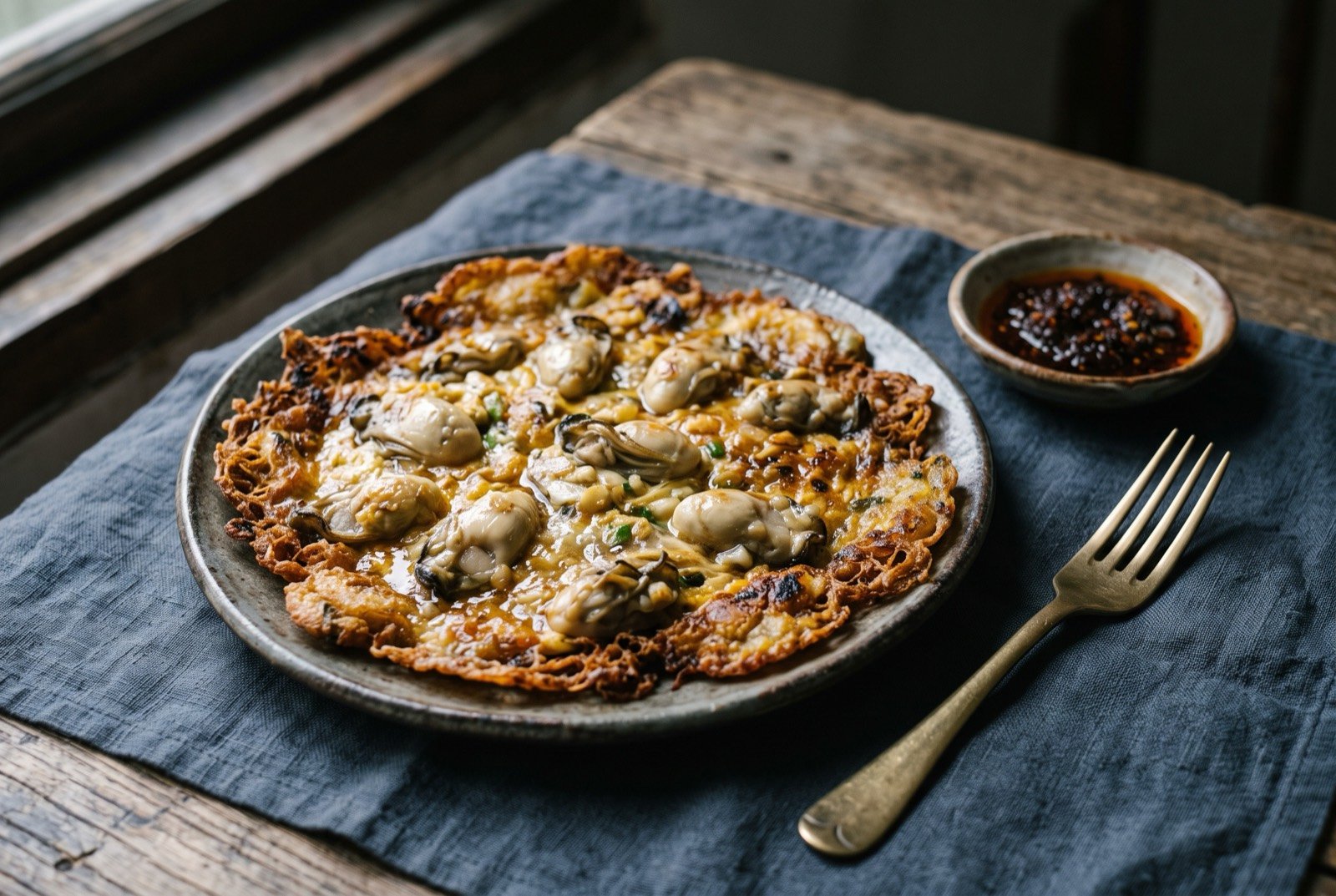
An illustration of the dish, not a photograph of it cooked.
- Time
- 20 minutes
- Reviewed
- Not yet reviewed from inside the tradition
- Cooked
- Not yet cooked and reported
Not to be confused with Fuzhou's own oyster cake (蛎饼), a completely different, deep-fried, rice-flour-wrapped dish eaten mostly as a breakfast side, this is Xiamen and Quanzhou's pan-fried version, built on sweet potato starch rather than rice flour. The Zheng Chenggong invention legend attached to it in Taiwan does not survive checking (see The History in Layers, above): the dish already existed on the Minnan and Chaoshan home coast as an everyday dish, and travelled with Minnan settlers to Taiwan rather than being invented there under siege.
As tradition built it
Serves 2 to 3. About 20 minutes.
Ingredients
- about 200g, shucked fresh oysters
- 1 part sweet potato starch
- 8 to 10 parts oyster, by weight, as a starting point for the batter ratio
- about 80ml water, to mix the batter to the consistency of thick yoghurt
- for frying lard, for frying
- to taste tomato sauce, sweet chilli sauce, shacha sauce and pickled radish shreds, to serve
Method
- Mix the sweet potato starch and water to a batter with the consistency of thick yoghurt, adjusted always by how it actually falls off a spoon.
- Fold in the fresh oysters just before cooking.
- Fry in a generously oiled pan, traditionally lard, on high heat until both sides are deeply golden, the exterior crisp and the interior holding the moist, springy 润Q texture Minnan cooks prize.
- Serve with tomato sauce, sweet chilli sauce, shacha sauce and pickled radish shreds.
What a modern chef changes
A measured hydration, dry-brined oysters, and a plancha's sustained heat
Rung 3
Method
- Grade and dry-brine the oysters briefly before cooking, to concentrate their liquor rather than let it dilute the batter.
- Build the starch batter to a precisely measured hydration using a kitchen scale rather than the traditional cook's eye, since a British kitchen's sweet potato starch and a Fujian kitchen's may not behave identically.
- Cook on a well-seasoned carbon steel pan or a plancha rather than a domestic non-stick, at a genuinely high, sustained heat a Big Green Egg's griddle plate can hold far more consistently than most stovetops, so the exterior sets into a real crisp lace while the oysters inside stay barely, precisely cooked.