Britain and Ireland · Volume 32, The Mill, the Pie and the Steel Pan
Lancashire Hotpot
Lancashire
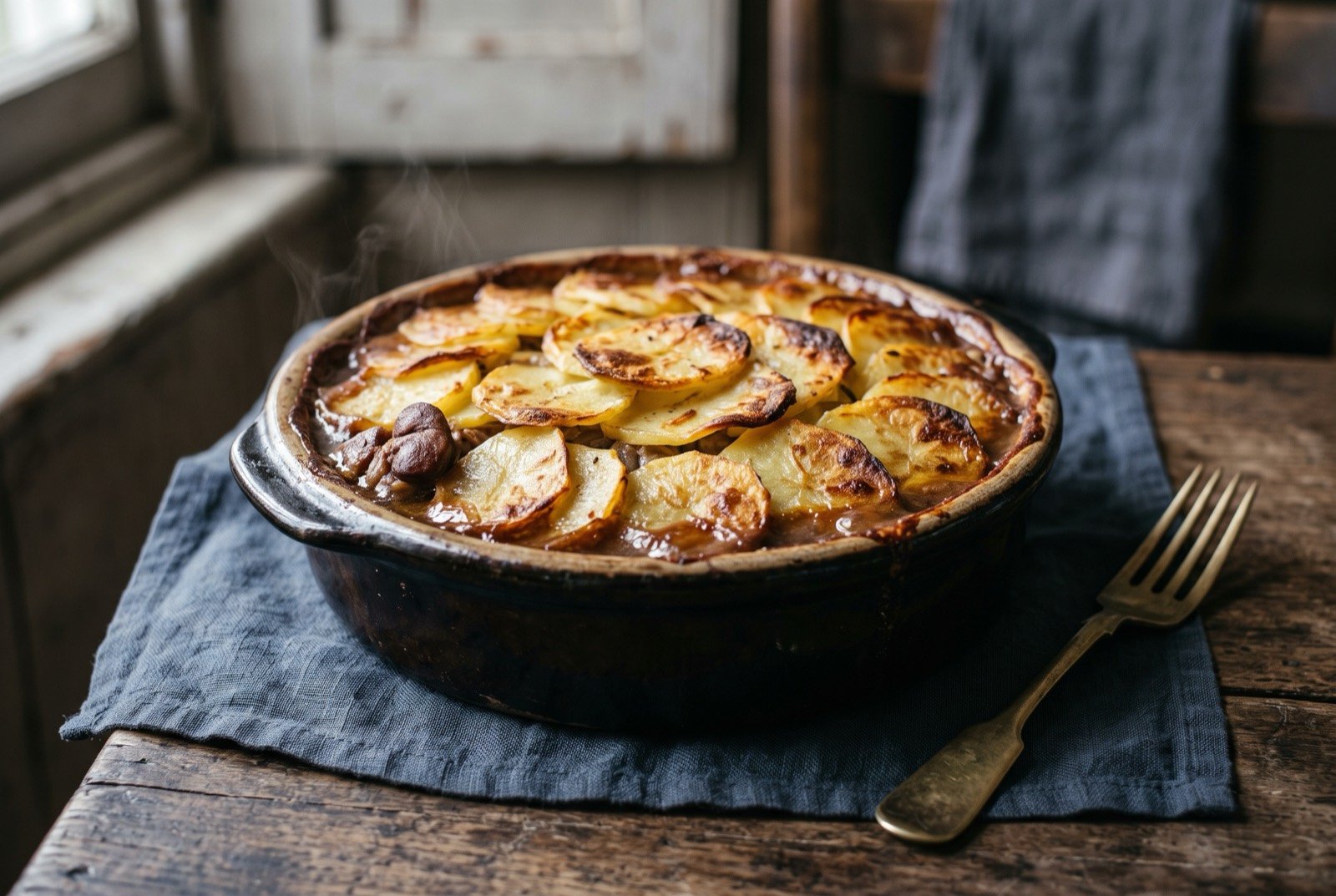
An illustration of the dish, not a photograph of it cooked.
- Time
- 3 hours 40
- Researched
- No outside sources linked
- Reviewed
- Not yet reviewed from inside the tradition
- Cooked
- Not yet cooked and reported
The popular story behind Lancashire hotpot, that it was invented specifically for cotton mill families who left a pot cooking unattended all day while both parents worked a shift, is told everywhere and sourced nowhere. Food historian Rachel Laudan, drawing on the research of the food historian Adam Balic, argues the dish cannot predate the late eighteenth century in England at all, since it depends on the potato, and that its tie to Lancashire specifically, as opposed to Cumberland or Cheshire where structurally similar layered meat-and-potato dishes also appear, "is dubious." What is not in dispute is that the dish became identified with Lancashire's cotton towns through the nineteenth and twentieth centuries regardless of where it began, which tells you something true about industrial Britain even where the founding legend does not survive checking: whatever their exact origin, these dishes belonged to whoever cooked them fastest, cheapest and most filling for a working household, and the region that industrialised first tends to get remembered as the one that invented them.
As tradition built it
Serves 4. About 3 hours 30 to 3 hours 40 minutes.
Ingredients
- 1kg lamb (a mix of under-shoulder, neck and shin), seasoned and lightly floured
- 700g onions, thinly sliced
- 40g butter
- 1kg King Edward potatoes, peeled and sliced 2mm thick
- 150ml chicken stock
- 4 a lamb kidney per person, halved, a traditional addition
Method
- Season and lightly flour the lamb, and lay it in a deep, straight-sided hotpot dish.
- Sweat the sliced onions in the butter for 4 to 5 minutes, then spread over the meat. Halve a lamb kidney per person and add it with the onions, if using, a traditional addition; oysters were once a common garnish too, back when they were cheap food for the poor rather than a luxury, and have simply priced themselves out of the dish rather than fallen from fashion.
- Layer the sliced potato on top and toss through the remaining butter, then pour the chicken stock in around the edges.
- Cover and bake at 200°C for 30 minutes, then drop to 130°C for 2.5 hours, then uncover and return to 200°C for a final 30 to 40 minutes to brown and crisp the potato top.
Notes
This exact recipe comes from a modern published source rather than an archival one; no nineteenth or early twentieth century recipe with real quantities was found in researching this chapter, and that gap is stated honestly rather than papered over with invented history.
What a modern chef changes
The braise separated from the potato lid, and the liquor clarified at the table
Rung 2
Method
- Sear the lamb hard on a Big Green Egg's direct fire before it goes anywhere near the braise, for a depth of flavour the stovetop version never reaches.
- Cook the seared lamb sous vide at 58°C for 12 hours, separately from the vegetables, per rung two's own logic taken further than a single shared pot allows: the meat reaches its own correct texture rather than a compromise point with the potato above it.
- Dehydrate a portion of the sliced potato before the final assembly, then layer it back in among the fresh slices for the top crust, giving a genuinely crisp, shatter-edged lid rather than the softer crust a rolling boil-and-bake produces throughout.
- Strain and clarify the braising liquor through a gelatine raft and a chinois, and pour it back over the dish at the table rather than leaving it to thicken unclarified in the pot.