Britain and Ireland · Volume 32, The Mill, the Pie and the Steel Pan
Bury Black Pudding
Lancashire
Illustration
- Time
- 1 hour
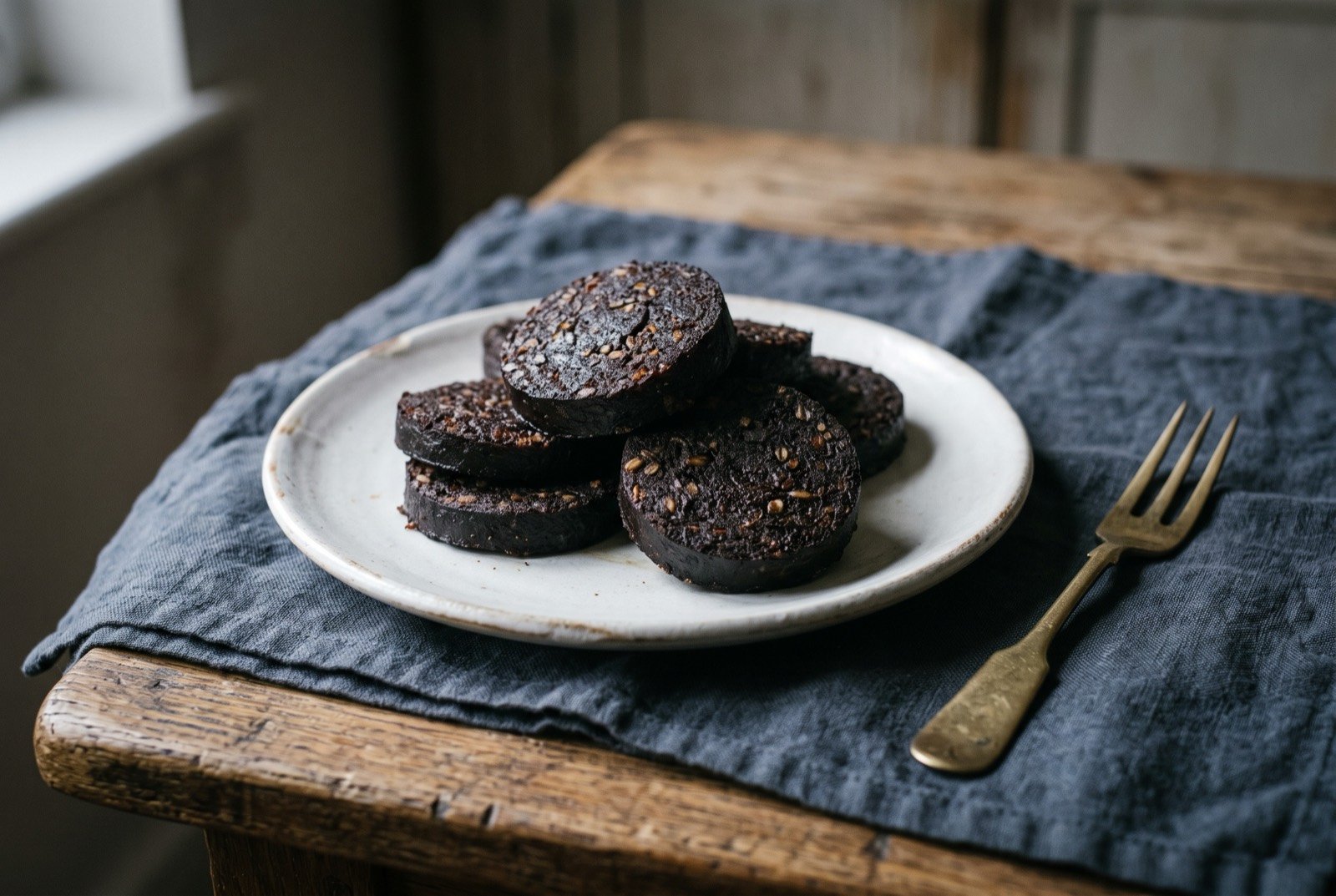
Black pudding tells a similar story with a similar gap in the evidence. Bury's own trade account, that European monks carried a blood sausage tradition, "blutwurst," through Yorkshire before it settled in the town, has no named monastery, no date and no independent corroboration; it is company folklore, not history, and this chapter treats it as such. What is genuinely, specifically Lancashire about Bury's version is technical rather than legendary: it is bound with pearl barley rather than the oatmeal used across most of the rest of England's black pudding tradition (and entirely unlike Scotland's oatmeal-only Stornoway pudding, already treated in Volume EU-34), a real recipe distinction rather than a marketing one. The scale of the industrial demand this fed is worth stating in real numbers rather than left vague: Manchester alone had 260 specialist tripe shops in 1906, and by the 1950s the United Cattle Products chain ran 146 tripe shops-cum-restaurants across Lancashire and the wider North West, with queues for seats reported at the time. Offal was not a poverty footnote here. It was a mass catering industry, run at the scale of a modern chain restaurant group, and its near-total disappearance by the late twentieth century says as much about changing status anxiety around cheap meat as it does about changing taste.
As tradition built it
Makes about 1kg. About 1 hour, plus air-drying.
Ingredients
Per 1000g of stuffed material
- 300g pearl barley groats, cooked in water and drained
- 200g pork back fat, diced to 6mm
- 150g fine oatmeal
- 50g flour
- 50g onion, finely chopped
- 250g fresh blood
- 21g salt
- 1g, 2g, ½g, 1g and ½g white pepper, rubbed marjoram, a pinch of pennyroyal, thyme and celery seed
- 36 to 40mm hog casings
Method
- Mix the warm cooked barley with the pork back fat, oatmeal, flour, onion, blood, salt and the white pepper, rubbed marjoram, pennyroyal, thyme and celery seed.
- Stuff into the hog casings, then poach at 80°C for 40 minutes until the core reaches 72°C.
- Cool in cold water, then hang to air-dry before refrigerating.
Notes
This period ratio, adapted from a 1908 British trade manual, gives barley at almost exactly double the oatmeal by weight, the technical detail that actually distinguishes a Bury pudding from most of the rest of England's oatmeal-bound tradition.
What a modern chef changes
Paul Heathcote's own refinement, held at a precise temperature rather than an open pan
Rung 5
Method
- Take Paul Heathcote's own decades-old refinement as the starting principle rather than reinventing it from nothing: trim the pudding mixture of any large lumps of fat before stuffing, and macerate a small quantity of sultanas in vinegar to fold through the mix, cutting the pudding's richness with a genuine sourness rather than a sweet one.
- Poach the stuffed pudding sous vide at a precise 80°C rather than in an open pan, holding it exactly at that temperature until the core reaches 72°C per rung five's own logic, for total consistency batch to batch.
- Dehydrate a thin, wafer-like disc cut from a slightly firmer batch of the same mixture until fully crisp, to scatter as a textural garnish over the soft, warm pudding.
- Toast and grind the celery seed and mace fresh in a dedicated spice grinder immediately before mixing, rather than using pre-ground spice, for a genuinely sharper aromatic lift than the traditional recipe's own spice cupboard would have allowed.