Britain and Ireland · Volume 32, The Mill, the Pie and the Steel Pan
Faggots
the Black Country, the West Midlands
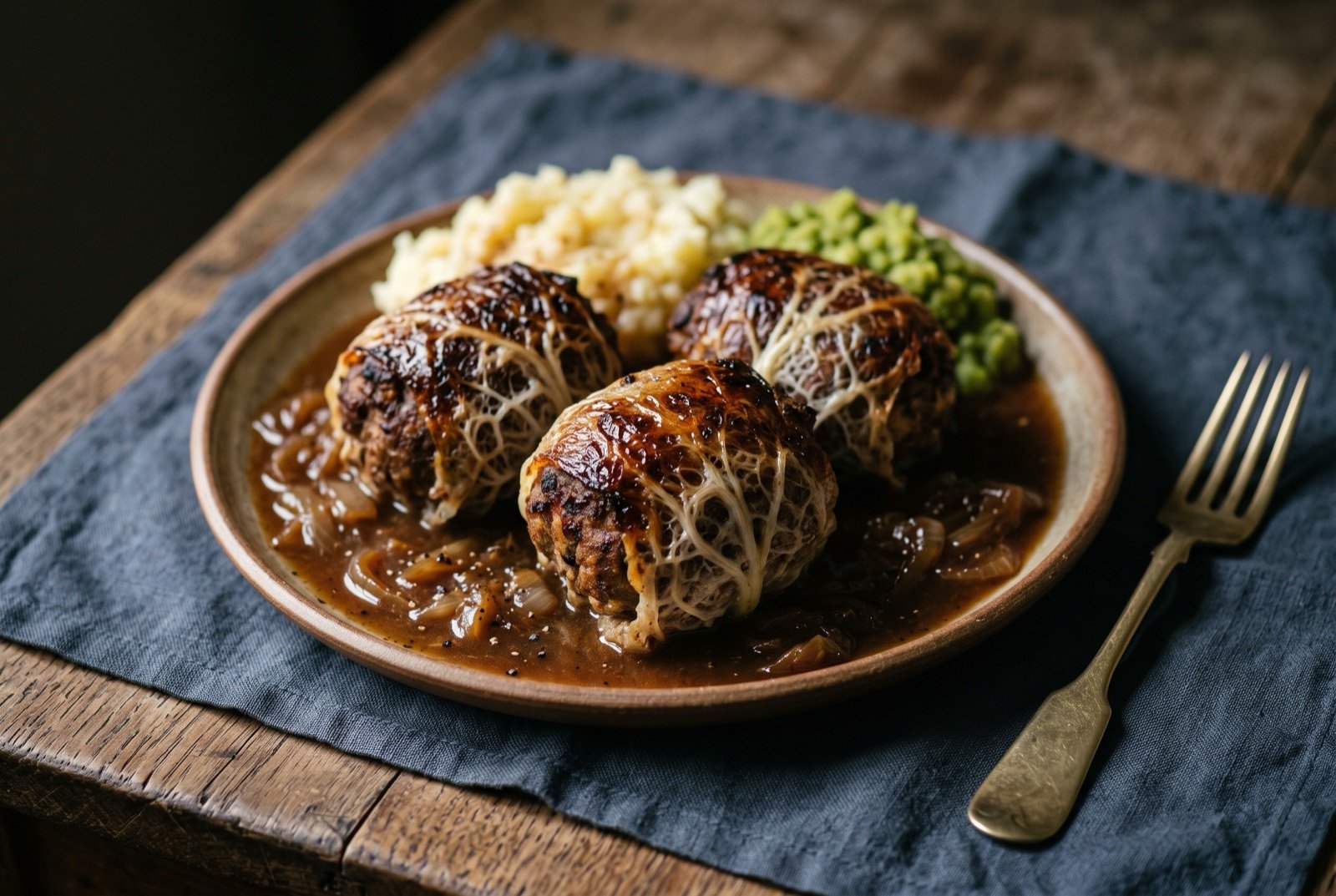
An illustration of the dish, not a photograph of it cooked.
- Time
- 1 hour
- Researched
- No outside sources linked
- Reviewed
- Not yet reviewed from inside the tradition
- Cooked
- Not yet cooked and reported
A related volume, EU-33 (Wales), has already told half of this story, honestly, from the receiving end: "faggots' full, twice-given treatment belongs to Volume EU-32, the English Midlands, where the dish is most completely documented and most identified." This is that fuller treatment. Faggots are consistently described as originating among the rural poor of west Wiltshire and the West Midlands, spreading in particular to South Wales in the mid nineteenth century, carried by agricultural labourers leaving the land for the coalfields. This chapter could not trace the west Wiltshire half of that claim to a primary source; it recurs everywhere in near-identical wording, which is the signature of one shared, untraced original claim rather than several independent confirmations, and it is named honestly as such rather than smoothed into settled fact.
What the West Midlands half of the story has, and what no source found for the Welsh version has, is a continuously documented shop trade running across four human generations. The Cook Shop, Old Hill, opened in 1889 when Eve Billingham began selling Black Country food she cooked herself from the front room of her home. It passed to her daughter Mary and husband Joe Priest, then to Iris and Bill Brazier, then to Nigel Brazier, who took it over in 1965 and closed it in September 2014 after 125 years of continuous trading, serving 300 to 400 customers queuing on its final Saturday. Brazier's own account of the recipe is worth quoting directly, since it states this chapter's own argument about elevation better than any outside commentary could: "These recipes date back to the 1800s. Black Country housewives didn't have red wine to pour into their faggots. If they had it, they'd drink it. The faggot is a way of using other bits of pig you couldn't put anywhere else." And on the modern chefs who reinvent the dish with garlic, herbs and wine: "If you put anything other than simple ingredients in a faggot it might taste good but it ceases to be a Black Country faggot." Len Broadbent, at Broadbent Butchers in Coseley, had sold two million faggots over six years by October 2014, from a shop he had run for over two decades: "I just think they are an easy, honest, traditional meal... Fashions come and go but there will always be a call for traditional food." Wales adopted this dish genuinely and adapted it into its own ffagodau, exactly as EU-33 says. But the dish's own fullest, best-documented life, four generations of named women and men selling it from their own front rooms and shop counters, belongs here.
As tradition built it
Serves 4. 60 minutes total (45 minutes covered, 15 minutes uncovered).
Ingredients
- 12oz (340g) pig's liver, minced or finely chopped
- 6oz (170g) pig's heart, minced or finely chopped
- 2 small onions, finely chopped and softened
- half a packet sage and onion stuffing mix, the traditional binder
- 6oz (170g) pork belly, minced, a common but optional addition
- as available caul fat, cut into squares roughly the size of a hand
To serve
Method
- Mix the minced liver and heart with the softened onions, stuffing mix and, if using, the minced pork belly.
- Spoon a portion of the mixture onto each square of caul fat and wrap it closed, the caul both holding the shape and basting the meat as it renders in the oven, per rung three.
- Bake covered with foil at 160°C fan (180°C conventional) for 45 minutes, then uncover and bake a further 15 minutes to brown, 60 minutes total.
- Serve with mushy peas, mashed potato and onion gravy.
Notes
In Nigel Brazier's own words, at The Cook Shop in Old Hill for 125 years before it closed in 2014: "If you put anything other than simple ingredients in a faggot it might taste good but it ceases to be a Black Country faggot," a warning worth taking seriously rather than working around.
What a modern chef changes
Brazier's own rule honoured by changing method, not a single ingredient
Rungs 3 and 4
Method
- Honour Brazier's own rule by changing method, not ingredients: poach the shaped, caul-wrapped faggots sous vide at a controlled 75°C until fully set through, holding the offal at a gentler, more even temperature than a domestic oven's dry heat allows, then finish them for a few minutes on a Big Green Egg's direct fire to crisp and colour the caul properly, per rung four's own logic of genuine direct heat applied briefly rather than a long, gentle bake throughout.
- Blitz the traditional onion gravy in a high-power blender until completely silky, then pass it through a chinois for a glossy, restaurant-smooth finish rather than the rustic, slightly grainy gravy a hand-whisked version gives.
- Toast and grind fresh sage in a dedicated spice grinder rather than using it dried and whole, sharpening the one herb Brazier's own recipe already allows without adding a single ingredient he would not recognise.