Britain and Ireland · Volume 32, The Mill, the Pie and the Steel Pan
Melton Mowbray Pork Pie
Leicestershire
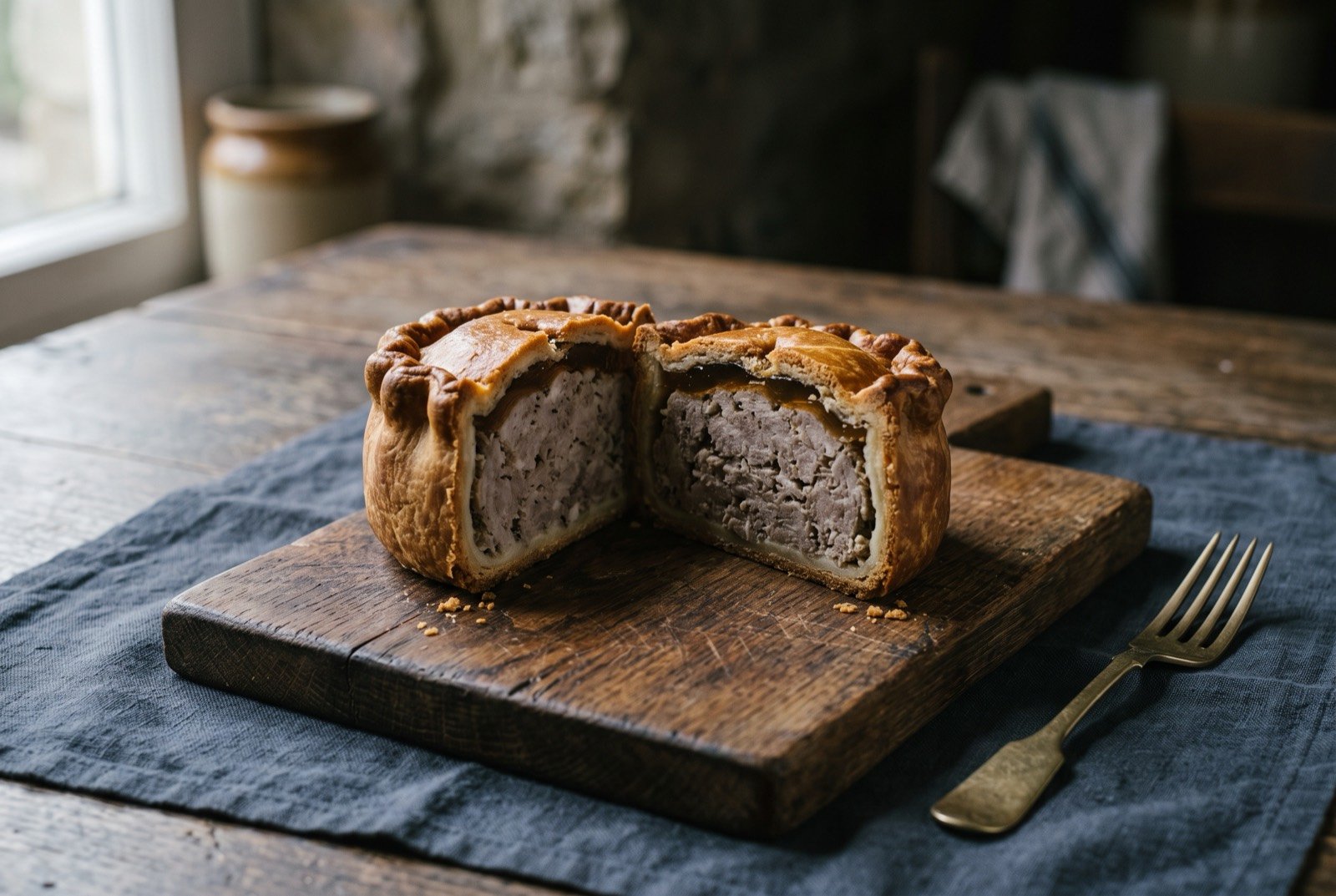
An illustration of the dish, not a photograph of it cooked.
- Time
- Not statedNo source states a time and the atlas has too few comparable dishes to estimate one.
- Researched
- No outside sources linked
- Reviewed
- Not yet reviewed from inside the tradition
- Cooked
- Not yet cooked and reported
Stilton's whey-fed pigs. The literal mechanism behind the Midlands pie belt's own geography: surplus whey from pressing Stilton cheese was excellent, cheap pig feed, so the same district that made the cheese also, almost automatically, carried a pork surplus, which is why Stilton's own three licensed counties, Leicestershire, Nottinghamshire and Derbyshire, sit almost exactly inside the Melton Mowbray pork pie's own protected production zone.
Uncured pork, and why grey is correct, not undercooked. A genuine Melton Mowbray pork pie's filling is fresh, chopped, unpreserved pork, no curing salts at all, which is exactly why it cooks to a natural grey-brown rather than the pink of a cured ham or a supermarket pie made with nitrite. A reader taught by every other cured British meat in this atlas to read pink as correct needs telling plainly that here, for once, grey is the mark of doing it properly.
As tradition built it
Makes one large pie. Bake until deep golden; timing not given in the source.
Ingredients
For the hot water crust
- 350g strong white flour
- 1 tsp salt
- 85g lard
- 185ml boiling water (or half water, half milk)
For the filling
- 1kg fresh, uncured pork, hand-chopped rather than minced, no cure of any kind
- a pinch of each salt and white pepper
- 1 egg, beaten, for the glaze
To finish
- 250ml warmed pork bone stock jelly
Method
- Melt the lard into the boiling water (or water and milk) and bring to a full boil, then work it into the flour and salt while scalding hot to a smooth, pliable dough.
- Reserve roughly a quarter of the dough for the lid, and hand-raise the rest around a wooden dolly or the base of a straight-sided jar, building the wall upward from the base with the fingers rather than rolling and draping it, so the pie stands freely without a supporting hoop or tin, per rung one.
- Fill with the fresh, uncured, hand-chopped pork, seasoned simply with salt and white pepper and no cure of any kind, which is exactly what keeps the cooked meat a natural grey-brown rather than the pink of a cured product, per rung five.
- Seal the lid, brush with the beaten egg, cut a steam vent, and bake at 200°C until the crust is a deep golden brown and the filling is cooked through.
- Once cooled slightly, pour the warmed pork bone stock jelly through the steam vent to fill the gaps left as the meat shrank, sealing the filling from the air and giving the pie its characteristic savoury jelly layer beneath the lid.
Notes
This is the method the Melton Mowbray Pork Pie Association's own Protected Geographical Indication specification requires: fresh pork at a minimum 30% of the finished pie, no artificial colours, flavours or preservatives, made within a defined area of roughly 1,800 square miles around the town itself.
What a modern chef changes
A cleaner jelly, a crackling garnish, and pepper treated as more than an afterthought
Rungs 1 and 5
Method
- Hold the bone stock at a precise, gentle temperature in a sous vide bath while it infuses with aromatics, rather than reducing it hard on the stove, for a cleaner, less muddied jelly, then pass it through a chinois for real clarity before pouring it into the baked pie.
- Dehydrate a portion of pork skin separately until fully crisp, then shatter it over the top as a crackling garnish, a texture the pie's own crust cannot give on its own.
- Mill fresh white and black pepper together in a dedicated spice grinder immediately before seasoning the filling, since pepper is essentially the specification's only permitted seasoning and deserves to be treated as more than an afterthought.
- Bake the pie in a Big Green Egg run indirect for the bulk of the cook and finished direct for the last few minutes, for a deeper, more even crust colour than a domestic oven gives.