Europe · Volume 32
England, the North and the Midlands
The Mill, the Pie and the Steel Pan
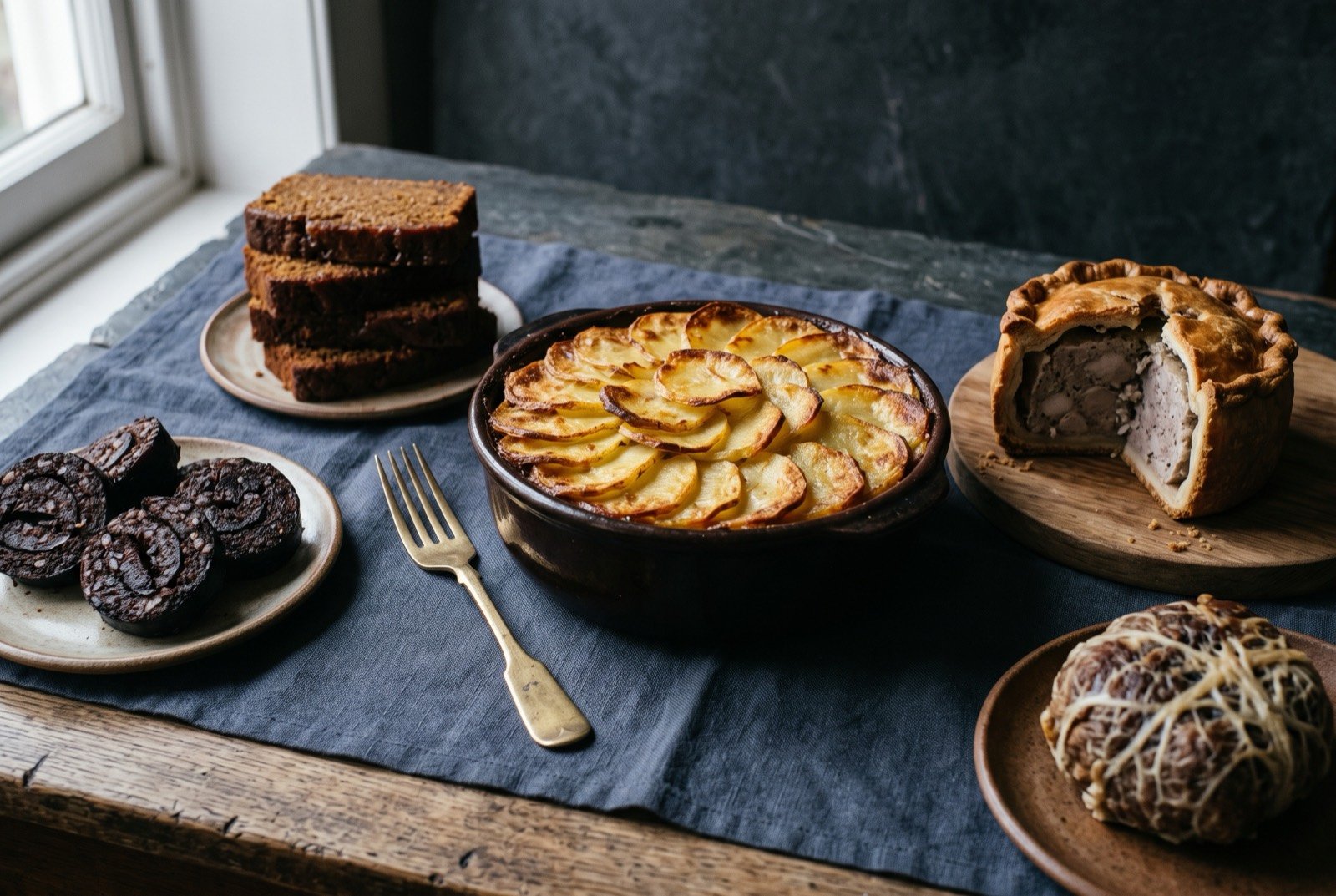
The North, the Midlands and Birmingham, taken seriously. Not one industrial food culture but two, cotton mill and pit village against dairy whey and pressed steel, and every dish as tradition built it, then what a modern chef would change.
Sources and review · What this chapter does not assert · How we research · Spotted something wrong?
A Sense of Place
The North runs on grass, oats and water long before it runs on anything else. Herdwick and Swaledale sheep hold the fells the way Welsh Mountain sheep hold the Cambrian range, hardy small breeds bred for slope rather than yield, and the Lonk, a horned hill breed particular to the Pennines, is the sheep Nigel Haworth still names by breed on his own menu rather than simply calling it lamb. Oats grow where wheat will not ripen reliably, and the region's baking runs on them and on their industrial-age partner, treacle, more than it runs on white flour. But it was coal, cotton and iron that decided what actually got cooked with all that grass and grain: a hotpot layered thick with potato to stretch a small ration of mutton across a mill family's dinner, a black pudding made from a butcher's own blood surplus, a pastry case that could travel down a pit shaft in a miner's snap tin without falling apart. The North East runs its own variant of the same logic around shipyard and colliery rather than cotton mill: pease pudding and a stottie loaf built specifically to carry a wet filling to a shipyard gang's midday break, singin' hinnies griddled for a pitman's holiday table.
The Midlands answers a related question differently. Around Melton Mowbray, Stilton cheesemaking and pork production grew up as one economy rather than two: the whey left over from pressing cheese was excellent, cheap pig feed, so a district that made cheese also, almost automatically, had a pork surplus, and a belt of towns across Leicestershire, Nottinghamshire, Derbyshire and into Lincolnshire and Northamptonshire built a shared hand-raised hot water crust pastry trade around it. Further west, in the Black Country's iron and coal towns, an imported dish, faggots, offal meatballs wrapped in caul fat, became the defining food of a wage economy with almost no land to grow anything on, sold from front-room shops by women running an informal cash trade that substituted for welfare provision the state had not yet built. And Birmingham itself did something the rest of this chapter's dishes did not: it invented a genuinely new one, within living memory, using its own centuries-old pressed-metal trade to build the very pan the dish is cooked and served in.
| Region | Defining logic | Dishes and products that carry it |
|---|---|---|
| Yorkshire and Lancashire | Hill sheep and dairy grass, oats over wheat, cotton mill and pit economics | Lancashire hotpot, Bury black pudding, parkin, Yorkshire curd tart, Wensleydale and Lancashire cheese |
| The North East | Shipyard and colliery packed-lunch food, a pease-and-bread grammar | Stotty cake, pease pudding, singin' hinnies, Craster kippers |
| The East Midlands pie belt | Stilton whey feeding a pork surplus, a shared hand-raised pastry trade across several towns | Melton Mowbray pork pie, Stilton, Pork Farms' own Nottingham pie trade |
| The West Midlands and the Black Country | An almost landless industrial wage economy, offal cooked to use every part of the pig | Faggots, the Cook Shop and Broadbent Butchers' own named shop histories |
| Birmingham | A pressed-metal manufacturing trade turned to a genuinely new dish and its own cooking vessel | The balti, cross-referenced in full to Volume EU-37 |
The History in Layers
What is genuinely indigenous, stated plainly before the layers arrive
Sheep on wet hill grass, oats and barley where wheat will not ripen, dairy cattle and their cheese, pig-keeping wherever a household had even a small yard for one. The bakestone and griddle tradition, cooking flat breads and cakes on a hot iron plate rather than in a domestic oven, is shared with Wales and Scotland and answers to its own Northern names, singin' hinnies on Tyneside, stotty cake likewise. Hand-raised hot water crust pastry, worked hot and shaped by hand around a wooden mould rather than baked in a tin, is this region's own equivalent of Wales's bakestone: a genuinely old, genuinely indigenous technology that a modern kitchen can still use exactly as built. Everything that follows sits on top of this, not instead of it.
The mill, the pit and the shipyard: what industrial Britain actually did to a plate of food
The popular story behind Lancashire hotpot, that it was invented specifically for cotton mill families who left a pot cooking unattended all day while both parents worked a shift, is told everywhere and sourced nowhere. Food historian Rachel Laudan, drawing on the research of the food historian Adam Balic, argues the dish cannot predate the late eighteenth century in England at all, since it depends on the potato, and that its tie to Lancashire specifically, as opposed to Cumberland or Cheshire where structurally similar layered meat-and-potato dishes also appear, "is dubious." What is not in dispute is that the dish became identified with Lancashire's cotton towns through the nineteenth and twentieth centuries regardless of where it began, which tells you something true about industrial Britain even where the founding legend does not survive checking: whatever their exact origin, these dishes belonged to whoever cooked them fastest, cheapest and most filling for a working household, and the region that industrialised first tends to get remembered as the one that invented them.
Black pudding tells a similar story with a similar gap in the evidence. Bury's own trade account, that European monks carried a blood sausage tradition, "blutwurst," through Yorkshire before it settled in the town, has no named monastery, no date and no independent corroboration; it is company folklore, not history, and this chapter treats it as such. What is genuinely, specifically Lancashire about Bury's version is technical rather than legendary: it is bound with pearl barley rather than the oatmeal used across most of the rest of England's black pudding tradition (and entirely unlike Scotland's oatmeal-only Stornoway pudding, already treated in Volume EU-34), a real recipe distinction rather than a marketing one. The scale of the industrial demand this fed is worth stating in real numbers rather than left vague: Manchester alone had 260 specialist tripe shops in 1906, and by the 1950s the United Cattle Products chain ran 146 tripe shops-cum-restaurants across Lancashire and the wider North West, with queues for seats reported at the time. Offal was not a poverty footnote here. It was a mass catering industry, run at the scale of a modern chain restaurant group, and its near-total disappearance by the late twentieth century says as much about changing status anxiety around cheap meat as it does about changing taste.
The full English breakfast is worth a plain correction here, since it is one of the most confidently mis-dated dishes in English food writing. It is not medieval. Tourist copy claims a lineage back to the fourteenth century without citing a specific dish, menu or document, and the claim is definitionally impossible in its modern form regardless, since neither the tomato nor the potato reached Europe before the sixteenth century. The better-sourced account, drawing on the food historian Pen Vogler's Scoff: A History of Food and Class in Britain, places eggs and bacon as an established pairing among the wealthy from the seventeenth and eighteenth centuries, with eggs remaining a genuine luxury for ordinary households well into the twentieth. Vogler's real argument is more interesting than a myth of ancient national breakfast: the modern cooked breakfast was substantially a middle-class, urban attempt to imitate a country-house breakfast, adopted specifically after the First World War, when servant shortages meant people had to cook the big-house breakfast themselves rather than have it cooked for them. The now-familiar full combination, mushroom, tomato, baked beans and black pudding all together, did not converge into the fixed list served today until the 1960s and 1970s. A separate, less rigorously sourced tradition holds that a plainer cooked breakfast was also adopted by manual workers earlier, for its calorie density ahead of a shift; this chapter has not found a source reconciling the two strands into one history; and it will not force one.
The Black Country's own trade in an imported dish, and why it belongs here rather than in Wales
A related volume, EU-33 (Wales), has already told half of this story, honestly, from the receiving end: "faggots' full, twice-given treatment belongs to Volume EU-32, the English Midlands, where the dish is most completely documented and most identified." This is that fuller treatment. Faggots are consistently described as originating among the rural poor of west Wiltshire and the West Midlands, spreading in particular to South Wales in the mid nineteenth century, carried by agricultural labourers leaving the land for the coalfields. This chapter could not trace the west Wiltshire half of that claim to a primary source; it recurs everywhere in near-identical wording, which is the signature of one shared, untraced original claim rather than several independent confirmations, and it is named honestly as such rather than smoothed into settled fact.
What the West Midlands half of the story has, and what no source found for the Welsh version has, is a continuously documented shop trade running across four human generations. The Cook Shop, Old Hill, opened in 1889 when Eve Billingham began selling Black Country food she cooked herself from the front room of her home. It passed to her daughter Mary and husband Joe Priest, then to Iris and Bill Brazier, then to Nigel Brazier, who took it over in 1965 and closed it in September 2014 after 125 years of continuous trading, serving 300 to 400 customers queuing on its final Saturday. Brazier's own account of the recipe is worth quoting directly, since it states this chapter's own argument about elevation better than any outside commentary could: "These recipes date back to the 1800s. Black Country housewives didn't have red wine to pour into their faggots. If they had it, they'd drink it. The faggot is a way of using other bits of pig you couldn't put anywhere else." And on the modern chefs who reinvent the dish with garlic, herbs and wine: "If you put anything other than simple ingredients in a faggot it might taste good but it ceases to be a Black Country faggot." Len Broadbent, at Broadbent Butchers in Coseley, had sold two million faggots over six years by October 2014, from a shop he had run for over two decades: "I just think they are an easy, honest, traditional meal... Fashions come and go but there will always be a call for traditional food." Wales adopted this dish genuinely and adapted it into its own ffagodau, exactly as EU-33 says. But the dish's own fullest, best-documented life, four generations of named women and men selling it from their own front rooms and shop counters, belongs here.
The balti: a genuinely new English dish, invented in living memory, in the city's own steel
This atlas's animating idea is that every restaurant technique in these cuisines has an indigenous ancestor, that elevating a food is a matter of doing traditional things deliberately rather than importing foreign method. Birmingham's balti is this chapter's clearest and strangest test of that idea, because the honest answer is that the balti has no ancestor at all. It is new. Volume EU-37, The New British Table, carries this atlas's full treatment of the dish, its genuinely disputed three-way invention story (Adil's, Al-Faisal's and Imran's restaurants, each with a real claim and no agreed inventor), its pan technology, and the named critics, Colleen Taylor Sen, Ziauddin Sardar, Madhur Jaffrey, who dispute the "Kashmiri" framing outright. That fuller telling is the dish's home, and this chapter will not re-tell it. But it earns a plain paragraph here too, because a genuinely new indigenous English regional dish, invented inside one lifetime and tied to a specific English city's own manufacturing trade the way a hotpot or a pork pie is tied to a county, is exactly the kind of case this book exists to notice rather than file quietly under "curry house history" and move on from.
Adil's, on Stoney Lane in Sparkbrook, opened in 1977 styling itself "the home of Balti Cuisine," and traded until 2022, when it closed for family reasons rather than commercial failure. The Balti Triangle, spanning Sparkbrook, Sparkhill and Balsall Heath, held over thirty balti houses at its 1990s peak. The pan itself, thin, flat-bottomed, pressed steel rather than heavy cast-iron karahi, was purpose-built in the city in the 1970s specifically to heat faster than the traditional vessel it replaced. The clearest single piece of evidence for calling this indigenous rather than imported is not culinary at all: it is manufacturing. The Jewellery Quarter Business Improvement District's own account confirms that balti bowls today are still "designed and manufactured in Birmingham's Jewellery Quarter using pressed-steel, just like the original 1970s bowls," naming AE Harris, one of the Quarter's longest-established manufacturers, as the maker now trading balti bowls as The Birmingham Balti Bowl Co. This ties the pan directly to the same small-workshop pressed-metal trade, buttons, pins, pen nibs, that built the Jewellery Quarter's international reputation across the eighteenth and nineteenth centuries. The food historian Lizzie Collingham, author of Curry: A Tale of Cooks and Conquerors, states the case for the dish's own legitimacy in six words: "It is authentic. It's an authentic, British curry." Chef Zaf Hussain puts the same claim more bluntly still: "Although curry came from India and Pakistan, the balti was born in Birmingham." No historian or critic surveyed in researching either this chapter or EU-37 has put the balti, Lancashire hotpot and the Melton Mowbray pork pie side by side in print as three parallel cases of a dish becoming identified with a specific English place through a specific local trade, cotton, dairy whey, pressed steel. That comparison is this chapter's own, offered plainly as an argument rather than dressed up as a cited fact: a hotpot took three centuries to become Lancashire's, a pork pie took a cheesemaking economy to become Leicestershire's, and a balti took about five years to become Birmingham's, and all three are genuinely, locally invented English regional food for exactly the same underlying reason, someone local worked out how to feed people well with what the district actually had to hand. The balti's own bid for legal protected-name status has a genuinely tangled, still-unresolved history, an apparent EU recognition claimed in 2015 press coverage sits awkwardly against later reports of a rejected 2016 application and a post-Brexit restart under the UK's own domestic scheme, and this chapter states that contradiction openly rather than picking whichever version reads more triumphantly.
The modern moment: refining a mill-town dish without pretending it needs a foreign accent to be taken seriously
The North's current restaurant scene answers this chapter's own animating question with roughly the same honest, mixed verdict Wales's did. Tommy Banks, at the Black Swan in Oldstead, cooking on land his family has farmed for five generations, ferments, pickles, dries and clamps vegetables using methods that are direct continuations of his own family's farmhouse preservation practice rather than an imported technique dressed in local ingredients; an overgrown sweetcorn cob fermented into what he describes as "a really rich, starchy paste, which tastes sour and like beer" from produce that would otherwise go to compost is as clean an indigenous-ancestor case as this atlas has found anywhere. Paul Heathcote, decades before the current wave of interest in Northern food, reinvented black pudding by removing its lumps of fat, working in vinegar-soaked sultanas and chopped sweetbreads, and finishing it gently in a bain-marie, refining a working-class product rather than replacing it, and titled his own book Rhubarb & Black Pudding to make that pairing of the genteel and the working-class explicit. Nigel Haworth still names the specific hill breed, Lonk, behind his own hotpot rather than simply calling it lamb, precisely the kind of small, real specificity this atlas asks every chapter to insist on.
Set against that, several of the region's most celebrated kitchens are honestly, openly importing technique wholesale rather than climbing an indigenous ladder at all. Hjem, in the Northumberland village of Wall, is Northumbrian and North Sea produce "seen through a Scandinavian lens," its own name Swedish for home; Mana, in Manchester, states plainly that its chef has "injected Japanese methodology and ideology" into British produce; and Opheem, in Birmingham, layers three traditions at once, British ingredients, Indian-subcontinental cooking, and a Japanese charcoal grill in place of a tandoor, which is arguably the single most interesting individual case in the whole region for testing this atlas's claim to destruction, since not one of its three layers is West Midlands indigenous method, even as the produce itself is proudly, specifically British. The honest pattern worth keeping: this region's gastropubs, the Pipe and Glass, the Broad Chare, the Three Fishes, tend toward real indigenous-ancestor refinement, because the format itself, taking an existing pub dish and doing it properly rather than replacing it with something else, structurally forces continuity. Its standalone tasting-menu restaurants tend toward openly imported grammar, because the tasting menu as a form was never a Northern invention to begin with. Both are legitimate. Only one of them is what this atlas's own animating idea is actually describing, and the chapter says which is which rather than blurring the two together for the sake of a tidier argument.
The Flavour Arsenal
Pearl barley. The binder that makes Bury's black pudding technically distinct from most of England's other regional versions, which lean on oatmeal instead; a period 1908 trade recipe gives barley at roughly double oatmeal's weight in the mix, a genuine, checkable ratio rather than a matter of house style.
Oatmeal. The North's working grain for the better part of two centuries, ground fine for Yorkshire's oatmeal-thickened dishes and worked whole into parkin, singin' hinnies and the wider bakestone tradition; buy whole groats and mill to order where a recipe calls for it, since pre-ground oatmeal loses character within months.
Black treacle and golden syrup, and the real reason the North splits down the middle over them. Yorkshire parkin runs on black treacle; Lancashire parkin, which drops the oats entirely, runs on golden syrup instead. This is not a matter of local taste alone: golden syrup only became a cheap, widely available refined product from around 1880, via the Tate refinery near Bootle in Lancashire, putting it within easy reach of Lancashire bakers years before it reached Yorkshire ones, by which point Yorkshire's own black treacle recipe had already set as the county's own. A genuine piece of industrial geography still sitting quietly inside a tin of cake.
Caul fat. The pig's own omentum, wrapped around a faggot's offal filling to hold it together and baste it as it bakes; a specialist order from a proper butcher today rather than a supermarket item, though not in any real supply crisis, and the standard substitute where it cannot be found is unsmoked streaky or back bacon.
Lonk, Herdwick and Swaledale sheep. Three named Northern hill breeds worth knowing apart rather than lumping together as "hill lamb." Lonk is the Pennine breed Nigel Haworth names directly in his own hotpot. Lakeland Herdwick carries Protected Designation of Origin status, restricted to pure-bred animals born, raised and slaughtered in Cumbria, its meat fine-grained and more intensely flavoured than lowland lamb owing to slow maturation on fell grazing. Swaledale carries no such protection, a genuine, hardy Yorkshire Dales breed with real character but a breed-story rather than a legal one.
Stilton's whey-fed pigs. The literal mechanism behind the Midlands pie belt's own geography: surplus whey from pressing Stilton cheese was excellent, cheap pig feed, so the same district that made the cheese also, almost automatically, carried a pork surplus, which is why Stilton's own three licensed counties, Leicestershire, Nottinghamshire and Derbyshire, sit almost exactly inside the Melton Mowbray pork pie's own protected production zone.
Uncured pork, and why grey is correct, not undercooked. A genuine Melton Mowbray pork pie's filling is fresh, chopped, unpreserved pork, no curing salts at all, which is exactly why it cooks to a natural grey-brown rather than the pink of a cured ham or a supermarket pie made with nitrite. A reader taught by every other cured British meat in this atlas to read pink as correct needs telling plainly that here, for once, grey is the mark of doing it properly.
The Technique Ladder
Rung 1. Work a hot water crust while it is genuinely hot, not once it has started to cool
A hot water crust pastry (flour and salt, bound with fat melted into boiling water and worked in while scalding) behaves completely differently hot than it does once it starts to set: hot, it is soft, pliable and workable by hand around a mould; cooling, it stiffens fast and becomes difficult to shape cleanly. This is why a hand-raised pie is built quickly, straight from the pan to the dolly, rather than left to rest like a shortcrust. It also explains the pie's own recognisable shape: baked freestanding, without a supporting hoop or tin, the dough bows and bulges very slightly outward as it cooks, which a tin-moulded pie never does. Treat the working window as a real chemistry constraint, not a stylistic choice.
Rung 2. Layer a braise by how long each element actually takes to cook, not all at once
Every credible hotpot method agrees on structure ahead of exact ingredients: the meat goes in first and cooks longest, the vegetables that take least time go in last, and the potato lid is arranged to crisp rather than to cook through with everything beneath it. Cooking everything from a single starting point gives a dish with an even, less interesting texture throughout and vegetables cooked well past their best; staging by genuine cooking time, the same logic Wales's own cawl runs on, is what gives the dish real structure rather than a uniform mush.
Rung 3. Bind offal with the correct starch, in the correct ratio, and wrap it in the correct membrane
Black pudding's barley-to-oatmeal ratio and a faggot's caul-fat wrap are not interchangeable stylistic choices between recipes, they are functional decisions about how much structure and moisture the finished product needs to hold. Barley gives black pudding a softer set than oatmeal does; caul fat bastes a faggot from the outside as it renders in the oven, which breadcrumbs and onion alone cannot do for themselves. Getting either wrong does not just change the flavour, it changes whether the dish holds together at all.
Rung 4. Griddle a dense dough on direct, dry heat, not in an underpowered oven
Singin' hinnies and stotty cake both depend on a genuinely hot, dry, direct heat source, historically a bakestone or griddle rather than a domestic oven, cooking a dense dough through before it dries out, with a sizzling, buttery crust as the audible sign it is working properly (the "singing" a singin' hinnie is named for). A Big Green Egg fitted with a flat plancha plate, run properly hot and dry, is the nearest equivalent in this reader's own kit, and treating it as a slow, underpowered oven rather than a fast direct griddle is exactly the mistake that produces a dense, pale result instead of a properly crisp one.
Rung 5. Uncured meat stays grey deliberately: read colour as a sourcing signal, not a doneness one
Every other cured product in this chapter, and in most of this atlas, uses colour as a cue: pink means properly cured, grey means something has gone wrong. A Melton Mowbray pork pie and the genuinely traditional, high-meat-content Cumberland sausage both invert that rule on purpose, using fresh, unpreserved meat specifically so the finished product reads grey rather than pink. Cooking either to a supermarket-trained expectation of pink perfection, or worse, adding a cure to "fix" the colour, destroys exactly what makes them what they are.
Rung 6. Treat a keeping cake's rest as part of the recipe, not a storage instruction
Parkin is not finished when it comes out of the oven. Its treacle continues to migrate into the crumb over several days of airtight storage, softening the texture and deepening the flavour as it goes, a maturation every credible source treats as the dish's defining trait rather than an optional extra. A parkin eaten the day it is baked is not a badly made parkin, it is an unfinished one.
Ferment or Preserve Bench
Bury black pudding. A genuine curing and preservation technique in its own right, blood, fat and barley bound and poached, then air-dried before refrigeration, extending a butcher's own blood surplus into a shelf-stable product rather than letting it go to waste.
Craster and Whitby kippers. Herring split, gutted and brined, then smoked over oak and whitewood for roughly sixteen hours at Craster, or over oak, beech and softwood at Whitby's Fortunes smokehouse, founded in 1872 and still run by the family's fifth generation. Worth stating plainly rather than leaving to tourist copy to gloss over: the North Sea's own herring fishery has been closed since a Common Fisheries Policy ban in the 1970s, so the herring smoked at both places today is sourced from Iceland and Norway rather than caught locally. The smoking tradition and the named smokehouses are genuinely local; the fish itself is not, and a reader deserves to know that rather than be sold a purely local story.
Traditional Cumberland sausage. Not a long cure, but a genuine preservation logic all the same: natural casing and a very high meat-to-fat ratio, coiled and hung, extending a household's own fresh pork slaughter across more meals than the fresh meat alone would allow.
Sourcing in Britain
The Melton Mowbray Pork Pie Association and its named members. Look for the PGI shield itself, not just the words "Melton Mowbray" on a supermarket own-label product, since the name is legally restricted to pies made within a defined area of roughly 1,800 square miles around the town and made without any curing salts. Dickinson & Morris (trading as Ye Olde Pork Pie Shoppe of Melton Mowbray), founded 1851, is the usual reference maker, selling direct from its Melton Mowbray shop and by mail order; it has been owned since 1992 by Samworth Brothers, a large Leicestershire food manufacturer, worth knowing since the small artisan-facing shop sits inside a much bigger industrial group. Other current MMPPA members include Mrs King's Pork Pies (Cotgrave), F Bailey & Son (Upper Broughton), Brocklebys (Melton Mowbray) and Walker & Son (Beaumont Leys, Leicester).
Stilton, and the maker worth naming over the generic PDO wording. The name is restricted to cheese made in Leicestershire, Nottinghamshire or Derbyshire alone, a legal irony given the village of Stilton itself sits in Cambridgeshire and always has, since Cooper Thornhill, an eighteenth century innkeeper on the Great North Road, simply marketed a Leicestershire farm cheese under his own village's name to passing coach traffic. For the genuine article, buy from Colston Bassett Dairy (Nottinghamshire, founded as a farming co-operative in 1913, widely regarded by specialist cheesemongers as the benchmark unpasteurised-style maker within PDO rules) or Cropwell Bishop Creamery, both sold through Neal's Yard Dairy or Paxton & Whitfield, or directly. Supermarket "Stilton" is very often genuine Long Clawson Dairy or Websters product under a retailer's own label, still real PDO cheese, but a reader chasing the best version should ask for Colston Bassett or Cropwell Bishop by name.
Bury black pudding, bought from Bury Market itself. The name carries no legal protection at all, unlike Melton Mowbray or Stilton, so specify barley-style Bury pudding by name if buying elsewhere, since most supermarket black pudding is oatmeal-based, a different regional tradition entirely. The Bury Black Pudding Company (Stall 5) and Chadwick's Original Bury Black Puddings (Stalls 7 and 8), both on Bury Market's Edward Block, are the two long-established stalls, both independently verifiable trading businesses rather than merely well-marketed ones.
Yorkshire Wensleydale PGI, currently made only by Wensleydale Creamery in Hawes to the protected specification; widely sold flavoured Wensleydale, including the familiar cranberry version, is not necessarily made to that specification, so look for the PGI wording specifically.
Lancashire cheese, and the version outside the PDO system worth seeking out anyway. Beacon Fell Traditional Lancashire Cheese carries PDO status, restricted to production north of the River Ribble. Mrs Kirkham's, at Lower Beesley Farm near Goosnargh, sits outside that PDO but is widely regarded, including by Neal's Yard Dairy after a working relationship of over thirty years, as the last remaining traditional raw-milk, clothbound farmhouse Lancashire cheesemaker, using a distinctive two-day curd method; sold through Neal's Yard Dairy, Paxton & Whitfield, or direct.
Lakeland Herdwick PDO, from pure-bred animals born, raised and slaughtered in Cumbria, carrying its own carcase stamp applied at the abattoir. Yew Tree Farm, Coniston, run by Jon Watson, sells hogget and mutton via Real Food Hub; Booths, the Lancashire and Cumbria supermarket chain, sources Herdwick under a long-term, named partnership with fifth-generation farmer Ian Knight.
Traditional Cumberland sausage, sought specifically for its 98% meat content rather than the PGI's 80% legal floor: the Slow Food Foundation's own Ark of Taste entry names only one current producer maintaining that traditional standard, which the reader should treat as evidence of the tradition's genuine fragility rather than a marketing flourish.
Whitby crab and North East kippers. The Whitby Crab Company, run by Matthew Asquith from a processing base in the neighbouring village of Staithes, supplies as far as Billingsgate Market. For kippers, L Robson & Sons (Craster) and Fortunes (Whitby, fifth-generation family run since 1872) both smoke to genuine, decades-old method, with the honest caveat above about where the herring itself now comes from.
Kit. A Big Green Egg fitted with a flat plancha plate is this reader's nearest equivalent to a proper bakestone or griddle, run hot and dry rather than treated as an underpowered oven, per rung four; the same Egg, run indirect, does useful work as a controlled-heat oven for the Yorkshire curd tart and the Melton Mowbray pie's own finish. A dedicated spice grinder earns its keep on fresh marjoram, sage and allspice throughout this chapter, since pre-ground spice is one of the clearest tells between a dish cooked properly and one cooked from a stale jar. No published sous vide or dehydrator adaptation of any dish in this chapter exists in the sourcing found for this research; every such use here is this chapter's own adaptation of a traditional method, not a borrowed one.
What decides great from grim, ranked. First, the PGI or PDO shield itself on a Melton Mowbray pie, Stilton, Yorkshire Wensleydale, Lakeland Herdwick or Cumberland sausage, since the plain regional name alone guarantees nothing legally. Second, a named maker over a generic version wherever the protection still allows several, Colston Bassett or Cropwell Bishop for Stilton, Mrs Kirkham's for genuine raw-milk Lancashire cheese outside the PDO system entirely. Third, honesty about provenance over a romantic claim: ask plainly whether a Whitby or Craster kipper is smoked from Icelandic or Norwegian herring, since the smoking itself is genuinely local even where the fish no longer is, and extend the same scepticism to any "traditional since" claim not backed by a named register entry or a source this chapter would trust.
Voices and Sources
This chapter rests on the food historian Neil Buttery, writing at britishfoodhistory.com and drawing in turn on Jane Grigson's English Food, for parkin, singin' hinnies and Yorkshire curd tart, including named, dated primary citations (Richard Fynes, 1873; J.G. Kohl, 1844; Richard Oastler's letter, 1842); on Rachel Laudan, citing the food historian Adam Balic, for the contested Lancashire hotpot origin; on Pen Vogler's Scoff: A History of Food and Class in Britain, via a History Hit feature, for the full English breakfast's real, more recent history; on National Museums Liverpool's own published recipe for scouse; on the Melton Mowbray Pork Pie Association and the UK government's own Protected Geographical Indication specification document for the pork pie; on the Stilton Cheesemakers' Association and the equivalent PDO specification for Stilton; on the Slow Food Foundation's Ark of Taste for Traditional Cumberland Sausage; on meatsandsausages.com, a specialist craft reference, for the period 1908 Bury black pudding recipe; and on the regional press, chiefly the Express & Star, for named, directly quoted Black Country faggot makers across two generations, Nigel Brazier of The Cook Shop, Old Hill, and Len Broadbent of Broadbent Butchers, Coseley.
On the balti, this chapter draws on Volume EU-37's own fuller research alongside independent confirmation via the Jewellery Quarter Business Improvement District (for the Birmingham Balti Bowl Co and AE Harris), the food historian Lizzie Collingham, and the National Geographic feature quoting chef Zaf Hussain.
On the modern kitchen, this chapter draws on Tommy Banks (Black Swan, Roots), Paul Heathcote, Nigel Haworth, Mark Birchall (Moor Hall), Aktar Islam (Opheem), Glynn Purnell (Purnell's) and Kenny Atkinson (House of Tides), via Great British Chefs, The Staff Canteen, the Michelin Guide's own copy, and named regional press including the Yorkshire Post and the Shropshire Star.
Things this chapter has deliberately not asserted
- That Lancashire hotpot was invented specifically for cotton mill families. This is repeated everywhere and sourced nowhere; the dish's tie to Lancashire specifically, rather than to Cumberland or Cheshire where structurally similar dishes also exist, is called "dubious" by the one serious food historian who has actually traced the cookbook record.
- That Bury black pudding arrived in England via European monks passing through Yorkshire. This is the producing company's own marketing history, with no named monastery, date or independent corroboration found anywhere in researching this chapter.
- That the full English breakfast has a medieval or ancient English origin. Its modern, standardised form is a nineteenth and twentieth century construction, substantially an Edwardian and interwar middle-class imitation of a country-house breakfast, with the now-familiar full list of components not converging until the 1960s and 1970s.
- That the west Wiltshire half of the standard faggots origin story is independently verified. It is repeated near-identically across many sources in a way that suggests one shared, untraced original claim rather than several independent confirmations, and this chapter has flagged it as such rather than asserting it as settled.
- That the Bakewell pudding's popular invention legend, a cook at a named inn accidentally pouring an egg-and-almond filling over jam, happened in any specific year. One version dates the accident to 1860, while the inn most commonly named in the story is elsewhere said to have been demolished in 1803, a contradiction this chapter could not resolve, and Bakewell's own local sources state that "this version of the origins is pooh-poohed by many historians who have traced the pudding's existence back to medieval times." For this reason Bakewell pudding and tart are named here in passing rather than given a full recipe entry, since no quantified, historically grounded ratio for either could be sourced with confidence.
- That the balti pan's design is confidently attributable to an engineer named Santokh Singh, or that a specific 1982 mention in the Balsall Heathan newspaper has been independently re-verified by this chapter. Volume EU-37 carries this atlas's fuller research into the balti's own history; this chapter has not restated either claim more confidently than that research can support.
- That the balti currently holds settled EU or UK protected-name status. Press coverage on this point is genuinely contradictory, an apparent 2015 recognition sits against later reports of a rejected 2016 application and a post-Brexit restart under the UK's own domestic scheme, and this chapter states that contradiction openly rather than picking whichever version reads better.
- That any named food historian or critic has previously drawn the direct comparison this chapter makes between the balti, Lancashire hotpot and the Melton Mowbray pork pie as three parallel cases of a dish becoming identified with a specific English place through a specific local trade. That comparison is this chapter's own argument, built from real, individually sourced material, not a claim borrowed from another source.
- That a named, current fine-dining or gastropub restaurant in this region serves an elevated version of the Melton Mowbray pork pie, or a reinvented Yorkshire pudding as a tasting-menu course. No such example was found in researching this chapter; both dishes appear, on the evidence gathered, to remain in the hands of their traditional producers rather than restaurant reinvention within this region specifically.
Work a hot water crust while it is genuinely hot, not once it has started to cool
A hot water crust pastry (flour and salt, bound with fat melted into boiling water and worked in while scalding) behaves completely differently hot than it...
Layer a braise by how long each element actually takes to cook, not all at once
Every credible hotpot method agrees on structure ahead of exact ingredients: the meat goes in first and cooks longest, the vegetables that take least time go...
Bind offal with the correct starch, in the correct ratio, and wrap it in the correct membrane
Black pudding's barley-to-oatmeal ratio and a faggot's caul-fat wrap are not interchangeable stylistic choices between recipes, they are functional decisions...
Griddle a dense dough on direct, dry heat, not in an underpowered oven
Singin' hinnies and stotty cake both depend on a genuinely hot, dry, direct heat source, historically a bakestone or griddle rather than a domestic oven...
Uncured meat stays grey deliberately: read colour as a sourcing signal, not a doneness one
Every other cured product in this chapter, and in most of this atlas, uses colour as a cue: pink means properly cured, grey means something has gone wrong.
Treat a keeping cake's rest as part of the recipe, not a storage instruction
Parkin is not finished when it comes out of the oven.
The dishes
- Lancashire Hotpot Lancashire
- Bury Black Pudding Lancashire
- Melton Mowbray Pork Pie Leicestershire
- Faggots the Black Country, the West Midlands
- Parkin Yorkshire
- Scouse Liverpool
- Yorkshire Curd Tart Yorkshire
- Singin' Hinnies Northumberland
- Cumberland Sausage Cumberland
Sources and review
- Researched
- No outside sources linked
- Reviewed
- Not yet reviewed from inside the tradition
- Cooked
- Not yet cooked and reported
Where this volume comes from
3 research briefs on file for this volume, researched to the rules on How we research. Published 3 September 2026. Last changed 8 September 2026.
The brief's own account of its sources
Local/first-party or specialist heritage sources used: National Museums Liverpool (scouse), the Melton Mowbray Pork Pie Association and gov.uk's own PGI specification (pie belt), meatsandsausages.com (black pudding, a specialist craft reference), Slow Food Foundation Ark of Taste (Cumberland sausage), regional press via Express & Star (faggots, with named, quoted, dated shopkeepers across two generations), Great British Life/Lancashire Life (tripe, Chorley cakes), APAB and the Jewellery Quarter Business Improvement District (balti).