Europe · Volume 31
England, the South and the West Country
The Roast, the Crust and the Clotted Cream
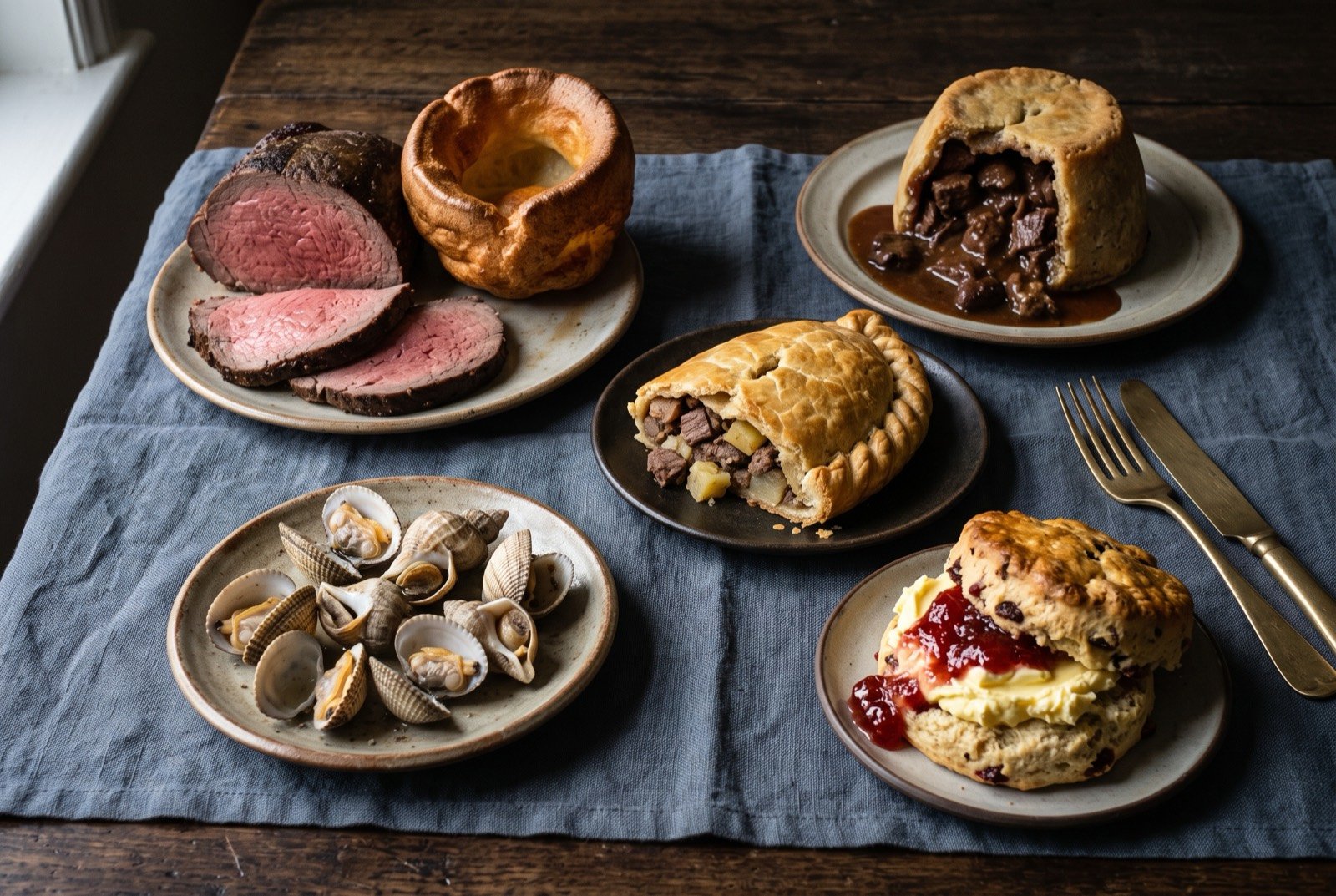
This is the reader's own home cuisine, and this atlas is written for a technically capable British home cook, so it earns more room here than a comparable population would get elsewhere in the book. The volume covers two food worlds stitched into one chapter on trade and identity grounds rather than a single ecological logic, and it says so plainly rather than pretending the join is seamless. London, the Home Counties and East Anglia sit in Britain's lowland zone: flat, fertile, arable land where wheat, sugar beet and market-garden produce dominate, and where London itself functions less as a food-growing region than as the country's oldest and largest trading floor, a place things arrive to be eaten rather than a place they are grown. The West Country, Cornwall, Devon, Somerset and Dorset, sits ecologically closer to Britain's pastoral, upland north than to the arable south it is bound into here: wet, cool, grass-fed, orchard-covered, with a serious Atlantic fishing coast. It belongs in this volume for real reasons, a shared "West Country" market identity, a shared tourism economy, the same county-boundary conventions the region's own protected-status foods use to define themselves, but its rain and its grass, not its position on a map next to Surrey, are what actually built its kitchen. Both halves share one more thing worth naming honestly: this is the only volume in the whole atlas built almost entirely from English-language sourcing, since the reader is not being introduced to a foreign tradition here but shown, with real technique and real history, what he already half knows. Every dish as tradition built it, then what a modern chef would change.
Sources and review · What this chapter does not assert · How we research · Spotted something wrong?
A Sense of Place
London, the Home Counties and East Anglia: a trading floor beside a granary
London has never really grown its own food, and that fact is the whole logic of its cooking. From at least 1400, when Billingsgate received its first royal charter, the city's relationship to fish, meat and spice has been the relationship of a market to its suppliers, not a farmer to his land. Dutch eel boats, "schuyts," supplied live eels to Billingsgate from at least 1412, under a royal concession renewed in gratitude for Dutch crews who fought the 1666 Great Fire; the condition attached to that concession, that at least one eel shop be staffed at Billingsgate at all times, is a small, telling detail of a city organising its food supply as infrastructure rather than agriculture. London's great historic eating institutions, the chop-house and its descendants, grew from exactly this: fast, individually cooked cuts of meat and fish served to a working, trading, professional population that had no time and no land to cook for itself at length.
East Anglia, by contrast, is a granary. The East of England holds around 28% of England's wheat area and roughly a quarter of its barley area, grown on fertile Ice Age boulder clay; the Fens, reclaimed from peat wetland across the seventeenth to nineteenth centuries, alone hold 48% of England's Grade 1 agricultural land. This is mustard country (Norfolk and southern Lincolnshire have supplied Colman's since 1814), sugar beet country (Britain's first beet sugar factory opened at Cantley, Norfolk, in 1912), and market-garden country, asparagus, rhubarb, gooseberries, worked by smallholders around Norwich for three centuries. It is also, along the North Sea coast at Great Yarmouth and Lowestoft, the site of one of the largest fisheries Europe has ever built and then lost: a herring economy so vast that by the early twentieth century Yarmouth alone was landing tens of millions of fish on a single good tide, and that trade's total collapse by the 1960s and 1970s is as much a part of this region's food story as its arrival ever was.
The Home Counties sit between the two, neither Billingsgate's market floor nor East Anglia's granary, a belt of orchard, hop garden and dairy pocket that has historically fed London directly, and that is where several of this chapter's smaller, sweeter dishes, the Sussex pond pudding, the Kentish hop and orchard produce, properly belong.
The West Country: pastoral, wet, and closer kin to the highland north than to the arable south beside it
The historian Cyril Fox, writing in 1932, divided Britain into a Highland Zone and a Lowland Zone, upland, pastoral, stock-rearing Britain against lowland, arable, densely settled Britain, a distinction still cited, and still argued over, in British archaeology and historical geography. It is not a settled consensus; some scholars think it oversimplifies real regional variation, and this chapter uses it as a real, citable piece of intellectual history rather than as an uncontested fact about the land. But it explains, better than any county map does, why the West Country sits oddly beside London and East Anglia in this volume. South West England has an oceanic climate with year-round rain, roughly 800 to 1,000mm a year across Devon and Somerset's lowlands, and up to double that on Dartmoor, Bodmin Moor and Exmoor. That rain is why the region is a genuinely major British dairy region, with the South West supplying somewhere in the region of a quarter of UK milk output, grazed on grass rather than grown on grain, in herds that stay outdoors longer than almost anywhere else in England thanks to a long, frost-light growing season. It is why cider-apple orchards are a distinct, serious land use across Somerset and Devon in a way the arable south east has no equivalent for. And it is why Somerset's own mixed geology, limestone karst and the Mendip Hills, the drained wetland pasture of the Somerset Levels, the Devonian sandstone further west, put Cheddar Gorge's cool limestone caves and the Levels' rich water meadows within a few miles of each other, and gave the region both its cheese and its beef in the same stretch of ground.
The pasty, the clotted cream, the cider and the Cheddar this chapter treats in full all make more sense as products of wet grassland and orchard than of grain country. The atlas keeps them here anyway, for real market and identity reasons rather than an invented ecological fit, and says so rather than pretending otherwise.
The structural logic, at a glance
| London and the Home Counties | East Anglia | The West Country | |
|---|---|---|---|
| Fat | Beef dripping, butter | Butter | Clotted cream, butter, lard |
| Starch | Wheat flour, suet pastry | Wheat, sugar beet | Wheat, potato |
| Protein | Traded in: beef, eel, oysters | Herring, sugar beet, mustard seed | Dairy cattle, sea fish |
| Preserving method | Jellying, pickling in malt vinegar | Salting and cold-smoking (bloater) | Scalding (clotted cream), cheddaring |
| Defining institution | The chop-house, the market | The mustard mill, the herring fleet | The farm dairy, the cider press |
The History in Layers
The chop-house, and London eating as a trade in itself
Chop-houses appear in London from the 1690s: English rather than French in style, serving individual chops or steaks, mostly mutton, fast, with ale or porter and a baked potato, in dark, functional rooms. Simpson's-in-the-Strand began as a chess and cigar house in 1828, gaining its kitchen only in 1848, when caterer John Simpson introduced hearty British dining advised by the chef Alexis Soyer, and its famous silver carving trolleys, devised specifically not to disturb the chess players next door. Rules, on Maiden Lane, opened in 1798 as an oyster bar and is usually cited as London's oldest restaurant, having had only three owners in over two centuries. Both kept trading through the Second World War on rationed five-shilling meals, filled out with the game, venison, rabbit, pheasant, that rationing never touched. This is worth naming as its own historical logic, distinct from the domestic kitchen this chapter otherwise treats: London eating out has, for over three centuries, been a trade unto itself, feeding a city that mostly does not cook for itself, rather than an extension of any single region's farmhouse table.
The herring fleet, and a collapse worth naming honestly
Yarmouth's herring fishery is traceable to Domesday, and by the nineteenth century the town was the largest herring port in the world, with up to 80 million fish landed in a single day in 1907 and around 380,000 tons landed at Yarmouth and Lowestoft combined in the record year of 1913. For roughly a century, from the mid-1800s, Scottish "Herring Lassies" travelled south each September, at peak around 10,000 seasonal workers, to gut and pack the catch by hand, three-woman crews packing some 700 fish a barrel across a ten-hour day. Ninety per cent of the peak catch was exported, chiefly to Germany and Russia, a trade that collapsed after the First World War and never recovered its scale. North Sea herring stock itself then collapsed from over 2 million tonnes of biomass in the 1960s to under 50,000 tonnes by the mid-1970s, entirely from overfishing, forcing a total ban in 1977; the stock has since recovered to roughly a million tonnes, but that recovery came decades after Yarmouth's own fishery had already ended, generally dated to 1963. The bloater, a whole, ungutted, lightly salted, briefly cold-smoked herring, and the last living trace of that trade, is now made by only three surviving traditional smokehouses in the whole Great Yarmouth and Lowestoft area, one of which closed its own bloater production in 2018 after slipping to producing barely a tonne a year. This chapter treats that decline as history, not nostalgia: a fishery this large does not simply fade, and naming why it collapsed, overfishing rather than changing taste, is part of taking the dish seriously.
The eel trade, and the honesty this chapter owes it
London's other great fish trade, eels, has an even more serious modern reckoning attached to it, and this chapter will not soften it. European eel is Critically Endangered on the IUCN Red List, its numbers reaching Europe down somewhere between 90 and 98% since the 1970s, its recruitment at roughly 1% of 1970s levels. It sits on CITES Appendix II; the EU bans its export outside the bloc, yet it remains legal to fish and eat within Britain, a genuine paradox. Glass-eel trafficking is now assessed as one of the world's most lucrative wildlife crimes, an EU-wide law enforcement operation running since 2015 has seized over 100 tonnes, some 327 million eels, and a 2023 UCL and Exeter DNA study of jellied eel products sold in Britain found most contained European eel DNA, with import and export patterns consistent with illegal trafficking somewhere in the supply chain. The dish this trade built, jellied eels, is treated in full below, and this history is why.
The gastropub, the most recent layer
The most recent structural change to English eating happened in one specific room, at one specific moment, for a documentable regulatory reason. In 1989 the government's "Beer Orders" forced large breweries to sell off half their pub estates, flooding the market with cheap leases just as a recession loomed. On 14 January 1991, David Eyre and Mike Belben opened The Eagle in a former Watney's brewery pub on Farringdon Road, serving River Café-calibre food, chalked on a blackboard, cooked to order in an open kitchen, in an unpretentious room with mismatched furniture. Food writer Charles Campion later coined the word "gastropub" to describe what The Eagle had started; the word did not exist when the room opened. Three decades on, the category has genuinely split: a first wave normalised serious cooking in an ordinary pub room, and by the early 2010s the trade press was declaring "the gastropub is dead" as the word itself curdled into marketing shorthand; a second wave, The Devonshire in Soho and the Michelin-starred Harwood Arms in Fulham among the clearest current examples, has pushed the kitchen back to the centre of the room, sometimes eclipsing the pub itself as the reason to walk in. This layer sits directly behind several of the modernist versions in this chapter's dishes.
The framework this chapter leans on
One more layer belongs here, quieter than the others but structurally important to how this chapter is written: the Protected Geographical Indication and Protected Designation of Origin registrations that now define several of this region's foods in exact legal terms. The Cornish Pasty PGI, the West Country Farmhouse Cheddar PDO and the Cornish Clotted Cream PDO are not marketing labels; they are registered specifications, held by DEFRA, that state precisely what ingredients, methods and geography a food must meet to carry its name. This chapter draws on those specifications directly, rather than on secondary paraphrase, wherever they exist, because they are unusually good primary sources for a home-market British volume: written to be checked, not to be sold.
The Flavour Arsenal
Fats: dripping, suet, clotted cream
Beef dripping, the rendered fat saved from a roasting joint, is the base fat of English roasting and, historically, of the chip shop fryer, giving a depth no vegetable oil replicates. Suet, the hard fat from around beef kidneys, is a structural ingredient rather than a flavouring one: grated cold into flour with a little salt and water, it melts during steaming to leave a light, slightly spongy crumb quite unlike a rolled shortcrust, and it is the single ingredient responsible for the entire steamed pudding family, sweet and savoury alike. Clotted cream, treated in full in the dishes below, is West Country dairy taken to its furthest point: a minimum 55% butterfat cream, under Cornwall's own Protected Designation of Origin, scalded slowly rather than whipped or churned.
Starches: wheat, and the potato that arrived late
Wheat carries almost everything in this chapter's pastry work, shortcrust for a pie lid, a stiffer, longer-rested dough for a pasty, suet-bound flour for a pudding, each a genuinely different structural choice rather than interchangeable "pastry." The potato, by contrast, is a comparatively late arrival to English cooking, not in wide domestic use until well into the eighteenth century, and it now underpins the mash beneath a pie, the wrinkled centrepiece of a West Country supper further west in this atlas's Iberian volumes, and, cut and double-fried, the other half of the country's most famous plate.
Preserved and cured protein: the herring family, and the honest question over eels
The bloater, the kipper and the red herring are one fish treated three different ways, and the differences are not cosmetic. A bloater is left whole and ungutted, its own retained pancreatic enzymes lightly ripening the flesh during a brief salt cure of perhaps twelve to eighteen hours, then cold-smoked for a period sources genuinely disagree on, anywhere from about four hours to well over a day; a kipper is split and gutted before a similar cure and an overnight smoke; a red herring is heavily salted and cold-smoked far longer still, up to two or three weeks, for a fish that will keep for months rather than days. Jellied eels sit in the same family of London preserved fish, but this chapter's arsenal entry for eel carries a caveat none of the others need: buy Lough Neagh eel specifically, PGI-protected and managed, where it can be found, rather than an unlabelled "eel" that may carry no such guarantee at all, and treat the whole category as an occasional dish rather than an everyday one, for the species' own sake.
The condiment shelf: English mustard, and why it differs from Dijon
English mustard is a blend of brown mustard seed (Brassica juncea) and white or yellow seed (Sinapis alba), milled and silk-sifted separately, then blended, with no vinegar, wine or sugar added at manufacture. Its heat comes from glucosinolates, sinigrin in the brown seed, sinalbin in the white, both inert until ground seed meets cold water, which activates the enzyme myrosinase and releases the pungent isothiocyanate oils responsible for the burn. Heat destroys that enzyme, which is the entire reason English mustard powder is mixed fresh with cold water rather than hot, and loses its punch within minutes of standing. Dijon, by contrast, is made with verjuice or dry white wine, ground to a smooth paste and briefly fermented, giving a sharper but faster-fading heat from a genuinely different chemical route. Malt vinegar, the other fixture of this arsenal, needs no more explanation than its ubiquity at a chip shop counter demands.
The cheese and cider shelf
West Country Farmhouse Cheddar, under its own Protected Designation of Origin, is hand-cheddared, cloth-bound, larded and matured a minimum of nine months in Cornwall, Devon, Dorset or Somerset; it shares a name, and nothing else legally protected, with the genericised "cheddar" sold worldwide, a word that escaped into the language as a manufacturing process rather than staying a place-bound recipe, decades before any protection regime existed to stop it. Cider apples split into four families on tannin and acid alone: sweet, sharp, bittersweet (Dabinett, Yarlington Mill, the backbone of most blended West Country cider) and bittersharp (Kingston Black, from Somerset, prized above all for cider made from one variety alone). "Real cider," under CAMRA's own definition, is fermented from the whole juice of fresh-pressed apples with no concentrate and no added sugar; several familiar "West Country" cider names do not in fact meet that bar, a distinction worth knowing before buying.
The Technique Ladder
The argument, from inside
Every technique in this chapter rewards the same thing this atlas keeps finding wherever it looks properly: patience with heat, and a refusal to fake with a shortcut what slow, correct method actually earns. None of it is exotic. All of it is precisely the kind of unglamorous correctness a technically capable home cook, with the kit this atlas assumes, can genuinely reproduce, and a good deal of it is exactly what separates a careful version of these dishes from the careless, corner-cut version this country has spent the last few decades getting a reputation for.
Rung 1. Steam in suet, and trust the fat to do the work
Grated cold suet worked into self-raising flour with a little salt and cold water gives a pastry that behaves nothing like a rolled shortcrust: it does not want to be handled much, and it does not want direct oven heat. Sealed into a pudding basin and steamed, gently, for hours rather than baked, the suet melts slowly through the surrounding flour and moisture in the steamer's air keeps the crust from drying out, producing a light, faintly spongy crumb that a hot, dry oven simply cannot make from the same dough. Rush the steam, or try to bake a suet pudding instead, and the fat renders out too fast, leaving a tough, greasy crust rather than a tender one.
Rung 2. Roast slow, baste in dripping, and build the gravy from the fond left behind
A proper roast joint depends on rendered fat repeatedly basted over the meat as it cooks, carrying Maillard-browned flavour back onto the surface and keeping it from drying under a low, steady heat; the gravy that follows is not a separate recipe so much as the direct continuation of the same process, the roasting tin's fond, the browned, caramelised residue stuck to the pan, deglazed with wine or stock and reduced while the meat rests. A gravy made from a jug of granules rather than a real fond is not a shortcut version of the same dish, it is a different, much weaker one, because there is no fond flavour in it to reduce.
Rung 3. Fill raw, and choose the cut and the cut size for cooking-time parity
A pasty and a stargazy pie share a genuine structural discipline most home bakers skip: the filling goes in raw, and the whole dish cooks through together inside a sealed or part-sealed pastry case during one bake. That only works if everything inside reaches doneness at roughly the same rate, which is why the Cornish Pasty Association specifies beef skirt over any more prized cut: skirt has little fat and no gristle, and critically, it cooks through in the same time as diced raw potato and swede, so a firm, waxy potato variety is specified for the same reason a floury one would collapse over the bake. Treat the filling's cut and dice size as a genuine engineering decision, not a matter of taste alone.
Rung 4. Batter cold, fry twice, and judge doneness by more than colour
A proper chip is fried twice: first at a lower temperature, around 120°C, to cook the potato through without colouring it, then rested, then finished at a much higher temperature, around 190°C, purely to crisp and colour the surface in the last few minutes. A good beer batter, kept cold and used immediately rather than left to stand, relies on carbon dioxide from the raising agent and the chill of the batter itself to stay light and shatter-crisp rather than turning heavy and doughy the moment it meets hot fat. Both principles reward the same underlying discipline as everywhere else in this ladder: manage heat and time deliberately, rather than trusting a single fry or a warm batter to do a job that genuinely needs two stages.
Rung 5. Scald slowly, cheddar by hand, and let time do what a shortcut cannot
Clotted cream depends on scalding, not boiling, cream at 70 to 80°C for a minimum of an hour, under the Cornish PDO's own specification, during which a thick crust forms as the fat concentrates, before a slow chill to below 5°C sets it. West Country Farmhouse Cheddar depends on an equivalent patience applied to curd rather than cream: cutting, scalding at a controlled 39 to 41°C, then cheddaring, the repeated turning and stacking of slabs of curd by hand to expel whey mechanically, followed by milling, salting and a minimum nine months' ageing in cloth. Neither process can be meaningfully sped up. A cream boiled too hot splits rather than clots; a curd cheddared too briefly, or matured too fast, never develops the depth either specification exists to protect.
Rung 6. Give it seconds of direct fire, not minutes through it
Borrowed by direct analogy from the wood-fired grills now driving some of London's most current cooking, BRAT's whole turbot over open flame, Ekstedt's entire menu built on it, this is the modern layer's own contribution to the ladder: a very short, very hot, direct exposure to open flame or hot coals drives the Maillard reaction across a surface alone, in seconds, laying down char and smoke without cooking the interior any further. This chapter borrows the logic rather than claiming any named West Country or London chef applies it to the specific traditional dishes treated below; state that plainly wherever the modernist version below leans on it.
The Technique and Preserve Bench
1. Real Cider Fermentation
Genuine West Country cider is fermented from the whole juice of fresh-pressed apples, traditionally a blend of bittersweet and bittersharp varieties (Dabinett, Kingston Black), with no added sugar and no reconstitution from concentrate, the CAMRA definition of "real cider" that several familiar commercial names do not in fact meet. Wild, ambient-yeast fermentation is still used by some small farmhouse producers, alongside "keeving," a slower, temperature-managed method that starves the yeast to leave natural residual sweetness without adding sugar at all.
2. Cheddaring and Affinage
Covered in full under the technique ladder above: cut, scald, cheddar by hand, mill, salt, cloth-bind and age a minimum of nine months. The single technique this chapter's honesty about "cheddar" depends on, since almost none of what carries that name worldwide has been through it.
3. Herring Curing: the Bloater, the Kipper and the Red Herring Family
One fish, three genuinely different cures: the bloater left whole with its gut retained for a brief salt cure and enzymatic ripening; the kipper split, gutted and smoked overnight; the red herring heavily salted and smoked for weeks rather than hours. Not a home technique for most readers given how few working smokehouses remain, but worth understanding for what it changes about buying: only three traditional chimney and kiln smokehouses still operate in the whole Great Yarmouth and Lowestoft area, and a "smoked" label on an industrially produced product guarantees none of this.
4. English Mustard: Cold Activation
Covered under the Flavour Arsenal above. The only home technique on this list a reader can reproduce perfectly with no special kit at all: mix mustard powder with cold water alone, at the point of use, and use it within minutes, since the enzyme responsible for its heat is destroyed by warmth and fades within the hour regardless.
Sourcing in Britain: finding the genuine article
Verified late August 2026. Because this is a home-market volume, the task here is not diaspora sourcing but naming the genuine article against a landscape of supermarket imitation, and being honest about where that genuine article does not currently have an obvious reference producer at all.
The ranked list: what decides great from grim
- West Country Farmhouse Cheddar, by maker's name rather than by the word "cheddar" alone. Look for Montgomery's, Keen's, Westcombe or Quicke's, cloth-bound rather than shrink-wrapped, a natural creamy colour rather than the deep orange of added annatto. Neal's Yard Dairy, Paxton & Whitfield and La Fromagerie all stock the genuine article; a supermarket "mature cheddar" block, whatever its label claims, has not been through nine months of hand-cheddaring in cloth.
- A genuinely certified Cornish pasty, mail-ordered from a named bakery rather than a motorway services. Chough Bakery, Padstow, and Ann's Pasties, Helston, both ship nationwide. Be aware that Ginsters and West Cornwall Pasty Co. carry the same genuine PGI certification, since the designation protects geography and method, not artisan scale, an honestly uncomfortable fact worth knowing before assuming any big name is automatically the lesser choice or any small one automatically the better.
- Rodda's Cornish clotted cream, PDO-protected and, unusually for this list, mainstream-available in most supermarkets. For Devon clotted cream, no single reference producer equivalent to Rodda's was confirmed in researching this chapter; buy from a named farm dairy rather than a generic "Devon cream" own-label.
- Real cider from a named farmhouse producer, Sheppy's or Burrow Hill/Somerset Cider Brandy Company, rather than assuming any big regional cider name automatically qualifies; several familiar West Country brands are made partly or wholly from concentrate and do not meet CAMRA's own "real cider" definition.
- Whitstable oysters, ideally eaten in Whitstable itself. Simply Oysters ships both wild native and farmed rock oysters with next-day delivery, but live shellfish genuinely travels less well than eating it at the source.
- Bloaters and traditional smoked herring, while the trade still exists. Only three chimney and kiln smokehouses remain in the whole Great Yarmouth and Lowestoft area; The Old Smokehouse, Lowestoft, dating from 1760, is the oldest working example, selling kippers, bloaters and red herring direct from the shop.
- Colman's mustard, named honestly as a supermarket staple rather than a locally sourceable artisan product. Norwich production ended in 2019 to 2020; the mustard itself is now made in Burton upon Trent and Germany, and the brand was reportedly up for sale as part of a Unilever and McCormick deal as of August 2026, worth checking for resolution.
- Jellied eels, bought only from a genuinely surviving specialist, and with the sustainability caveat above kept firmly attached. M. Manze, trading since 1902, remains open at three London locations as of this research, though its Deptford branch closed permanently in January 2025.
Kit notes for this volume
A cheese press is genuinely necessary for a reader attempting a home Cheddar; Moorlands Cheesemakers supplies a UK-based hard cheese kit including mould and follower. Clotted cream needs no dedicated purchase, a wide roasting tray as a water bath and a shallower dish for the cream, no more than about 4cm deep, will do, but a reliable thermometer is not optional, since the entire technique depends on holding 70 to 80°C without ever reaching a boil. The Big Green Egg, run hot for a genuinely short exposure, is the honest domestic route to Rung 6's borrowed live-fire technique, though this chapter is explicit that no named West Country or London kitchen currently applies it to the specific dishes treated above.
Voices and Sources
From inside the tradition
- Fergus Henderson, St JOHN, Smithfield. Opened 1994; codified nose-to-tail eating in his 1999 book Nose to Tail Eating: A Kind of British Cooking, and remains this chapter's clearest single reference point for what serious modern English cooking looks like when it takes offal and traditional cuts seriously rather than apologetically.
- Brett Graham, The Ledbury, Notting Hill. Three Michelin stars; runs his own deer farms supplying both his own kitchen and the Harwood Arms, a genuinely traceable modern supply chain behind a modern British menu.
- Hugh Fearnley-Whittingstall and Gill Meller, River Cottage, Devon and Dorset border. Fearnley-Whittingstall's move from London to a Dorset gamekeeper's cottage, televised from 1999, is the clearest single origin point for West Country farm-to-table cooking as a movement rather than an individual restaurant; Meller's own cookbook Gather organises West Country ingredients by landscape rather than by course, a genuinely useful structural idea this chapter has borrowed from directly.
- Nathan Outlaw, Port Isaac, Cornwall. Two Michelin stars, an explicit minimal-intervention philosophy on Cornish seafood, author of Nathan Outlaw's British Seafood.
- Paul Ainsworth, Padstow, Cornwall. One Michelin star, Cornish produce with a playful, classically trained hand.
- Justin Gellatly, formerly St JOHN Bakery, later Bread Ahead, Borough Market. The clearest direct lineage between St JOHN's own bakery and Britain's wider bread and doughnut revival.
- The Cornish Pasty Association, and Farmhouse Cheesemakers Ltd, the trade bodies behind the Cornish Pasty PGI and West Country Farmhouse Cheddar PDO respectively, whose own registered specifications, held by DEFRA, are the strongest primary sources behind this chapter's pasty and cheese sections.
- Jonathan Jarrett, medieval historian, for the single best piece of critical sourcing behind this chapter, his direct debunking of the Tavistock Abbey cream-tea origin story against the abbey's own primary archive.
- Neil Buttery, British Food: A History, and the Dorset History Centre's own archival blog, both used repeatedly across this chapter for careful, source-attentive British food history of a kind genuinely harder to find than it should be.
- London Museum, for London's pie, mash and eel trade history, and the Slow Food Foundation's Ark of Taste, for bloaters and saffron cake.
Things this chapter has deliberately not asserted
- The arsenic-and-crimped-handle story for the Cornish pasty, as settled fact. Even the pasty's own PGI specification presents it only as "the most popular" of several stories, with no cited primary source behind it, and this chapter follows that lead rather than inventing its own debunking.
- The Tavistock Abbey, AD 997, origin of the Devon cream tea. A named medieval historian checked the abbey's own primary archive and found no trace of the story; it appears to originate in an unattributed 2004 article and should not be repeated as history.
- Any documented age or origin for the jam-first-versus-cream-first cream tea rivalry. The regional split itself is real and current, evidenced by the National Trust's own public apology over the question, but no source found dates the divergence earlier than modern, tourism-era rivalry, and the practical "different traditional bread" explanation offered for it is plausible folk-reasoning, not sourced history.
- Tom Bawcock's Eve as sixteenth-century history. The earliest documentary trace of the festival dates to a 1927 folklore magazine article describing a turn-of-the-century celebration, not a documented sixteenth-century famine or a named historical fisherman; the widely told storm-and-famine story should be presented as legend.
- A single settled origin for Cornish saffron, Phoenician, Roman or medieval Spanish trade routes are all claimed by different sources with no consensus among them, and this chapter treats the whole trade-origin question as a live, contested legend rather than picking one version to assert.
- Romney Marsh lamb as a Protected Geographical Indication or Designation of Origin product. It holds neither; the comparable protected British salt-marsh lamb is Gower Salt Marsh Lamb, in Wales, a different product from a different place, and this chapter does not confuse the two.
- Any currently operating Michelin-level restaurant built specifically around elevating jellied eels or pie and mash. None was found in researching this chapter; where the modernist thread needed an anchor for these two dishes, it was built from documented technique and honest sourcing rather than an invented restaurant example.
- The Ethicurean and Mark Hix's Oyster & Fish House, Lyme Regis, as currently operating restaurants. Both closed within the last two years, and this chapter treats them as important recent history rather than a current recommendation.
- Any single traditional recipe with real quantities for stargazy pie or Cornish saffron cake, unlike the pasty, no trade-body or historically sourced recipe with credible provenance was found for either, and the versions given above are built from the well-documented structural core of each dish rather than presented as a traced historical original.
- A precise seed ratio or flour proportion for Colman's mustard. Searched for specifically and not found; it appears to be genuinely undisclosed by the manufacturer, and this chapter does not invent a figure.
- A single bloater curing time. Sources found in researching this chapter conflict by close to an order of magnitude, and this chapter presents a range rather than a false precision.
- That today's jellied eels are reliably, legally sourced. The evidence, a 2023 DNA study finding widespread European eel content in UK products against a documented trafficking problem in the wider glass-eel trade, points the other way, and this chapter has not softened that finding for the sake of the dish's charm.
Steam in suet, and trust the fat to do the work
Grated cold suet worked into self-raising flour with a little salt and cold water gives a pastry that behaves nothing like a rolled shortcrust: it does not...
Roast slow, baste in dripping, and build the gravy from the fond left behind
A proper roast joint depends on rendered fat repeatedly basted over the meat as it cooks, carrying Maillard-browned flavour back onto the surface and keeping...
Fill raw, and choose the cut and the cut size for cooking-time parity
A pasty and a stargazy pie share a genuine structural discipline most home bakers skip: the filling goes in raw, and the whole dish cooks through together...
Batter cold, fry twice, and judge doneness by more than colour
A proper chip is fried twice: first at a lower temperature, around 120°C, to cook the potato through without colouring it, then rested, then finished at a much...
Scald slowly, cheddar by hand, and let time do what a shortcut cannot
Clotted cream depends on scalding, not boiling, cream at 70 to 80°C for a minimum of an hour, under the Cornish PDO's own specification, during which a thick...
Give it seconds of direct fire, not minutes through it
Borrowed by direct analogy from the wood-fired grills now driving some of London's most current cooking, BRAT's whole turbot over open flame, Ekstedt's entire...
The dishes
- Roast Beef and Yorkshire Pudding England
- Steak and Kidney Pudding England
- Pie and Mash with Liquor London
- Jellied Eels London
- Fish and Chips England
- Cornish Pasty Cornwall
- Stargazy Pie Cornwall
- Cornish Cream Tea Cornwall
- Eton Mess Berkshire
Sources and review
- Researched
- 9 sources cited
- Reviewed
- Not yet reviewed from inside the tradition
- Cooked
- Not yet cooked and reported
Where this volume comes from
3 research briefs on file for this volume, researched to the rules on How we research. Published 28 August 2026. Last changed 8 September 2026.
The brief's own account of its sources
This is a home-market British topic, so the atlas's local-language search rule does not apply the way it does elsewhere; all sourcing is English-language, as instructed for this volume. Rough source-quality split across both parts of this brief: Primary and official (strongest tier, read in full): the actual DEFRA and EU product specification PDFs for Cornish Pasty PGI, Cornish Clotted Cream PDO and West Country Farmhouse Cheddar PDO, fetched and read as complete documents rather than summaries, form the backbone of the West Country pasty, cream and cheese sections.