Europe · Volume 37
The New British Table
South Asian and Caribbean Britain
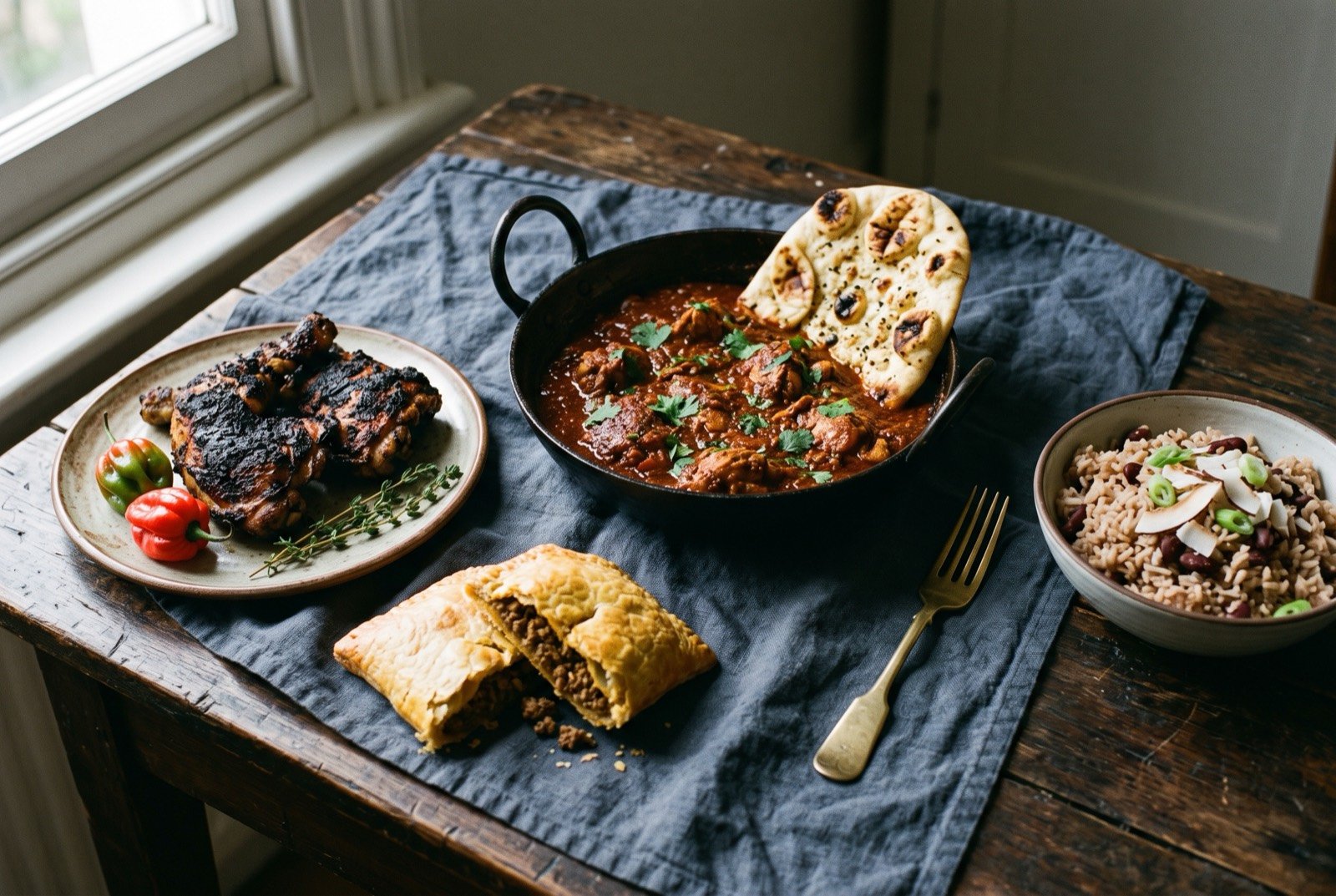
Two food worlds invented in Britain by people who came from somewhere else, and given here the same explicit, named weight this atlas gives Indigenous Australian or Māori food elsewhere, not folded as a footnote into a chapter about England. The chicken tikka masala on a curry house menu and the beef patty on a Peckham high street were not carried here fully formed. They were built here, mostly by Sylheti Bangladeshi restaurateurs and by the Windrush generation and its children, out of memory, necessity and a British customer's expectations, and they are British dishes in their own right even where their techniques and spice logic reach back to Bengal, the Punjab and Jamaica's Cockpit Country. Every dish as tradition built it, then what a modern chef would change: once as the trade or the household actually built it, once rebuilt with modernist technique.
Sources and review · What this chapter does not assert · How we research · Know this better? Tell us
A Sense of Place
The Sylheti East End and the second migration nobody counted twice
South Asian Britain, for the purposes of this chapter, is overwhelmingly a Bangladeshi story, and specifically a Sylheti one. Men from Sylhet, in northeastern Bangladesh, had worked as lascars, deckhands and cooks, on East India Company and later British merchant vessels since at least the seventeenth century, a role tied to Sylhet's place in the tea and jute trade and its river network into Calcutta's docks. The numbers were real long before Windrush entered anyone's vocabulary: roughly 5,000 to 6,000 lascars employed annually on British ships in the 1850s, over 50,700 crewing British merchant vessels by 1938, an estimated 50,000 Indian seamen passing through British ports every year between 1900 and 1947. Many jumped ship or were simply abandoned once a contract ended, and settled near the docks despite legislation built specifically to stop them, the Lascar Act of 1823, the Merchant Shipping Act of 1894, the Coloured Alien Seamen's Order of 1925. By 1943 an estimated 500 to 600 Sylhetis lived in London, nearly all ex-seamen, working as caterers, cleaners, kitchen porters and washers up. Ayub Ali Master's Shah Jalal Restaurant and Coffee House, opened in the East End in 1920, is the earliest named establishment in this whole story, and it doubled as a community and political meeting place as much as a cafe.
The trade's real scale came later, in two further waves: settlement following the British Nationality Act 1948, which gave Commonwealth citizens the right to live and work in Britain, and a second, larger wave after Bangladesh's independence war in 1971. This chapter states the general pattern rather than a tidy single cause: Sylhet's seafaring and remittance economy was already established well before 1971, and independence reinforced rather than started the flow. What is not in question is the outcome. By the early 1970s more than three-quarters of Indian restaurants in Britain were owned and run by Bangladeshi migrants, overwhelmingly from Sylhet, and the figure held above 80 per cent through the 1990s before beginning a real, documented decline: around 85 per cent British Bangladeshi-owned by 1998, down to about 65 per cent by 2003. The Bangladesh Caterers Association, founded in 1960 by Israel Miah, still represents an estimated 12,000 of Britain's roughly 12,000 to 12,500 curry restaurants and takeaways, a figure that tells you how completely one small corner of one country built an entire national institution.
Southall, a different South Asian Britain entirely
It matters that this is not the only South Asian Britain, and the chapter says so plainly rather than letting the curry house stand in for the whole subcontinent. Southall, in west London, is a Punjabi Sikh settlement, not a Bengali one, the primary point of arrival for Punjabi Sikhs from the 1950s onward: station signage runs bilingual in English and Gurmukhi, and the Sri Guru Singh Sabha Gurdwara there is among the largest outside India. Its Broadway is built on sari shops, jewellers and sweet centres rather than restaurants, a genuinely separate retail and religious world from the Sylheti East End, sharing a subcontinent but very little else in terms of trade, migration route or reason for being in Britain at all.
Windrush, and a Caribbean Britain built around the same three things: a dock, a market and a Sunday table
HMT Empire Windrush docked at Tilbury on 22 June 1948, carrying the first large wave of Caribbean migrants filling postwar labour shortages under the same British Nationality Act that drew Sylhetis into permanent settlement. Migration continued through the 1950s and 1960s until the Commonwealth Immigrants Act of 1962 restricted it. The difficulty of finding familiar food is documented well before Windrush itself: Jamaican poet Una Marson's 1937 poem "Quashie comes to London" laments missing breadfruit, ackee and saltfish, and dumplings, and postwar novelists, George Lamming, Samuel Selvon, wrote the same complaint into fiction through the 1950s. Caribbean migrants were largely housed around Brixton, and Brixton's markets became the commercial and social heart of the new community, grocers and butchers selling rice, dried codfish, ackee and fruit that no English greengrocer stocked. Ridley Road Market in Dalston, already a century old by then, took on the same role from a different direction, and its Caribbean traders faced real, violent racism through the 1950s and 1960s, the market itself becoming a site of anti-fascist organising rather than simply a place to shop.
Rice and peas, red kidney beans and coconut milk, became the default Sunday dish of Windrush households specifically because a Sunday roast was never going to be it, and a genuinely small, well-evidenced technological detail matters here: when pressure cookers became common in postwar British homes, Windrush families used them to tenderise dried peas fast enough that a proper Caribbean meal became possible on a weeknight for someone working shifts, not only on the one day a week with time to spare.
The structural logic, at a glance
| South Asian Britain, the curry house trade | Caribbean Britain, the Windrush table | |
|---|---|---|
| Who built it | Overwhelmingly Sylheti Bangladeshi restaurateurs | The Windrush generation and British-born Caribbean children |
| The founding pressure | A British customer's palate and a small kitchen's need for speed | Homesickness, and British shops with nothing familiar on the shelf |
| The technology that made it work | The base gravy, batch-cooked once, finished many ways | The pressure cooker, and later the chest freezer |
| Where it still concentrates | Brick Lane, in real decline; Birmingham's Balti Triangle | Brixton and Ridley Road markets; Notting Hill Carnival |
| The unresolved argument | Whose recipe, whose invention, whose name on the dish | Whether the commercial version (Turtle Bay) can stand in for the community's own cooking |
The History in Layers
The curry house as a British invention, built by people who mostly weren't Indian
The single most important fact for a reader to hold through this whole section is that the British Indian restaurant is, in the overwhelming majority of cases, a Bangladeshi institution wearing an Indian name, because "Indian restaurant" sold better to a British customer in the 1960s and 1970s than "Bangladeshi restaurant" did, and because the trade itself grew out of that earlier Sylheti seafaring and catering diaspora rather than out of any wave of migration from India proper. The scale of Bangladeshi ownership above is real and repeatedly documented, though this chapter is careful about the precise figures: a widely repeated claim that over 90 per cent of British curry houses are Bangladeshi-owned traces back to Guardian food writer Bee Wilson's reporting, and a further claim that 95 per cent of those owners come specifically from Sylhet could not be traced to anything beyond aggregated repetition. The direction and rough scale of the fact are solid. The decimal-point precision often attached to it is not, and this chapter will not pretend otherwise.
What that trade is currently living through is a genuine crisis, not a slow, comfortable decline. The Bangladesh Caterers Association's last full survey, in 2008, counted around 12,000 curry restaurants and takeaways; industry estimates by 2023 put closures since then at 3,000 to 4,000 establishments. Yawar Khan, chairman of the Asian Catering Federation, has predicted half of Britain's curry houses will close within a decade. On Brick Lane specifically, curry restaurants fell from 35 in 2014 to 18 by 2021, two of them never reopening after Covid lockdowns. The cause is not customer taste turning elsewhere. It is a 2015 UK immigration rule requiring restaurants sponsoring a non-EU chef's visa to meet a minimum salary threshold, cited at £29,500, against an industry average nearer £22,000, on top of roughly £6,000 in solicitor's fees, an Immigration Skills Charge, a healthcare surcharge, and a nine-month wait, all to bring in a single specialist cook. Niaz Caan, executive chef at City Spice on Brick Lane, put it plainly: "Now you don't even get one phone call... If we could source chefs from this country we would, but we have tried numerous times." Bodrul Islam, of Star of India in Northampton, more plainly still: "We just stopped trying." Layered on top of the visa problem is a generational one: the children and grandchildren of the men who built this trade have, in large numbers, chosen not to inherit it, reaching instead for professions their parents worked precisely so they could afford to choose. This reached Parliament itself, in the form of a formal Early Day Motion on curry house closures. A chapter about this cuisine written in 2026 is, honestly, describing a trade at real risk of disappearing within a generation, not one settled comfortably into the national furniture it appears to occupy.
The Birmingham balti: three restaurants, one invention, no agreed inventor
The balti's origin is a genuinely, currently unresolved three-way dispute, and this chapter presents it as exactly that rather than choosing a winner. Adil's, on Stoney Lane in Sparkbrook, opened in 1977 styling itself "the home of Balti Cuisine" and claiming Kashmiri roots for the method; sources cannot even agree on its founder's name, some giving Rashid Mahmud, others Mohammed Arif, an inconsistency this chapter states rather than resolves. Al-Faisal's traces to Chaudhry Ajaib, whose representative has said plainly: "When we started, we brought the baltis over from abroad." Imran's traces to Mohammed Afzal Butt, who arrived with his family in 1967 and converted a clothing shop bought in 1981 into a balti house. The dish's first known appearance in print is a 1982 mention in the local community newspaper, the Balsall Heathan, later than any of the three restaurants' own founding dates, which tells you something about how long an invention can circulate before anyone writes it down.
Serious food writers doubt the Kashmiri framing entirely. Historian Colleen Taylor Sen has stated plainly that food in Baltistan, the region the dish's name may or may not actually reference, "bears no resemblance" to a Birmingham balti curry. Scholar Ziauddin Sardar called the whole invented lineage "a triumph of marketing" aimed squarely at white British customers, and Madhur Jaffrey, in 2014, dismissed it outright as "a craze with no authentic origins." Local balti historian Andy Munro offers the more useful, less romantic explanation: the inventor, whoever he was, "wanted to attract white Brummies and knew they would want quick service and meat off the bone, as opposed to the Pakistani custom" of cooking it on the bone. What is not in dispute is the mechanics: a thin, flat-bottomed pressed steel or carbon-steel pan, two flat handles, high heat, roughly ten minutes' cooking, vegetable oil rather than ghee, and no separate serving dish at all, the balti cooked and eaten from the same vessel, scooped up with naan rather than spooned over rice, in what one source calls "the Birmingham scoop." The pan itself is credited to a named Birmingham engineer, Santokh Singh, per a local housewares proprietor's own account. The Balti Triangle, Sparkbrook, Balsall Heath and the Moseley fringe, reportedly peaked at 30 to 40 balti houses in the 1990s, and is now, like the wider curry trade, in real decline, an unsuccessful bid for UK or EU protected-name status having gone nowhere.
Chicken tikka masala, and the confession that should reframe how this whole subject gets written about
The most repeated origin story credits Ali Ahmed Aslam, owner of Shish Mahal on Glasgow's Gibson Street, who opened the restaurant in 1964: a customer in the early 1970s complained his chicken tikka was too dry, and Aslam improvised a gravy from spices, cream and a tin of Campbell's condensed tomato soup, which he reportedly kept in for a stomach ulcer. Aslam died in December 2022, aged 77, and his obituary ran internationally still repeating the story.
Here is the fact that should genuinely change how a reader treats every neat, colourful origin story in this entire cuisine. Restaurateur Iqbal Wahhab, Bangladeshi-born founder of the trade magazine Tandoori and later of the Cinnamon Club and Roast, has stated on his own website that he and the late food historian Peter Grove invented the specific tomato soup detail themselves, in the 1990s, to satisfy journalists who kept asking for the dish's history, reportedly after a couple of bottles of wine. In his own words: "I made it up and I love the fact that people to this day quote this story back to me as if they've unearthed some great revelation." He has separately admitted fabricating a second, equally durable claim, that London has more Indian restaurants than Delhi and Bombay combined, a line later repeated uncritically by Boris Johnson as Mayor of London. This chapter treats both as invented and repeats neither as fact. It is worth being honest, too, about a loose end even this confession doesn't tidy up: Wahhab's own site places his fabricated tale in "a northern English restaurant," not explicitly Glasgow, while the press reporting of his admission frames it as specifically undermining the Shish Mahal story, and those two accounts do not fully agree with each other.
Strip the soup story away and what remains is genuinely unresolved rather than genuinely solved. Sultan Ahmed Ansari, of Glasgow's rival Taj Mahal restaurant, claimed to have created the dish in the 1950s, before Aslam's restaurant even opened, and Peter Grove himself, elsewhere, is on record saying the dish existed years before Shish Mahal's founding. The Multicultural Handbook of Food, Nutrition and Dietetics attributes its creation to Bangladeshi chefs generally, who ran most British Indian restaurants through the 1960s, and Peter and Colleen Grove's own scholarly conclusion, published separately from Wahhab's confession, holds it "was most certainly invented in Britain, probably by a Bangladeshi chef." Historian Lizzie Collingham's Curry: A Tale of Cooks and Conquerors dates the arrival of tandoor ovens in British Indian restaurants to 1968, which is the real technical precondition for chicken tikka existing as a menu item at all, suggesting a gradual, distributed invention across several kitchens rather than one clean moment in one restaurant. This chapter's honest position, and the only one the evidence actually supports, is that the dish has several plausible parents and no provable single one.
What is fully documented, and does not need hedging, is what the dish was made to mean. On 19 April 2001, Robin Cook, then Foreign Secretary, told the Social Market Foundation: "Chicken tikka masala is now a true British national dish, not only because it is the most popular, but because it is a perfect illustration of the way Britain absorbs and adapts external influences. Chicken tikka is an Indian dish. The masala sauce was added to satisfy the desire of British people to have their meat served in gravy." He used the dish deliberately, to argue for a civic rather than ethnic idea of Britishness. The speech was not universally welcomed at the time. Iqbal Wahhab himself questioned whether curry houses represent genuine multiculturalism or simply reflect British assumptions about India dressed in minarets and pub-style banquette seating, and some Indian chefs objected to a framing that treated the dish as something white Britain had appropriated rather than something genuinely, jointly made. A 2009 campaign by Glasgow MP Mohammad Sarwar to have the dish formally recognised, by Parliament and separately by the EU, as a Glasgow invention went nowhere on both counts, "precisely because," as more than one report put it, "no one could prove it was theirs."
Jerk, the Maroons, and a technique built to hide, not to advertise
Jerk chicken's history is real documented history, not folklore repeated until it hardens into fact. Jamaican literary scholar Carolyn Cooper describes jerk as one of the enduring legacies of the fusion of African and Taíno cultures in Jamaica. After the British took the island from Spain in 1655, Maroons, Africans who had escaped enslavement, claimed freedom in Jamaica's mountainous interior and settled among the surviving Taíno, who shared their own food knowledge in turn. Chef Gariel Ferguson describes the traditional method precisely: escapees hunted wild boar, seasoned it with pimento, salt and bird peppers, wrapped it in pepper elder leaves, and cooked it in an underground pit built specifically to produce no visible smoke, because a fire's smoke would have betrayed exactly where a community hiding from recapture was located. This is the whole argument of this atlas in miniature: a technique invented under genuine existential pressure, later becoming a dish people choose to eat for pleasure rather than one that once kept them alive.
The dish's route into Notting Hill Carnival runs through a different, later and equally real history of pressure. In 1958, Notting Hill saw sustained racist attacks on its Black residents; in 1959, the murder of Antiguan carpenter Kelso Cochrane prompted Trinidadian activist Claudia Jones, founder of the West Indian Gazette, to organise the first indoor Caribbean carnival, at St Pancras Town Hall, in direct response. Jones ran it annually until her death in 1964. The street carnival most people now picture began in 1966, when social worker Rhaune Laslett organised a festival aimed at local children and community cohesion, drawing in Trinidadian steelpan players whose music pulled Caribbean residents out into the street. By 1976, attendance had passed 150,000, alongside real tension with police over the "sus" law. Jerk chicken, cooked over smoking oil drums rather than a hidden earth pit, has become the event's culinary centrepiece, and Riaz Phillips, author of Belly Full and one of the few serious in-tradition writers on this exact subject, has pointed to the specific irony directly: a dish invented for concealment has become the headline act at an event that exists to be as visible as possible. A 2024 economic study puts Carnival's total impact at £396 million a year, food and drink spending alone at £78.83 million, though no source breaks that figure down by vendor or by ethnicity, so this chapter states the scale of Carnival honestly without pretending to isolate the jerk trade's own share of it.
The modern moment: South Asian Britain's fine-dining generation, and how honestly it talks about invention
A real, current generation of British South Asian restaurateurs is doing something the curry house trade itself never claimed to do: elevating this food deliberately, at restaurant level, rather than simply cooking it fast and cheap for a British customer after the pub. JKS Restaurants, founded in 2008 by siblings Jyotin, Karam and Sunaina Sethi, now spans Gymkhana, Hoppers, Brigadiers and several others, holding six Michelin stars across the group. Gymkhana, in Mayfair, is styled explicitly on the colonial-era Indian gentleman's clubs of the same name, its design mixing genuine family heirlooms with real hunting trophies sourced from the Maharaja of Jodhpur alongside an invented Edwardian-club aesthetic; Karam Sethi has said the food itself draws on "very rustic, homely Indian food they would eat at their grandparents' house" rather than fusion invention.
Dishoom, founded in 2010 by Shamil Thakrar and his cousin Kavi, is the clearest and most honest example of this whole generation, because its founders do not claim authentic reproduction at all. Dishoom recreates the vanishing Irani cafes of mid-twentieth-century Bombay, hundreds of them at their mid-century peak, roughly 25 left today, and Thakrar has said plainly: "We can't physically preserve them, and I think they'll disappear, but at least we can document them, share love for them." Each branch is built from a fifty-page design guide documenting the partly archival, partly invented backstory of every photograph and fitting on its walls. Dishoom is not a Bombay cafe. It is a British-made elegy for one, and it is worth stating that plainly, since it is exactly the kind of honest self-awareness about invention this chapter has been asking of the curry house trade throughout.
Asma Khan offers a genuine, useful contrast. Darjeeling Express began as a home supper club in 2012, became the first British restaurant to feature its chef on Netflix's Chef's Table, and runs on an all-female kitchen of home cooks rather than professionally trained chefs, positioned toward home-style authenticity rather than Dishoom's curated myth-making. Kricket, founded from a shipping container at Pop Brixton in 2015 by Will Bowlby, sits somewhere between the two, targeting modern, accessible Indian food rather than either curry-house speed or white-tablecloth grandeur. Between them, this generation shows a trade that spent half a century building a fast, cheap, base-gravy-driven national institution can also, in its own more recent moment, build something genuinely elevated, so long as it is honest about which of the two it is doing.
The modern moment: a very small, very recent wave of British Caribbean chefs
The honest finding for this half of the chapter is different, and it should be stated as plainly as the South Asian side's real success: British Caribbean fine dining has almost no institutional history before roughly 2020, and what exists now is genuinely new, small in scale, and not yet Michelin-recognised in the way JKS's restaurants are. That is not a failure of research. It is the accurate current state of the scene, and inflating it would be exactly the kind of false completeness this atlas's house style refuses.
What does exist is worth naming properly. Kerth Gumbs, born in Anguilla and trained at Le Cordon Bleu after moving to London in 2004, won Great British Menu in 2020 and is now head chef at Fenchurch Restaurant, on the 37th floor of the Sky Garden, fusing British seasonal produce with Caribbean flavour instinct. Nathaniel Mortley, known as NattyCanCook, grew up in Peckham, worked in Michelin-starred kitchens including Jason Atherton's City Social, served time in prison, and trained as a chef inside The Clink, the prison's own training restaurant, before opening 2210 by NattyCanCook in Herne Hill in October 2025, named for the date his grandmother, who inspired his cooking, died, and built on Bajan and Guyanese family recipes. Raymond Fowler, of RapChar in Brixton, grew up in a Jamaican orphanage and spent 21 years working toward his own restaurant; food critic Jay Rayner is reported to have written that "he can indeed cook," a small but real sign of Caribbean cooking being reviewed on its own technical merits rather than as a novelty.
This scene has already suffered a genuine, recent loss. Dominic Taylor, British-Jamaican and British-Saint Lucian, trained classically at Lewisham College, won Channel 4's Five Star Kitchen: Britain's Next Great Chef in 2023, and used the win to open The Good Front Room at the Langham Hotel in February 2026, serving dishes like ackee and saltfish cake with scotch bonnet aioli. He died suddenly on 13 July 2026, aged 44, weeks before this chapter was written, and obituaries rightly called him a champion of Caribbean cuisine. A chapter written honestly about this scene in August 2026 has to record that loss as exactly what it is: real and recent, to a food world still small enough that it is felt directly.
Set against this small, genuine wave, Turtle Bay, the largest Caribbean-branded restaurant chain in Britain, with 52 sites by 2024, deserves honest scrutiny rather than inclusion by default. Founded in 2010 by a Sri Lankan-British restaurateur previously behind the Mexican chain Las Iguanas, it has been criticised for lacking Caribbean ownership or staff representation, and ran a widely condemned 2015 social media campaign encouraging customers to have photos edited to mimic Rastafarian imagery, which it later apologised for and deleted. This chapter does not treat Turtle Bay as representative of Caribbean Britain's own cooking; it is commercial scaling built on the aesthetic of a culture rather than grown from inside it.
The Jamaican patty, and a lineage this chapter will not pretend is settled
The patty's popularity in Britain traces directly to Windrush-era migration, moving from Jamaican home kitchens into supermarket chiller cabinets over roughly seventy years. Its own deeper ancestry is where this chapter draws a firm line. The most repeated claim, that the patty descends from the Cornish pasty via seventeenth-century Cornish sailors and traders, later seasoned with cumin from indentured Indian labourers and cayenne from enslaved Africans, appears everywhere online and nowhere in a source this atlas would trust: no peer-reviewed food history and no named Jamaican culinary historian was found behind it, only commercial retailer copy and Wikipedia repeating itself. This chapter names the claim, and declines to assert it.
What is better documented is the British high street object itself. Theresa Roberts, who came to the UK in the 1960s to join parents who had arrived as part of the Windrush generation, founded Jamaica Patty Co. in 2013 specifically because she could not find, in London, patties that tasted like the ones she remembered, and built the business on her father's own recipe; her first shop opened in Covent Garden in 2014. Port Royal Patties, founded around 2000 and now stocked across Tesco, Asda and Morrisons, drew on a genuine cluster of Jamaican investors, including figures from Jamaica's own Mother's Enterprise and Island Grill chains, to bring production knowledge into a British bakery business. This chapter also corrects a lead worth naming: Golden Krust, a real and large Jamaican-American chain producing over 50 million patties a year, is a US and Jamaica operation with no confirmed British high street presence, and should not be mistaken for one. Patty retail in Britain, on the evidence this chapter found, remains independent-bakery and small-brand led rather than chain-dominated on anything like the scale of the curry house.
The Flavour Arsenal
The base gravy, a British invention doing the work an entire spice cabinet does elsewhere
This is the single most important entry in this whole arsenal, and it belongs here rather than under technique alone, because it functions exactly like a foundational stock or a mother sauce anywhere else in this atlas: a large batch of onion, garlic, ginger and tomato, cooked down slowly and blended smooth, from which a curry house kitchen builds tikka masala, jalfrezi, bhuna, korma, dansak and madras by adding a different finishing spice mix, cream, chilli, yoghurt or tamarind to a base measure of the same gravy. Food writer Bee Wilson describes chefs preparing "a gigantic vat of base sauce" daily, adjusted for hotness and creaminess to the customer in front of them. It exists for speed, consistency and cost, letting a menu that reads as fifty dishes be cooked to order in under ten minutes by a kitchen of two or three people, and it is genuinely not how curry is cooked in a South Asian home, or in most restaurants across South Asia itself. It is a British restaurant-trade invention, full stop, and understanding that is the single fastest way to understand everything else in this half of the chapter.
Garam masala and the curry house spice blend
A standardised finishing mix, cumin, coriander, cardamom, cinnamon, clove and black pepper in proportions that vary house to house, added late to a dish rather than built in from the start the way a home cook would use whole and ground spice at different stages. UK-manufactured blends from TRS, Rajah, Natco and East End Foods, all founded by South Asian immigrants building the supply chain the restaurant trade itself needed, are what most British curry houses actually buy rather than grinding their own.
Tandoor roasting, restaurant equipment a home kitchen has genuinely never had
The clay tandoor's arrival in British Indian restaurants from 1968 is the precise technical hinge that made chicken tikka, and everything built on top of it, possible at all. No domestic British kitchen historically owned one, which is worth stating plainly rather than glossing over, since this atlas's own reader, with a Big Green Egg capable of very high, live-fire heat, is genuinely better equipped than most home cooks to approximate it.
Ghee and vegetable oil, the fat that tells you which kitchen you're in
Home Punjabi and Bengali cooking leans on ghee; the curry house trade, cost-conscious and cooking at high volume, leans on plain vegetable oil, and that single substitution is one of the more honest, underdiscussed reasons restaurant curry and home curry taste distinctly different from each other, beyond the base gravy itself.
Scotch bonnet, the chilli that now sits on every major UK supermarket shelf
Genuinely mainstream now, confirmed stocked at Sainsbury's and Tesco in fresh packs, a state of affairs that would have been unthinkable to the Windrush generation, who could not buy one anywhere near their own kitchen.
Jerk seasoning and pimento, wet or dry, and worth sourcing properly
Allspice, thyme, scotch bonnet, spring onion, garlic and ginger, built as either a wet marinade or a dry rub, and pimento wood itself, the genuine smoking fuel behind real jerk, is now directly importable into the UK from Jamaica, contrary to any assumption that a British cook would have to fake it with allspice berries and a different wood entirely.
Ackee, legally tinned only, and the reason why
Fresh, unripe ackee contains hypoglycin A, the toxin behind Jamaican vomiting sickness, at levels that drop to negligible once the fruit ripens and is properly processed; fresh ackee import into the UK is restricted, and what reaches British shelves, Dunn's River above all, is commercially canned and genuinely safe. This chapter could not confirm the precise UK or EU statutory instrument behind the restriction, only that it is consistently, widely reported, and states that gap honestly rather than inventing a regulation number.
Saltfish, yam, dasheen and plantain, the Caribbean starches now sold on a British high street
Dried salted cod, once a Windrush-era substitute for fish that could not be sourced fresh, and a set of ground provisions, yam, dasheen, green banana, plantain, now stocked as ordinary supermarket produce rather than specialist imports, a genuine measure of how completely this table has entered the mainstream British shop.
The Technique Ladder
The argument, from inside
Every technique in this chapter answers a version of the same problem: how do you make a food world that reaches back to Bengal, the Punjab or Jamaica actually work inside a British kitchen, whether that kitchen is a curry house in 1975 needing to serve forty dishes off one hob, or a Windrush household in the same decade needing a Sunday dinner without the ingredients it grew up on. None of what follows is decorative. It is what necessity built, and what a technically capable home cook, with real kit, can now do on purpose rather than under pressure.
Rung 1. Build a real base gravy, and understand exactly what you are and aren't doing
The base gravy is the curry house trade's central invention, and reproducing it properly at home means batch-cooking one large stock of onion, garlic, ginger and tomato, cooked down until it loses its rawness and takes on real depth, then holding it in the fridge or freezer to finish differently, dish by dish, exactly as the trade itself does. This is not a shortcut to be embarrassed about. It is the actual mechanism this whole cuisine runs on, and pretending otherwise, by cooking each curry from scratch every time and calling it more authentic, misunderstands what a curry house dish is supposed to be in the first place.
Rung 2. Tandoor heat without a tandoor
A Big Green Egg run hot and direct, fitted with a raised grid or a pizza stone to concentrate radiant heat from above and below at once, is a genuinely credible domestic stand-in for the clay tandoor's ferocious, dry heat, close enough to sear a marinated chicken thigh's surface into real char while the yoghurt-based marinade keeps the inside from drying out, the same balance a professional tandoor is built to strike.
Rung 3. Match the pan to the dish, properly, not decoratively
A balti pan's whole purpose is thin steel, high heat and a short cooking time in the same vessel the food is served in, and using one properly means resisting the urge to treat it like a wok for stir-frying vegetables: it wants meat off the bone, a hot pan, and a finish inside ten minutes, cooked and served without ever leaving the bowl.
Rung 4. Smoke low, and let the wood be the point
Jerk cooked over pimento wood, genuinely available imported into the UK, at a real low-and-slow barbecue temperature rather than a hot, fast grill, gives the dish the smoke character the Maroons' original underground pit was built to deliver, and a Big Green Egg held low and steady is the closest a British kitchen gets to that pit without digging one.
Rung 5. Rest bone-in curries properly, and don't rush the braise
Curry goat and the slower end of Caribbean and curry house cooking alike depend on a long, low simmer on bone-in cuts, the bone itself doing real work building body into the sauce that a boneless cut simply cannot replicate, and a home cook with a sous vide or a very low oven can hold that same long, gentle heat with far more control than a bubbling stovetop pot ever offers.
Rung 6. Laminate a patty pastry properly, and understand why the colour matters
A Jamaican patty's turmeric-yellow, flaky pastry depends on a proper lamination, folding cold fat through the dough in layers the way a British shortcrust or a French rough puff would, and the colour is not a garnish, it signals the same curry-adjacent, Indian-indentured-labour spice influence this whole chapter has already traced into the filling itself.
The Preserve Bench
This cuisine does not carry the deep fermentation tradition several other volumes in this atlas do, and this chapter states that honestly rather than manufacturing a parallel that doesn't exist. What it does have is its own, genuinely distinct discipline of batch-building and holding flavour ahead of service.
1. The Base Gravy, Batch-Cooked and Held
Already covered in full above. The curry house trade's own preserve-bench equivalent: cooked once in real volume, refrigerated or frozen in measured portions, and drawn on daily, exactly the discipline a serious home cook should adopt rather than building a single curry from raw ingredients every time.
2. Jerk Marinade, Made Ahead and Rested
A wet jerk marinade genuinely improves held overnight before it ever meets the chicken, the allspice, garlic and scotch bonnet mellowing and combining rather than tasting raw and separate, and any excess keeps well refrigerated for a second batch within a few days.
3. Curry Powder, Blended in Bulk Rather Than Bought Pre-Mixed Each Time
Both the South Asian and Caribbean sides of this chapter depend on a standing spice blend rather than a fresh one built dish by dish, and a dedicated spice grinder, toasting whole spices before grinding and storing the finished blend in an airtight container out of light, genuinely outperforms a shop-bought tin within weeks of making it.
Sourcing in Britain
Verified August 2026. Where a supplier could not be fully confirmed, that is said rather than smoothed over.
Brick Lane and its surrounding streets, east London. The historic Sylheti curry-house and grocery strip, in real, well-documented decline: curry restaurants fell from around 60 in the mid-2000s to 23 by early 2020 on one count, 35 to 18 between 2014 and 2021 on another, roughly 80 per cent of closures replaced by other food retail entirely rather than by another restaurant. Taj Stores, at 112 Brick Lane, opened 1936, is still trading under the third generation of the same family, and is London's longest-running South Asian greengrocer.
Ridley Road Market, Dalston. Running since the 1880s, now 150 or more stalls, shifting from a largely Jewish market in the 1950s to a Caribbean one through the 1960s and 1970s, now a mixed African, Caribbean, Turkish, South Asian and Polish market. Yam, plantain, cassava, ackee, saltfish and callaloo have been sold here since the Windrush era; the market itself faces genuine, currently reported commercial pressure.
Southall Broadway, west London. A Punjabi Sikh, not Bengali, South Asian retail centre, worth visiting for its sari shops and its sweet centres, above all Panji Sweets and Savouries, rather than for curry-house supplies, since this is a genuinely separate South Asian community from the Sylheti East End.
Brixton Market and Electric Avenue. Caribbean-associated since the 1950s and 1960s, currently under real, independently reported ownership pressure, with rising rents displacing long-standing traders even as the market's underlying trade continues.
The ranked list: what decides great from grim
- A proper balti pan, thin steel, two flat handles. The Birmingham Balti Bowl Co. makes pressed steel versions in the city's own Jewellery Quarter, though its claim to sole authenticity rests on its own account rather than independent confirmation.
- UK-manufactured curry house spice blends bought from the trade's own suppliers, not a supermarket's generic own-brand tin. TRS and East End Foods, both now under the same Vibrant Foods ownership group, and Natco Foods, all founded by South Asian immigrants building the very supply chain this trade needed, remain the most reliable source.
- Real Jamaican pimento wood, not a substitute. FireFly Barbecue imports genuine pimento wood chunks directly from Jamaica; no substitute is needed for this ingredient in a UK kitchen.
- Genuine Jamaican jerk seasoning, not a generic "Caribbean spice" blend. Walkerswood is confirmed available through specialist and online retailers, though not yet confirmed on mainstream UK supermarket shelves.
- Tinned ackee from a brand that actually processes it to safety standard. Dunn's River, under Grace Foods UK, is stocked across Tesco, Asda, Sainsbury's and Waitrose; fresh ackee should never be sourced or used, for the food safety reasons stated in the Flavour Arsenal above.
- Scotch bonnet chilli, now genuinely mainstream. Confirmed current stock at Sainsbury's and Tesco removes any need to hunt for a specialist import.
- A home tandoor alternative, honestly assessed. No UK kitchen realistically needs a dedicated clay tandoor; a Big Green Egg run direct and hot, as this chapter's own technique ladder sets out, does genuinely credible work in its place.
- Caribbean ground provisions, yam, dasheen, green banana, plantain, from a specialist rather than assuming supermarket stock is complete. Home From Home Foods, trading since 1976, is a long-standing, if only lightly independently verified, source for the full range.
Kit notes for this volume
A Big Green Egg does more real, load-bearing work in this chapter than in almost any other volume in this atlas: it stands in for a tandoor, for a balti pan's ferocious direct heat, and for a genuine low-and-slow pimento smoke, three entirely different jobs from one piece of kit. A sous vide earns its place for curry goat's long, bone-in braise, held with more precision than a stovetop pot allows. A dedicated spice grinder is worth using for both the curry house's own garam masala blend and a home-mixed jerk dry rub, toasted and ground fresh rather than bought pre-mixed. A proper balti pan, bought rather than substituted with a wok, is the one piece of specialist kit in this chapter that has no honest domestic equivalent.
Voices and Sources
From inside the tradition
- Shamil Thakrar, co-founder of Dishoom, on record that his restaurants are not authentic reconstructions of Bombay's Irani cafes but a deliberate act of storytelling and preservation for a world that is genuinely disappearing.
- Asma Khan, Darjeeling Express, the first British chef to appear on Netflix's Chef's Table, running an all-female kitchen of home cooks rather than professionally trained chefs, positioned toward home-style authenticity rather than curated invention.
- Karam Sethi, JKS Restaurants, on Gymkhana's food drawing from "very rustic, homely Indian food they would eat at their grandparents' house."
- Iqbal Wahhab, Bangladeshi-born founder of Tandoori magazine and later of the Cinnamon Club and Roast, whose public confession to fabricating the chicken tikka masala soup story, and the "more Indian restaurants in London than Delhi and Bombay combined" claim, is treated in this chapter as a genuinely important, self-correcting source rather than a footnote.
- The Bangladesh Caterers Association, founded 1960, still representing an estimated 12,000 of Britain's curry restaurants and takeaways, and the clearest institutional voice on the trade's current crisis.
- Riaz Phillips, author of Belly Full and West Winds, the strongest in-tradition writer located on Caribbean Britain's food history, on jerk chicken's journey from a technique of concealment to Notting Hill Carnival's headline dish.
- Theresa Roberts, founder of Jamaica Patty Co. in 2013, who came to Britain in the 1960s to join Windrush-generation parents and built her business specifically to recreate a patty she could not otherwise find in London.
- Kerth Gumbs, Anguilla-born chef at Fenchurch Restaurant in the Sky Garden, and Nathaniel Mortley, of 2210 by NattyCanCook in Herne Hill, two of the small number of chefs currently building serious British Caribbean cooking at restaurant level, alongside the late Dominic Taylor, of The Good Front Room, who died in July 2026, a genuine and recent loss to a very small scene.
The commercial scene, honestly assessed rather than assumed
Turtle Bay, the largest Caribbean-branded restaurant chain in Britain, is commercial scaling without Caribbean ownership or, by its own admission after a 2015 controversy involving a widely criticised social media campaign, without adequate representation either; it should not stand in for the community's own cooking. Levi Roots, whose Reggae Reggae Sauce began on Dragons' Den in 2007 and reportedly outsold Heinz ketchup in its first weeks, is a genuine commercial success story with no fine-dining or technique-elevation component, and this chapter treats him as exactly that rather than inflating his role.
Things this chapter has deliberately not asserted
- That chicken tikka masala's origin is settled. The Shish Mahal and Glasgow story is the most repeated, not the most proven, and its most famous detail, the tin of Campbell's tomato soup, is admitted invention from a named source, Iqbal Wahhab, not history.
- That there are more Indian restaurants in London than in Delhi and Bombay combined. A second claim Wahhab has personally admitted fabricating, later repeated uncritically by Boris Johnson, and repeated here only to name it as false.
- A single, agreed inventor of the Birmingham balti. Three restaurants, Adil's, Al-Faisal's and Imran's, each have a genuine claim, sources cannot even agree on Adil's own founder's name, and this chapter presents the dispute rather than resolving it.
- That garlic naan was invented specifically in Birmingham's Balti Triangle. Commonly served alongside balti, but no sourced claim connects its invention to the Triangle specifically.
- A precise figure for what proportion of British curry houses are Bangladeshi or Sylheti-owned. The direction, high and historically dominant, is solid; specific figures above 90 per cent, and the further claim that 95 per cent of owners trace to Sylhet specifically, rest on repetition rather than a traceable primary dataset.
- The Cornish pasty ancestry of the Jamaican beef patty. Repeated constantly across commercial and tertiary sources, traceable to no peer-reviewed food history or named Jamaican culinary historian, and not asserted here as fact.
- The precise UK or EU statutory basis for the fresh ackee import restriction. The restriction itself is real and consistently reported; this chapter could not confirm the exact regulation behind it and states that gap rather than inventing a citation.
- A single, dated invention moment for the curry house base gravy system. No source names who first did it or in what year; this chapter presents the well-evidenced trade context, the 1960s to 1980s growth of Sylheti-run restaurants, as the plausible setting rather than asserting a precise date.
- That Andi Oliver is connected to restaurants called "Skittles" or "Little Bay." No evidence for this claim was found, and it is not repeated here.
- A jerk-specific or food-stall-specific share of Notting Hill Carnival's economic impact. A real, sourced figure exists for Carnival's total economic impact and its food and drink spending; no source isolates jerk vendors or Caribbean-owned stalls specifically within that total.
Build a real base gravy, and understand exactly what you are and aren't doing
The base gravy is the curry house trade's central invention, and reproducing it properly at home means batch-cooking one large stock of onion, garlic, ginger...
Tandoor heat without a tandoor
A Big Green Egg run hot and direct, fitted with a raised grid or a pizza stone to concentrate radiant heat from above and below at once, is a genuinely...
Match the pan to the dish, properly, not decoratively
A balti pan's whole purpose is thin steel, high heat and a short cooking time in the same vessel the food is served in, and using one properly means resisting...
Smoke low, and let the wood be the point
Jerk cooked over pimento wood, genuinely available imported into the UK, at a real low-and-slow barbecue temperature rather than a hot, fast grill, gives the...
Rest bone-in curries properly, and don't rush the braise
Curry goat and the slower end of Caribbean and curry house cooking alike depend on a long, low simmer on bone-in cuts, the bone itself doing real work building...
Laminate a patty pastry properly, and understand why the colour matters
A Jamaican patty's turmeric-yellow, flaky pastry depends on a proper lamination, folding cold fat through the dough in layers the way a British shortcrust or a...
The dishes
- Chicken Tikka Masala Britain
- Birmingham Balti Birmingham
- Chicken Jalfrezi Bengal, by way of the British curry house
- Onion Bhaji British curry house
- Naan British curry house
- Jerk Chicken Jamaica, by way of the Maroons
- Jamaican Beef Patty Britain
- Rice and Peas Jamaica, and every Windrush household's own Sunday dish
- Curry Goat Jamaica, by way of Indian indenture
- Ackee and Saltfish Jamaica
Sources and review
- Researched
- 4 sources cited
Where this volume comes from
4 research briefs on file for this volume, researched to the rules on How we research. Published 28 August 2026. Last changed 8 September 2026.
The brief's own account of its sources
This brief rests on two research passes totalling roughly 45 sources between them. The South Asian half is unusually well grounded for a contested-origin subject precisely because a key figure in the mythology, Iqbal Wahhab, has personally and publicly confessed to fabricating part of it, a rare, citable case of food history correcting itself; the migration and curry-house-crisis material is supported by real press investigation (Hyphen Online, Good Beer Hunting) and institutional record (the Bangladesh Caterers Association, UK Parliament's Early Day Motions).