Europe · Volume 33
Wales
The Bakestone, the Broth and the Salt Marsh
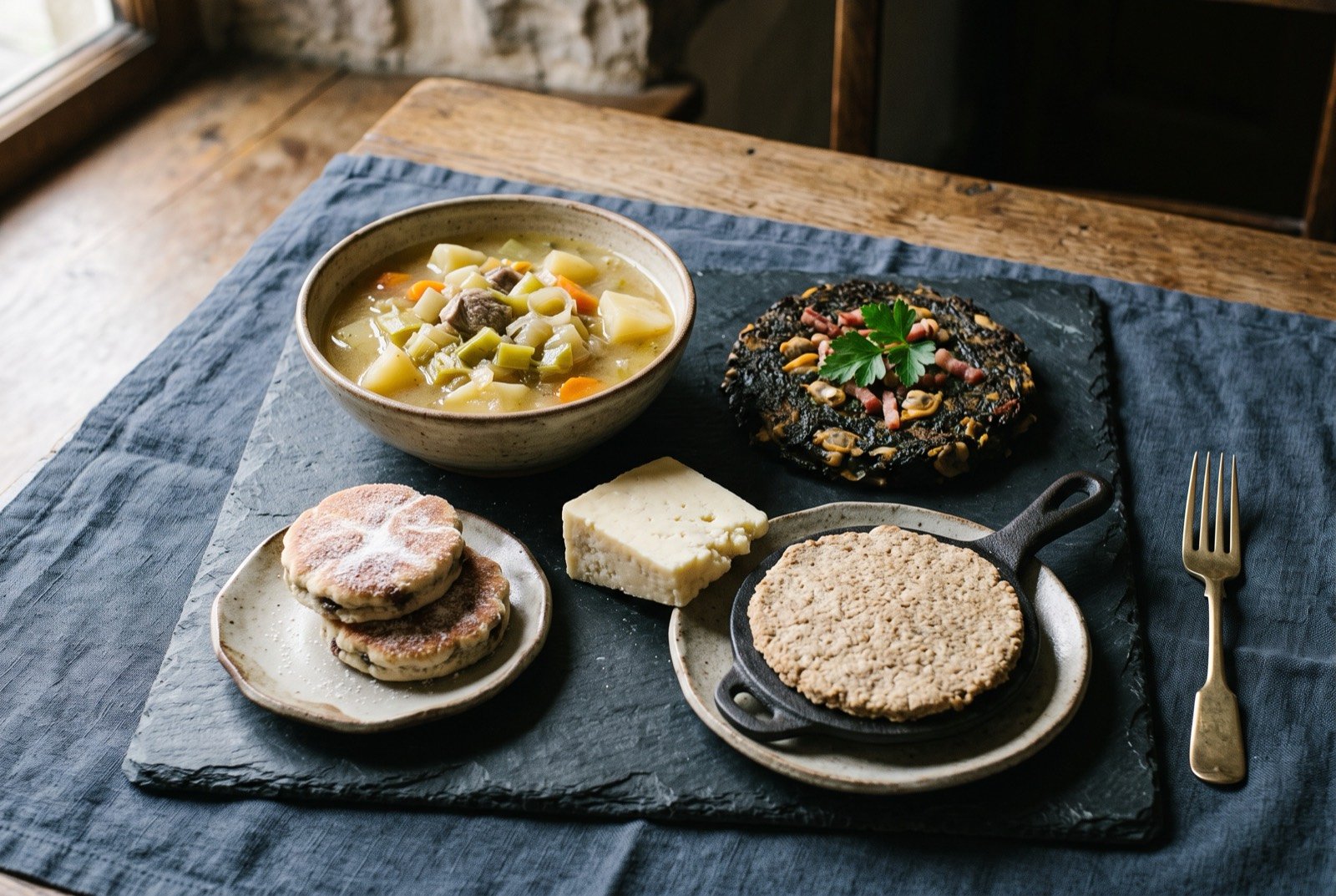
Two ecologies running the length of one small country: a wet, grass-and-oat upland where sheep and cattle do the work wheat cannot, and a long coast of estuary mud, salt marsh and rock where cockles, laverbread and salt-marsh lamb come from the same tide. Between them sits a seam of coal and slate that, within two or three generations, turned farmers into a wage-earning, chapel-going industrial population with almost no garden to grow food in, and turned a handful of imported and adapted dishes, faggots chief among them, into what the world now calls Welsh food. Every dish as tradition built it, then what a modern chef would change.
Sources and review · What this chapter does not assert · How we research · Spotted something wrong?
A Sense of Place
Upland Wales runs on three unforgiving facts: high rainfall, thin acid soil and an altitude that shortens the growing season, which is why the region's food logic is grass, oats and dairy rather than wheat. Gerald of Wales, touring the country in 1188, recorded that sheep and lamb meat, milk, cheese, butter and oats were the sustenance of the Welsh, a description broadly true of the majority population for another seven centuries. Oats were, in the words of the Welsh food historian Carwyn Graves, "the most important of all Welsh crops, and ingredients, until the second half of the 20th century," especially in the "western, windward regions and mountainous areas where other grains performed poorly," traditionally sown on 15 March, Ffair Garon. That seasonal rhythm is built into the landscape's own place names: hendre names the lowland winter dwelling, hafod the upland summer one, to which livestock and often the whole household moved from roughly May to October, men tending the herds while women made butter and cheese at the hafodty. Wherever a Hafod survives on a modern map, a corresponding Hendre is usually still findable nearby, which is a landscape still legible if you know what you are reading.
The coast runs on a different but related logic. The Gower Peninsula, Britain's first protected landscape, carries salt marsh on its northern shore, at Llanrhidian, Landimore, Penclawdd and Crofty, roughly a fifth of all Welsh saltmarsh, grazed by sheep since medieval times on samphire and sorrel. The same estuary, the Burry Inlet, has yielded cockles since Roman times, evidenced archaeologically. Laver, the seaweed behind laverbread, was gathered by hand from rocks the length of the coast, historically most associated with Anglesey, Glamorgan and Pembrokeshire rather than any single stretch.
Cardiff is the third force, and it arrived comparatively late and fast. The city grew from one of Wales's smallest towns to its largest across roughly seventy years of dock building, and by the early twentieth century was the largest coal-exporting port on earth: exports peaked at 10.7 million tonnes in 1913, and the world's first million-pound business deal was struck at the Coal Exchange in Mount Stuart Square in 1904. That trade brought Norwegian, Somali, Yemeni, Spanish, Italian, Caribbean and Irish sailors and dockers into what became Tiger Bay, Butetown, described in 1911 as one of the most colourful and cosmopolitan communities on earth, and still home to one of Britain's oldest Somali communities. Inland from the port, the coalfield pulled a rural population into terraced valley towns with almost no land to grow food on, which is the structural fact behind everything the valleys ate: bought food, one pot, a pig in the yard where a garden allowed it, and a female-run informal economy selling faggots and small beer from the house next door.
| Region | Defining logic | Dishes and products that carry it |
|---|---|---|
| North Wales and the uplands (Gwynedd, Conwy, Meirionnydd) | Rain-fed hill grazing, oats over wheat, transhumance between hendre and hafod | Bara ceirch, lobscows, salt marsh lamb from the Dwyryd, Welsh Black cattle |
| South Wales, the Gower and the coast | Estuary shellfish, hand-harvested seaweed, salt marsh grazing | Laverbread, Penclawdd cockles, Gower Salt Marsh Lamb |
| The industrial valleys (Glamorgan, Gwent) | A wage economy with almost no land, cheap protein and a female-run informal food trade | Faggots, cawl thickened with oatmeal, Caerphilly cheese, teisen lap |
| Cardiff and Tiger Bay | A world port funnelling seafarers from fifty countries through one square mile | A genuinely multicultural café culture, still under-documented as a cuisine in its own right |
The History in Layers
What is genuinely indigenous, stated plainly before the layers arrive
Sheep and cattle on wet hill grass; oats and barley where wheat will not ripen; buttermilk, curd and cultured dairy; hand-harvested seaweed and shellfish worked from an estuary coast old enough to be archaeologically dated to the Roman period at Penclawdd and earlier at Cardiff's own edges. The bakestone, cooking bread, oatcakes, pancakes and cakes on a flat iron over direct heat rather than in a domestic oven, answers to three different names by region, maen in the south-east, gradell in the north and Ceredigion, planc in the south-west, which is itself a small piece of evidence for how differently this one basic technology was inherited across the country. Everything that follows sits on top of this, not instead of it.
The chapel calendar, and what it actually shaped
Welsh nonconformism, dominant from the mid-nineteenth century, did not just fill Sunday. Calvinistic Methodism ran a genuine temperance strand, and by the 1850s temperance had become one of the cornerstones of Welsh society, with its own tea rooms, magazines and even hotels. The clearest food-culture trace of this is te capel, chapel tea, gatherings after a service where bara brith was served on bone china, a tradition Carwyn Graves says lasted roughly a century and a half, alcohol-free and social rather than solemn. In the mining valleys the same reforming instinct plausibly, though not provably, connects to diod fain or diod ddail, small beer brewed from nettle, dandelion, ground ivy, redcurrant leaf and ginger and sold door to door as a genuine non-alcoholic household product: one recorded seller made 42 bottles a week for seven shillings' profit, in the words of the museum record that preserves her account, "an invaluable addition to the low family income." The link from temperance movement to diod fain trade is this chapter's own inference from parallel facts rather than a documented causal claim, and it is offered as plausible context, not settled history.
The coalfield's imported dish that became the valleys' own
Faggots, forcemeat balls of pig's liver, lungs and pork fat, bound with breadcrumbs, onion and sage, wrapped in caul fat and roasted, are the characteristic food of the South Wales mining village, but they did not originate there. Their roots are in the rural poor of west Wiltshire and the West Midlands, and they arrived in South Wales in the mid-nineteenth century carried by agricultural labourers moving into the coalfield for work. Neath Market has served faggots and peas since the 1920s and still runs an annual competition each September. This is squarely the crossover the atlas's own structure exists to handle honestly: faggots' full, twice-given treatment belongs to Volume EU-32, the English Midlands, where the dish is most completely documented and most identified. Wales's own version, Welsh ffagodau, is real, was genuinely adopted and adapted, and is named here rather than re-treated, because the dish crosses a border the food itself barely respects.
What is more distinctly Welsh than the dish itself is the economy that grew up around selling it. Miners' wives and widows cooked and sold faggots from their own homes on set days, a documented pattern that in some South Wales villages continued into the 1950s: one recorded seller made a hundred faggots at two pence each every Friday evening, using the proceeds to buy fresh meat for her own family's Sunday dinner. That is a genuinely Welsh structure, a female-run cash economy substituting for absent welfare provision, wrapped around a borrowed dish, and it is a more honest way to tell this part of the story than a simple claim of invention.
Cardiff's port, and a food history still waiting to be written properly
Tiger Bay is Wales's oldest multi-ethnic community by a clear margin, and its café culture is genuinely well documented as social history: named spaces including Basque, Italian, African and Somali cafés and all-night shebeens, and the Cairo Café, run from the 1940s to 1968 by the Yemeni sailor Ali Salaman and his Welsh wife Olive, which functioned simultaneously as restaurant, boarding house and mosque for the district's communities. What this research could not find, despite a real search, is a single specific dish with a documented recipe that can be said to have emerged from Tiger Bay's own kitchens, as opposed to the well-attested fact of the community and its café culture. That gap is stated honestly rather than filled with an invented dish, and it marks Cardiff's multicultural food history as a real and important thread this chapter has been able to name but not yet properly cook from.
Caerphilly cheese, and the accident that took it out of Wales
This is the volume's clearest case of a Welsh food's own history working against the tidy version usually told about it. Caerphilly was first made around 1830 on small farms near the town whose name it carries, most likely because that was where it was sold rather than where every wheel was made, with a moister curd than the industrial cheese now sold under the name. The often-repeated claim that its thick rind and high salt content were designed specifically for miners, portable and durable underground, sweat-replenishing at the coalface, is widely and consistently told by the cheese trade itself, but this chapter could not trace it to a primary miners' account or an academic labour history rather than marketing copy, and it is held at arm's length accordingly. What is well documented is the cheese's actual use: crumbled into a bowl of cawl at the table, its heat softening it, alongside thick bread.
The real, checkable history is stranger and more interesting than the miners' legend. From around 1900, competition for milk saw Welsh production decline, and cheesemaking shifted wholesale to Somerset and Wiltshire, where farmers adopted the recipe specifically because it matured faster than cheddar and let them sell cheese while their cheddar was still ageing. Welsh farmhouse production stopped entirely during the Second World War. Postwar English factories kept favouring Caerphilly over cheddar for the same reason, faster maturity, less capital tied up, and for most of the twentieth century the cheese that carried a Welsh town's name was, in practical terms, an English product. Its Welsh identity has been actively rebuilt only since the 1980s, by named small producers, Caws Cenarth from 1987, Castle Dairies reviving production in Caerphilly town itself in the late 1990s using pre-war hand technique. Traditional Welsh Caerphilly received Protected Geographical Indication status in 2017. The cheese most likely to come to a British cheese-literate reader's mind, Gorwydd Caerphilly, prized by Neal's Yard Dairy and widely treated as the benchmark of the style, is made not in Wales but in Somerset, since its makers, the Trethowan brothers, relocated production there in 2014. This chapter treats that as fact worth stating plainly, not as a technicality to smooth over: Caerphilly is simultaneously a genuine South Wales invention, a food structurally tied to the coalfield through cawl, and a cheese that spent most of the twentieth century made almost entirely outside Wales, with its Welsh identity now a live act of reconstruction rather than an unbroken thread.
The modern moment: technique returning to a country that lost more of it than most
The clearest, best-sourced explanation for why Wales's food culture reads thinner in most English-language writing than its raw ingredients deserve comes again from Carwyn Graves, and it names a specific mechanism rather than gesturing at general poverty. Industrialisation dismantled household food production in Wales without the guild structures that preserved artisanal technique on the European mainland, and the cultural movement that might otherwise have defended Welsh food, the same movement that fought hard and successfully for the Welsh language, put its energy into language and literature rather than food, so individual techniques died with the people who held them rather than being carried forward institutionally. That is a genuinely useful, checkable claim, and it explains something the "Wales only ever ate poverty food" cliché does not: what was lost was the technique, not just the ingredients, which is exactly the gap a current run of Welsh chefs is now trying to close by going back to primary sources, a grandmother's own recipe, a place name from the Mabinogion, an actual bakestone, rather than inventing a generic rustic register to stand in for it. Graves's own evidence also undercuts the poverty framing directly where it survives checking: Gerald of Wales recorded a Welsh diet richer in meat and dairy than the grain-and-gruel English and French lowlands around it; an 1863 government food enquiry found Welsh labourers better fed than their English counterparts; and Welsh oysters were a cheap, mass-market protein for centuries, a hundred for a penny at 1652 Carmarthen market, a Menai Straits and Swansea Bay fishery employing nearly five hundred men at its peak.
The Flavour Arsenal
Oats. The working grain of the uplands for the better part of a millennium, ground for bara ceirch, thickening cawl, and the porridge-family dishes, llymru, brwes, siot, that never fully made it into English-language Welsh food writing. Buy whole oat groats and mill to order where the recipe calls for it; pre-ground oatmeal loses character within months.
Laver. Porphyra umbilicalis, a red algae hand-harvested from coastal rock, historically most associated with Anglesey, Glamorgan and Pembrokeshire. Washed repeatedly to remove grit, then reduced by slow boiling to a dark, greeny-black paste, the base of laverbread.
Caerphilly and its Glamorgan ancestor. Now made from cow's milk, but the region's older cheese-making tradition, per Carwyn Graves's own research, ran on sheep's and goat's milk into the nineteenth century, noted at the time as better suited to melting and baking than cow's cheese, a plausible if unproven technical ancestor for why this country's cheese cookery, Glamorgan sausage, rarebit, Anglesey eggs, leans so heavily on cheese that behaves well under direct heat.
Welsh Black cattle and Welsh Mountain sheep. The former descends from pre-Roman British cattle, historically dual-purpose and split into a stockier North Wales beef strain and a more dairy-like South Wales strain; the latter is the small, hardy foundation breed of the hills, its genetics tracing in places to Viking-era Scandinavia and Roman Britain, in one case, the Lleyn, to a single Irish flock imported in the early nineteenth century, a reminder that "ancient Welsh breed" is not automatically true of every breed carrying the name.
Salt marsh grass. Not a kitchen ingredient in the conventional sense, but the actual flavouring mechanism behind Gower Salt Marsh Lamb and the Dwyryd's own PGI salt marsh lamb: tidal grazing on samphire and sorrel, with no supplementary concentrate feed, genuinely changes the animal's fatty acid profile, a claim backed by IBERS research at Aberystwyth showing higher polyunsaturated fat, conjugated linoleic acid and omega-3 content than concentrate-fed lamb. Treat the pasture as the seasoning it demonstrably is.
Leeks. The national emblem vegetable, running through cawl, Glamorgan sausage and Anglesey eggs alike, and one of the newer entries to Wales's own protected-food register, Welsh Leeks receiving PGI status only in 2022.
Cockles. Hand-raked from the Burry Estuary at Penclawdd since at least the Roman period, an industry that was, until the 1970s, overwhelmingly women's work.
Buttermilk. Llaeth enwyn, worked into potatoes, cakes made without eggs, puddings and porridges, and drunk on its own with ginger; an 1880s Welsh-language source praised its fermented, health-giving qualities.
The Technique Ladder
Rung 1. Read the bakestone as its own heat register, not a failed oven
Before household ovens were common, whole terraces shared a communal street oven on an allocated baking day, documented at Rhyd-y-car Terrace, built 1795, which leaves the obvious question: what did a household cook on the other six days. The bakestone, a flat iron plate over direct heat, is the answer, and it produces a genuinely different result from oven baking, a crisp, slightly charred exterior over a soft, steam-cooked interior, because the heat comes from below and the food is thin enough to cook through before it dries out. A Big Green Egg with a flat plancha plate set directly over the coals, run hot and dry, is the nearest thing in this reader's own kit to a proper bakestone, and the instinct to treat it as an underpowered oven, extending cooking time at lower heat, is exactly the mistake that produces a dense, pale Welsh cake instead of a properly crisp one.
Rung 2. Build a broth in stages, not all at once
Every credible cawl source agrees on structure over ingredient list: meat goes into salted water first and simmers alone for the better part of an hour before anything else joins it, root vegetables follow in stages by how long they take to cook, and the leeks and, once it arrived, the potato go in last, with a flour-and-water paste used to thicken the finished broth rather than flour worked in from the start. Cooking everything together from the outset gives a broth with an even, less interesting texture and vegetables cooked well past their best; staging by cooking time is what gives the dish its actual structure, and it is why the two-course serving, broth first, then meat and vegetables, works as a piece of technique rather than a formality.
Rung 3. Treat seaweed as a long reduction, not a quick blanch
Laver's cell walls do not break down the way a leafy vegetable's do. St Fagans' own account of laverbread preparation states plainly that after repeated washing, the seaweed is boiled "for hours," not minutes, until it collapses into a smooth, dark paste; a widely repeated but unverified figure of ten hours at a controlled 80 to 98°C traces to an unreliable AI-generated source and should not be trusted as precise, but the underlying principle, that this is a multi-hour reduction rather than a quick cook, is well attested. A slow cooker or a very low oven, run for several hours and checked rather than timed to the minute, is the honest way to reproduce this at home.
Rung 4. Judge lamb and beef by their grazing, and cook accordingly
Salt marsh and rough hill grazing produce meat with a genuinely different fat composition from concentrate-fed animals, per the Aberystwyth research above, which has a real cooking consequence: this fat renders and behaves differently under heat, and trimming it away in the name of tidiness, or cooking it to a uniform supermarket-lamb doneness, throws away exactly what the animal's own grazing paid for. Cook salt marsh lamb to preserve rather than render out its fat, and rest it properly, longer than a concentrate-fed joint of the same weight, to let that fat redistribute.
Rung 5. Build a cheese sauce with a roux, and add the cheese off the heat
The failure mode behind every bad, oily, split rarebit or Glamorgan sausage filling is the same: cheese melted directly over high, direct heat, which tightens its proteins and forces the fat out as an unpleasant slick. The fix is standard technique rather than a Welsh secret, a roux of butter and flour to bind fat and liquid together, mustard and a splash of vinegar or Worcestershire sauce worked in as emulsifiers before the cheese arrives, and the cheese itself folded in off the heat, in stages, so residual warmth melts it without ever breaking the emulsion. This is basic dairy chemistry rather than a documented historical technique specific to Wales, and it is worth applying with real discipline precisely because the dishes that depend on it, rarebit and Glamorgan sausage both, are otherwise so simple that bad technique has nowhere to hide.
Ferment or Preserve Bench
Llaeth enwyn, buttermilk. The everyday cultured dairy of the upland farm kitchen, worked into potatoes, eggless cakes, puddings and porridges, and drunk on its own with ginger; an 1880s Welsh-language source specifically praised its fermented, health-giving character.
Carmarthen Ham. Britain's first commercially produced dry-cured ham, sold by the Rees family at Carmarthen Market for over two hundred years, salt-cured and air-dried at 16 to 25°C for six to nine months, and Protected Geographical Indication since 2016. This is the genuine indigenous ancestor behind the extended dry-curing and ageing several of Wales's current fine-dining kitchens now practise, even where the chefs doing it are not citing it directly.
Laverbread. Not strictly a ferment, but a genuine long-reduction preservation method in its own right: hours of slow boiling break the seaweed down into a paste that, once cooled, keeps for several days, longer than the raw laver itself ever would.
Sourcing in Britain
Welsh Lamb and Beef, and the mark that actually proves it. Look for the PGI shield on the packet, not the word "Welsh" alone; Hybu Cig Cymru, the statutory body and legal guardian of both marks, verifies that only meat from animals born, reared and processed in Wales through an approved abattoir and cutting plant carries it. For the salt marsh product specifically, Weobley Castle Farm on the Gower, run by the Pritchard family, is the named farm behind Gower Salt Marsh Lamb PDO; Cig Oen y Glastraeth, on the Dwyryd Estuary in Gwynedd, is its North Wales counterpart, PGI-certified in its own right.
Caerphilly cheese, and the substitution worth naming plainly. For the genuine Protected Geographical Indication article, made in Wales, buy from Caws Cenarth (Cenarth, Ceredigion, the longest-established maker, founded 1987) or Bodnant Welsh Food (Conwy Valley), both available direct or through The Welsh Cheese Company, an online specialist with an unusually strong independent review record. Gorwydd Caerphilly, the version most likely to be familiar from Neal's Yard Dairy and similar cheesemongers, is genuinely excellent cheese but is made in Somerset, not Wales, since its makers relocated production there in 2014; it should not be presented, or bought, as the Welsh article.
Laverbread. Selwyn's Seafoods, based near Penclawdd, hand-harvests and processes laver at its own North Gower factory and sells it fresh, made to order, direct and through the Welsh food hub Blas ar Fwyd in Llanrwst. Parsons, trading from Burry Port, Carmarthenshire, sells the tinned version and describes itself as the only British manufacturer of pickled cockles and mussels; the historic ratio of fresh to tinned quality could not be verified against a credible source in researching this chapter, and this chapter does not claim one is definitively better than the other.
Penclawdd cockles. Selwyn's Seafoods is the verified, currently trading source; ask specifically whether a given batch is hand-raked from the Gower sands or processed there from elsewhere, since the honest answer varies by batch and season and this chapter could not establish a single settled figure either way.
Oats, for bara ceirch and cawl thickening. Buy whole oat groats where possible and mill to order in a dedicated spice grinder; pre-ground oatmeal loses character within months on a shelf.
Halen Môn, Anglesey Sea Salt. The first Protected Designation of Origin product from Wales, seawater drawn from the Menai Strait, pre-filtered through a natural sandbank and mussel bed, then simmered over several days until crystals form and are hand-skimmed. Widely stocked, and cited by name at Gorse in Cardiff among others.
A general Welsh larder. Blas ar Fwyd in Llanrwst stocks over 150 Welsh producers and ships UK-wide; Wally's Delicatessen in Cardiff's Royal Arcade, trading since 1981, is the country's best-known general deli and increasingly stocks Welsh alongside its European lines.
Kit. The Big Green Egg fitted with a flat plancha plate is this reader's nearest equivalent to a genuine bakestone, run hot and dry rather than treated as an underpowered oven, per rung one. A dedicated spice grinder earns its keep here on oats specifically, since pre-ground oatmeal is one of the clearest tells between a dish cooked properly and one cooked from a stale bag. No published sous vide or dehydrator adaptation of any dish in this chapter exists in Welsh culinary literature; every such use here is this chapter's own adaptation, not a borrowed technique.
What decides great from grim, ranked. First, the PGI shield on Welsh Lamb or Beef, since the word "Welsh" alone guarantees nothing. Second, genuine Protected Geographical Indication Caerphilly from a named Welsh maker rather than the excellent but English Gorwydd, where the distinction actually matters to the reader. Third, fresh laverbread from a verified Gower processor over an anonymous "seaweed paste" import, since provenance here is the real marker of quality, not a proven taste difference this chapter could confirm.
Voices and Sources
This chapter rests on Amgueddfa Cymru, National Museum Wales, and specifically its St Fagans food-heritage collection and blog, for laverbread, cockling, faggots, small beer and the Dowlais cawl recipe; on Welsh Wikipedia and Wicipedia, checked independently against the English-language versions of the same claims wherever both existed; on Hybu Cig Cymru, the Welsh Government and Business Wales for the Protected Geographical Indication and Designation of Origin register; on Aberystwyth University's IBERS unit for the sheep genetics study and the salt marsh grazing fat-composition research; on the published Welsh food historian Carwyn Graves, author of Welsh Food Stories, for the chapel calendar, the loss and recovery of technique, and the corrective evidence against a flattened poverty narrative; on Casgliad y Werin Cymru, the People's Collection Wales, for lobscows and teisen lap, with one archival page reachable in this research only via a search-engine summary rather than a direct read; on Slow Food Foundation's Ark of Taste for Penclawdd cockles and the Welsh sheep breeds it lists as at risk; on the Swansea-focused local heritage writing of Swansea Scoop for the cockle women's own named voices; and on The Warsan for Tiger Bay's Somali community history. On the modern and sourcing side, this chapter draws on the working chefs Gareth Ward (Ynyshir), Tom Waters (Gorse), Hywel Griffith (Beach House), Chris Harrod (The Whitebrook) and Matt Powell (ANNWN), on the Michelin Guide's own current Wales listings, and on Companies House and the Food Standards Agency for independent verification of the named producers and retailers above.
Things this chapter has deliberately not asserted
- That the North Wales uplands have their own ratio-and-timed cawl recipe comparable to the Dowlais version used here. Every quantified, timed cawl source found in researching this chapter is South Wales industrial; lobscows is named as the North's own pot dish, but no source gives it real quantities, and this chapter has not invented any.
- That Caerphilly cheese's thick rind and high salt content were specifically designed for miners. This is widely repeated by the cheese trade itself but could not be traced to a primary miners' account or academic labour history in this research, and is held at arm's length accordingly.
- That laverbread is boiled for exactly ten hours at 80 to 98°C. This specific figure traces to an unreliable, AI-generated source. The defensible claim is that it is boiled for several hours, not that a precise figure is known.
- That fresh laverbread is definitively better than tinned. Every source found making this claim is a Western food blog with no strong technical backing; this chapter could not verify it and has not asserted it.
- That Anglesey eggs is an old, traditional dish. Every source addressing its history is English-language tourism or recipe writing, none citing a documented first appearance, and the dish is essentially invisible in the Welsh-language and academic sources this research reached. Its age is genuinely unresolved, and it has accordingly been left out of this chapter's Dishes section rather than given a false pedigree.
- That Welsh onion cake, teisen nionod, is a genuinely old farmhouse dish. Every source found is a modern food blog offering speculative, undocumented history; this chapter has not included the dish for that reason.
- That Welsh rarebit originated as a specifically Welsh invention. The Welsh name for baked cheese is genuinely old; the English "Welsh rabbit" most plausibly began as an English joke at Welsh expense, and this chapter states that plainly rather than repeating the tourist-board version.
- That Richard Burton is reliably on record calling laverbread "Welsh caviar." The line is very widely repeated but this chapter could not trace it to a primary interview.
- That a specific dish, with a real recipe, emerged from Tiger Bay's genuinely documented multicultural café culture. The social and community history is well attested; no specific Tiger Bay dish with a documented recipe was found, and this chapter has named the gap rather than invented a dish to fill it.
- That Gareth Ward's cooking at Ynyshir, Wales's only two-star restaurant, descends from an indigenous Welsh technique. It does not, by his own account and by every source describing his kitchen; his ingredients are Welsh, his method is openly, proudly Japanese, and this chapter has let that stand rather than force the atlas's own general argument onto a case where it does not fit.
Read the bakestone as its own heat register, not a failed oven
Before household ovens were common, whole terraces shared a communal street oven on an allocated baking day, documented at Rhyd-y-car Terrace, built 1795...
Build a broth in stages, not all at once
Every credible cawl source agrees on structure over ingredient list: meat goes into salted water first and simmers alone for the better part of an hour before...
Treat seaweed as a long reduction, not a quick blanch
Laver's cell walls do not break down the way a leafy vegetable's do.
Judge lamb and beef by their grazing, and cook accordingly
Salt marsh and rough hill grazing produce meat with a genuinely different fat composition from concentrate-fed animals, per the Aberystwyth research above...
Build a cheese sauce with a roux, and add the cheese off the heat
The failure mode behind every bad, oily, split rarebit or Glamorgan sausage filling is the same: cheese melted directly over high, direct heat, which tightens...
The dishes
- Cawl South Wales (Dowlais, Merthyr Tydfil)
- Laverbread, Cockles and Bacon The Gower and Swansea Market
- Bara Ceirch North Wales (Bala and Meirionnydd)
- Glamorgan Sausage Glamorgan
- Welsh Cakes Wales
- Bara Brith Wales
- Welsh Rarebit Wales (English-coined name)
- Gower Salt Marsh Lamb, Roasted The Gower
Sources and review
- Researched
- No outside sources linked
- Reviewed
- Not yet reviewed from inside the tradition
- Cooked
- Not yet cooked and reported
Where this volume comes from
3 research briefs on file for this volume, researched to the rules on How we research. Published 28 August 2026. Last changed 8 September 2026.
The brief's own account of its sources
Part One (North Wales/uplands). Of roughly 30 to 32 distinct source uses, approximately 19 to 20 are local, Welsh-language, official or academic: Casgliad y Werin Cymru (2 items, one partially blocked by a 403), Amgueddfa Cymru/National Museum Wales (3 items), Golwg360 (2 articles), Carwyn Graves's own site (4 essays, a published Welsh food historian), Aberystwyth University/IBERS (1 genetics study), Hybu Cig Cymru (2 pages), Eat Welsh Lamb and Welsh Beef, Welsh Mountain Sheep Society, Welsh Black Cattle Society, Cig Oen y Glastraeth, Food Innovation Wales/Welsh Food and Drink, Business