Europe · Volume 36
Ireland
The Grass, the Grain and the Border That Doesn’t Cut the Table
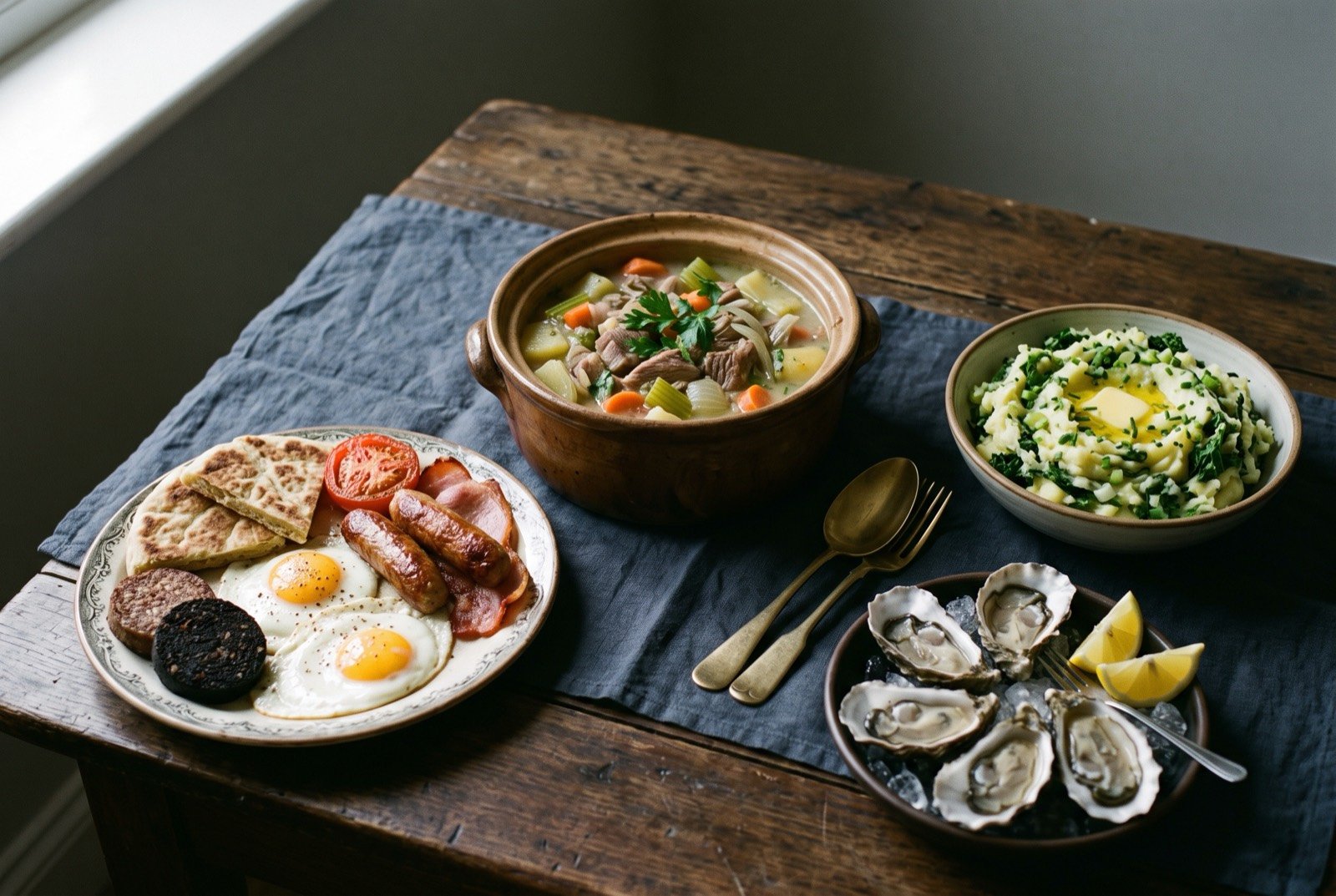
One island, treated as one volume, because the food itself is not cut where the 1921 border is. Ulster, the old province of oats, linen and dairy that gives the north its whole culinary grammar, runs across both states, and the soda farl on a plate in Letterkenny is the same object, cooked the same way, as the one on a plate in Belfast. The border is not nothing, and this chapter says plainly, rather than smoothing over, the two places it still genuinely shows up at the table: the different memory of wartime shortage on each side, and the live, current business of how dairy and beef now cross the Irish Sea. Every dish as tradition built it, then what a modern chef would change.
Sources and review · What this chapter does not assert · How we research · Spotted something wrong?
A Sense of Place
A climate that grows grass better than almost anything else
Ireland's food is downstream of its weather, and the mechanism is more precise than "it rains a lot." The country's grasslands cover roughly 80 percent of its agricultural area, and the grass growth rate exceeds the European average by more than a third, with dairy and beef herds able to graze up to 300 days a year on short, mild winters and summers that are, in Bord Bia's own phrase, "never too dry or sultry." That is the actual reason Ireland is a dairy and beef country: not a preference handed down through generations, but a climate that grows grass better than it grows almost anything else, which pushed farming toward pasture-based cattle and sheep rather than arable cropping. Wheat struggles in the same cool, damp conditions that make the grass so good, and it remains under-represented even in the archaeological plant record from the early Christian period despite its high status. Barley has been grown since roughly 4000 BCE and became the backbone of monastic self-sufficiency; oats, needing minimal maintenance and tolerating poor soils, became the everyday grain of the ordinary farmer, the base of porridge and bread for people barley and wheat were never really grown for. This wheat-scarce, oat-and-barley-rich, grass-drowned ecology is the whole island's starting condition, before a single dish is named.
The potato, then everything after it
Onto that ecology the potato arrived and, by the early nineteenth century, had become dominant to a degree with no real parallel elsewhere in Europe. What that dominance built, and what its collapse in the Famine did to the country, is treated in full in the next section, because it deserves real weight rather than a passing mention. What matters here, at the level of a sense of place, is that the potato remains the island's one true universal starch in a way no single grain ever was: colcannon, champ and boxty are not regional curiosities, they are the potato meeting, respectively, Dublin's kale-and-cabbage larder, the everyday scallion-and-milk pot, and the border midlands' particular grated-and-mashed technique, three different answers to the same standing question of what to do with the one crop the whole island could reliably grow.
The Atlantic coast, historically underused at home
Here is a genuine paradox, not folklore: despite hundreds of years of experience sourcing and cultivating food from the sea, Irish per capita fish consumption is low by European standards, 22.3 kg a year against 34.7 kg in France and 90.1 kg in Iceland, average weekly intake equivalent to less than a quarter of the recommended portion. The explanation offered by Irish reporting on the figures is that a real rupture, not an ancient pattern, sits behind it: "only in the nineteenth century local knowledge seemed to slip away when conflict, political indifference and economic abandonment led to a decline and neglect in coastal activity," and most of Ireland's seafood today is still exported rather than eaten at home. Lobster is the clearest single case: Trinity College Dublin's Centre for Environmental Humanities records that it "was once considered the poor man's chicken," fed to pigs and goats and crushed for fertiliser or fish bait in the colonial period, before a documented reversal from the early eighteenth century onward saw it move onto upper-class tables instead, with over 5,000 boats and 23,000 fishermen lobstering by the mid-1870s against a fraction of that scale today. The west coast, Galway, Clare, Kerry, Cork, Donegal, is where this chapter's own Atlantic tradition lives, in oysters, mussels and seaweed rather than the fried-fish repertoire that never quite became a national habit the way it did in Britain.
Ulster's own grammar, and Dublin's
Ulster's ecology is not simply "the same as the rest of Ireland but colder." Its economy ran harder on linen and oats than the rest of the island, its Presbyterian and dissenting Protestant settlement pattern gave it a different religious calendar to the rest of the island's Catholic one, and its farming, smaller mixed holdings rather than large pastoral estates, produced a kitchen built around what a griddle over a turf fire could do quickly rather than what a bread oven could do slowly: the soda farl and the potato farl are Ulster's own answer to bread, not a regional variant of a southern one. Dublin, meanwhile, is a hinge rather than a region: a port city whose working-class food, coddle above all, was built from whatever cheap, already-cooked-elsewhere protein came off the boats and out of the local shops, and whose modern food scene, a genuine bakery and coffee boom over the past decade, is now exporting its own influence back out to the rest of the country the way capital cities do.
The structural logic, at a glance
| The Republic's dairy and beef heartland | The west coast | Dublin | Ulster | |
|---|---|---|---|---|
| Staple starch | Potato, oats | Potato, foraged seaweed as a supplement | Potato, wheat bread | Potato, oats |
| Fat | Butter | Butter, little historic fish oil use | Butter, dripping | Butter |
| The leavening logic | Buttermilk and bicarbonate of soda | Same | Yeast, for the bakery-driven modern city | Buttermilk and bicarbonate of soda, griddle-baked |
| Aromatic | Scallion, parsley | Dulse, carrageen | Whatever the docks brought in | Little beyond onion and pepper, historically |
| The preserving discipline | Salt-curing pork (bacon) | Drying seaweed, exporting rather than eating the catch | Smoking and salting for the working docks | Salt-curing pork, griddle-baking bread fresh rather than storing it |
The History in Layers
The Lumper, and why the poorest ate the worst potato
The pre-Famine potato economy was not one crop but several, graded by quality, and the poor were left with the worst of them. The Lumper variety, introduced from Scotland, spread not for flavour or nutrition but for "higher yields, adaptability to poor soils, and, not least, reliability": it tested with the lowest specific gravity and dry matter content of the varieties the Royal Dublin Society tried in the 1830s, against better potatoes such as the Apple and the Cup. A Kerry observer in 1832 recorded that labourers' "only food being lumpers and what the ministers would not eat," a plain statement that the inferior variety was what the poor were left with while better potatoes were grown for sale or for landlords. By 1845 individual daily consumption is estimated at 12 to 14 lb of potatoes per person across large parts of the population, and the Lumper's geographic spread showed a marked east-west gradient, concentrated precisely in the western counties, Galway, Mayo, Laois, that would go on to suffer the Famine's worst mortality. That is not a coincidence this chapter treats lightly: the crop grown by the poorest was also the crop most exposed when Phytophthora infestans arrived.
An Gorta Mór, and the honesty a single national story cannot carry
The Famine of 1845 to 1852 deserves real weight here, not a passing mention. What actually happened to Irish food culture as a result was near-total demographic and dietary collapse built on a single crop's failure, and its long shadow is the reason the potato's later re-embrace, colcannon, champ, boxty, reads as something closer to reclamation than simple continuity. But the single national story of universal hunger is itself a simplification worth resisting. Regina Sexton, UCC's food historian and a contributor to the Atlas of the Great Irish Famine (Cork University Press, 2012), has researched an unpublished nineteenth-century recipe book alongside the letters of George Boole, UCC's first Professor of Mathematics, and found that food and dining culture at the end of the Famine "was far more complex than the stereotype of potatoes and little else," and that the Famine's impact in Cork specifically was "very mixed, where people starved while others had plenty." This chapter repeats her corrective deliberately: the Famine was not evenly experienced, and abundance persisted alongside starvation in the same counties, which is a harder and more honest story than a single national narrative can carry.
Primary testimony survives from inside the crisis itself. The National Folklore Collection's Schools' Collection, gathered from schoolchildren across roughly 5,000 primary schools in the 1930s and now UNESCO Memory of the World-listed, records an 85-year-old Borrisoleigh, Co. Tipperary informant, Michael Moloney, recalling that during the Famine year schoolchildren "used to eat the leaves off the trees," that the crisis "affected the poor people most for they had no money to buy food," and that fever victims sometimes "went out, hid in a ditch, and died a miserable death." Wider searches of the same archive surface accounts of eating raw turnips, weeds and seaweed boiled with salt, and stirabout made from Indian meal mixed with salt herring as substitute foods. These are individual parish-level testimonies, offered here as illustrative primary voice rather than statistical evidence, and this chapter is careful not to generalise a single Tipperary account to the whole country. What this chapter does not assert is that the potato "fell from favour" after the Famine and had to be deliberately rehabilitated into colcannon, champ and boxty: that narrative is common in popular writing but was not found supported by a scholarly source, and is named in this chapter's closing section rather than repeated as fact.
Where the border does leave a real trace: rationing memory
Ireland's food is not cut by the 1921 border, but this chapter would be dishonest to pretend the border left no trace at all, and the clearest one is wartime memory. Northern Ireland ran on the UK's points-based rationing system from 1940 to 1941, covering meat, eggs, bacon, sugar, fats and cheese, not ending until UK-wide de-rationing on 4 July 1954. Lisburn Museum's own account states the North "didn't face many food shortages" relative to the rest of Britain, partly because of proximity to the still-neutral South, from which "day trips" for "illicit supplies" were common enough that returning travellers were routinely searched by customs officers. The Republic, neutral throughout, remembers the same years under a different name entirely, "the Emergency," a term still used by older Irish people specifically for this period, and by several accounts its shortages were more severe on particular items than the North's: Ireland had the highest tea consumption per head in the world outside Britain before the war, and the ration collapsed to as little as half an ounce a week at its worst, one of the period's most vividly remembered privations. A widely disliked "black loaf," a 100 percent wholegrain bread mandated to conserve wheat, was nutritionally inferior in practice to its official billing. What both sides of the border agree on independently is that smuggling ran hard in both directions during the war, each population supplementing what its own rationing system denied it, a genuine point of shared cross-border food history rather than a divided one. This chapter cannot confirm whether that specific wartime memory is still actively discussed in either country's food writing today; the sources behind this claim are historical rather than evidence of live present-day reference, and it is offered as an inference, not a demonstrated ongoing legacy.
Where the border leaves a trace today: the Irish Sea and Brussels
The second, current place the border shows up is trade, and it works through two genuinely separate mechanisms this chapter is careful not to conflate. Under the Windsor Framework, Northern Ireland continues to follow EU food and feed hygiene and safety law for goods, while directly applicable EU law no longer applies in Great Britain: Great Britain and Northern Ireland now run on different food regulatory regimes, with Northern Ireland effectively still inside the EU single market for goods including dairy and beef, while Great Britain is not. The practical machinery has rolled out in phases: the Northern Ireland Retail Movement Scheme brought all dairy products under individual product-level "Not for EU" labelling from October 2024, and a further phase covering a broader range of prepackaged retail agrifood followed in July 2025. Whether it is actually working is genuinely contested: trade press over a year in reported that the framework's green and red lane system "isn't cutting red tape for GB-NI trade as intended, according to experts," and at the start of 2026 Northern Ireland faced a new veterinary medicine border in the Irish Sea, described by the British Veterinary Association as potentially "devastating" for animal and human health, a live and unresolved problem, not settled history.
That is the Windsor Framework's specific remit: goods moving between Great Britain and Northern Ireland. A separate and, for most of this chapter's producers, more consequential friction point governs goods moving from the Republic to Great Britain: an ordinary customs and sanitary border under the EU-UK Trade and Cooperation Agreement, since the Republic is a separate customs territory from the UK entirely. Established importers, Neal's Yard Dairy has bought Irish farmhouse cheese since the 1980s and still lists a dedicated Ireland collection today, clearly have working supply chains that absorb this. Separately, and worth naming honestly rather than folding into either trade mechanism, Irish beef exports to the UK market have been reported down more than 10 percent, driven substantially by competition from Australian and New Zealand beef in UK wholesale and foodservice rather than by either Brexit mechanism directly, a reminder that not every current pressure on this island's dairy and beef trade is a border story.
The modern moment: a New Irish Cuisine finding its own voice
The most recent layer is a genuine restaurant movement, not marketing. JP McMahon opened Aniar in Galway in 2011, held a Michelin star continuously since 2012 or 2013, and named the restaurant Aniar, Irish for "from the west," to make the point explicit: a micro-seasonal, foraged-and-preserved tasting menu built specifically on curing, pickling, smoking and fermenting Atlantic and pastoral ingredients rather than imported French grammar. McMahon has written directly about what unlocked this: the New Nordic movement, he says, "gave Irish chefs permission to treat the local landscape with seriousness," a genuinely useful admission that Ireland's own modern movement is in real conversation with Scandinavia's, discussed at length in this atlas's Nordic volume, rather than emerging in isolation. He also runs Food on the Edge, a two-day chef symposium held in Galway every October and now in its second decade, drawing international speakers to discuss the future of food, evidence that Irish fine dining now positions itself as an international node rather than a provincial one. This modern moment runs alongside, not instead of, the honest diagnosis of why the tourist version of Irish food so often fails, treated in full below.
The Flavour Arsenal
Buttermilk, the working acid
Soured buttermilk, not yeast, is the island's real everyday leavening agent, and the reason is ecological rather than a matter of taste: soft wheat grown in Ireland's damp climate has low gluten strength and performs poorly against slow yeast fermentation, while bicarbonate of soda reacting against buttermilk's lactic acid works fast and needs no proving time at all, a genuine fit for a tradition built around a griddle over an open or turf fire rather than a purpose-built bread oven, since ovens were far less commonly owned in rural Ireland, and especially rural Ulster, than a griddle plate that could sit directly on a hearth fire. This single fact explains soda bread, soda farls, wheaten loaf and boxty all at once: not four separate inventions but one ecological answer, reused.
The potato, worked three ways
Boiled and mashed, the potato becomes colcannon and champ's base. Grated raw and combined with cooked mash, it becomes boxty's particular double-textured dough, a raw-and-cooked hybrid found nowhere else in this chapter's arsenal. Left over from a previous meal and worked with flour and butter, it becomes potato bread. Three different techniques from one crop, and the reason boxty in particular survives as a border-country dish, associated with Leitrim, Cavan, Fermanagh, Sligo, Mayo and Longford, rather than a national one, seems to be less about the potato itself than about which of the three techniques a given county's kitchens settled on.
Bacon, the preserved protein at the centre of the table
Salt-cured pork, historically home-cured or hard-cured by small producers, sliced and boiled, is the island's actual everyday protein, not the corned beef most visitors expect. Families reared their own pigs and grew their own vegetables, which made bacon and cabbage a genuinely practical staple rather than a special dish, and the contrast with corned beef and cabbage, an Irish-American invention built from what was cheap in nineteenth-century New York rather than what was eaten at home, is treated in full in the dishes below. Black pudding and white pudding, blood-and-oatmeal and blood-free oatmeal-and-pork-scrap sausages respectively, sit in the same family, continuous with the wider British and Irish blood-sausage tradition rather than carrying a single named, distinctly Ulster identity of their own, alongside Cork's structurally different drisheen, sieved into casing from blood, milk, salt and fat for a softer, more gelatinous result, and Scotland's Stornoway pudding, oatmeal-heavy and separately protected, the same family split three ways across these islands by national lines the food itself does not draw.
The Atlantic larder: oysters, mussels and seaweed
Galway Bay's native oyster and the west coast's rope-grown mussels, Killary Fjord above all, are this chapter's clearest Atlantic entries, and dulse and carrageen moss sit beside them as the arsenal's genuine deep-time ingredient: Irish monks were harvesting dulse at Skellig Michael and elsewhere over a thousand years ago, alongside fish, seabirds and eggs, and Irish carries more than 25 distinct words for different seaweed types, ceilp for kelp, duileasc for dulse, carraigín for carrageen, real linguistic evidence of a working vocabulary rather than a recent rediscovery. Sloke, sea lettuce, dulse and carrageen moss were traditionally boiled together with limpets and oatmeal into a dish called cruasach. Seaweed's culinary role was never the whole story either: from the seventeenth century, kelp was burned in stone kilns on beaches to produce soda-ash for glass, pottery and soap, an industrial use entirely separate from the kitchen and worth naming honestly rather than folding into a tidier culinary-only history. Seaweed became critically important again during the Famine, one of the few sources of nutrition still available to those living near the coast, the same crisis that runs through this whole chapter.
Oats and barley, the grains wheat left behind
Oats, needing little maintenance and tolerating poor soil, was the ordinary farmer's grain, the base of porridge and of oatcakes wherever wheat's demands were too much for the land. Barley's older role was monastic and brewing-adjacent, cultivated since roughly 4000 BCE, and both grains persist today less as a national staple than as the quiet, unglamorous backbone under the potato and buttermilk story that gets told first.
The Technique Ladder
The argument, from inside
Every technique in this chapter answers to the same set of constraints: a wet, mild climate that grows grass and grazing animals far better than grain, a rural kitchen built around a griddle rather than an oven, and a coastline whose seafood spent most of the last two centuries being exported rather than eaten at home. None of it is decorative. Buttermilk leavening works fast because a griddle fire, unlike an oven, cannot hold a slow, gentle rise. Long braising exists because the island's meat, historically kept alive for wool, milk and breeding rather than slaughtered young, needed real time to become tender. A technically capable home cook with real kit can reproduce all of it properly, provided the constraint each technique was actually solving for is respected rather than treated as a flourish.
Rung 1. Time the chemistry, not the clock
Bicarbonate of soda begins reacting with buttermilk's lactic acid the moment the two are combined, releasing carbon dioxide that a slow yeast dough would develop over hours. There is no proving stage to fall back on if the mixture sits too long before it reaches heat: overmixed or delayed soda dough loses its rise before it ever meets a griddle. This is why every soda-leavened dish in this chapter, soda farls, potato bread, boxty, is worked briefly and cooked promptly, never rested the way a yeasted dough would be.
Rung 2. Conduction, not radiant heat
A griddle cooks by direct, even contact rather than the surrounding hot air an oven relies on, which means the whole logic of judging doneness is different: a farl is turned by watching its edges and testing its give, not by trusting a fixed oven temperature and a timer. A domestic hob pan run too hot scorches the outside of a soda farl before the centre sets; a Big Green Egg fitted with a flat plancha plate and a probe thermometer reading the plate's own surface temperature, rather than the ambient dome temperature, gives a home cook the same steady conduction heat a cast-iron griddle over a turf fire once provided by feel.
Rung 3. Collagen needs real time, not high heat
Mutton and hogget, animals kept alive for years rather than months, carry far more connective tissue than young lamb, and that tissue only becomes tender through a long, low conversion of collagen into gelatine, a process that stalls if the liquid is ever allowed to boil hard rather than barely simmer. This is the whole chemistry behind why Irish stew, cooked properly, needs two hours or more at a bare simmer rather than a fast forty minutes: rushing the heat toughens the meat it is meant to soften.
Rung 4. Salt draws water before it does anything else
Home-cured bacon depends on the same sequencing this atlas keeps returning to in cured meat everywhere: salt drawing moisture out of the flesh first, inhibiting spoilage organisms, before any smoke, sugar or spice does its own separate work. A brine strength and cure time judged by touch and long practice in a farmhouse kitchen becomes, at home, a matter of weighing the salt precisely against the meat's own weight and holding a consistent fridge temperature throughout, the same discipline this atlas has applied to cured fish and meat across every volume so far.
Rung 5. Smoke and ferment the Atlantic larder deliberately, not as decoration
Modern Irish kitchens smoking mussels over hardwood before pairing them with a ferment, or working dulse into a seasoning rather than treating it as a garnish, are not inventing technique from nothing: they are returning the seaweed and shellfish larder to a level of deliberate handling closer to the Famine-era dependence on it than to its long, exported-not-eaten middle period. A Big Green Egg fitted for cold smoking, held well below the point where heat starts to cook the flesh rather than flavour it, and a dehydrator holding a controlled low temperature for a seaweed or vegetable ferment, are the direct home equivalents of what a restaurant fermentation programme is doing at scale.
The Ferment and Preserve Bench
1. Buttermilk, Cultured Rather Than Fermented
Covered in full in the Flavour Arsenal and Technique Ladder above. Worth restating here because it is the bench's odd one out: buttermilk's souring is a dairy fermentation in its own right, but its role in this chapter is almost entirely chemical, reacting against bicarbonate of soda, rather than the slow microbial transformation the rest of this bench relies on.
2. Bacon, Salt-Cured Before Anything Else
Also covered above, in the Bacon and Cabbage and Ulster Fry entries. The one genuinely reproducible home cure in this chapter, given a real fridge, real patience, and a scale precise enough to weigh salt against the joint's own weight rather than by eye.
3. Dulse, Dried Rather Than Cooked
Dried dulse, eaten as a snack in its own right at the Auld Lammas Fair and worked into modern kitchens as a powdered seasoning, is genuinely reproducible at home with a dehydrator held at a low, controlled setting, though this chapter's own home cook is better served buying commercially dried dulse, widely available in the UK, than attempting to harvest and dry a wild Atlantic seaweed without local knowledge of safe harvesting grounds and tides.
4. Farmhouse Cheese, Understood but Not Attempted
Not a home technique, and this chapter does not pretend otherwise. Ireland's farmhouse cheese revival, Milleens from 1978, Durrus and Gubbeen following soon after, Young Buck's raw-milk blue in Newtownards from 2013, depends on months of controlled ageing, washing and, for Young Buck specifically, unpasteurised milk handled to a standard no home kitchen can safely replicate. Worth understanding for what it explains about the island's own dairy confidence, worth buying from a proper stockist, never worth attempting from raw milk at home.
Sourcing in Britain
Verified August 2026. Where a supplier could not be fully confirmed, that is said rather than smoothed over.
The genuine gaps, stated plainly first. No fresh, UK-obtainable Waterford Blaa was confirmed; baking it at home, as this chapter's own recipe does, is the honest route. Fresh Lough Neagh eel is not realistically obtainable in Britain: the fishery itself was voluntarily suspended for the 2025 season and remains closed for three years from 2026, with elver recruitment down 75 to 80 percent from historic levels, a live conservation crisis rather than a supply inconvenience. Connemara Hill Lamb, EU protected since 2007, has no confirmed active UK stockist selling fresh to home cooks. McGeough's Connemara Fine Foods' UK mail-order delivery could not be confirmed. Glenilen, Abernethy and Cuinnéog, three genuinely artisan Irish butters, have no confirmed UK retail stockist as distinct from Kerrygold, which is universally available but is not the same product.
The ranked list: what decides great from grim
- Real Irish farmhouse cheese, not a generic soft white cheese sold under an Irish-sounding name. Neal's Yard Dairy runs a dedicated Ireland collection currently including Cashel Blue, Durrus and Coolea, and has imported Irish cheese since the 1980s. Young Buck, Newtownards' raw-milk blue, is separately confirmed at The Courtyard Dairy and Sheridans Cheesemongers.
- Genuine Irish soda bread flour and a real method, not a supermarket "Irish-style" mix bulked with additives. Odlums products, including Irish White and Brown Soda Bread Mix, are confirmed currently stocked at Morrisons and Sainsbury's online groceries.
- Clonakilty black and white pudding, the clearest widely available benchmark for this chapter's whole preserved-protein family. Confirmed stocked at Asda, Sainsbury's and, in Northern Ireland, Morrisons and Budgens, plus Ocado.
- Genuinely grass-fed, seasonal Irish butter, understood as more than a brand name. Kerrygold is universally stocked and genuinely built on grass-fed, seasonally softer milkfat, real mechanics behind the marketing, but it is the mass-market end of a spectrum this chapter's own arsenal describes running all the way to small-batch farmhouse butter that currently has no confirmed UK retail route.
- Hannan Meats, Moira, Co. Down, the clearest single verified UK-reachable named producer for genuinely well-handled Irish and Northern Irish beef. Runs its own retail shop, The Meat Merchant, beside its dry-ageing facility, and its Glenarm Shorthorn line is sold exclusively there and at Fortnum & Mason, London.
- Guinness, or another genuine Irish stout, for any braise that wants one. Trivially available in every UK supermarket, and not a dish this chapter needed to spend research budget over-verifying.
- Dried dulse and carrageen moss, this chapter's own Atlantic seasoning. Widely available through UK health food shops and specialist online sellers stocking Irish and Scottish seaweed, a low-risk, high-payoff ingredient this chapter's own arsenal recommends working through a spice grinder.
Kit notes for this volume
A Big Green Egg fitted with a flat plancha attachment does more genuine work in this chapter than almost any other single piece of kit, standing in directly for the griddle over an open turf fire that this whole soda-bread family was built around, provided its surface temperature is read by a probe thermometer rather than judged by hand. A sous vide setup earns its place twice over: holding mutton and hogget at a genuine long, low braising temperature for Irish stew, and holding a proving bowl at a steady temperature for the Waterford Blaa's lean, unforgiving dough. A dehydrator does real, honest work concentrating boxty's raw grated potato and drying dulse at a controlled low temperature. A dedicated spice grinder is worth using specifically for dulse, turning a dried seaweed snack into the fine seasoning powder this chapter's oyster and yellowman entries both call for.
Voices and Sources
From inside the tradition
- JP McMahon, Aniar, Galway. The clearest single voice behind this chapter's modern moment, Michelin-starred since 2012 or 2013, and the source behind this chapter's Irish stew corrective and its account of the New Nordic movement's real influence on Irish kitchens.
- Aishling Moore, Goldie, Cork. A Michelin Bib Gourmand seafood restaurant built explicitly on gill-to-fin technique, and author of Whole Catch (2024, Blasta Books), a genuine, home-replicable account of whole-fish butchery and curing.
- Darina Allen, Ballymaloe. The source behind this chapter's real, quantified colcannon and champ recipes, and a genuinely in-tradition voice on the Halloween coin custom the dish shares with barmbrack.
- Regina Sexton, University College Cork. The island's leading academic food historian, whose research into Famine-era Cork provides this chapter's most important corrective against a single, flattened national story of the Famine.
- Sarah Boland and Hannah O'Donnell, Vada, Dublin. A zero-waste neighbourhood restaurant built on stocks and vinegars from trims and cores, reviewed by the Irish Times in 2025 as evidence of a wider, quieter shift in Dublin's everyday cooking.
- Danni Barry, now executive chef at Ballynahinch Castle, Connemara. Formerly of Deanes EIPIC, Belfast, Northern Ireland's second female chef to hold a Michelin star, and a real data point on how the island's fine-dining geography has shifted from city to countryside since.
The UK diaspora, honestly assessed rather than assumed
Clare Smyth, from a farm in County Antrim, holds three Michelin stars at Core by Clare Smyth in London, the only British female chef to do so, and is the clearest current evidence of a genuinely celebrated Irish culinary diaspora working at the top of British food, a phenomenon RTÉ itself has covered under the half-affectionate name "the Murphia." This chapter has not undertaken a full verification pass of London or wider UK restaurants specifically claiming Irish tradition, and says so rather than naming establishments this research did not confirm.
Things this chapter has deliberately not asserted
- Irish stew as an ancient dish, older than its documented paper trail. Food writer Theodora Fitzgibbon's 1968 claim that it is "likely one of the oldest Irish recipes in existence" is a single mid-twentieth-century writer's assertion; the earliest reference found behind this chapter is the Inchiquin Papers, around 1753, with the first printed recipe only in 1798.
- A single, ancient rule of mutton-only purism. Fitzgibbon's own insistence that "carrots, turnips or pearl barley" spoil the dish appears to be a mid-century codification rather than an unbroken folk consensus; regional variants adding both have long existed.
- Whether Dublin coddle should contain tomato. Genuinely, currently contested among Dubliners themselves; this chapter presents both positions rather than choosing one.
- Coddle's specific eighteenth-century sailors-of-Ringsend origin story. Repeated across food media but not traced to a single strong primary or academic source; treated as folk etymology, not settled history.
- That the potato "fell from favour" after the Famine and had to be deliberately rehabilitated into colcannon, champ and boxty. Widely asserted in popular writing, not found supported by a scholarly source.
- Boxty as a standard component of the Ulster Fry. Contradicted by every better-sourced description of the dish, which names potato farl specifically; likely a conflation by a non-local source.
- Drisheen as a standard component of the Ulster Fry. Contradicted by sources placing drisheen firmly and specifically in Cork and Limerick.
- A precisely quantified, in-tradition ratio for potato farls. The technique, warm mash worked with flour and butter and griddled, is well attested; a specific gram ratio attributable to a named local source was not found, and this chapter's own recipe should be read as workable rather than historically precise.
- The dulse-and-Yellowman pairing's attribution to a named individual, John Henry McAuley. Found only in secondary retellings, not a primary Northern Irish heritage document.
- Nineteenth-century oyster export patterns specific to Galway, Clare, Kerry or Cork. Only a general claim about northern harvests being export-destined could be sourced with any confidence; this chapter does not extend that claim to the whole west coast.
- The Waterford Blaa's Huguenot origin story. Widely repeated, including by bakeries themselves, but not independently verified against a primary historical source.
- Whether Second World War rationing memory is still actively discussed in contemporary Irish or Northern Irish food culture. The sources behind this chapter's rationing section are historical, museum and academic material, not evidence of live, present-day cultural reference, and the chapter treats any ongoing legacy as inference rather than demonstrated fact.
- A specific, distinct Ulster identity for black pudding, separate from the wider British and Irish blood-sausage tradition. No dedicated local producer history, recipe or spice profile distinguishing it was found; this chapter presents Ulster's black pudding as continuous with that wider family rather than asserting an identity of its own.
Not Just Stew, Britain and Ireland. Research briefs: EU-36-tradition.md and EU-36-modernist-sourcing.md. Sourcing verified August 2026.
Time the chemistry, not the clock
Bicarbonate of soda begins reacting with buttermilk's lactic acid the moment the two are combined, releasing carbon dioxide that a slow yeast dough would...
Conduction, not radiant heat
A griddle cooks by direct, even contact rather than the surrounding hot air an oven relies on, which means the whole logic of judging doneness is different: a...
Collagen needs real time, not high heat
Mutton and hogget, animals kept alive for years rather than months, carry far more connective tissue than young lamb, and that tissue only becomes tender...
Salt draws water before it does anything else
Home-cured bacon depends on the same sequencing this atlas keeps returning to in cured meat everywhere: salt drawing moisture out of the flesh first...
Smoke and ferment the Atlantic larder deliberately, not as decoration
Modern Irish kitchens smoking mussels over hardwood before pairing them with a ferment, or working dulse into a seasoning rather than treating it as a garnish...
The dishes
- Irish Stew The Republic
- Bacon and Cabbage The Republic and Ulster
- Colcannon The Republic
- Dublin Coddle Dublin
- Boxty The border midlands
- Soda Farls Ulster
- Ulster Fry Northern Ireland
- Galway Bay Oysters The west coast
- Waterford Blaa Waterford, southeast Ireland
- Yellowman and Dulse Ballycastle, County Antrim
Sources and review
- Researched
- 1 source cited
- Reviewed
- Not yet reviewed from inside the tradition
- Cooked
- Not yet cooked and reported
Where this volume comes from
3 research briefs on file for this volume, researched to the rules on How we research. Published 28 August 2026. Last changed 8 September 2026.