Europe · Volume 34
Scotland, the Highlands and Islands
Salt, Smoke and the Land the Clearances Remade
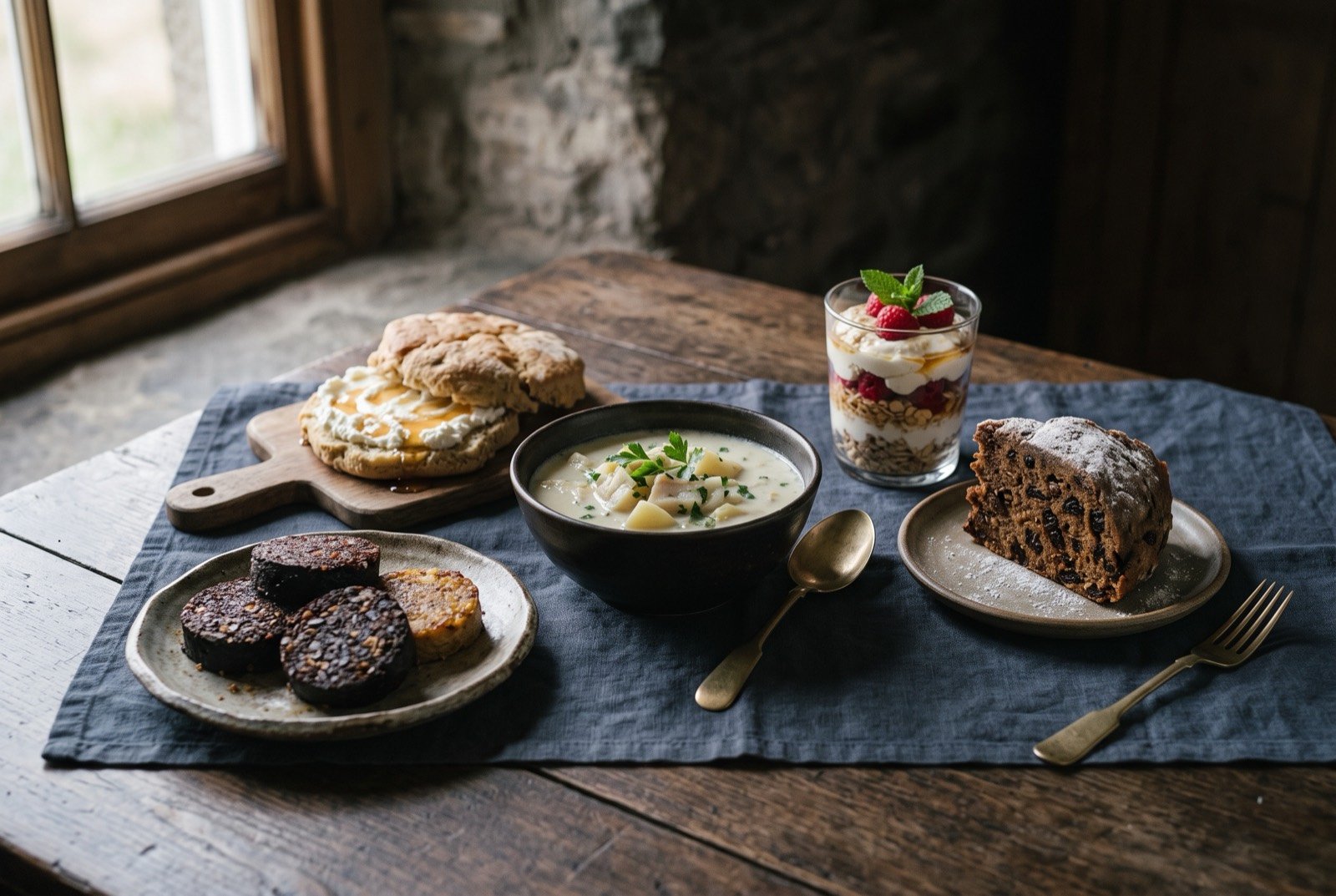
Two islands and a mainland fringe, held together less by a border than by a shared answer to the same problem: how to feed people on wind, salt spray, thin soil and a growing season that ends before it properly starts. Oats and barley where wheat will not ripen, kale and dairy on whatever ground is left, and the sea worked hard because the land cannot be. This volume splits the mainland Highlands from the Hebrides, Orkney and Shetland for a reason that is not simply geographic: the mainland and the Hebrides share a Gaelic tongue and a crofting economy, while Orkney and Shetland spent three centuries as Norwegian territory and speak, in dialect if not in a living tongue, the ghost of Norn instead. What unites all three is a single historical fact more powerful than any of that: the Highland Clearances, which took crofting land and turned it first into sheep pasture and then, once sheep stopped paying, into sporting estate, a transformation that still governs who eats the venison and the grouse today. Every dish as tradition built it, then what a modern chef would change.
Sources and review · What this chapter does not assert · How we research · Know this better? Tell us
A Sense of Place
The mainland Highlands: crofting on a Gaelic coast
Crofting is not simply small farming. It is a distinct, legally defined Scottish land tenure, confined historically to Argyll, Caithness, Inverness, Ross and Cromarty, Sutherland, Orkney and Shetland, and given statutory protection since the Crofters Holdings (Scotland) Act 1886. An average croft runs to around 5 hectares; around 21,000 crofts still cover more than 750,000 hectares and support roughly 30,000 people, and a crofter is typically a tenant paying rent rather than an owner, though many have since bought their crofts. Before the eighteenth-century agricultural improvements that made oats the dominant cereal, the crofting diet ran on oats, kale and barley, with the potato arriving after 1701 and becoming increasingly central well before the Clearances. A mid-eighteenth-century account of the poor's diet puts it plainly: "milk-meats and oatmeal, several ways prepared, and kail and roots dressed in several manners." Kale filled the role potatoes filled in Ireland, the one vegetable a kail-yard could be relied on to give. Gaelic is still a living working language here in a way nowhere else in mainland Britain can claim: Highland Council has more Gaelic speakers than any other Scottish council area, 12,040 people, 5.2% of the population, of whom 682 use it as their main home language. It carries its own precise food vocabulary, gruth for crowdie, sitheann for venison, cearc-fhraoich, literally heather-hen, for grouse, and its own calendar: bonnach Brìde, Bride's bannock, given out on Là Fhèill Brìghde, the first of February, and an oat bonnach Bealltainn roasted at the fire on the first of May.
The Hebrides: machair and a Gaelic tongue that never left
Machair is itself a Gaelic word, the fertile, low-lying grassy plain found on the Atlantic-facing coastlines of the Outer Hebrides, built from shell sand ground down by wave action over thousands of years. It is not wild land left alone; it depends on continued low-intensity crofting, rotational cropping and light grazing, to sustain the floral diversity that makes it what it is, and it is considered increasingly hard to maintain as crofting itself changes. Alexander Carmichael's Carmina Gadelica, the great nineteenth-century collection of Hebridean Gaelic folklore, even names the machair's stunted, marginal cereal strips with precision: coirce coilchinn, dwarf oats, eòrna coilchinn, meagre barley, seagal coilchinn, stunted rye. The Hebrides' food inheritance is explicitly Gaelic in language and in practice. Crofting itself is croitearachd; Stornoway's own black pudding carries the Gaelic name marag dhubh, literally black pudding, a name Lewis crofters used for generations before any commercial branding gave it a postcode.
Orkney and Shetland: a Norse tongue that did not survive
Orkney and Shetland belonged to the Norwegian crown until 1468 and 1469, when they were pledged, not sold or gifted, to James III of Scotland as security for the unpaid dowry of Margaret of Denmark on her marriage to the Scottish king. It is worth being precise about that word pledged, because it is a genuinely live local political point: Shetland News ran a piece as recently as 2025 specifically arguing that Norway never gave Shetland away, since the pledge was never formally redeemed, only absorbed by prescription over the centuries since. Udal law, the Norse-derived tenure system that survived the transfer in fragmentary form, still carries one concrete legal effect today: a landward proprietor's title extends to the lowest ebb, with no prior Crown right, unlike the rest of Scotland where the Crown holds the foreshore. That single fact of foreshore ownership, broadly interpreted by crofters as covering seaweed, wreck, sand and shingle, is the same legal logic that later let North Ronaldsay's entire sheep flock be legally confined to a diet of seaweed on the shore, and that today underpins the islands' use of the same foreshore for salmon farming. Norn itself, the North Germanic language Norse settlers brought from around 850AD, declined steadily once Scots became the language of power after 1468 and 1469, and is conventionally dated extinct around 1850. This is why the right register for Orkney and Shetland material is English and island dialect, not Gaelic: Gaelic was never the language spoken here, while it remains the historic Hebridean vernacular a short sea crossing away.
Bere barley is the clearest single marker of how differently these islands were shaped by ecology. A six-row landrace suited to short, cool, northern seasons, it was once the dominant barley of the whole Highlands and Islands and is now milled commercially at exactly one place on earth: Barony Mill in Birsay, Orkney, a working watermill in continuous use on the same site since at least the twelfth century. Bere is genuinely ancient here: charred grains from the Neolithic farmstead at Knap of Howar on Papa Westray, radiocarbon dated to occupation between roughly 3800 and 2800BC, show barley cultivation among the earliest attested farming activity anywhere in northern Europe. Whether today's specific bere landrace descends in an unbroken line from that Neolithic barley, or was introduced or displaced by a distinct Viking-era six-row barley in the ninth century, is genuinely unresolved in the research literature, and this chapter treats both possibilities as live rather than picking the tidier story.
The structural logic, at a glance
| Mainland Highlands | The Hebrides | Orkney and Shetland | |
|---|---|---|---|
| Staple grain | Oats | Oats, some bere | Bere barley, oats |
| Fat | Butter, beef suet | Butter, fish oil historically | Butter, mutton fat |
| The preserving discipline | Smoking salmon, drying and curing venison | Peat-smoking fish, blood sausage (marag dhubh) | Salt-curing and peat-smoking mutton (reestit mutton), whey fermentation (blaand) |
| Aromatic | Juniper, heather honey | Little beyond salt and peat smoke | Little beyond salt and peat smoke |
| The winter answer | Brose, smoked salmon, venison from the estate | Marag dhubh, salted fish | Reestit mutton and tattie soup, bere bannock |
The History in Layers
A land cleared twice: crofts into sheep, sheep into sport
The Highland Clearances ran in two broad waves. The first, from the 1750s to 1815, followed the failed 1745 Jacobite Rising and saw landowners consolidate small tenancies into large farms, introducing sheep for profit where crofting families had lived. The second, from 1825 to 1855, followed the post-Napoleonic economic collapse, the failure of the kelp industry that had employed 60,000 Scots at its early nineteenth-century peak, and the 1846 to 1848 Highland potato famine; some landowners burned crofts outright to force tenants out. Displacement estimates range from 70,000 to over 150,000 people, though reliable figures are genuinely hard to establish this far back. One of the best-documented single cases is Strathnaver in 1814, where Patrick Sellar, factor to the Countess of Sutherland, oversaw the removal of an estimated 430 families; William Chisholm's mother-in-law, Margaret MacKay, died five days after being left inside a house set alight during the clearance, and Sellar stood trial for arson and culpable homicide at Inverness in 1816 and was acquitted. Resistance culminated in the Bernera Riot of 1874 and the Crofters' War of 1882, which finally forced the Crofters Holdings (Scotland) Act 1886 and, with it, security of tenure.
What most popular writing about Highland game leaves out is that this same land, cleared once for sheep, was cleared again, in effect, for sport. Once sheep stopped being reliably profitable, landowners converted the same upland into deer forest and grouse moor, a transformation sharpened by fashion at the very top of British society: Queen Victoria and Prince Albert's enthusiasm for stalking at Balmoral, bought in 1852, sparked a Victorian aristocratic vogue, sometimes called Balmorality, for buying and managing whole estates around maximising grouse. Driven grouse shooting, made possible by the newly invented breech-loading double-barrelled shotgun, became the dominant form of shooting from the 1850s onward. The Scottish Government's own 2019 Werritty Review is the strongest single source on what this actually looks like today: less than 7% of Scotland's land area carries some form of grouse moor management, across around 120 estates, and of sixteen estates the Review Group itself surveyed, only one grouse enterprise made a small profit, all the rest were loss-making, with private investment running to £183 per hectare against £50 per hectare for subsidised sheep farming. One gamekeeper works for every 704 hectares, against one shepherd for every 4,046.
Who actually eats the grouse is a genuinely contested question, and both sides of that argument deserve naming rather than adjudicating. Revive, a land-reform coalition campaigning against grouse moor management, commissioned polling reporting that only one in four hundred Scottish adults eat grouse more than once or twice a year, and that eighty per cent never eat it at all, despite almost a fifth of Scotland's land mass being managed as grouse moor; no methodology or sample size for that figure has been published, a real weakness. Estate bodies cite a different set of figures, a £14.5 million wage contribution and around 2,640 full-time-equivalent jobs, drawn from the same 2018 Scottish Government research the Werritty Review itself cites. What is not contested is the shape of the history: grouse consumption before the Victorian sporting boom was almost certainly limited and opportunistic, and the dish's association with country-house dining is a nineteenth-century, landowner-driven invention laid on top of a much older, much plainer crofting diet, not a survival of it.
Venison's own arc runs far longer and ends in a genuine irony. Red deer have been eaten in Scotland from at least the Mesolithic, some 12,800 to 6,100 years ago; shell midden sites at Cnoc Coig on Oronsay and Sand near Applecross yield red deer bones beside wild boar and shellfish, and deer-bone harpoons and spears. By the medieval period venison had become a prestige food reserved for nobility, and under the sporting estates it passed firmly under landowner control. Scotland today produces around 3,500 tonnes of wild and farmed venison a year, two thirds of it consumed in the UK; farmed venison began commercially only in 1973, and around 70 deer farms now operate. The wild deer population stands at roughly a million, up from half a million in 1990, and NatureScot's legally mandated annual cull already exceeds 100,000 animals, with estimates suggesting culls need to rise by a further 50,000 a year to meet biodiversity targets. The irony is this: most venison reaching a plate today comes from population control, a conservation necessity, not from sport stalking pursued for its own sake, precisely the inversion of the trophy image the word venison still tends to conjure.
Herring, twice over, and a sea that emptied
The herring boom did not happen once. On the mainland, the building of Pulteney Harbour at Wick in 1811 and the Scotch cure method developed in 1819 drove the fishery's expansion; by 1862 over 1,100 vessels were based at Wick for the summer season, the town's population multiplying three or fourfold when the fleet was in, and Stornoway grew into one of Europe's leading fishing ports on the back of the same trade. In the Hebrides specifically, the boom ran roughly from 1850 to the Second World War and rested overwhelmingly on female labour: up to 3,000 island herring girls travelled the length of Britain each season, working in three-person crews, two gutters and a packer, a skilled gutter processing thirty to fifty herring a minute with her fingers wrapped in flour-sack rag against the knives and the salt brine. Shetland's boom is a separate, larger story again: a short-lived boom in the 1830s collapsed abruptly in 1839, and the real expansion came later, from the 1880s, peaking in 1905 at an almost unbelievable one million barrels, 113,021 tonnes, cured and exported by around 1,700 boats and 20,000 men, with Lerwick and Baltasound briefly among the most important herring ports on earth. The whole trade, wherever it ran, shared one fate: the First World War pulled fishermen into the Royal Naval Reserve and severed the export markets to Germany, Russia and the Baltic states, and the industry never fully recovered. The underlying stock did not survive the century either: North Sea herring catches peaked above a million tonnes in 1965, the spawning biomass collapsed from over 2 million tonnes in the 1960s to under 50,000 tonnes by the mid-1970s, and a moratorium on directed North Sea herring fishing ran from 1977 into the early 1980s. The West of Scotland stock that fed the Hebridean fishery specifically remains in serious long-term decline: its total allowable catch has been cut from 22,690 tonnes in 2015 to a proposed 24 tonnes for 2027, and Stornoway's fleet today fishes almost entirely for whitefish and shellfish.
Whisky's own escape from the excise man
By the 1820s as many as 14,000 illicit stills were being confiscated annually across Scotland, and more than half the whisky actually consumed in the country escaped duty altogether. The 1823 Excise Act legalised distilling for a £10 licence fee plus a set duty per gallon of proof spirit, and George Smith of Upper Drummin in Glenlivet, previously an illicit distiller himself, was the first person in Scotland to apply for and receive a licence under the new Act, founding what became The Glenlivet. The effect was immediate: licensed distilleries rose from 111 in 1823 to 263 by 1825, seventy nine of them commissioned in the ten months after the Act passed. Today Scotch whisky divides into five regions, Highland, Speyside, Lowland, Islay and Campbeltown, with 154 distilleries operating as of May 2026. Speyside, geographically inside the Highlands but formally separated as its own region only in 2009, now holds over sixty distilleries in an area about fifteen miles wide and produces over sixty per cent of Scotland's single malt; the Highland region proper has around thirty six distilleries spread across a far larger, more varied territory. About ninety per cent of the industry's barley is sourced within Scotland, and in 2025 Scotch whisky exports were worth £5.36 billion, 1.3 billion bottles sent to over 160 markets, supporting more than 41,000 jobs.
Salmon farming: the industry that rebuilt the islands' economy, and who actually owns it
This is the single largest modern change to the islands' food economy, and it deserves stating in hard figures rather than impression. Scottish salmon exports were worth £828 million in 2025, up from £445 million in 2016; production reached 195,182 tonnes in 2025, up from 162,817 tonnes in 2016; cumulative export value over the past decade exceeds £6 billion, sold into 94 markets, with France, the United States and China together accounting for nearly ninety per cent of export value. Regionally over that decade, exports attributable to Shetland alone totalled £1.3 billion, the Western Isles £1.1 billion, and Orkney £663 million. The sector directly employs around 2,500 people, with a further 8,500 jobs supported in feed, logistics, processing and equipment; Scottish Sea Farms alone employs 642 people and is Shetland's single largest private employer. These employment and community-benefit figures come from Salmon Scotland, the industry's own trade body, and a report it commissioned, and should be read as industry-favourable framing rather than neutral measurement.
Who actually owns this nominally Scottish industry is documented and genuinely contested. Mowi and Scottish Sea Farms are Norwegian owned; Bakkafrost Scotland, formerly the Scottish Salmon Company, was bought by the Faroese firm Bakkafrost in 2019. The Ferret, a Scottish investigative outlet, states that as much as ninety nine per cent of caged salmon production from Scottish-branded companies on the west coast is controlled from outside Scotland. Nor is ownership the only live controversy: in 2025 UK government inspectors issued warning letters to farms over sea lice exceeding safety limits, average lice counts more than doubled year on year by that August, Scottish salmon companies had filed 210 appeals against lice management controls, and one campaign group's analysis found a 243% rise in environmental non-compliances alongside 48 tonnes of formaldehyde discharged into Scottish lochs that year. None of this is reason to romanticise what farming replaced. Wild Atlantic salmon is no longer commercially netted or sold from Scottish waters at all: coastal netting was banned in 2016 on conservation grounds, stocks having fallen by roughly seventy per cent in twenty five years, and the sole remaining UK netting operation selling wild salmon is on the River Tweed, its fish caught on the English bank. A reader who believes they can still buy wild Scottish salmon is, gently, mistaken, and any retailer implying otherwise should be treated with real suspicion.
Norse under one flag, Gaelic under another
The clearest hard evidence of a distinct Norse culinary inheritance in Orkney and Shetland concerns pork. Uniquely within Scotland, islanders here kept and ate pigs, letting them forage through winter, where mainland Scots traditionally disdained, even superstitiously feared, pork. Orkney's own pork and kale dish is found, according to at least one food historian, nowhere else in Britain, though that specific claim rests on a weaker Western secondary source, and its further suggestion of a link to Norwegian fårikål should be treated with real caution: this atlas's own separate research into the Nordics found fårikål itself very likely a nineteenth-century Danish import into Norway rather than an ancient dish, so an ancient-Norse-inheritance claim for Orkney pork built on a supposed link to fårikål risks stacking one contested claim on top of another already shaky one. By contrast the Hebridean inheritance is unambiguously Gaelic, in language and in daily practice, right down to the name of a black pudding.
One tradition deserves naming directly, because it sits at the sharpest possible point of contested Hebridean identity today: the guga hunt, the harvest of young Northern gannets from the remote rock of Sula Sgeir, conducted for centuries by the Men of Ness from Lewis, documented back to at least 1549, and protected by a specific legal exemption written into the Wildlife and Countryside Act 1981. In 2025, for the first time in recorded history, NatureScot refused to grant a licence for the hunt, citing possible harm to the gannet population even at reduced take limits, a decision that has drawn protest from both the hunters themselves and animal rights campaigners. Its future is genuinely open at the time of writing, and this chapter treats it as exactly that, rather than as settled heritage practice on the one hand or a closed question on the other.
The Flavour Arsenal
Oats, the grain that never stopped being the answer
Oats became the dominant Highland cereal after the eighteenth-century agricultural improvements and never really lost that position. Brose is oatmeal mixed with boiling water or stock and left briefly to swell, denser than porridge and best made with medium or coarse oatmeal; brochan, the Gaelic-named version, is thinner, historically drunk medicinally, recorded by Martin Martin as a remedy for coughs as early as 1703. The same grain, toasted rather than soaked, is what turns skirlie from a plain onion fry into something with real body, and what gives cranachan its whole reason for existing: pinhead or medium oatmeal dry-toasted in a heavy pan, four to eight minutes, stirred constantly, until deep golden and smelling of toasted hazelnuts, then tipped straight onto a cold plate to stop it cooking further, since warm oatmeal folded into cream will steam it and make it weep.
Bere, the barley that survives in one mill
Bere's real age and real range are covered above. What matters for the kitchen is narrower and more concrete: this is not a mainland Highland grain, whatever a generic list of Scottish ingredients might imply, but an Orkney and, historically, Shetland one, milled today at exactly one working site on earth. Barony Mill's own published method for bere bannock combines beremeal, plain flour, baking powder, cream of tartar and salt with enough milk or water for a stiff, pliable dough, rolled to about an inch thick and cooked on a dry griddle around five minutes a side until golden. This is a modern, chemically leavened recipe; no source traces the exact ratio of beremeal to wheat flour, or the leavening method, used before commercial baking powder existed, and this chapter does not invent one.
Crowdie, and the black roll that keeps it
Crowdie, gruth in Gaelic, is made by letting raw, usually skimmed, milk sour and thicken naturally, then warming it gently, never boiling or even simmering, since heat that high toughens the curds, until it curdles, draining the result through muslin for thirty to forty five minutes, then salting. Black crowdie, or gruth dhu, rolls the finished cheese in toasted pinhead oatmeal and cracked black pepper, made commercially today by Highland Fine Cheeses in Tain. Claims that crowdie descends from a Viking or Pictish original recur constantly across popular writing and rest, wherever this research traced them, on no cited archaeological or documentary evidence at all; this chapter does not repeat them as fact.
Heather honey, on the clock with the grouse
Ling heather, the dominant nectar source across Scottish moorland, flowers through August, but the actual nectar flow lasts only four to six days within that window, which is why beekeepers traditionally moved hives to the moor around the twelfth of August, the same date the grouse season opens. Sourcing on the honey itself is genuinely thinner than this chapter would like: most material found was commercial retail rather than agricultural or beekeeping-trade sourcing, and the largest named Scottish heather honey producer traced is based outside the Highlands proper, in the Lothians, Dumfriesshire, Stirlingshire, Fife and Aberdeenshire. Treat specific claims about the honey's viscosity or difficulty of extraction as commercially sourced rather than independently confirmed.
Venison and grouse, the sporting estate's inheritance
Both are covered in depth above as history. What is worth adding here as a plain, practical note: Food Standards Scotland's own 2012 risk assessment on wild-shot game flags lead ammunition residue as an ongoing food-safety concern in wild-shot grouse specifically, and notes cooks' own tendency to try to remove as much lead shot as possible before cooking. No traditional, pre-restaurant Highland method for preparing either bird or beast, with real ratios and timings, could be found in credible sourcing for this chapter; what exists in the modern record is restaurant technique, which this chapter is honest about not projecting backward as folk history it cannot support.
Wild salmon and sea trout, now a memory more than a menu item
Both bradan, salmon, and sea trout are now heavily constrained, conservation-sensitive resources rather than freely available ones. Atlantic salmon is classified Endangered in Great Britain following a thirty to fifty per cent population decline since 2006, and coastal netting has been banned in Scotland since 2016. Sea trout rod catches have fallen to their lowest recorded levels in west Highland areas near salmon farms, a decline conservation voices attribute to sea lice spreading from farms sited near river mouths. Traditional cold-smoking, still practised by the surviving island smokehouses, dry-brines fillets in sea salt with a little dark brown sugar for twelve to twenty hours depending on temperature, washes off the brine, dries the fish, then cold-smokes it below thirty degrees Celsius, commonly to a maximum of twenty eight, for around eighteen hours, traditionally over chipped ex-whisky-barrel oak, a total process of up to forty eight hours from raw fish to finished product.
Stornoway black pudding, one blood sausage among three
Stornoway black pudding was granted Protected Geographical Indication status by the European Commission on 9 May 2013, re-registered under the UK's own scheme on 31 December 2020, restricted to product made in the town or parish of Stornoway itself. The specification's permitted ingredients are exact: beef suet, oatmeal, onion, the blood of sheep, cattle or pig, water only where dried blood is used, salt, pepper, and casing or skin, nothing else, with artificial colours, flavours, bulking agents and preservatives all explicitly banned. Ingredient ranges are fixed: beef suet 37 to 50%, oatmeal 16 to 20%, onion 15 to 18%, blood 12 to 26%, salt 0.6 to 2%, pepper 0.4 to 2%. Suet is cut to pieces of one to five millimetres using a bowl cutter, a step the specification itself calls highly skilled and judged by eye. It is, notably, barley-free: it is oatmeal, not bere or any other barley product, that gives the pudding its characteristic rough crumb, distinct from the island's other great grain. The PGI application itself was a defensive move: the Stornoway Black Pudding Producers Association formed in 2006 specifically over concern about impostor puddings made outside the Western Isles trading on the Stornoway name, and a petition against that misuse gathered over 1,500 signatures before the protection was granted.
This atlas is treating Stornoway black pudding as one part of a blood sausage family split three ways across separate chapters: Stornoway here, Bury black pudding in a future England volume, and Ireland's drisheen in a future Ireland volume. The three are worth naming side by side now rather than waiting for those chapters to exist. Bury's pudding is traditionally boiled and served with malt vinegar, most often fried as part of a full English breakfast, and its real difference from Stornoway's is regional and culinary context more than a radically different ingredient list, though Bury versions typically run a finer, less oatmeal-forward texture. Drisheen, strongly associated with Cork, is compositionally distinct in a way that actually matters: it includes milk alongside blood, fat and salt, is boiled and sieved to a smooth consistency, and is traditionally set in the animal's main intestine, giving it a gelatinous texture with nothing in common with Stornoway's coarse, oatmeal-textured crumb. Stornoway's own identity rests specifically on the combination of beef suet and Scottish oatmeal, no dairy anywhere in it, and a PGI specification with a stricter ban on preservatives and bulking agents than either comparator appears to carry in law.
Reestit mutton and blaand, the taste of a larder with no fridge
Reestit mutton is a genuine, still-living Shetland tradition, listed by Slow Food UK's Ark of Taste as now produced solely in Shetland, though once practised more widely across Scotland's crofting counties. Mutton from sheep aged eighteen months or older is salted in brine, sources give the period variously as ten to fifteen days or two to three weeks, then hung to dry, traditionally in the rafters of the house, the reest itself, above a peat fire, where the smoke seasons and helps preserve the meat, for a minimum of around five weeks before use. It is genuinely comparable to, but not the same technique as, Faroese skerpikjøt, which is wind-dried without any salt at all over five to nine months in a purpose-built shed; reestit mutton is fundamentally a salt cure with peat smoke added, over weeks rather than months, and both descend from a shared North Atlantic Norse tradition of keeping meat without refrigeration by two genuinely different routes. Blaand, meanwhile, is a fermented, low-alcohol drink made from whey, historically the everyday drink in Orkney and Shetland before tea and coffee arrived, its production having effectively died out by the mid-twentieth century and been deliberately revived only from 2005. Its Norse pedigree rests on shared distribution across other Norse-settled North Atlantic islands and a Norwegian-derived name, not a documented medieval recipe, and this chapter treats it accordingly, as a real and reproducible technique rather than a continuous unbroken tradition.
Whisky, drunk beside the food for two centuries, now sometimes cooked into it
Whisky's default role in this cuisine has always been to sit beside the food, not inside it, and most of whisky country's serious dining still works that way: The Macallan Estate's TimeSpirit restaurant, built with the Roca brothers of El Celler de Can Roca, offers a whisky pairing menu structured exactly like a wine pairing would be, the spirit alongside the dish rather than built into it. A genuinely different model exists at GEAMAIR, at the Craigellachie Hotel in Speyside, where chef Pawel Sowa treats fermentation and maturation as what he calls creative lenses rather than flavour gimmicks, building dishes with whisky in mind from the start. The chemistry behind that approach is real rather than marketing: alcohol does not cook off nearly as fast as commonly assumed, a wine-based sauce retaining roughly forty per cent of its original alcohol after fifteen minutes of simmering, and the same holds for a whisky reduction. Guaiacol and related phenolic compounds in a peated whisky belong to the same aroma family that gives smoked food its character, detectable at extremely low thresholds, so a peated single malt reduced into a butter or pan sauce can deliver a genuine smoke-adjacent note without literally smoking the dish at all, a real technique grounded in shared chemistry between peated barley and wood-smoked fish or meat.
The Technique Ladder
The argument, from inside
Nothing in this chapter's technique is decorative. Salt draws water out of fish and meat because water is what spoils them; peat and oak smoke work slowly, at a controlled low temperature, because heat that cooks the surface shut stops the smoke doing its real preserving work underneath; a cloth wrapped around a boiling pudding insulates it from the direct violence of a rolling boil that would otherwise waterlog it. A technically capable home cook with real kit can reproduce almost all of it properly, provided the reproduction respects exactly what the original constraint was solving for.
Rung 1. Salt first, dry the skin, then decide which smoke you want
Every cured fish and every hot-smoked haddock in this chapter starts the same way: salt applied before anything else, drawing surface moisture out by osmosis and firming the flesh, which both protects it during hot smoking and concentrates the flavour underneath. What differs, and what a home cook needs to decide deliberately rather than by accident, is what comes next. A genuine Arbroath smokie is salted, then hot-smoked over hardwood in a sealed half-barrel, fully cooked in under an hour, ready to eat straight from the smoke. A cold-smoked salmon or haddock is salted, dried, then held below thirty degrees Celsius for many hours, cured and flavoured but never actually cooked by the smoke itself. These are two different techniques solving two different problems, not two points on the same dial, and a Big Green Egg genuinely does both, provided the cook knows which one is being asked for before lighting it.
Rung 2. Toast the oat before you soak it
Raw oatmeal tastes of very little. Dry-toasted in a pan until it colours, it develops real, nutty, roasted flavour through the same Maillard chemistry that browns a steak, and that toasting has to happen and finish before the oats meet any liquid, since wet oatmeal will steam rather than brown. Cranachan's whole character depends on getting this step right and then stopping it, tipping the hot pan straight onto a cold plate so the oats do not carry on cooking in their own residual heat and turn bitter.
Rung 3. Give the smoke time, not heat, and know which one you're doing
This is Rung 1's principle taken further, into a preservation technique proper rather than a flavouring one. Reestit mutton depends on a long, cold, patient process, salt first, then weeks of peat smoke at ambient temperature, never anything approaching a cooking heat, because the whole point is to remove enough moisture and add enough smoke compound to keep the meat edible for months, not to cook it at all. A UK kitchen cannot fully replicate the specific rafter-and-peat-fire method genuine reestit mutton depends on, and this chapter says so rather than pretending a Big Green Egg is a straightforward substitute for a Shetland but-and-ben's chimney space. What it can do honestly is approximate the principle: a genuine dry salt cure, then a genuine cold smoke, held well under thirty degrees Celsius for hours rather than minutes, over whatever legal UK smoking fuel comes closest to peat's particular phenolic character.
Rung 4. Cloth and time, not a rolling boil
A clootie dumpling wrapped in scalded, floured muslin and simmered gently for a full three hours, resting on an upturned saucer so it never touches the base of the pan directly, is not simply a boiled pudding in a bag. The cloth insulates the mixture from the full violence of the boil, letting a dense, sugar-and-suet dough set slowly and evenly instead of turning waterlogged at the edges before the centre has cooked at all. Rushing this by raising the heat produces a heavier, wetter result than the same recipe cooked patiently ever will.
Rung 5. Respect a lean animal, sous vide before you sear
Wild venison carries almost no intramuscular fat, which is precisely the problem a traditional long, dry roast, developed for far fattier farmed meat, was never built to solve gently. Dry-ageing the loin or haunch for several days in a controlled fridge environment lets proteolytic enzymes tenderise the muscle and concentrate flavour, the dried surface pellicle trimmed away before cooking; sous vide, holding the meat at a precise internal temperature well below what a hot pan alone can guarantee, then finishes the job without the risk of overcooking a cut with nothing to protect it. A hard, fast sear afterwards, in a pan or on the hottest part of a Big Green Egg, delivers the Maillard crust sous vide alone cannot.
The Cure and Smoke Bench
1. Crowdie's Simple Culture
Let raw, usually skimmed, milk sour and thicken naturally at room temperature, then warm it gently, never to a simmer, until it curdles. Strain through muslin for thirty to forty five minutes, then salt. For black crowdie, roll the still-slightly-warm curds in toasted pinhead oatmeal and cracked black pepper before they set fully, so the coating actually adheres.
2. Reestit Mutton's Long Salt
Covered in full above as this chapter's fifth technique rung. Worth restating here as a standalone bench entry: a genuine home cook can dry-salt a mutton or hogget joint for several days, then cold-smoke it for several hours, well under 30°C, and arrive at something honestly in the same family as the Shetland original, without ever claiming to have reproduced the rafter-and-peat method itself.
3. Cold-Smoking Salmon and Haddock at Home
Dry-brine fillets in sea salt with a little dark brown sugar for twelve to twenty hours depending on ambient temperature, wash off the brine, dry the fish thoroughly, then cold-smoke below thirty degrees Celsius, commonly to a maximum of twenty eight, for around eighteen hours, over oak or, for something closer to the island style, chipped ex-whisky-barrel oak. For a hot-smoked haddock in the Arbroath style instead, salt overnight, then smoke over hardwood at a genuinely high, humid heat, fully cooking the fish in under an hour.
4. Blaand, Revived Rather Than Remembered
A fermented whey drink, genuinely reproducible at home from the whey crowdie-making leaves behind, but this chapter found no single settled traditional ratio or fermentation time to give as a fixed recipe, since the tradition itself lapsed for decades before its deliberate revival from 2005. Treat it as a real, worthwhile experiment for a cook with the time and curiosity for it, not as a dish this chapter can responsibly hand over with McNeill-level precision.
5. Stornoway Black Pudding, Understood but Not Attempted at Home
Covered in full at Dish 7. Worth restating here plainly: the PGI specification's own suet-cutting step is described as highly skilled, judged by eye rather than by measurement, and this chapter draws the same line it draws for hákarl elsewhere in the atlas. Buy it from a licensed producer. Understand it. Do not attempt to make it from scratch as a home project.
Sourcing in Britain
Verified August 2026. Where a supplier's current stock could not be confirmed, that is said rather than smoothed over.
The genuine gaps, stated plainly first. Wild Scottish salmon is not commercially available at all; any retailer implying otherwise should be treated with suspicion, for the reasons given above. Summer Isles Foods' current online retail availability could not be confirmed; a direct product page returned an error, and one retailer listing stated its products are no longer available through official channels. There is no strong in-tradition source for which whisky to cook with rather than drink; the convention given below is a repeated generalist one, not an authoritative Scottish rule.
The ranked list: what decides great from grim
- The blood and suet ratio in a genuine Stornoway black pudding. The PGI specification fixes beef suet at 37 to 50% and blood at 12 to 26%; supermarket imitations routinely substitute cheap rusk and a lower blood content, producing a drier, greyer product. Charles Macleod ships fresh, cooked pudding UK-wide.
- Genuine hot smoking over hardwood, not a cold-smoked or artificially coloured imitation, for anything sold as an Arbroath smokie. M&M Spink ships nationwide.
- Farmed versus claimed-wild Scottish salmon. Since wild is not commercially available, buy well-farmed and honestly labelled: Loch Duart sells its own oak-smoked salmon direct, and the island smokehouses Hebridean Smokehouse and Salar Smokehouse both ship by mail order, peat and oak smoked respectively.
- Bere barley, beremeal or bere bannocks, from Barony Mill, the sole commercial mill still stone-grinding bere in the UK, UK mainland shipping only.
- Crowdie, genuine and cultured rather than a generic soft cheese, from Highland Fine Cheeses in Tain, sold direct with UK next-day delivery.
- Heather honey, raw and unpasteurised, from the Scottish Bee Company or Heather Hills Farm, both shipping UK-wide.
- Highland venison, from Macbeth's, Aberdeenshire Larder or Donald Russell, all sourcing wild red and roe deer from Scottish estates.
- Grouse, in season 12 August to 10 December, from Macbeth's, The Blackface Meat Company or the Wild Meat Company; check delivery zones before ordering, since some couriers explicitly exclude Highland and Island postcodes.
- Whisky for cooking versus drinking. No definitive in-tradition rule was found; the repeated working convention is a lighter Speyside-style single malt or a decent blend for cooking, reserving heavily peated Island malts for drinking neat.
Kit notes for this volume
A Big Green Egg fitted for cold smoking, held well under 30°C, does the real, honest work behind this chapter's own smoked salmon, smoked haddock and home-cured reestit mutton alike, and the same fire run hot and humid gives a genuine Arbroath-style hot smoke for a different dish entirely; knowing which one you are lighting matters more than the kit itself. Sous vide earns its place for venison collops' precise, fat-free doneness and for cock-a-leekie's more evenly cooked fowl. A dehydrator and high power blender together turn a handful of raspberries into a genuinely useful concentrated garnish, and cooked black pudding into a savoury seasoning rather than only a breakfast component. A chinois is the honest modern equivalent of the muslin crowdie has always been strained through, and works equally well clarifying a reduced stock. A dedicated spice grinder is worth using for cracked juniper in skirlie and for grinding fresh pepper into black crowdie's own oatmeal coating.
Voices and Sources
From inside the tradition
- Charles Macleod, Stornoway, founded 1947 by Charles Menendez Macleod, the best-documented current Stornoway Black Pudding PGI producer, nine Great Taste Awards for the pudding alone.
- M&M Spink, Arbroath, family business since 1965, descended from generations of the Spink family's trade in Auchmithie, the smokie's originating village.
- Barony Mill, Birsay, Orkney, the sole commercial mill in the world still stone-grinding bere barley, in continuous use on the same site since at least the twelfth century.
- Highland Fine Cheeses, Tain, the named commercial producer of Skinny Crowdie and Black Crowdie.
- Hebridean Smokehouse, North Uist, and Salar Smokehouse, South Uist, the two established Outer Hebridean smokehouses, peat and oak smoked respectively.
- Slow Food UK's Ark of Taste, the primary documentary source behind this chapter's understanding of reestit mutton as a genuinely living rather than purely historic tradition.
- The UHI Agronomy Institute, running a bere barley research programme since 2002 that has done more than any other body to keep the grain from disappearing entirely.
- The Ferret, a Scottish investigative outlet, the primary source behind this chapter's understanding of who actually owns and profits from the salmon farming industry.
Where this is cooked well today
The full verified Michelin-starred roster for the Highlands, Islands and whisky country in the 2026 Guide runs to five restaurants: Restaurant Andrew Fairlie, Gleneagles, two stars held every year since 2006; The Glenturret Lalique, Crieff, two stars, the first restaurant inside a working distillery anywhere to hold Michelin recognition; 1887 at The Torridon, Wester Ross, a new star in 2026; Killiecrankie House, near Pitlochry, a new star in 2026, its kitchen genuinely blending Asian technique, miso from green peas, kimchi from foraged wild garlic, with Scottish ingredients, worth naming as hybrid rather than pure indigenous restoration; and Loch Bay, Stein, Skye, the island's only starred restaurant, which closes for good after its final service on 31 October 2026. Everything else worth naming here is serious cooking without a star, which is most of what actually feeds this cuisine's honest current picture: Edinbane Lodge and Scorrybreac on Skye, both built on hand-dived scallops and personally foraged ingredients; the Applecross Inn, a working pub rather than fine dining but a genuine reference point for west coast shellfish served without pretension; the Seafood Shack in Ullapool, proof that a genuinely good version of Highland seafood-on-the-go exists, even if it usually has to leave the country to be found on a menu elsewhere; and Inver, on Loch Fyne, whose chef Pam Brunton worked at Noma and Fäviken before returning to Scotland, a kitchen that should be understood plainly as New Nordic method applied to Argyll produce, not as indigenous Scottish technique rediscovered.
A caution on two counts. Boath House, Nairn, has changed hands and closed twice within a single year and is, at the time of writing, for sale rather than operating as a restaurant; treat any listing describing it as currently open with real scepticism. And a restaurant sometimes named in casual writing as "Home," on Skye, could not be verified to exist under that or any traceable name, and does not appear in this chapter as a result.
Things this chapter has deliberately not asserted
- Rumbledethumps as a Highland dish. Every source traced places it firmly in the Scottish Borders, with the earliest printed recipe dated to 1825; it does not appear in this chapter.
- The Earl of Atholl's 1475 well-poisoning legend as documented history. The story that Atholl brose's invention followed the capture of the Lord of the Isles by filling a well with whisky, honey and oatmeal has no primary historical source behind it in this research and is treated as folklore, not fact.
- Crowdie's claimed Viking or Pictish origin. This recurs constantly in popular writing and rests, wherever traced, on no cited archaeological or documentary evidence.
- The "Findlay family" origin story for Cullen skink. Repeated across tourism writing, it could not be traced to any primary or academic source.
- A causal ancient-Norse-inheritance claim for Orkney's pork and kale dish, built on a supposed parallel with Norwegian fårikål. This atlas's own separate Nordics research found fårikål itself very likely a later Danish import into Norway, which undermines using it as evidence of ancient Norse inheritance elsewhere.
- Bere barley as a mainland Highland grain. It is specifically and almost solely an Orkney and historically Shetland grain, milled today at one site in the world, and this chapter has kept it there rather than letting a generic "Highland ingredients" list smuggle it onto the mainland.
- A single settled brine ratio or curing time for reestit mutton. Sources give the salting period as anywhere from ten days to three weeks, and one specific brine ratio found rests on a single anecdotal tradesperson's account rather than a documented standard.
- Any claim that a named Highland tourist business deliberately serves inferior product. The structural, economic reasons good shellfish and salmon disproportionately miss Highland tables, better prices abroad, are real and sourced; deliberate deception by any named business is not alleged anywhere in this chapter.
- A definitive correct whisky for cooking rather than drinking. No strong in-tradition source settles this; it is presented as a working convention, not a rule.
- The existence of a restaurant called "Home" on Skye. Not found in any traceable source, and not included.
- Boath House, Nairn, as a currently operating restaurant. It is not, at the time of writing, despite some listings still describing it as open.
- The exact wording of the Stornoway Black Pudding PGI specification, read directly from the primary document. The percentage ranges given in this chapter rest on consistent secondary corroboration of that specification rather than a direct read of the primary PDF, which resisted text extraction during this research.
- The future of the guga hunt. NatureScot's 2025 refusal of a licence, the first in recorded history, leaves this genuinely unresolved, and this chapter treats it as an open question rather than settled either way.
Salt first, dry the skin, then decide which smoke you want
Every cured fish and every hot-smoked haddock in this chapter starts the same way: salt applied before anything else, drawing surface moisture out by osmosis...
Toast the oat before you soak it
Raw oatmeal tastes of very little. Dry-toasted in a pan until it colours, it develops real, nutty, roasted flavour through the same Maillard chemistry that...
Give the smoke time, not heat, and know which one you're doing
This is Rung 1's principle taken further, into a preservation technique proper rather than a flavouring one.
Cloth and time, not a rolling boil
A clootie dumpling wrapped in scalded, floured muslin and simmered gently for a full three hours, resting on an upturned saucer so it never touches the base of...
Respect a lean animal, sous vide before you sear
Wild venison carries almost no intramuscular fat, which is precisely the problem a traditional long, dry roast, developed for far fattier farmed meat, was...
The dishes
- Cullen Skink Mainland Highlands, Moray coast
- Cock-a-Leekie Soup Mainland Highlands and the whole of Scotland
- Skirlie Mainland Highlands
- Cranachan Mainland Highlands and the whole of Scotland
- Clootie Dumpling Mainland Highlands and the Hebrides
- Venison Collops Mainland Highlands
- Stornoway Black Pudding The Hebrides
- Bere Bannock with Crowdie and Heather Honey Orkney
- Reestit Mutton and Tattie Soup Shetland
Sources and review
- Researched
- 5 sources cited
Where this volume comes from
4 research briefs on file for this volume, researched to the rules on How we research. Published 28 August 2026. Last changed 20 September 2026.
The brief's own account of its sources
Across both passes, roughly 80 sources were consulted. The strongest tier is genuinely primary and Scottish or local: Scottish Government and public bodies (Crofting Commission, Scottish Government/gov.scot including the Werritty Grouse Moor Management Group report, NatureScot, Food Standards Scotland, Highland Council, National Records of Scotland, Historic Environment Scotland), the UK protected food names register (GOV.