Britain and Ireland · Volume 34, Salt, Smoke and the Land the Clearances Remade
Cock-a-Leekie Soup
Mainland Highlands and the whole of Scotland
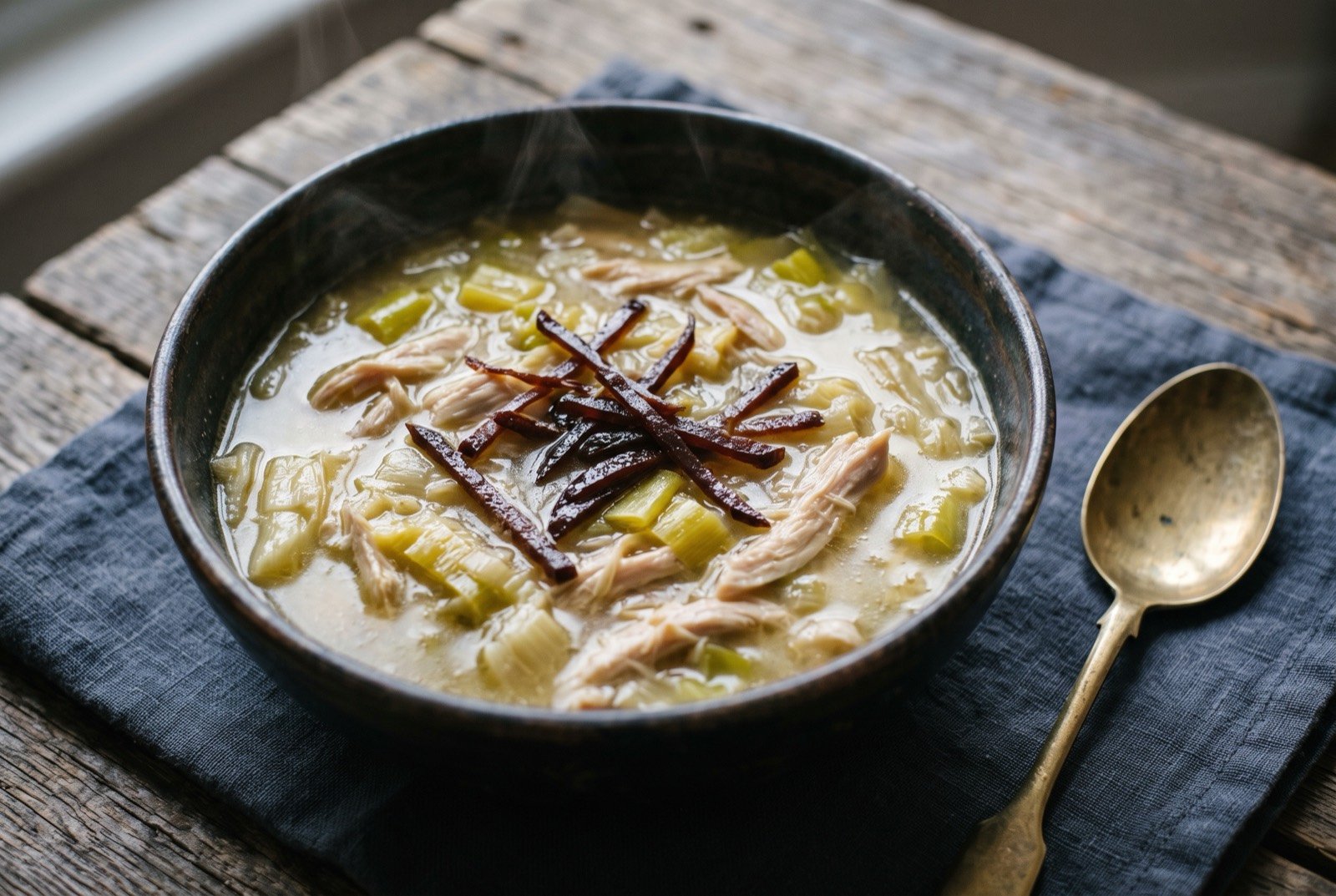
An illustration of the dish, not a photograph of it cooked.
- Time
- 3 hours
- Researched
- 5 sources cited
- Reviewed
- Not yet reviewed from inside the tradition
- Cooked
- Not yet cooked and reported
A chicken and vegetable dish was served to James VI as early as 1598, and the specific name "cockie leekie" is first recorded in 1737, in the Ochtertyre House accounts. Prunes were originally a significant component, added for flavour and to use dried fruit through winter, and the nineteenth-century cookery writer Meg Dodds insisted the soup "must be very thick of leeks," the first part of them boiled down into the broth until it becomes what she called a lubricious compound. Most modern versions omit the prunes or reduce them to an afterthought; this chapter restores McNeill's own original touch of a julienne of prune served alongside, since it is genuinely part of the documented dish rather than a modern flourish.
As tradition built it
Serves 6. About 3 hours.
Ingredients
- 1.5kg boiling fowl or large chicken
- 900g leeks, trimmed and sliced
- 15 pitted prunes
- 1 tbsp pearl barley
- a pinch a pinch of allspice, salt
- 2.5 litres water
Method
- Put the chicken in a large pot with the water, bring to a simmer, and cook 2 to 2.5 hours, until completely tender. Lift out the bird, strain the stock, and set both aside.
- Return the stock to the pot with most of the leeks and the barley, and simmer 30 to 40 minutes, until the leeks have broken down and the soup is genuinely thick with them, in Meg Dodds's own phrase.
- Shred the chicken meat, discarding skin and bone, and return it to the pot with the remaining leeks and the prunes for a final 10 to 15 minutes, so the prunes soften but keep their shape.
- Season with allspice and salt, and serve with a fine julienne of a reserved raw prune scattered over each bowl.
What a modern chef changes
The bird cooked more evenly, and the vanishing garnish restored on purpose.
Kit note, not tied to a numbered rung.
Method
- Poach the chicken sous vide at around 75°C for several hours rather than simmering it whole, for meat that stays properly moist and shreds cleanly, rather than the stringier result a rolling simmer often gives a whole bird.
- Reduce the strained stock hard before building the soup, for a depth the traditional long simmer alone does not always achieve.
- Never skip the julienne of prune garnish. It is McNeill's own detail, not an invented flourish, and it is the single most commonly dropped element of the modern dish.