Britain and Ireland · Volume 34, Salt, Smoke and the Land the Clearances Remade
Venison Collops
Mainland Highlands
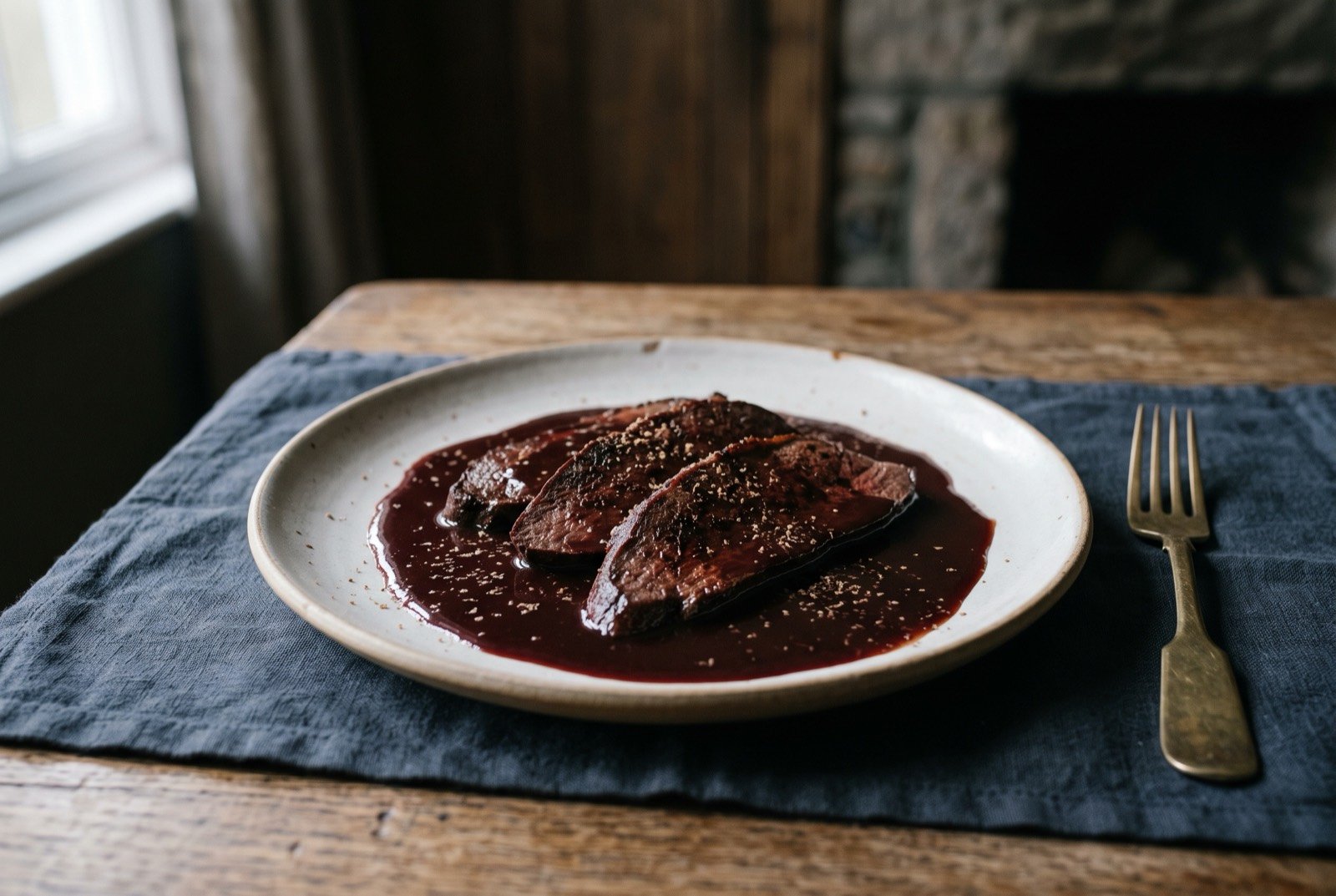
An illustration of the dish, not a photograph of it cooked.
- Time
- 30 minutes
- Researched
- 5 sources cited
- Reviewed
- Not yet reviewed from inside the tradition
- Cooked
- Not yet cooked and reported
McNeill's own recipe gives no fixed weight for the venison itself, only a method, oblong slices cut from the haunch, or neat slices trimmed from the neck or loin, and a gravy built from the trimmings and bones, thickened with butter worked into lightly browned flour, then finished with a squeeze of lemon or orange, a small glass of claret, pepper, salt, cayenne "the size of a pin's head," and a scrape of nutmeg. This chapter gives it as McNeill wrote it, historic descriptive measures intact, since inventing false modern precision for a period recipe would be its own kind of dishonesty.
As tradition built it
Serves 4. About 30 minutes.
Ingredients
- 600g venison haunch or loin, cut into thin oblong collops
- as available trimmings and any bones, for the gravy
- 20g butter, worked into 20g flour
- juice of 1/2 lemon or orange
- a small glass claret
- to taste pepper, salt
- the size of a pin's head cayenne
- a scrape nutmeg
Method
- Simmer the trimmings and bones in a little water to draw out a gravy, then strain.
- Melt the butter, work in the flour, and cook briefly before whisking in the strained gravy to a light sauce.
- Add the lemon or orange juice, claret, pepper, salt, cayenne and nutmeg, and simmer gently to combine.
- Fry the venison collops quickly in a hot pan, no more than a minute or two a side, since they are thin and cook fast.
- Serve the collops with the sauce spooned over.
What a modern chef changes
A lean animal, treated as lean rather than roasted as if it were fat.
Rung 5
Method
- Dry-age the venison loin or haunch for 3 to 5 days in a controlled fridge environment before cutting, trimming away the dried surface pellicle once done.
- Cook the collops sous vide at around 56 to 58°C to a rosy, even doneness throughout, rather than relying on a hot pan alone to judge such thin, fat-free cuts correctly.
- Finish with a hard, fast sear in a screaming-hot pan for the crust sous vide cannot give, then build McNeill's own claret and citrus sauce from the trim exactly as written, since the sauce itself needs no modernising at all.