Britain and Ireland · Volume 34, Salt, Smoke and the Land the Clearances Remade
Reestit Mutton and Tattie Soup
Shetland
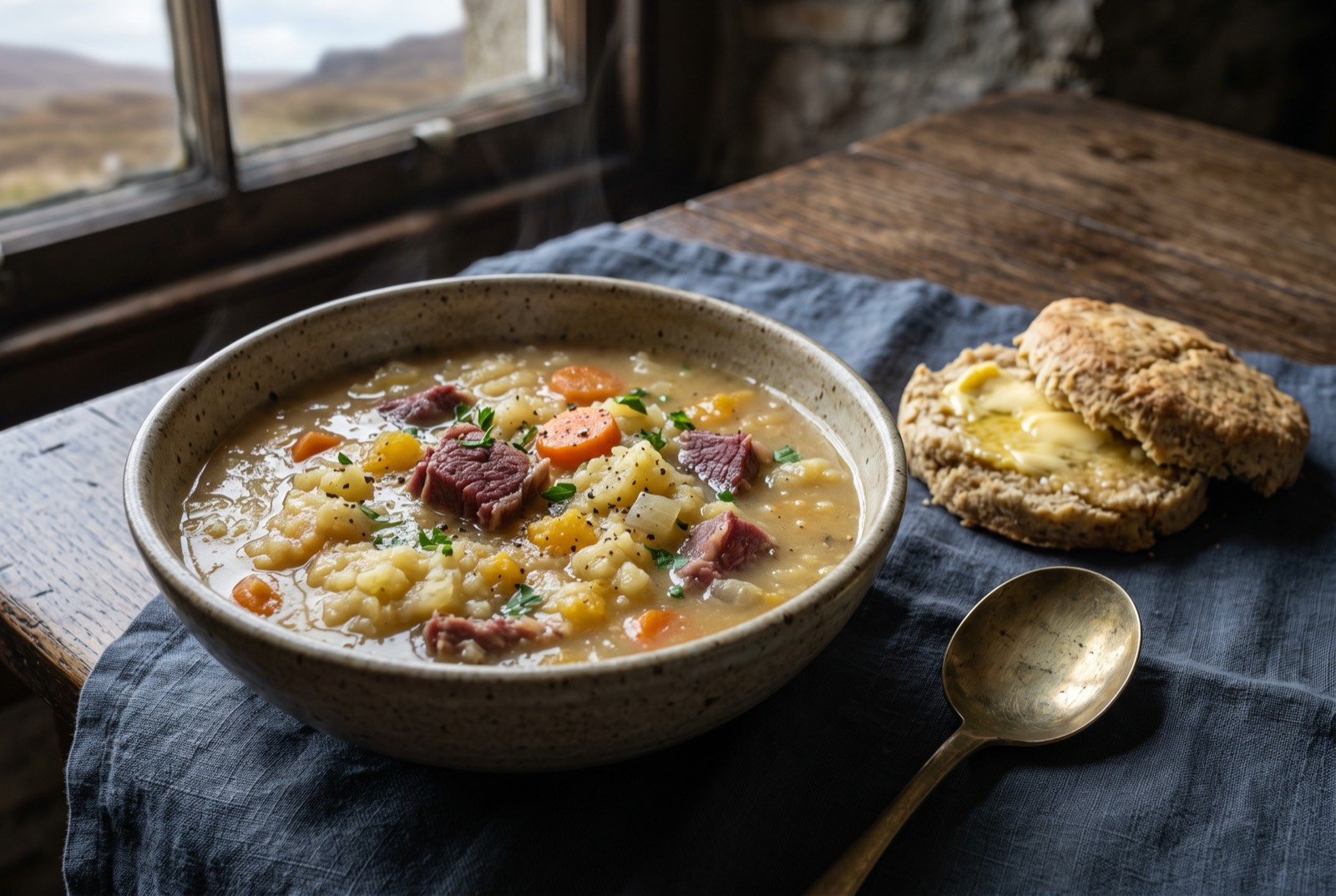
An illustration of the dish, not a photograph of it cooked.
- Time
- 3 hours 20
- Researched
- 5 sources cited
- Reviewed
- Not yet reviewed from inside the tradition
- Cooked
- Not yet cooked and reported
Salt-cured, peat-smoked mutton simmered with potato, carrot and swede, Shetland's own claim to a national dish.
As tradition built it
Serves 6. About 3 hours, plus 20 minutes' initial simmering.
Ingredients
- 600g reestit mutton
- to cover water, to cover
- 1 large onion
- 3 carrots
- 150g swede (about a sixth of a medium one)
- 3 large floury potatoes
Method
- Place the reestit mutton in a large pot, cover with water, bring to the boil, and simmer 20 minutes. Discard this water, which carries off much of the meat's excess salt.
- Return the mutton to the pot with fresh water to cover generously, bring back to the boil, then simmer about 2 hours, until fork-tender. Remove the meat, allow it to cool slightly, discard any large chunks of fat, and break the meat into pieces.
- Return the stock to the boil. Peel and chop the onion, carrots, swede and potatoes into rough chunks, and add to the pot. Simmer about 30 minutes, until the vegetables are tender.
- Partially mash the vegetables in the pot with a potato masher, for a thick, chunky texture rather than a smooth one.
- Stir the mutton back through, or serve it separately atop buttered bannocks, with the soup poured alongside.
What a modern chef changes
The cure done at home, honestly, as far as a UK kitchen can take it.
Rung 3
Method
- Dry-salt a mutton or hogget joint yourself, at roughly 2 to 3% salt by the meat's own weight, for several days in the fridge, turning it daily.
- Cold-smoke the cured joint on a Big Green Egg, held well under 30°C, over the closest legal UK approximation to peat smoke you can source, for several hours, an honest attempt at the reest's own rafter-and-peat-fire principle, not a claim to have fully replicated it.
- Simmer and finish exactly as the tradition method above, since the soup itself needs no further modernising once the meat underneath it has been given real, deliberate attention.