Europe · Volume 35
Scotland, the Lowlands and the Central Belt
The Pie, the Pluck and the Girder Drink
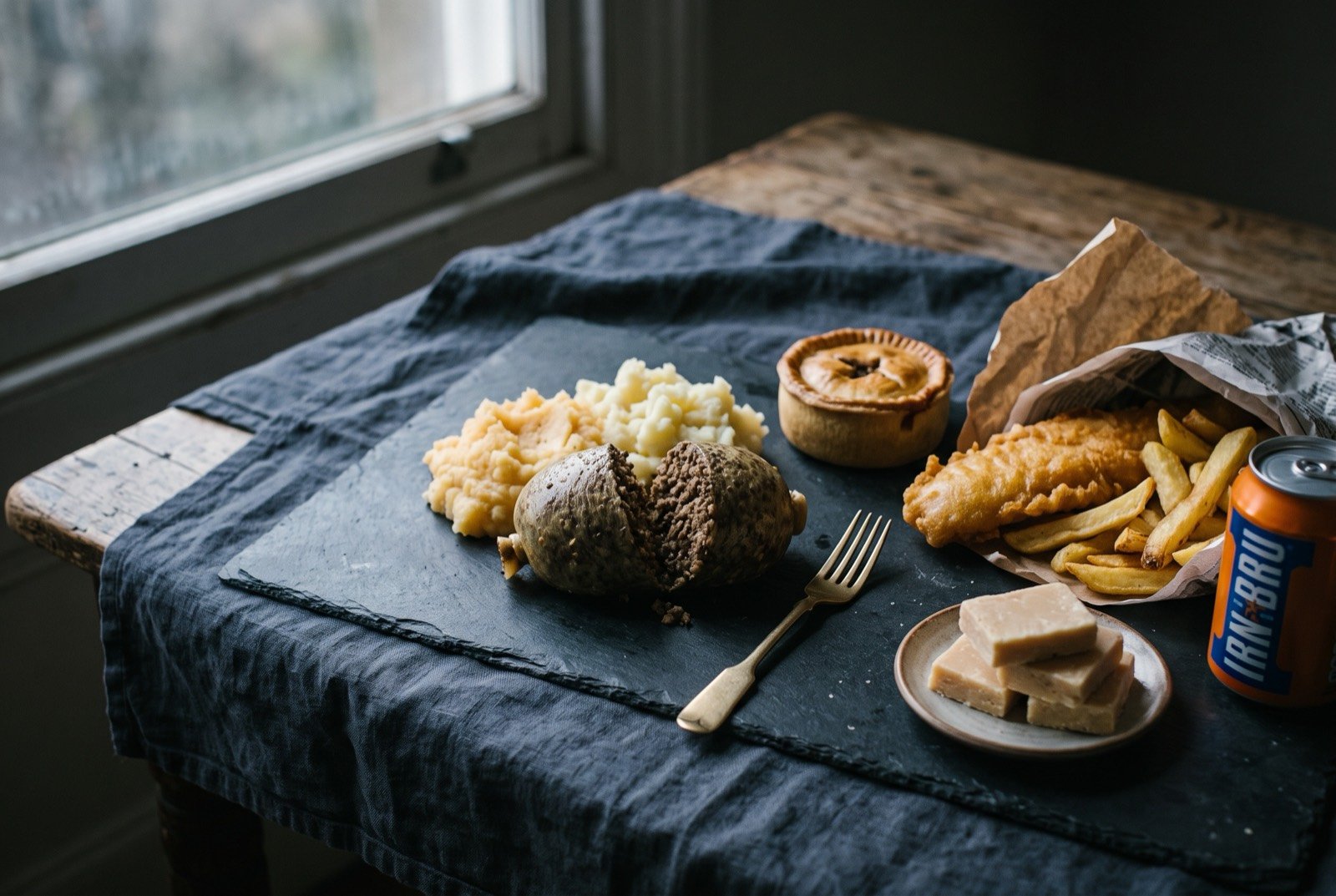
This is not the Scotland of the crofting Highlands and the Atlantic islands, already given its own volume elsewhere in this atlas. This is urban, industrial, Presbyterian Scotland: Edinburgh's New Town and Old Town, Glasgow's tenements and shipyards, the whole Central Belt strip of factory floors and chip shop windows that sits between them. It is a food world built less by what grows on the hill than by what a mill worker could carry in one hand, what a family could stretch across a tenement week, and what a Sunday closing law would or would not allow a man to drink. Every dish as tradition built it, then what a modern chef would change.
Sources and review · What this chapter does not assert · How we research · Know this better? Tell us
A Sense of Place
The Lowland Zone, and why it is not simply "the rest of Scotland"
Scotland's own geographers have long split the country into a Highland Zone and a Lowland Zone, a division older and more structurally real than any modern administrative border, and this volume follows that line rather than the crofting-versus-city cliché it can sound like from outside. The Lowland Zone is the flatter, more fertile, more populous strip running from the Solway to the Moray coast at its northern edge, cut through by the Forth and the Clyde, and it was here, not in the glens, that Scotland industrialised: coal, iron, shipbuilding on the Clyde, jute in Dundee, and around Edinburgh and Glasgow a density of people that the Highlands never held and, after the Clearances, never would again. That density is the whole story. A crofting economy feeds itself from what one household's land can produce; an industrial economy feeds itself from what a wage can buy, cooked fast, in small kitchens, often by someone who has been standing at a bench or a furnace for ten hours. The fat is beef dripping and lard, cheap by-products of an industrial meat trade rather than a pastoral one; the starch is the potato and, from the twentieth century, wheat flour bought rather than milled at home; the aromatic, where there is one at all, arrives by ship rather than by hedgerow, black pepper and mace in a Scotch pie, curry spice by the 1960s in a Gorbals kitchen. This is not a lesser cuisine to the Highlands' game and its cold Atlantic fish. It runs on a different logic entirely: portability, cost, speed and, again and again, what an immigrant trade brought in and made permanently local.
Edinburgh and the east: capital, kirk and the pie
Edinburgh's food identity was set by two forces working against each other. One was capital: a seat of law, church and, after 1707, an increasingly professional and mercantile class who built the New Town from the 1760s onward specifically to get away from the crowded Old Town, and who marked that social distance at the table with finer bread, more meat, imported wine, tea and sugar, while the Old Town that remained behind them ran on oats, kail, herring and the cheap, portable, one-handed street food, the penny mutton pie chief among it, that a working city actually needs. The other force was the kirk. Presbyterian Scotland built, from the mid nineteenth century, some of the strictest licensing and Sabbath observance law in western Europe, and while that law shaped drinking hours and Sunday leisure far more directly than it shaped what went into a pot, its cultural weight sat over Edinburgh's food in a different way: a lingering suspicion, in professional Scottish kitchens well into the twentieth century, that food itself was a slightly frivolous, folly-driven business, better handled in borrowed French words than named plainly in Scots.
Glasgow and the west: the Clyde, the tenement, and an industrial pantry built by immigrants
Glasgow's food logic is the Clyde's. By the second half of the nineteenth century the river's yards, John Brown's, Fairfield's, Denny's among them, had made Glasgow one of the world's great shipbuilding cities, and during the First World War the Clyde alone built over two fifths of all British shipping tonnage. That industry built the tenement, the single end and the room and kitchen, a coal range kept lit all day as the only heat, the only hot water and the only cooker a family had, and it built a genuinely working class food culture around cheap, dense, stretchable meals: stovies from a Sunday roast's last scraps, a macaroni pie's starch stretched further with cheese sauce, a bowl of soup thickened with whatever was to hand. It is also, unmistakably, an immigrant city's food culture. Roughly four thousand Italians settled in Scotland between 1890 and 1914, most from Tuscany and, later, the hill towns around Frosinone, and it was they, not native tradition, who built the Scottish chip shop virtually from nothing: by 1914 the country had some four and a half thousand of them, and Glasgow alone was reportedly selling around eight hundred thousand fish suppers a week. A second, later immigrant wave, Punjabi and above all Bengali and, after 1971, Bangladeshi families settling in the Gorbals from the 1930s onward, built Glasgow's curry house trade with the same thoroughness, so completely that the city has repeatedly, if not uncontestedly, laid claim to inventing Britain's most popular curry dish. Central Belt food, more than almost anywhere else in this atlas so far, is what people who were not born there built for the people who were.
The structural logic, at a glance
| Edinburgh and the east | Glasgow and the west | |
|---|---|---|
| Fat | Beef dripping, butter | Beef dripping, lard |
| Starch | Wheat flour, oats, potato | Potato, macaroni, wheat flour |
| Protein | Mutton and beef offal, white fish | Beef and mutton offal, white fish, later poultry (curry trade) |
| Aromatic | Black pepper, mace, allspice | Black pepper, later garam masala and chilli |
| The industry behind it | Print, law, finance, brewing | Shipbuilding, coal, textiles, the docks |
| The immigrant layer | Italian (chip shop, ice cream) | Italian (chip shop, ice cream), South Asian (curry house) |
The History in Layers
A dish claimed, not invented: haggis before Burns
The popular story that Scotland invented haggis does not survive a serious look at the record, and this chapter would rather say so plainly than repeat a comforting national myth. Cooking chopped offal in a stomach casing is an old, geographically unspecific technique: a recipe for something very like it appears among the papers of one of Richard II's own cooks around 1390, and the English cookery writer Gervase Markham gives a recipe for "haggas" in The English Huswife in 1615. The Scottish food historian Catherine Brown, who has made the fullest case for this, argues that haggis was eaten across English society for something like four centuries before falling out of English fashion around the middle of the eighteenth century, at which point English writers began marking it out, for the first time, as specifically "Scotch." What is not in dispute is what happened next. Susanna MacIver's Cookery and Pastry, published in Edinburgh in 1773, calls for "Good Scotch Haggis" by name, and Robert Burns's poem "Address to a Haggis," written and first published in the Caledonian Mercury in December 1786, did the rest: not a recipe, but a claim, praising the dish as the honest, plain food of the ordinary working Scot against the fashionable French cooking of the Edinburgh dinner table, and in doing so fixed haggis permanently as a national emblem rather than a shared British peasant dish that had simply drifted north. The honest version of this history is not "Scotland invented haggis." It is that Scotland claimed it, at a specific moment, for a specific reason, and made the claim stick so completely that the older, shared history behind it has almost entirely disappeared from view.
Burns Night, dated precisely
The first Burns supper was held on 21 July 1801, the fifth anniversary of the poet's death, at Burns Cottage in Alloway, organised by the Reverend Hamilton Paul, a Freemason, for nine men connected to Burns through Tarbolton Lodge. Haggis and sheep's head were served, "Address to a Haggis" was recited before the meal, and the gathering resolved on the spot to hold a second supper the following January, for Burns's actual birthday: the origin of the 25 January date that has held ever since. Edinburgh followed in 1815, and a grander public dinner there the next year was attended by Sir Walter Scott. The Robert Burns World Federation, founded in 1885 to co ordinate Burns Clubs internationally and still active from Kilmarnock today, is the clearest evidence that this is a maintained institution rather than a folk survival: a fixed running order, piping in the haggis, the address recited and the dish ceremonially cut open at the poem's climax, the Immortal Memory speech on Burns's life, the Toast and Reply to the Lassies, still followed with real seriousness at formal club suppers a hundred and twenty five years on. This chapter has deliberately not tried to weigh how seriously ordinary Scots, as opposed to formal Burns clubs, treat the night today: no genuine survey evidence was found either way, only tourist board copy, and that is not a foundation this atlas builds a claim on.
The pie, the pluck and the 1967 regulation
Both of this chapter's two great pastry dishes have a real, checkable history rather than a folkloric one. The Scotch pie descends from the "penny mutton pie" sold across the Lowlands from the late eighteenth century onward, cheap, portable and eaten standing up, one handed, by working men; the folklorist F. Marian McNeill, writing in 1937, already called it as popular in her own day as it had been in eighteenth century Edinburgh. It is, unusually for a British street food, legally defined: the Meat Pie and Sausage Roll Regulations of 1967 specify a shallow cylindrical case no more than five inches across, at least a fifth meat by weight when cooked, with no jelly permitted. Mutton, spiced with pepper, mace and nutmeg, was the original filling; cheaper, more available beef displaced it through the 1950s and 60s, so that a mutton Scotch pie today is a minority, heritage choice rather than the everyday one. The dish's reputation took a real, documented battering during the BSE crisis of the 1990s, and its recovery is itself institutional history: the Scotch Pie Club, founded in Buckhaven, Fife, in 1999 by the butcher Alan Stuart, has run the World Championship Scotch Pie Awards every year since, an annual, competitive, trade wide effort to hold the standard up rather than let the pie's name slide into a punchline. James Pirie and Son of Newtyle have taken the title six times in the 2020s alone; J&W Aitken's of Alloa, genuinely Central Belt, won it at the 2025 anniversary awards. Neither haggis nor the Scotch pie carries any form of UK protected status, unlike Scotch beef, Scotch lamb or Stornoway black pudding, despite a Scottish MEP push for one in 2016. It is worth being honest about that gap rather than assuming, as many Scots do, that the dish is protected by law.
The tenement, the piece, and a health record worth stating correctly
A single end or a room and kitchen, a coal range kept lit from morning to night as the only source of heat, hot water and cooking, was the ordinary Glasgow working household for most of a century, and the food habits that grew out of it, stretching a Sunday joint into a Monday stovies, building a filling macaroni pie from little more than pasta, cheese sauce and pastry, were survival cooking made into permanent local taste rather than poverty imitating better food. Scots for a packed lunch, "a piece," entered popular memory permanently through Adam McNaughtan's 1960s song "The Jeely Piece Song," in which a mother in a new tower block throws a jam sandwich down to her child in the street below: gentle satire on the same slum clearance programme that was, at the time, meant to be improving exactly this kind of life. It is worth stating the region's public health record with the same care this atlas insists on everywhere else, rather than repeating the tabloid shorthand. Glasgow does carry a genuine, well documented excess mortality rate, higher than Liverpool or Manchester even after full statistical adjustment for deprivation, the so called Glasgow effect. What the research does not support is pinning that excess on diet alone: the fullest academic synthesis, a joint 2016 study from the Glasgow Centre for Population Health, NHS Health Scotland, the University of the West of Scotland and UCL, points instead to deindustrialisation, political and policy vulnerability, and the fact that roughly half of the excess deaths under 65 relate directly to alcohol and drugs. A more recent academic reading argues the whole phenomenon is better called a political effect than a Glasgow one. This chapter treats the finding as real and the diet based explanation for it as unproven, because that is what the evidence actually shows.
Sabbatarianism: what it shaped, and what it did not
Scottish Presbyterianism had, by the early twentieth century, produced some of the strongest temperance and prohibitionist movements anywhere in western Europe, and the law followed: the Forbes MacKenzie Act of 1854 fixed licensing hours and closed most drinking premises on Sundays, a framework that held, in its essentials, for over a century. As late as the 1950s a strict Presbyterian Sunday in Scotland could mean shut pubs, no sport, park swings physically chained up, and a cold meal in the house rather than a cooked one. The fight over Sunday opening did not end until the 1970s: a 1976 licensing committee vote to permit it was formally regretted by the Church of Scotland's Glasgow Presbytery, and the Cowie Tavern in Stirlingshire became, in 1977, the first pub in the country to hold a Sunday licence. What this chapter will not do is extend that history further than the evidence allows. Licensing hours and Sunday closing are thoroughly documented; a direct link from Presbyterian doctrine to what Lowland Scots actually cooked and ate, as opposed to when and where they could drink it, is not, and no source found in researching this chapter supports making that leap.
Italian Scotland, built from nothing into an institution
The chip shop is not an old Scottish tradition wearing a foreign name; it is, straightforwardly, an Italian one. Pietro Nardini arrived in Renfrewshire from Barga, a Tuscan hill town nicknamed, for the scale of its own emigration, "the most Scottish town in Italy," around 1890, and the fish and ice cream business his sons built in Largs from 1935 is still trading. Glasgow's Val d'Oro, on the site of a restaurant opened in 1875 by the Beltrami family and renamed by the Corvi family in 1938, marked its hundred and fiftieth anniversary in 2025; Jaconelli's on Maryhill Road has served the same ice cream recipe since 1924. Edinburgh's own great Italian chip shop dynasty, Brattisani's, ran continuously in the city for a hundred and fifteen years, from 1889 to 2004, and deserves naming as history even though its last branch has closed. By 1914 Italian families had built roughly four and a half thousand chip shops across Scotland, a network dense enough that the fish supper, wrapped first in paper then in newspaper to hold its heat, paired in Glasgow with "a bottle of ginger," any fizzy soft drink, very often Irn Bru, and seasoned east of the country with vinegar and brown sauce mixed as "chippy sauce" rather than the plain salt and vinegar of the west, became genuinely, permanently Scottish without ever losing the name of the people who built it.
The deep fried Mars bar, told honestly
This dish deserves the same honest treatment this atlas gives every over familiar claim, because it is very often misunderstood as ancient junk food folklore when it is neither ancient nor, in any real sense, ordinary eating. It was invented, more or less by accident, at the Haven Chip Bar in Stonehaven, Aberdeenshire, in the early 1990s, when a schoolboy dared a friend to try a battered Mars bar and the shop's fryer rang her employer for advice on how to fry it; the Aberdeen Evening Express picked the story up on 23 August 1995, and national and international press coverage did the rest. The shop, now the Carron Fish Bar, national fish and chip shop of the year in 2019, still sells them, and has said as much as seven in ten go to visitors specifically hunting the novelty rather than to regulars. There is even a peer reviewed study on the phenomenon itself, published in the journal Appetite, examining how the dish functions in the UK press as recurring shorthand for Scottish ill health, whether or not it says anything true about how Scots actually eat. Stonehaven is Aberdeenshire, not the Central Belt this volume covers, and the honest conclusion is that this is a media artefact of the mid 1990s, not a Lowland tradition; it earns its place in this chapter only because the industrial confectionery and chip shop worlds it sits between, the Scotch pie on one side and Tunnock's on the other, are both entirely real.
Tunnock's and Irn Bru: two branded icons that actually are what they claim to be
Thomas Tunnock bought a bakery in Uddingston for eighty pounds in 1890; his grandson Boyd Tunnock invented the teacake in 1956 and the firm remains family run, now into a fifth generation, from the same small Lanarkshire town, turning over more than sixty million pounds a year and exporting as far as Ghana and Japan. It is a genuine rarity in this atlas so far: a mass produced, supermarket ubiquitous confection that is, at the same time, a properly respected national institution rather than a commodity that happens to be Scottish. Irn Bru's story runs on the same honest-branding logic. Barr's launched it as "Iron Brew" in 1901 and renamed it, phonetically, in 1946, after a change in food labelling law required brand names to be literally true and the drink, whatever its name suggested, had never actually been brewed; it does genuinely contain a trace of iron, ammonium ferric citrate, behind the "made in Scotland from girders" joke. The famous claim that Scotland is the only country on earth where Coca Cola is not the best selling soft drink does not hold up under a proper fact check: the Scottish investigative outlet The Ferret rated it false, since Cuba and North Korea also outsell Coca Cola locally, for reasons of American trade embargo rather than Scottish taste. What is true, and well documented, is that Irn Bru genuinely has outsold Coca Cola in the domestic Scottish market since the late 1940s, though the gap has narrowed since, and that AG Barr's 2018 decision to halve the drink's sugar content, its first recipe change in a hundred and seventeen years, provoked a petition of over forty five thousand signatures and reports of fans stockpiling the old formula. Both products are, in short, exactly as Scottish and exactly as beloved as their branding claims, which is rarer than it sounds.
Macaroni pie, the best documented dish in this whole chapter
If one claim in this chapter deserves to be trusted without qualification, it is this one. The earliest confirmed advertisement for a baked macaroni pie, macaroni cheese sealed inside a hot water crust pastry case, comes from Hays bakers of Dundee in June 1920, selling them at four pence each, with earlier partial precedents (a game and macaroni pie in the Leith Herald in 1867, fish and macaroni pie recipes running through provincial papers in the 1890s) showing pasta working its way into Scottish pie fillings well before that. Scotland's first dedicated macaroni manufacturer, founded in Glasgow in 1933 by Fidele and Antonio Todisco, and James Marshall's rival firm from 1936, gave the dish an industrial supply chain of its own within little more than a decade of its first sighting. It very nearly disappeared from national memory in 2015, when Greggs dropped it from its Scottish range as its lowest seller, prompting real public complaint and a #SaveThePie campaign that even drew comment from the then First Minister; it has since returned. This is, unusually for a dish this humble, a piece of food history traceable almost decade by decade through named bakeries and dated newspaper adverts, and it should be treated with exactly that confidence.
Glasgow's curry house, and a claim this chapter will not settle
Glasgow's South Asian community has real, dated roots: the city's first Muslim association formed in 1933, its first mosque opened in a converted building in 1944, its first Sikh gurdwara in 1954, all in the Gorbals, and Shish Mahal and Koh I Noor have both traded there since the 1960s. What this chapter will not do is repeat, as settled fact, the story that Shish Mahal's Ali Ahmed Aslam invented chicken tikka masala there in the early 1970s by improvising a sauce from tinned tomato soup for a customer who complained his chicken was dry. That story is genuinely, publicly contested, and not only by rival claimants: the trade journalist Iqbal Wahhab has said openly that he and the food historian Peter Grove invented the soup anecdote in 1994, over a couple of bottles of wine, because journalists kept asking what the dish was and did not like the true answer, which is that nobody actually knows. A separate Glasgow family, the Ansaris of the Taj Mahal restaurant, make their own, earlier claim, from the 1950s, which this research could not independently verify either. What can be said honestly is that chicken tikka masala was almost certainly invented somewhere in Britain, very possibly by a Bangladeshi chef, since the great majority of British Indian restaurants including Glasgow's own were Bangladeshi run by the 1970s, and that Glasgow's own claim to it, real civic pride and repeated Curry Capital of Britain titles included, rests on a founding story that one of its own inventors has admitted making up. This dish's proper home, with the fuller treatment its genuinely British invention deserves, belongs to this atlas's future volume on the New British Table, South Asian and Caribbean Britain; it is named here, honestly and at length, because Glasgow's claim to it is too large a part of this city's food identity to leave out, not because this chapter is the place to give it a recipe.
The Flavour Arsenal
The pluck, and what it actually is
Haggis is built from the sheep's pluck: heart, liver and lungs, traditionally taken together as they are removed from the animal, minced and mixed with toasted oatmeal, suet, finely chopped onion, and a spicing of black pepper, mace or allspice and sometimes cayenne, moistened with stock and traditionally packed into the sheep's own stomach. Modern commercial haggis very often uses a beef bung or a synthetic casing in place of the stomach, for reasons of cost and consistency rather than any change in the filling itself. A fact worth stating plainly, since it is commonly garbled: sheep's lungs are entirely legal for human consumption in Britain when they pass inspection, and the ban that makes American haggis lung free is an American federal regulation with no bearing whatsoever on UK law.
The pastry family: hot water crust
Both the Scotch pie and the macaroni pie share the same structural pastry, boiling water and melted fat, traditionally beef dripping or lard, worked hot into flour to produce a stiff, mouldable dough that sets firm enough to hold its own shape without a tin, exactly what a pie meant to be eaten standing up, one handed, actually requires. It is a completely different discipline from a cold, flaky French pastry, closer in logic to a raised game pie than to a vol au vent, and it rewards a hot oven and a confident hand rather than the cold, careful handling a butter pastry needs.
Confectionery: sugar worked two ways
Tablet and Tunnock's teacakes and caramel wafers represent two distinct sugar disciplines. Tablet is built by deliberately encouraging sugar to crystallise, boiling sugar, butter and condensed milk to soft ball stage, around 118 to 120°C, then beating the mixture hard to seed a fine, even crystal structure, the exact opposite of fudge, where crystallisation is the thing to avoid. Tunnock's teacake and caramel wafer instead depend on layered, non crystalline sugar work, a whipped marshmallow dome enrobed in tempered chocolate for the teacake, a laminated caramel and wafer stack for the other, industrial precision applied to a genuinely old confectioner's technique.
The industrial soft drink
Irn Bru sits in this chapter's larder as a genuine, functioning cooking ingredient as much as a drink: its sugar and acidity behave, in a braise or a glaze, almost exactly like the cola used in the well known Coca Cola gammon, sweet, dark and slightly bitter, reducing down to a sticky, deeply coloured glaze that a plain sugar syrup cannot match.
The Technique Ladder
Rung 1. Offal preservation by stuffing and long, gentle simmering
Haggis's core logic, dicing fast spoiling offal, binding it with oatmeal, packing it into a natural casing and simmering it for hours, is functionally an indigenous ancestor of charcuterie and forcemeat work, and rewards exactly the precision a chinois and a sous vide bath bring to any other forcemeat.
Rung 2. Hot water crust pastry
Fat and boiling water worked hot into flour, producing a structural, self supporting dough built to be eaten standing up rather than plated.
Rung 3. Controlled sugar crystallisation
Sugar, butter and condensed milk boiled to a precise temperature and then deliberately agitated to seed even crystal growth, tablet's whole method, and a genuinely different discipline from any smooth confection built to avoid exactly the same crystallisation.
Rung 4. Double frying
A first, lower temperature fry to cook the interior and set the batter, a second, hotter fry to crisp and colour the outside, the real mechanism behind a proper chip shop's texture, brought to Scotland by Italian immigrant families rather than invented locally.
Rung 5. Sweet, acidic braising and reduction
A carbonated, sugared soft drink reduced down around a joint of meat, exactly the same principle as beer or cider elsewhere in this atlas's Europe, applied here to a drink most cooks would never think to braise with.
Rung 6. Hot smoking, fast and hard
Not this volume's own invention, the Arbroath smokie belongs properly to the Highlands and Islands, but the principle, a very hot, fast, enclosed smoke rather than a long cold one, transfers cleanly to a Big Green Egg run hard with the lid shut, and is worth knowing even here.
The Ferment and Preserve Bench
This is not a fermentation heavy cuisine in the way the Netherlands' herring trade or Ethiopia's injera pit is, and this chapter would rather say so than invent a tradition that is not really there. What genuinely exists is a preserving discipline built around fat and salt rather than lactic acid.
1. Rendering and keeping beef dripping
The historic base fat of Lowland frying, rendered slowly from beef trimmings, strained through muslin and kept chilled in a sealed container for weeks; it is now a minority practice, since roughly ninety nine per cent of British chip shops fry in vegetable oil today, but it remains the genuinely correct fat for a chip shop style fry at home, and a Big Green Egg's indirect heat, held low and steady, renders it cleanly without scorching.
2. A modern, larder first ferment practice
Edinburgh's Condita runs its kitchen on an actively maintained rolling stock of pickles and ferments, built with local foragers so that a matching flavour is always to hand rather than made to order, a genuinely modern discipline rather than an old one, and directly transferable to a home cook with a dehydrator and decent cold storage: a standing jar of pickled ramson capers or a fermented gooseberry vinegar, kept going year round, does more for a Lowland larder than any single one off pickle.
Sourcing in Britain
Verified August 2026. Where a supplier could not be fully confirmed, that is said rather than smoothed over.
The one genuine gap, stated plainly first. No named, currently trading chip shop within Edinburgh or Glasgow itself was confirmed still frying in beef dripping; the documented dripping fryers found in this research trade in Surrey and Greater Manchester. A home cook wanting the traditional fat is better served sourcing it directly than hunting for a Central Belt chippy that still uses it.
The ranked list: what decides great from grim
- Macsween of Edinburgh haggis, not a supermarket own label made to a lighter spec. Founded 1953, still family run into its third generation, and the maker of the first commercially available vegetarian haggis in 1984; widely stocked at Waitrose and Ocado.
- Simon Howie for scale and reliability. The UK's best selling haggis brand, accounting for over half of national Burns season sales; sold through thescottishbutcher.com directly and through every major UK supermarket.
- Grants of Speyside, for the oldest surviving family recipe. Trading since 1824, its haggis recipe dating to around 1890, sold through House of Bruar.
- Genuine pinhead oatmeal, Scottish milled, not a generic porridge oat. Hamlyns of Scotland, fourteen generations in Banffshire oat milling since 1888.
- Walkers Shortbread, for the same reason Macsween earns first place: still the family's own, not sold on. Founded 1898 in Aberlour, still family owned and managed; sold via walkersshortbread.com and every major UK supermarket.
- Genevieve or Central Belt tablet from a genuine small maker, since no national artisan tablet brand exists. The Wee Scottish Tablet Company and Mrs Tilly's Tablet are both small, currently trading, hand made producers; treat any claim of a large scale artisan tablet brand with suspicion, since the category genuinely has not produced one.
- Ayrshire Earlies in season, not out of it. PGI protected since 2019, but only from May to the end of July; a potato sold as "Ayrshire" outside that window is not the protected product. Sold under the Scotty Brand label via Tesco and other major supermarkets in season.
- Beef dripping, sourced direct rather than hunted for at a chip shop counter. N&D Walsh, family run since 1963, supplies it by mail order.
- Irn Bru, trivially available everywhere, made by A.G. Barr plc, a FTSE 250 company, not a small producer, from its Cumbernauld plant.
Kit notes for this volume
A Big Green Egg, run hot and direct for the Scotch pie's crust and the deep fried Mars bar's elevated batter, and indirect and low for rendering dripping, earns real, repeated use across this chapter. Sous vide is the honest modernist tool for haggis, gammon and the Lorne sausage terrine alike, holding each at a precise, unattended temperature no stovetop pot reliably matches. A sugar thermometer, or a sous vide bath used as one, is essential rather than optional for tablet: soft ball stage is a real, narrow temperature window, and guessing it by eye is how most home tablet fails. A dehydrator, used briefly on battered fish before its first fry, is a small, genuinely useful step this chapter borrows from proper chip shop double frying logic and applies where it had not been applied before.
Voices and Sources
From inside the tradition
- Tom Kitchin, The Kitchin, Leith. One Michelin star, built on a "nature to plate" sourcing philosophy from a close network of Scottish suppliers; his haggis bon bons are a direct, serious elevation of the everyday dish rather than a rejection of it.
- Lorna McNee, Cail Bruich, Glasgow. One Michelin star since 2021, the first woman in Scotland to win one; works with West Coast produce and her own kitchen garden, classical sauce technique underpinning modern Scottish cooking.
- The Radford family, Timberyard, Edinburgh. One star and a Michelin Green Star, family run since 2012, serving only wild meat and ethically sourced fish, built entirely around the Scottish season.
- Sam Yorke, Heron, Leith. One star since 2023, Scotland's youngest starred chef at 25, trained under Dominic Jack.
- Graeme Cheevers, Unalome, Glasgow. One star, modern European cooking built from Orkney scallops to North Sea cod.
- Tyler King, Condita, Edinburgh. One star, an owner run kitchen built on an actively maintained larder of ferments and preserves, worked with local foragers.
- Roberta Hall-McCarron, The Little Chartroom, Leith. Trained under Tom Kitchin and Dominic Jack, named specifically by Times critic Chitra Ramaswamy as part of the current serious Edinburgh scene.
- Nico Simeone, Six by Nico, Glasgow founded. Not fine dining in the Michelin sense, but the clearest named precedent for taking chip shop and confectionery culture seriously as source material, via his "Chippie" tasting menu built explicitly around his own Italian grandparents' chip shop.
- Mark Greenaway, Grazing by Mark Greenaway, Edinburgh. Wrote Perceptions (2016), World's Best Chef Cookbook 2017, explicitly to argue against the "Mars bars and haggis" caricature of Scottish food.
- Jeremy Lee, Dundee born, chef at Quo Vadis, London. Cited for his diagnosis of why Scottish chefs so often cooked French cuisine in Scotland, French words and a French foundation, rather than naming and developing their own.
- Catherine Brown, Scottish food historian. The strongest single source for haggis's genuinely contested, non exclusively Scottish origin.
- F. Marian McNeill, author of The Scots Kitchen (1929) and The Scots Cellar, the standard reference work for traditional Scottish cookery, and the source this chapter's haggis and Scotch pie recipes are built from.
- James Pirie and Son of Newtyle, and J&W Aitken's of Alloa. The current, repeatedly award winning names in Scotch pie making, verified currently trading.
- Macsween of Edinburgh, Simon Howie and Grants of Speyside. The three named haggis producers this chapter treats as genuinely comparable, at three different scales, from a large national brand to an old, small family recipe house.
The industrial institutions
- Tunnock's, Uddingston. Founded 1890, still family run into a fifth generation, a genuine national institution rather than merely a commodity brand, despite being one of the most ubiquitous confectionery products in Britain.
- A.G. Barr plc, Cumbernauld. Maker of Irn Bru since 1901, a FTSE 250 company whose branding claims about the drink's Scottishness and popularity are, on proper fact checking, largely true.
- Walkers Shortbread, Aberlour. Founded 1898, still family owned, one of the very few Scottish food producers in this chapter to have scaled nationally without leaving the family.
Things this chapter has deliberately not asserted
- That haggis is a purely or originally Scottish invention. The dish's documented English pudding history runs at least to 1615 and arguably to 1390; what is genuinely Scottish is the eighteenth century claiming and fixing of the dish as a national emblem, catalysed specifically by Burns.
- That Ali Ahmed Aslam and Glasgow's Shish Mahal definitively invented chicken tikka masala. The dish's most famous origin story, the tinned tomato soup anecdote, has been publicly admitted as fabricated for press purposes by one of the two men who invented it in 1994; a rival Glasgow claim exists and was not independently verified either, and the likelier true origin, per food historians, lies among Bangladeshi chefs working in Britain more broadly. This dish's full treatment belongs to this atlas's future volume on the New British Table.
- Any direct causal link between Presbyterian doctrine and what Lowland Scots actually cooked or ate, as opposed to when and where they could drink and socialise. Only licensing hours and Sunday observance are thoroughly documented by named, dated sources; this chapter has not extended the argument further than that.
- That the deep fried Mars bar represents ordinary Scottish eating. It is a documented, dated, media driven novelty from a single Stonehaven chip shop in the early 1990s, and a peer reviewed study exists specifically on how UK press coverage of it functions as a negative stereotype of the Scottish diet.
- A single, agreed cause for Glasgow's excess mortality "Glasgow effect." The finding itself is real and academically established; its cause remains genuinely disputed among researchers, and diet alone is not the accepted explanation.
- Edinburgh Rock's exact founding date and its inventor's birth year, which are internally inconsistent across the sources found, and its whole origin story, which is explicitly apocryphal in the sourcing behind it.
- A single, historically documented "original" stovies recipe. Every quantified version found was a modern recipe rather than an archival one, and every source agrees the dish varies enormously by household; no canonical version exists to assert.
- How seriously ordinary Scots treat Burns Night relative to how tourists perceive it. No survey or polling evidence was found either way; only tourist board copy makes the claim, and this atlas does not build on that tier of source.
- A confirmed Tunnock's royal warrant. None was found in this research, and it is not asserted here.
- That any named Scottish chef has applied sous vide, a high power blender or other modernist equipment to tablet specifically, or to Irn Bru as a savoury cooking ingredient, at restaurant level. No such precedent was found for either; this chapter's own elevations of both dishes are offered honestly as its own extrapolation, not as documented professional practice.
- That a beef dripping frying chip shop currently trades within Edinburgh or Glasgow itself. The documented examples found in this research were outside Scotland entirely.
Offal preservation by stuffing and long, gentle simmering
Haggis's core logic, dicing fast spoiling offal, binding it with oatmeal, packing it into a natural casing and simmering it for hours, is functionally an...
Hot water crust pastry
Fat and boiling water worked hot into flour, producing a structural, self supporting dough built to be eaten standing up rather than plated.
Controlled sugar crystallisation
Sugar, butter and condensed milk boiled to a precise temperature and then deliberately agitated to seed even crystal growth, tablet's whole method, and a...
Double frying
A first, lower temperature fry to cook the interior and set the batter, a second, hotter fry to crisp and colour the outside, the real mechanism behind a...
Sweet, acidic braising and reduction
A carbonated, sugared soft drink reduced down around a joint of meat, exactly the same principle as beer or cider elsewhere in this atlas's Europe, applied...
Hot smoking, fast and hard
Not this volume's own invention, the Arbroath smokie belongs properly to the Highlands and Islands, but the principle, a very hot, fast, enclosed smoke rather...
The dishes
- Haggis, Neeps and Tatties Lowland Scotland
- The Scotch Pie Edinburgh and the Lowlands
- Lorne Sausage and Tattie Scone Central Belt Scotland
- Macaroni Pie Dundee, then nationwide
- Stovies Glasgow tenement kitchens
- The Fish Supper Italian immigrant Scotland
- Deep Fried Mars Bar Stonehaven, Aberdeenshire
- Tablet Central Belt confectionery
- Irn Bru Glazed Gammon Modern Central Belt kitchen
Sources and review
- Researched
- 10 sources cited
Where this volume comes from
4 research briefs on file for this volume, researched to the rules on How we research. Published 28 August 2026. Last changed 20 September 2026.