Britain and Ireland · Volume 36, The Grass, the Grain and the Border That Doesn’t Cut the Table
Soda Farls
Ulster
Illustration
- Time
- 25 minutes
- Researched
- 1 source cited
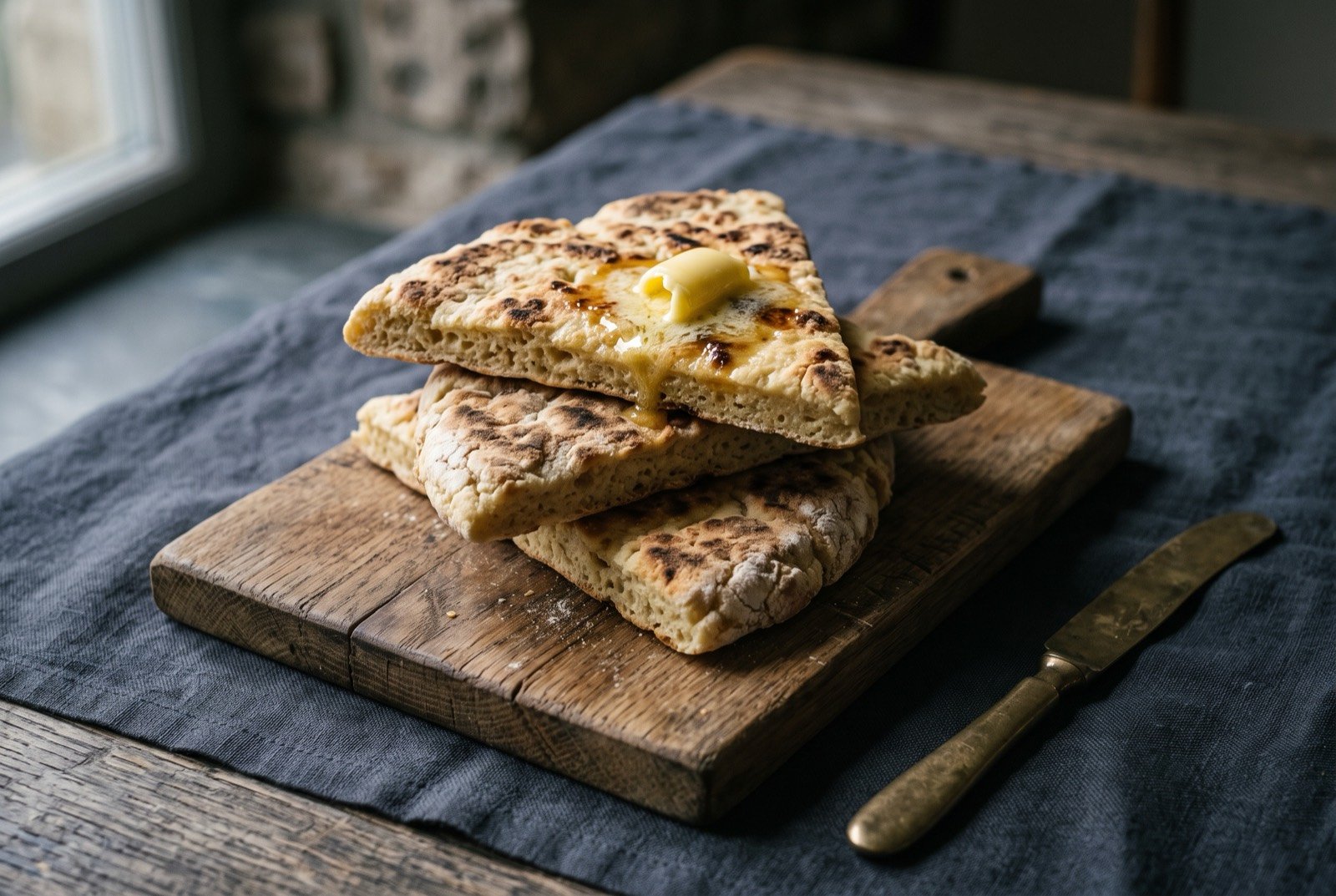
The Ulster-Scots Agency's own heritage material gives real, specific quantities for this dish, a genuinely in-tradition source rather than a generalist recipe site. The name itself is local: "farl" comes from the Ulster-Scots and Scots word fardel, a quartered round, and the griddle method, rather than an oven-baked loaf, is the form specifically associated with Northern Ireland, distinct from the "wheaten" or brown soda loaf baked in a tin that is the everyday term for wholemeal soda bread across the rest of the island.
As tradition built it
Makes 4 farls. About 25 minutes.
Ingredients
- 300 g plain flour
- 1 heaped tsp bicarbonate of soda
- ½ tsp salt
- 250 ml buttermilk
Method
- Sift the flour, bicarbonate of soda and salt together, and make a well in the centre.
- Work in the buttermilk gradually to a soft dough, kneading lightly, since overworking toughens the finished bread.
- Roll to roughly 1 inch (2.5cm) thick, and cut into quarters.
- Cook on a preheated griddle or heavy pan, 8 to 10 minutes per side, until golden, turning once or twice.
- Best eaten the same day, with butter and jam.
What a modern chef changes
The precision the Ulster-Scots Agency's own recipe already implies, taken further.
Rung 1 and Rung 2
Method
- Weigh the bicarbonate of soda precisely rather than levelling a spoon by eye, since an over- or under-measured raising agent is the most common reason a home soda farl comes out either soapy-tasting or dense.
- Cook on a Big Green Egg's flat plancha attachment, the surface temperature held steady by probe thermometer rather than judged by hand, the honest home equivalent of a griddle over an even turf fire.
- Mix and shape the dough only once the griddle is fully up to temperature, so the bicarbonate's reaction has not begun to fade before the farls ever meet the heat.