East Africa and the Islands · Volume 17, The Great Lakes
Eshabwe
Ankole, southwestern Uganda
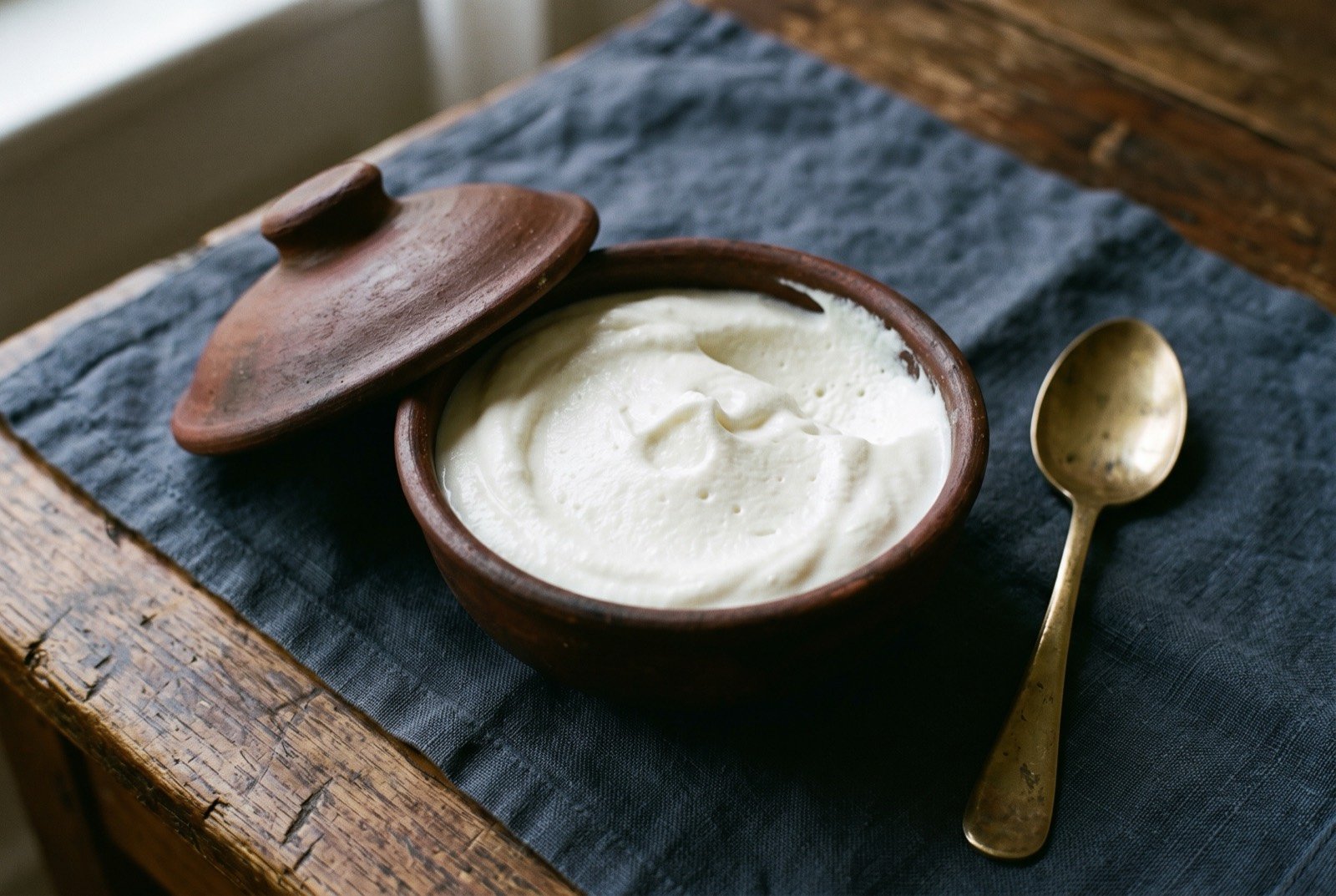
An illustration of the dish, not a photograph of it cooked.
- Time
- 30 minutes
- Reviewed
- Not yet reviewed from inside the tradition
- Cooked
- Not yet cooked and reported
An emulsion inversion built by hand, out of two ingredients, by cooks who had no thermometer and no whisk and did not need either. In an Ankole marriage ceremony four people taste it: the groom, the groom's father, the bride's paternal aunt, the ishenkazi, and her maternal uncle, the nyinarimi. It was made by elderly women in silence, in a quiet room, and served in an orwabya, a lidded clay bowl. Today it is an everyday condiment with millet bread, matooke, potatoes, beans, greens and roast meat. Read the sourcing section before you attempt this. Eshabwe is the one dish in this book that a British cook will fail at for a reason that is nothing to do with technique, and the reason is that they bought the wrong fat.
As tradition built it
Serves 10 as a condiment. About 30 minutes, all of it stirring.
Ingredients
- 1 kg mature, un-boiled ghee, at cool room temperature
- 1/2 tsp rock salt, crushed to a powder
- 250 ml boiled water, cooled to room temperature or below
- a pinch or two a further pinch or two of ordinary salt
- a bundle a bundle of clean sisal fibre, or a balloon whisk
Method
- Make the brine, rwabarire. Grate, pound or crush the rock salt to a powder and dissolve at most half a small teaspoon into the cup of cooled boiled water. Stir until it has fully dissolved and taste it to check it is not too strong.
- Put the ghee in a wide, shallow pan or bowl with the sisal wrap and stir them together. Some cooks add a pinch of crushed rock salt directly at this point to help the ghee soften.
- Add the brine in small quantities, stirring continuously, until the ghee begins to dilute and whiten.
- Keep stirring and adding water until the ghee turns white. The aroma changes at this point and cooks use that change as a marker.
- Add a small amount of ordinary salt and stir until it dissolves. Salt thickens eshabwe as well as seasoning it.
- Keep stirring until it thickens and develops small bubbles. The end point looks like thick plain white yoghurt.
- Squeeze out and remove the sisal wrap, then sieve into a clean covered container.
- Serve chilled or at room temperature. It keeps a week to a month refrigerated, or 2 to 3 days in a covered vessel standing in a basin of cold water.
Notes
After a Ugandan account with quantities.
What a modern chef changes
A cultured, half-clarified fat, a temperature you actually control, and a wine reduction taken from a Kampala chef
Rungs 4 and 5
Method
- Make the fat, because you almost certainly cannot buy it here. Culture 1 litre of double cream with 2 tablespoons of live cultured buttermilk for 24 to 36 hours at 20 to 22°C. Churn it to butter, wash the butter lightly, then melt it gently to around 60°C only and hold it there so the water separates but you do not clarify off the solids. Skim rather than strain. You now have a cultured, incompletely clarified butterfat that retains its phospholipids and protein fragments, which is to say it retains its emulsifiers. Rung 4: a fully clarified commercial ghee has had them removed and will not invert.
- Work cold and use a probe. Warm water melts crystalline fat, the globules coalesce, and the emulsion breaks into a pool of oil. Keep the brine at fridge temperature and the fat at 18 to 20°C, and check both. This is the one place in the volume where a thermometer beats a tradition, because the tradition was operating in a highland climate that did the temperature control for it.
- Use an unrefined salt. Rung 4's electrolyte argument. Divalent cations, calcium and magnesium, screen surface charges at the fat-water interface more effectively than sodium alone, so a grey sel gris or a coarse unrefined rock salt will outperform iodised free-flowing table salt, which is pure sodium chloride plus an anti-caking silicate and actively unhelpful.
- Then do what Ernest Kayondo did. Reduce 200 ml of red wine to 2 tablespoons, cool it completely, and beat it into the finished eshabwe with a few crushed peppercorns. Eshabwe is butterfat in salt water and it has no tannin and very little glycerol body. The reduction supplies both. This is not fusion. It is a Kampala chef treating a Ugandan emulsion as a mother sauce, which is what it is.