East Africa and the Islands · Volume 17, The Great Lakes
Luwombo
Buganda, Uganda
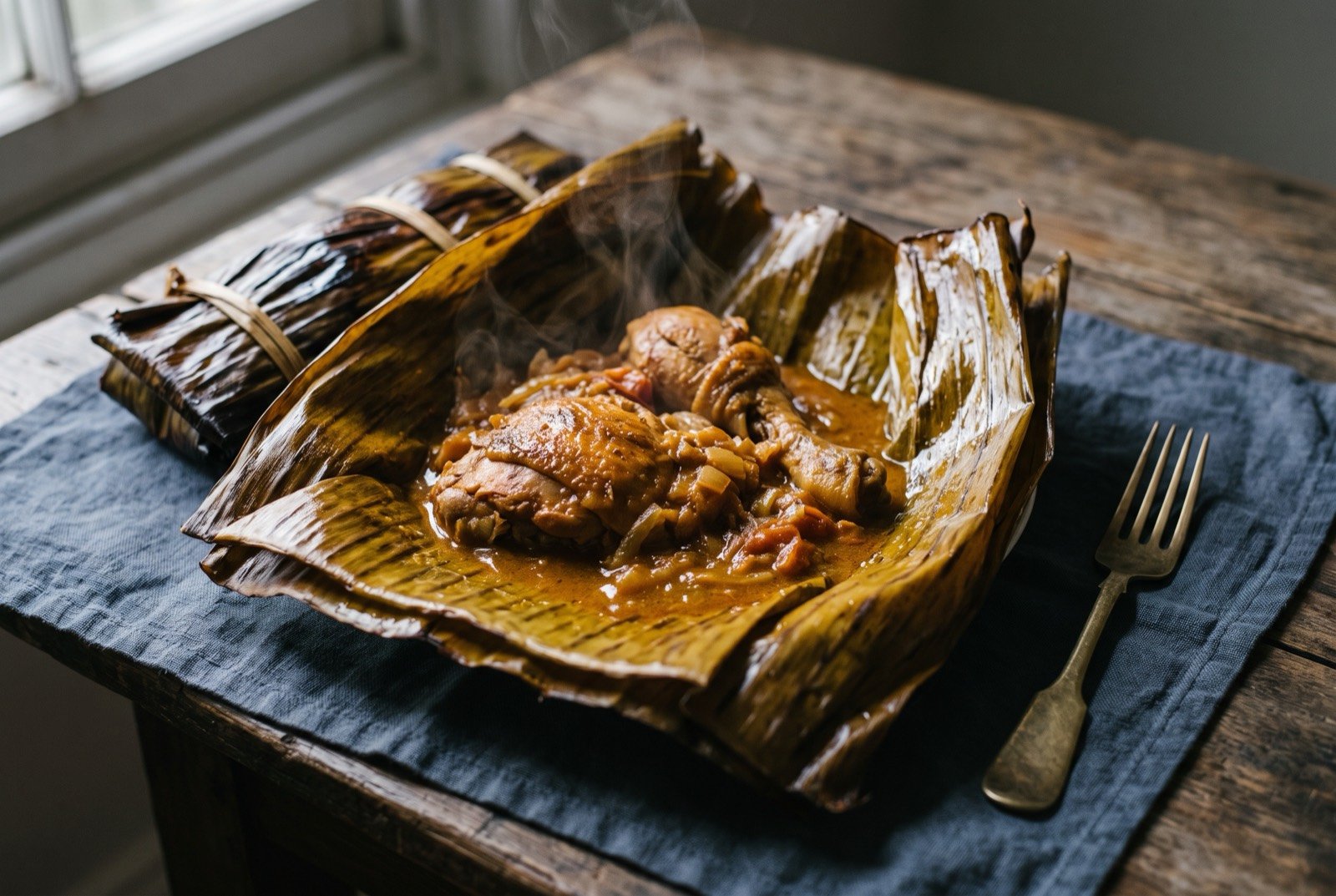
An illustration of the dish, not a photograph of it cooked.
- Time
- 2 hours 30
- Reviewed
- Not yet reviewed from inside the tradition
- Cooked
- Not yet cooked and reported
Oluwombo is the leaf parcel; luwombo is the dish. Baganda tradition attributes it to Kawuuta, also written Kawula or Kawuula, head royal chef to Kabaka Mwanga II, in the late 1880s, and it was for some time reserved for the Kabaka, princes, chiefs and royal visitors before spreading to kwanjula and embaga, the introduction and wedding ceremonies, and then into everyday cooking. In Buganda a ceremony without luwombo is a minor ceremony. The specific year usually given for its invention is discussed at the end of this chapter. Say the obvious thing about it and then say why the obvious thing is not quite true. Luwombo is a sealed, low-temperature, moist cook in a pouch, which sounds like sous vide. It differs in the two ways that matter. The pouch is not inert: it transfers aroma, phenolics and smoke into the fat phase of the sauce. And it is not evacuated: steam pressure inside the parcel does the sealing. It is closer to en papillote than to sous vide, and it is better than either at one specific job, which is cooking a sauce and its protein together without any reduction step at all. The rule about size is a physical constraint and it is a gift to restaurant service. Ugandan sources are emphatic: do not build a big luwombo. One parcel per person, because a large parcel cooks unevenly and some of the meat will be underdone.
As tradition built it
Serves 4, as four parcels. About 2 hours 30.
Ingredients
- 1 chicken, about 1.6 kg, jointed into 8 and then halved again
- 8 large banana leaf sheets, ideally young ndiizi leaves
- enough to tie 4 parcels banana fibre or strips of the stripped midrib, to tie
- 2 onions, sliced
- 3 tomatoes, chopped
- 4 garlic cloves, crushed
- 20 g fresh ginger, grated
- 1 green chilli
- 200 ml light stock or water
- to taste salt
Method
- Smoke the leaves. Strip the midribs, then pass each leaf over an open flame, over hot charcoal, or over burning dry banana leaves, until it turns brownish yellow and goes glossy and limp. Wipe both sides with a damp cloth to take off ash. This is the single most important step in the dish.
- Sear the chicken pieces, traditionally over burning banana peelings for the smoke. Build a separate sauce of onion, tomato, garlic, ginger, chilli and salt, and cook it out.
- Divide between four parcels. Chicken and sauce into the centre of a double thickness of leaf, with only about 50 ml of the stock or water each. Fold the leaf over, work the fibre round it like a bandage, and finish with a reef knot at the top.
- Set the parcels on a banana stem trivet over water, cover with more leaves, then the lid.
- Steam on low heat for 1 hour 30 to 2 hours for chicken. The range given across Ugandan sources for luwombo generally is 1 to 4 hours, depending on the meat.
- Serve in the parcel, with matooke, posho, rice or sweet potato.
What a modern chef changes
A harder-smoked leaf, a two-stage steam, the liquor treated as the dish, and leaf powder to rebuild what plating loses
Rungs 1, 6 and 3
Method
- Smoke the leaves harder than looks sensible, and do it over the Big Green Egg's dying coals. Rung 6. The leaf is a filter: the lipophilic guaiacol and syringol fractions transfer into the fat phase over two hours, and the acrid heavy pyrolysis products stay stuck to the leaf. You cannot over-season a luwombo by smoking the leaf, only by smoking the meat, which is why the tradition never does the latter.
- Two temperatures, and never open the parcel. 45 minutes at a hard steam, then drop to the barest simmer under the pot for a further 75 minutes. The first stage renders and sets the sauce; the second converts connective tissue to gelatin without tightening the breast. Nothing evaporates and nothing browns after the initial sear, so the sauce concentrates only by extraction.
- Reduce nothing, and add nothing at the end. This is the discipline the dish exists to teach. If the sauce inside the parcel is thin, the fault was upstream: too much added liquid at step 3, or a leaf that was not properly sealed. Fix it next time, not now. A luwombo finished with cornflour is a braise wearing a costume.
- Keep a jar of toasted banana leaf powder and dust the plate. Rung 1's restaurant move. Toast a batch of leaves hard, blitz, sieve, and store airtight. If you plate the contents out of the parcel, which a restaurant will sometimes have to, that powder is the only way to put the vessel's aroma back.