Melanesia, Micronesia and Polynesia · Volume 06, The Root, the Reef and the Earth Oven
Bougna
New Caledonia
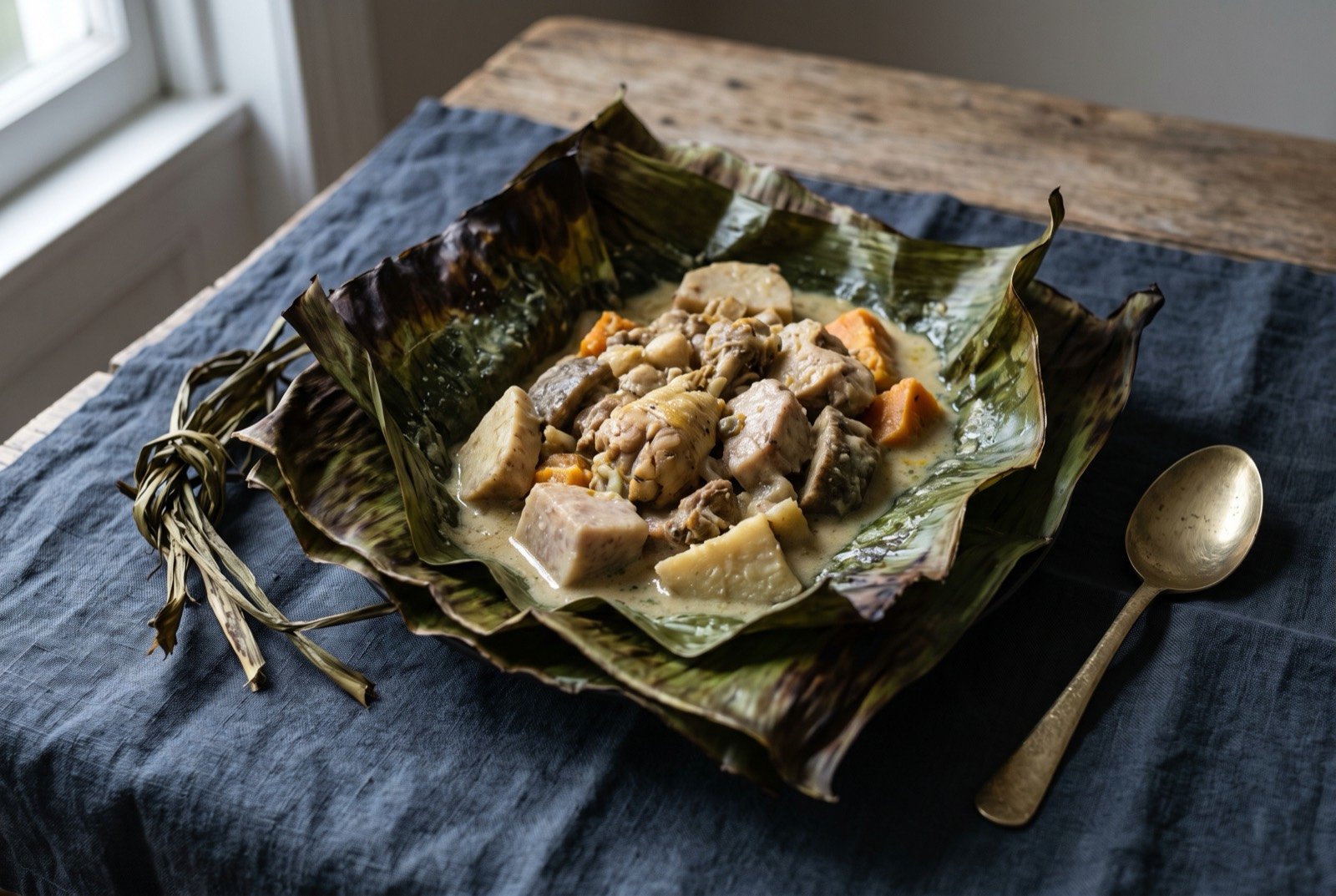
An illustration of the dish, not a photograph of it cooked.
- Time
- 2 hours
- Researched
- 16 sources cited
- Reviewed
- Not yet reviewed from inside the tradition
- Cooked
- Not yet cooked and reported
Chicken, pigeon, pork, reef fish, or, subject to strict seasonal and quota hunting rules, roussette, layered with taro, sweet potato, yam and poingo banana, dressed with coconut milk, wrapped in banana leaf, and cooked either in the traditional earth oven or, in a simplified home version, in a covered pot known as bougna marmite. Wikipédia, "Bougna," fetched directly; Nouvelle-Calédonie Tourisme, "Où manger un bougna en Nouvelle-Calédonie"
Its own name deserves telling plainly, because it changes how the dish should be read: "bougna" derives from "bougnat," the nineteenth century nickname for Auvergnat migrants in Paris, and the cooking method was named by Marist missionaries from Yssac-la-Tourette, in the Auvergne, who arrived to evangelise the Pacific in 1843. The stone-oven technique itself long predates that date and is unambiguously Kanak; the French name is a nineteenth century coinage laid on top of an indigenous method, not a French import of the technique. Older Kanak names survive regionally and are worth carrying alongside the French one: bunyâ at Ouvéa, itra or iţa at Lifou, aël at Maré. [Wikipédia, "Bougna," as above]
As tradition built it
Cook in the earth oven for roughly two hours.
Ingredients
- 1 large chicken, jointed chicken, pigeon, pork, reef fish, or (subject to strict seasonal and quota hunting rules) roussette
- 1 taro, 4 sweet potatoes, 1 yam, 4 poingo bananas taro, sweet potato, yam and poingo banana
- 6 to 8 coconuts, milked coconut milk
- 3 large tomatoes, a bunch of spring onion and parsley; salt, pepper, oil and garlic to taste tomato, spring onion, salt, pepper, oil, garlic and parsley
- to taste ginger, turmeric or basil, in some regional versions
- as available a young banana leaf, for wrapping
- as available liana, for tying
Method
- Choose a young banana leaf whose central rib is not too pronounced. Pass it over an open flame, turning repeatedly, until it softens and browns.
- Cut the meat or fish, chosen from chicken, pigeon, pork, reef fish or (subject to strict seasonal and quota hunting rules) roussette, and the root vegetables, taro, sweet potato, yam and poingo banana, and arrange them in a rounded parcel on the leaf.
- Season with tomato, spring onion, salt, pepper, oil, garlic and parsley, and, in some regional versions, ginger, turmeric or basil.
- Douse the assembled parcel with coconut milk.
- Fold the leaf closed carefully and tie with liana.
- Dig a pit, lay pre-heated stones at the bottom, place the parcels on top, cover with more hot stones, then freshly cut leafy branches, then earth. Cook for roughly two hours.
Notes
No source consulted gave stone temperature, pit dimensions or a more granular timing than "roughly two hours"; this chapter reports that limit honestly rather than inventing precision that was never documented.
What a modern chef changes
After Alphonse Ishice Kocé, the Kanak chef who trained under Joël Robuchon and Yannick Alléno before returning to Nouméa to build a restaurant on Kanak ingredients rather than transplant French haute cuisine wholesale
Rungs 1 and 4
Method
- Portion the parcel for a single serving rather than a communal one, following the logic of Kocé's own reported reworking, while keeping the leaf-wrap and coconut milk method structurally identical to the tradition above.
- Fully stabilise a Big Green Egg in indirect mode before loading, reproducing the earth oven's two hour, evenly stored heat rather than a shorter, hotter cook. Rung 1.
- Reduce a portion of the coconut milk separately on the stovetop before pouring, rather than using it raw straight from the tin, building a slightly thickened, more concentrated sauce a single-portion plate can carry visually in a way a communal parcel does not need to. Rung 4.
Notes
Kocé, born on Maré into a Kanak family, worked his way through the Hôtel Meurice in Paris, Robuchon's brigade in London, and rose to Junior Sous Chef at Alléno's three Michelin starred restaurant in Dubai, before returning home during the COVID-19 pandemic to open Celeneraw, since relocated and trading as Pacific Good Food, in Nouméa, built around Kanak cabbage, cassava, sweet potato and lagoon fish. presencekanak.com, 31 October 2019; lepetitjournal.com He has said plainly that New Caledonia is not yet ready for imported fine dining concepts, and that the way forward is building gastronomy from genuinely local products, citing Caledonian shrimp, vanilla and native berries as underused rather than reaching for an external model. His menu is reported, via a secondary review citation this chapter could not independently verify against his own site on research day, to include bougna reworked as an à la carte fish and prawn plate rather than a communal parcel, moving the dish from ceremonial to single portion format while keeping its coconut-milk-and-leaf method intact.