Britain and Ireland · Volume 36, The Grass, the Grain and the Border That Doesn’t Cut the Table
Irish Stew
The Republic
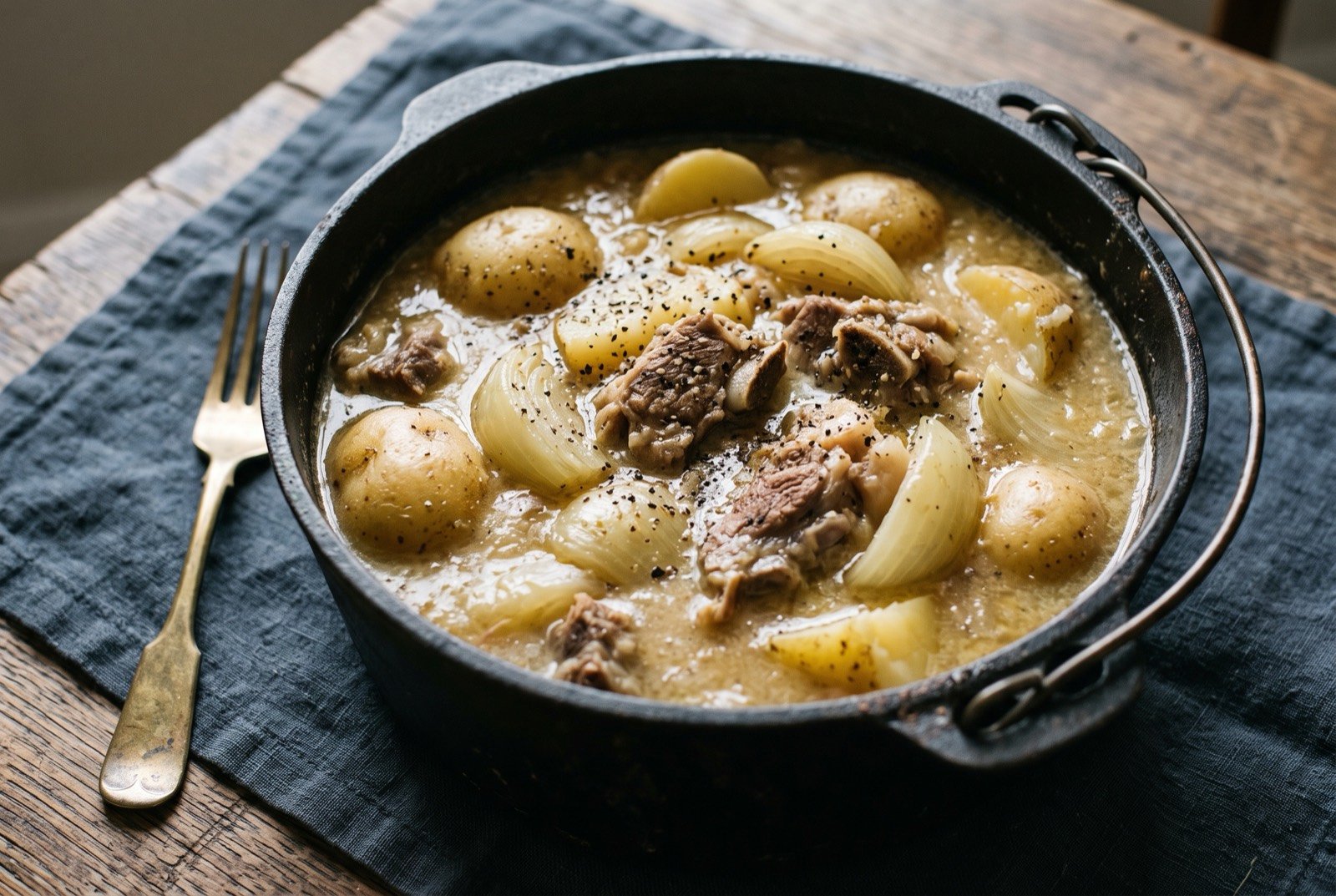
Illustration
- Time
- 2 hours 30
- Researched
- 1 source cited
The earliest printed recipe found behind this chapter is Eliza Melroe's, 1798: "Take fat mutton chops, potatoes, onions or leeks, pepper and salt... stew the above with a small quantity of water, in a vessel covered." JP McMahon, chef-patron of Aniar in Galway, has written the clearest modern account of what the dish actually depends on and what has been quietly lost: "Lamb was too valuable alive, it gave wool, milk, and eventually cheese and yoghurt," which is why the animal genuinely eaten in this stew was mutton, killed old, not lamb, killed young. His real complaint about the modern version is not that restaurants use the wrong meat by accident, but that the market has erased the category entirely: hogget and mutton are now routinely marketed simply as "lamb," following American convention, so a diner ordering Irish stew today has almost no way of knowing whether they are eating the tough, richly flavoured, slow-cooked meat the dish was built to transform, or a young animal that never needed the two hours of gentle heat the dish still nominally gives it.
As tradition built it
Serves 4 to 6. About 2.5 hours.
Ingredients
- 1.3 kg mutton or well-hung hogget, neck and shoulder, bone in, cut into large pieces
- 2 large onions, thickly sliced
- 900 g floury potatoes, some halved and some left whole
- to just cover water
- to taste salt
- to taste black pepper
Method
- Layer the meat, onions and potatoes in a heavy pot, seasoning well between layers.
- Add water just to cover.
- Bring to a bare simmer, never a rolling boil, cover, and cook 2 to 2.5 hours, until the meat is falling from the bone. The whole potatoes will have started to break down and thicken the broth by the end; the halved ones hold their shape.
- Serve straight from the pot, with extra black pepper at the table.
What a modern chef changes
The category the market has hidden, put back at the centre.
Rung 3
Method
- Source genuinely aged mutton or hogget from a named rare-breed or specialist butcher, and ask for it by that name, not "lamb." This is the single most transferable piece of technique in this whole entry: the dish only works as intended on the animal it was built for.
- Braise the shoulder sous vide, around 80 to 82°C for 12 hours, then finish briefly in the reduced, strained cooking liquor with fresh potato and onion added at the end, for evenly tender meat without the risk a rolling boil poses to older, tougher cuts cooked all together in one pot.
- Crack the black pepper coarsely in a dedicated spice grinder rather than a pre-ground tin, releasing more of its oil into the finished broth.