Britain and Ireland · Volume 31, The Roast, the Crust and the Clotted Cream
Cornish Pasty
Cornwall
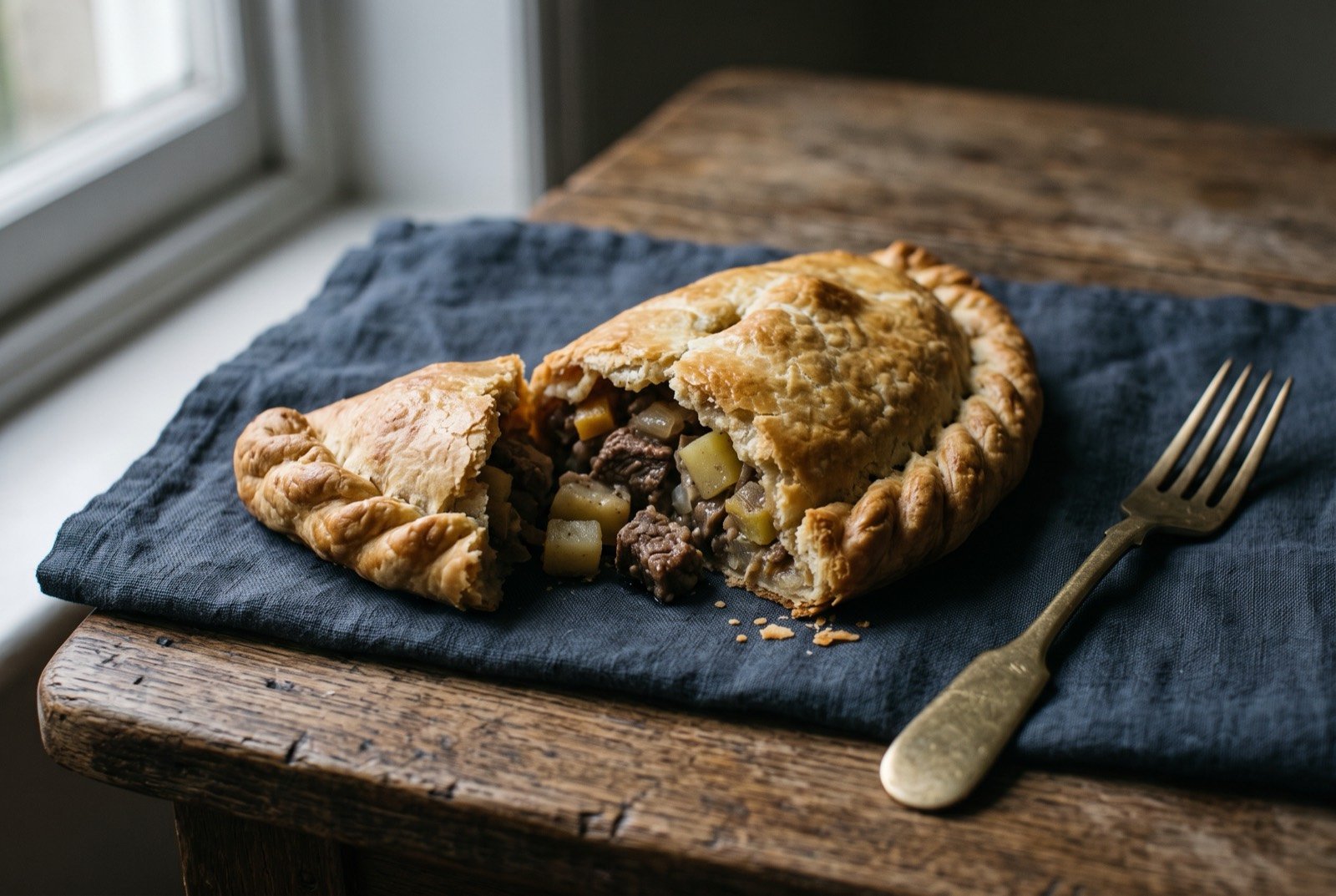
An illustration of the dish, not a photograph of it cooked.
- Time
- 4 hours
- Researched
- 9 sources cited
- Reviewed
- Not yet reviewed from inside the tradition
- Cooked
- Not yet cooked and reported
The Cornish Pasty has held Protected Geographical Indication status since 2011: made in Cornwall, filled raw with beef, potato, swede and onion in fixed minimum proportions, seasoned with salt and pepper alone, and crimped to one side in a D shape. The popular story that the crimped edge served as a disposable handle, discarded by miners for fear of arsenic contamination underground, is presented even by the official specification itself as "the most popular" of several stories rather than as documented fact; what is genuinely documented is the pasty as portable working food for Cornish tin miners and farm labourers from the late eighteenth century onward.
As tradition built it
Makes 6. About 4 hours, mostly resting.
Ingredients
For the pastry
- 500g strong bread flour
- 120g lard or white shortening
- 125g Cornish butter
- 1 tsp salt
- 175ml cold water
For the filling
- 400g beef skirt, cubed
- 300g potato (waxy variety), diced
- 150g swede, diced
- 150g onion, sliced
- roughly 2:1, to taste salt and pepper, roughly 2:1
- 1, beaten (or a little milk) egg or milk, to glaze
Method
- Rub the fats into the flour and salt to a breadcrumb texture, then bring together with the cold water. Knead a little longer than a standard shortcrust, to develop some elasticity.
- Rest, wrapped, for at least 3 hours. The dough is genuinely difficult to roll and shape fresh, and this rest is functional, not optional.
- Roll into 6 circles of roughly 20cm.
- Layer the raw beef, potato, swede and onion over one half of each circle, season with the salt and pepper, fold the pastry to a D shape, and crimp firmly along one edge, by hand or with a fork.
- Glaze with egg or milk.
- Bake at 165°C fan for 50 to 55 minutes, until deeply golden.
What a modern chef changes
The raw-fill discipline treated as engineering, exactly as the PGI specification itself implies rather than states outright.
Rung 3
Method
- Dice the swede and potato to genuinely match the beef skirt's own cooking rate, not to a fixed size out of habit. The whole dish depends on everything reaching doneness together from raw inside a sealed case; a piece cut too large will still be underdone when the pastry is finished.
- Use beef skirt specifically, and resist substituting a more expensive cut. Skirt's own lack of fat and gristle is precisely why it cooks through in parity with raw diced vegetable, and a fattier or tougher cut breaks that parity in either direction.
- Judge the bake by the crimp's own colour, not by a fixed time alone, since a home oven's real heat varies enough from a commercial deck oven that a rigid 50 minutes can under or overbake depending on the equipment behind it.