The Sinosphere · Volume 30, The Red-Lees Jar, the Ten-Second Slice and a Coast Two Tongues Call Home
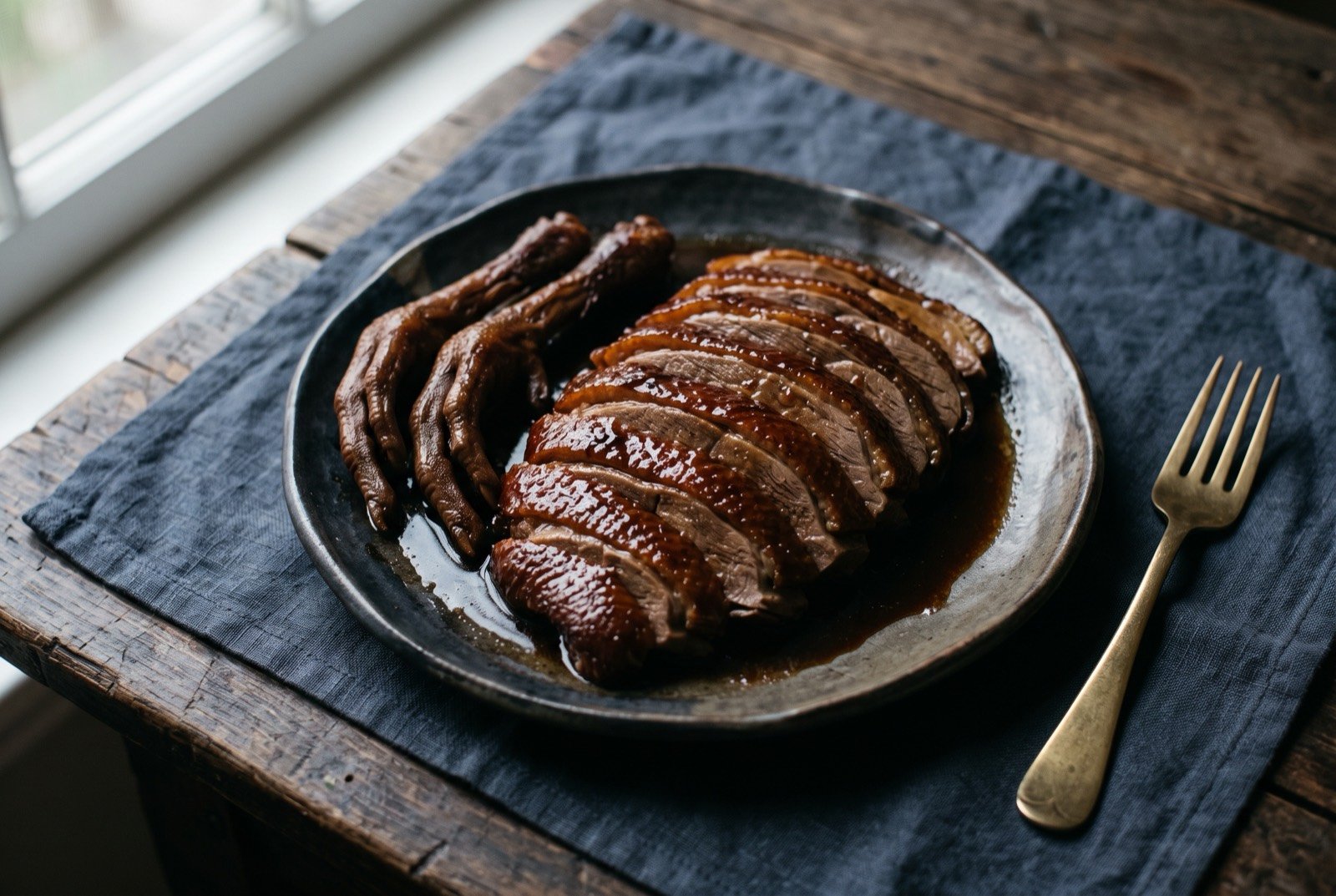
Chaozhou braised goose (卤鹅)
Chaozhou, Guangdong
Illustration
- Time
- 1 hour
- Researched
- Researched from 80 sources in the brief
The Chenghai lion-head goose, farmed over 300 years and prized for its size, over 9kg at maturity, is the only bird considered correct. The best-known Hong Kong kitchens keep their lu shui alive for decades rather than discarding it, a stock topped up and reboiled daily so its flavour only deepens with age; Chan Kan Kee's, in continuous use since 1948, is the most documented example.
As tradition built it
A whole goose, over 9kg. The lu shui simmers as an ongoing stock; the bird itself takes three hangs and three soaks, roughly an hour in all.
Ingredients
For the lu shui master stock
- about 3kg (pork spine or soup bone) fine pork bone
- about 2.5kg lean pork
- 3 whole old hens, about 5kg in total old chicken
- 500g Jinhua ham ham
- 500g dried scallop
- 2 kg southern ginger
- 150 g tsaoko
- 100 g cassia bark
- 100 g star anise
- roughly 50 to 100g each a dozen more aromatics, in smaller quantities
- about 300g dark soy sauce
- about 500g fish sauce
- about 250g Shaoxing huadiao wine
- 1 whole Chenghai lion-head goose, over 9kg, cleaned
Method
- Build the lu shui master stock from the pork bone, lean pork, old chicken, ham and dried scallop, simmered with the spice package of southern ginger, tsaoko, cassia bark, star anise and a dozen more aromatics in smaller quantities, finished with dark soy, fish sauce and Shaoxing huadiao.
- Bring the stock to a rolling boil and submerge the whole cleaned goose for roughly 15 minutes.
- Hook the goose by the neck and lift it clear to rest 3 to 5 minutes while the heat drops to a simmer.
- Repeat for a second, similar soak, then rest again.
- Give a third and longest soak of roughly 30 minutes, the goose emerging richly fragrant and mellow golden-amber after the third hang.
Notes
One published spice-package ratio runs to 2kg of southern ginger against 150g tsaoko, 100g each cassia bark and star anise, and a dozen more aromatics in smaller quantities.
What a modern chef changes
The lu shui kept alive the traditional way, a two-stage crisping, and a weighed spice packet
Rung 4
Method
- Age and maintain the lu shui the traditional way, since its whole value lies in unbroken continuity.
- After the third hang, rest the bird uncovered in a dehydrator on its lowest setting to dry the skin fully and evenly, then give a final, brief high-heat finish over the Big Green Egg's direct coals, a two-stage approach that gives a more reliably crisp, blistered skin than air-drying alone in a British kitchen's ambient humidity ever reliably manages.
- Build the spice packet's exact ratios by weight on a scale rather than by eye, the one part of this dish where a modernist kitchen's precision genuinely improves on a method traditionally judged by an experienced cook's nose and years of repetition, since a British reader making this dish for the first or second time has neither.