Asia · Volume 31
Guangdong and Hainan
The Wok’s Breath, the Tea Trolley and the Coconut Coast
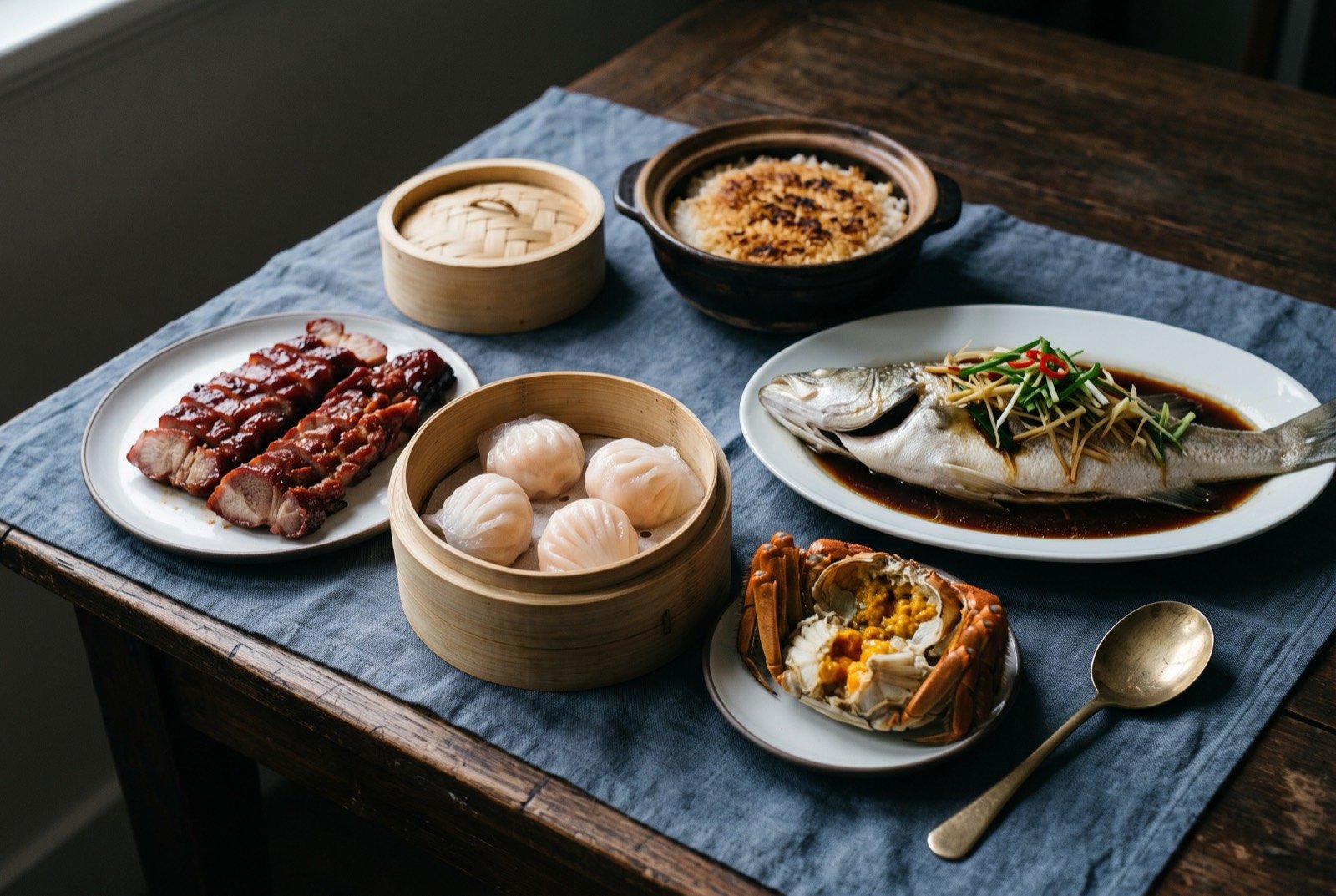
Guangdong and Hainan, taken seriously: the Pearl River Delta's freshness-and-wok-hei grammar, the Hakka hill interior it shares an uneasy history with, and Hainan's own separate, coconut-fed tropical ecology six hundred kilometres south across the Qiongzhou Strait. Not the flattened, boneless, sweetened food that travelled west under a Cantonese name, but the discipline underneath it, and every dish as tradition built it, then what a modern chef would change: once as tradition built it, once named exactly for the modernist technique it already is.
Sources and review · What this chapter does not assert · How we research · Spotted something wrong?
A Sense of Place
The delta that taught a cuisine to trust its own ingredients
The Pearl River Delta is a hot, humid, low-lying alluvial plain where the West, North and East Rivers meet the sea, and Cantonese food logic starts from that ecology rather than from any imported idea of restraint. From the Ming dynasty onward, farmers in Nanhai and Shunde engineered a distinctive land-water system: digging ponds for fish, piling the excavated earth into raised dykes around them, and planting mulberry on the dykes to feed silkworms, whose waste in turn fed the fish. This mulberry-dyke fish pond system (桑基魚塘) intensified through the Qing as Guangzhou's monopoly on China's silk exports made growers abandon rice fields for mulberry across Panyu, Zhongshan and Xinhui, engineering a three-dimensional agriculture of dyke crops above and fish below. The result is a delta permanently producing freshwater fish, shrimp and pond life alongside rice, which is why Cantonese cooking treats live and freshly killed ingredients as the baseline rather than the luxury.
The guiding idea that follows is 不時不食, do not eat what is out of season, a phrase traced to the Analects and still cited today as the frame for Cantonese cooking: eat according to the natural cycle, and let technique serve the ingredient rather than mask it. This is the root of the much-repeated claim that Cantonese food is defined by lightness. One Guangzhou food writer's rebuttal is worth keeping in view rather than smoothing away: he argues that "unseasoned equals respectful of the ingredient" oversimplifies a cuisine that also loves deep sauces, cured meats and intensely worked stocks, and that the "light Cantonese food" story is itself partly a modern marketing simplification. Both things are true at once. Steaming, blanching and clear soup-making really are prized because they let a genuinely fresh ingredient speak; siu mei, congee finished with lashings of rendered fat, and a properly reduced old-fire soup are just as central, and just as Cantonese.
Sitting alongside that restraint is 鑊氣, wok hei, the sensory signature of a dish cooked hard and fast in a very hot, well-seasoned wok. Chinese-language technical writing describes it as a composite of wok breath, aroma, colour and texture together, produced by Maillard and caramelisation reactions above roughly 200°C as ingredients hit hot metal and hot oil at the same instant. Wok hei and 不時不食 are not contradictory: one decides what goes into the wok, the other decides how fast it comes back out.
Guangzhou's food culture was shaped directly by being a chokepoint of foreign trade. From 1757 to 1842, under the Qing "one-port" policy, Canton was China's only legal port for trade with the West, and the licensed merchant guild known as the Thirteen Factories, or Cohong, handled it, remitting over a million taels of silver a year, at points around 40 percent of the entire Qing customs revenue. Guangzhou's own municipal cultural material argues this concentration of foreign wealth pushed the cuisine toward greater refinement and broadened its ingredient vocabulary, and records that Cohong merchants such as Puankhequa were entertaining British guests to English-style menus as early as 1769, with domestic staff inside the foreign factories largely Cantonese. That is a plausible, locally argued explanation, from a single municipal source rather than independent economic history, for why Cantonese food has historically absorbed imported ingredients, tomatoes, evaporated milk, Worcestershire-style sauces, custard, without treating them as foreign impositions.
Hakka Guangdong: guests who arrived after the good land was taken
The Hakka, 客家, "guest families," are ethnically and linguistically Han Chinese, called guests because they arrived in the south relatively late, after the fertile Pearl River Delta lowland was already claimed. The standard account holds that Han people from the Yellow River basin fled south during the wars at the end of the Western Jin in the early fourth century, with further large waves at the end of the Tang and again at the end of the Southern Song, settling in the hill country where Guangdong, Fujian and Jiangxi meet. Within Guangdong, Hakka communities concentrate in the hilly interior, principally Meizhou, which styles itself the world capital of the Hakka, Heyuan, and Huizhou, ancestral home of a large share of the Hakka diaspora, geographically and culturally distinct from the Cantonese-speaking delta lowlands.
That lowland-highland split was not always peaceful. The Punti-Hakka Clan Wars, fiercest between 1855 and 1867, pitted Cantonese-speaking "local" lineages against Hakka settlers across the western delta and Siyi region, driven by population pressure after New World crops such as maize and sweet potato made hill land farmable, and by fights over irrigation and dyke rights as commercial delta agriculture drew in more settlers. Chinese-language accounts describe roughly a million deaths and mass indenture of the losing side; the Hakka share of the population in the Siyi area is said to have collapsed from about a fifth before the wars to about three percent after. Hakka and Cantonese Guangdong are not simply two flavours of one regional cuisine but two communities with a real, sometimes violent history of contested land and status, and Hakka cuisine's separateness follows from that history, not only from taste.
Whether Hakka cuisine counts as a strand of Cantonese cuisine or its own tradition is a genuinely live disagreement, not settled taxonomy this chapter should paper over. One standard division names Guangfu, Chaozhou and Hakka, sometimes called Dongjiang cuisine after the East River running through Hakka Guangdong, as the three constituent styles of Cantonese cuisine. A competing framing states plainly that Hakka and Chaozhou cuisine are not classified as part of Cantonese cuisine at all, with Guangfu cuisine merely influenced by both. A framing attributed to the historian Yang Yanjie goes further still, arguing that because Hakka settlement scattered thinly across a Guangdong-Fujian-Jiangxi border zone with poor internal communication, Hakka cooking never formed one coherent system: what is called Hakka cuisine in Guangdong is a regional absorption into the wider Guangdong food system, in Fujian an absorption into Min cuisine, in Jiangxi into Gan cuisine, so that "Hakka cuisine" may be less one cuisine than a family resemblance shaped by a shared migration history and expressed differently depending on which province's food system it landed in. This chapter treats Hakka cuisine within Guangdong as its own distinct thread without adjudicating whether it is Cantonese.
What is not in dispute is Hakka food logic itself, which follows directly from a hill-farming, migrant-labour economy: consistently saltier, oilier and more reliant on preservation than the delta's fresh-and-light style, because Hakka communities settled poorer hill soil, needed to replace salt lost to hard physical labour, and had far more limited transport links to bring in fresh perishables. The summary phrase is 鹹、油、香, salty, oily, fragrant, and the signature dish-set said to embody it is 四炆四炒, four braises and four stir-fries.
Hainan: administratively Guangdong until 1988, ecologically never Guangdong at all
Hainan sits south of the Qiongzhou Strait, fully in the tropics, hot and humid with year-round growing conditions the Pearl River Delta mainland does not share. It was governed as part of Guangdong province until it became its own province in 1988, which is why its most famous chicken breed is still classed among the "eight fine chicken breeds of Guangdong" in older sources, and why this volume treats it alongside the mainland rather than folding it into Southeast Asia. But the ecology genuinely diverges. Hainan grows double-cropped rice across more than 80 percent of its paddy area, with a growing season of 260-plus days that lets some southern counties run a third crop; it has grown coconut for around 2,000 years and holds roughly 99 percent of China's coconut acreage, worked into feed, fat and drink at every stage rather than used as a garnish; and it is China's only fully tropical province, growing mango on the largest acreage nationally, jackfruit, papaya and guava alongside native lychee and longan. That tropical fruit basket is, concretely, what a free-ranging Wenchang chicken forages on directly.
Hainan's coastal Han fishing culture sits alongside the Dan people, 疍家, a boat-dwelling community historically distinct from land-based Hainanese, concentrated in villages such as Xincun and Yingzhou in Lingshui, an estimated 15,000 people descended from Guangdong-coast migrants who arrived over 500 years ago. Their dialect is Cantonese-affiliated rather than Hainanese Min, they developed "saltwater songs" as an oral culture of the boat-dwelling life, and Mazu worship is central to their religious life.
And Han Hainanese coastal cuisine, coconut-fed poultry, mangrove crab, tropical fruit, should not be allowed to stand in for the whole island. The Li, Hainan's indigenous population predating Han settlement, live in the mountainous interior around Wuzhishan, farm rice, sweet potato and cassava, cook in a traditional three-stone stove and in bamboo tubes roasted directly in fire, and make fish tea, a fermented, not brewed, preparation of salt-cured river fish used to honour guests. Hainan's Miao, a smaller and even less documented group, hold a strong sour-and-spicy flavour preference explained historically by upland salt scarcity, and make three-colour, originally five-colour, glutinous rice at the third-day-of-the-third-month festival, dyed with mulberry leaf, turmeric and a red-blue vine leaf, to commemorate five founding clans. This research found no peer-reviewed ethnography of either group's foodways, only municipal tourism material and local news; that is a real and honestly stated gap, not a detail smoothed over for the sake of completeness. The island genuinely holds at least two separate food worlds, a coconut-fed Han coastal one and an under-documented upland indigenous one, and this chapter does not let the first stand in for the second.
A table of peoples, logic and dishes
| Place | Defining logic | The dishes that carry it |
|---|---|---|
| Guangzhou and the Pearl River Delta | freshness first, wok hei, minimal seasoning over live and same-day ingredients | white-cut chicken, congee, Cantonese steamed fish, wonton noodles |
| Yum cha and the tea house tradition | a 19th-century social institution built around steamed and fried small plates | har gow, siu mai, cheung fun, turnip cake |
| Siu mei, the roast and cure counter | hang-roasting on a controlled high-low-high heat curve | char siu, roast goose, siu yuk |
| Hakka Guangdong, the hill interior | salty, oily, preserved, built for hard farm labour and poor transport links | salt-baked chicken, mui choy pork, stuffed tofu, pounded tea rice |
| Hainan's coastal Han tradition | coconut and tropical fruit at every stage, poached poultry and mangrove seafood | Wenchang chicken, Jiaji duck, Dongshan goat, Hele crab |
| Hainan's Li and Miao interior | upland foraging, fermentation, ceremonial dye-rice, badly under-documented | fish tea, three-colour rice |
The History in Layers
The tea house is younger than it looks
Yum cha's tea house tradition is routinely spoken of as timeless, and the most detailed Chinese-language history disagrees. The standard account places its origin in the Xianfeng and Tongzhi reigns of the mid-nineteenth century, starting as crude roadside "penny houses" serving tea and simple cakes to travellers and labourers, gradually formalising into grander tea houses. Guangzhou's earliest named tea houses, Sanyuan Lou and Xinghua Lou, both opened in 1846. One account adds a class dimension worth keeping: in the late Qing, the grand tea houses served extravagant banquets to officials who could disregard price, while cheaper houses served working people, and the two traditions merged into the recognisably modern format only in the first decade or so after 1911. Two of Guangzhou's surviving century-old tea houses, Lian Xiang Lou, opened 1889 and credited with pioneering lotus-seed paste fillings, and Tao Tao Ju, also over a century old, are real, continuously operating institutions. As of 2024, Guangzhou's municipal government has been considering legislation specifically to protect the surviving morning-tea culture, after public pressure to abolish per-head "tea seat" charges and preserve traditional trolley service, itself a sign that mainland Cantonese speakers regard the tradition as under active threat, not settled heritage.
The dishes this chapter had to check rather than assume
A single cuisine spanning a tea house repertoire, a roast counter and a genuinely distinct island tradition means competing and legendary origin stories are the normal condition here, not an edge case, and this chapter follows the atlas's standing rule: attribute, don't adjudicate, except where the record genuinely settles something.
Siu mai did not start in Guangdong at all. The best-documented account places its earliest origin in Yuan-dynasty Dadu, today's Beijing, recorded in a fourteenth-century Korean-published Chinese textbook mentioning vegetarian-filled "稍麥" for sale. A separate legend locates the name's origin in Hohhot, Inner Mongolia, where two brothers selling steamed buns are said to have created a thinner, open-topped version to sell alongside their tea business. A third theory derives the name from a Mongolian word for "not yet cooled." What is agreed is that after the dish moved south, rice became a common filling addition, and the pork-and-shrimp, orange-roe-topped version now recognised worldwide as "siu mai" is the Cantonese tea-house form that spread overseas through twentieth-century Cantonese emigration, not the northern original.
Salt-baked chicken's 300-year Huizhou salt-merchant origin, and mui choy pork's attribution to the exiled poet Su Dongpo, are both folk legend, not documented history. Both are widely repeated in Chinese tourism and reference material, and neither is corroborated by a primary historical source found in this research. This chapter names them as legend precisely because they are good stories, worth telling as such.
Har gow is credibly, if not conclusively, placed at a specific family tea house in Wu Cun, then on Guangzhou's outskirts, in the 1920s to 1930s, in a rice-farming, fish-and-shrimp-rich area; the first version, called "Five Phoenix fresh shrimp dumpling," used a thicker rice-flour wrapper before urban tea houses adopted the now-standard translucent wheat-starch skin. Wonton noodle soup is dated with similar confidence to 1920s Guangzhou, travelling to Hong Kong with Cantonese emigrants over the following two decades. Neither dish has a named individual inventor with verifiable attribution beyond that tracing.
Wenchang chicken's imperial origin stories do not survive checking. One legend holds a Ming-dynasty Wenchang official presented the chicken to the emperor, who named it; a competing claim asserts the breed was already famous "as early as the Song dynasty." The two stories conflict, and neither is corroborated by a primary historical source. What is better attested is the breed's classification among the eight fine chicken breeds of Guangdong, a real trace of Hainan's pre-1988 administrative history rather than a dynastic anecdote.
Why doesn't Hainan have "Hainanese chicken rice"?
This is worth stating plainly rather than leaving implicit, because the crossover matters more than usual here. Multiple serious Chinese outlets ask the question directly, and the answer is consistent: "Hainanese chicken rice" as a composed rice dish is not a Hainan-original preparation. It does not meaningfully exist as a named, ordered dish on the island in the form eaten in Singapore or Malaysia, where it is already fully treated in this atlas, in the Singapore, Penang and the Straits Creole World volume, under the dish Hainanese chicken rice. What Hainan has is Wenchang chicken, a poached or white-cut chicken dish in which the chicken, not the rice, is the point. "Chicken rice" as an integrated preparation, rice fried in garlic, ginger, lemongrass and chicken fat, finished with stock and pandan leaves so the rice itself becomes the engineered centrepiece, was invented among Hainanese diaspora kitchens in colonial Malaya, most credibly traced to Liang Juqing in 1920s to 1930s Malacca, with the Singapore side commonly credited to Wang Yiyuan, who reportedly learned the dish before bringing it to Singapore in 1936. One widely quoted Chinese formulation captures the relationship correctly: Hainanese chicken rice descends from Wenchang chicken, carried by early twentieth-century Hainanese emigrants to Nanyang and then adapted and evolved there. Descent, not identity. This chapter treats Wenchang chicken as the mainland ancestor and gives it its own full recipe below, under its own name, rather than re-treating the diaspora dish.
That emigration itself has a real, dateable history worth naming. Hainanese emigration to Southeast Asia began around 1850, later than the Hokkien and Cantonese waves that had already claimed the more established trades, which is why Hainanese migrants disproportionately ended up in food and hospitality work. Migration accelerated around the 1927 Kuomintang-Communist split, Singapore's construction of a major military base in the same period, and the 1939 Japanese occupation of Hainan Island. On a 1927 survey of Hainanese-owned businesses in Nanyang, 195 of 445 shops were coffee shops, the origin of the kopitiam trade Hainanese migrants became known for across colonial Malaya and Singapore, which they carried back to Hainan on return.
The Flavour Arsenal
豉油, light and dark soy sauce, the backbone of steamed fish and white-cut chicken dips. The standard ratio for steamed fish soy is light soy, dark soy, sugar and water at roughly 2:1:1:1, simmered with a little oil until the sugar dissolves.
蠔油, oyster sauce, 磨豉醬, ground bean sauce, 海鮮醬, hoisin, and 麻醬, sesame paste, the classic char siu marinade quartet, alongside garlic, shallot and ginger paste, wine and five-spice.
蜜糖 and 麥芽糖, honey and maltose, the finishing glaze for char siu and the roast counter generally, brushed on late in roasting for colour and lacquer.
粗鹽, coarse sea salt, heated and used as the packing medium for Hakka salt-baked chicken.
梅菜, preserved mustard greens, mui choy, the defining Hakka preserved vegetable, associated with Huizhou cultivation.
蝦子 and 大地魚, dried shrimp roe and dried plaice, the umami base of wonton-noodle broth.
陳皮, aged mandarin peel, a recurring flavour base in old-fire soups.
臘腸 and 臘肉, Cantonese cured sausage and cured pork belly, essential to clay pot rice and turnip cake.
蝦米, 冬菇 and 瑤柱, dried shrimp, dried shiitake and dried scallop, the "three treasures" of turnip cake and much delta cooking.
Coconut, at every stage of Hainan's cooking rather than as a garnish: worked into a Wenchang chicken's own feed as much as into the pot.
XO sauce, a late-twentieth-century Hong Kong restaurant invention built on dried scallop, dried shrimp and chilli, not a historic condiment, but named here because a version of it belongs on any Cantonese-Lingnan pantry shelf built after 1980.
The Technique Ladder
Rung 1. Wok hei is a chemistry, not a mystique, and it has a shelf life measured in seconds
Cantonese kitchen tradition names five discrete heat levels from roaring down to minimal; wok hei sits at the roaring end. What is actually happening is the Maillard reaction between amino acids and reducing sugars at very high, very brief contact heat, the near-instant vaporisation and recondensation of oil and sauce aromatics thrown off the food as it is tossed through the flame, and the carbon patina of a properly seasoned, never scrubbed-bare, wok contributing its own flavour compounds. The effect fades within seconds of the food leaving the flame, which is the entire operational reason a Cantonese kitchen plates and serves a stir-fry immediately rather than holding it.
What a cook does with this rung. Cook in small batches on the hottest burner available, season the wok and never scour it to bare metal, and serve the instant the dish leaves the heat. For a reader without a commercial burner, this chapter's Sourcing section below names a genuine route to real wok hei at home.
Rung 2. Steam by weight and by full boil, then trust the residual heat
Cantonese steaming for fish depends on absolute freshness and exact timing: bring the water to a full rolling boil before the fish goes in, elevate the fish above the plate, traditionally on chopsticks laid underneath, so steam circulates on every side rather than pooling underneath, and keep the heat at full roaring throughout, since slow steaming toughens rather than gently cooks the flesh. Timing runs by weight, roughly 6 minutes per catty, about 600g, so 8 to 10 minutes for a 400 to 750g fish; then the fish comes off the heat and finishes for a further 3 to 5 minutes under the lid on residual steam alone, seasoned only afterwards with ginger, spring onion and the soy dressing above.
What a cook does with this rung. Never steam a fish that has been frozen and thawed; the discipline is unforgiving of anything less than genuinely fresh. Time by weight, not by habit, and resist lifting the lid during the residual rest.
Rung 3. Double-boiling and old-fire simmering are two different machines, not two names for one
Cantonese soup technique draws a hard line between 煲, direct boiling, the everyday "old-fire soup" brought to a rolling boil then dropped to a low simmer for one to three hours, and 燉, double-boiling, in which ingredients and liquid are sealed inside a lidded ceramic vessel set inside an outer pot of water, so the food never touches direct heat or a rolling boil. The working proverb is 煲三燉四, three hours for a boiled soup, four for a double-boiled one. Because the heat reaching a double-boiled soup is indirect and gentle, the proteins never agitate into cloudiness, achieving the clarity a French consommé chases afterwards through an egg-white raft, by never disturbing it in the first place.
What a cook does with this rung. A dedicated double-boiling crock is worth owning for exactly this reason; a heavy heatproof bowl set inside a larger pot of simmering water, tightly covered, does the same job. Never rush a double-boiled soup by raising it to a direct boil to save time; that defeats the entire method.
Rung 4. Poach to an exact point, then shock it: this is where sous vide has nothing to teach
White-cut chicken's poaching method, 三提三浸, three lifts and three dips, lowers the whole bird into just-simmering water by the head or neck, lifts it clear, dips it again, lifts it, a third time, then fully submerges it to finish, so the cavity fills evenly with hot water and internal and external temperature equalise rather than the outside overcooking while the inside lags behind. A 1.4kg bird needs about 25 minutes this way, a smaller bird proportionately less. The bird is then plunged immediately into iced water, which firms the skin and fat layer into the characteristic taut, jellied texture a slow cool-down would never produce. This is precise, temperature-controlled cooking to an exact endpoint, followed by a rapid thermal shock: sous vide logic, arrived at without a circulator, and the reason this chapter treats a water bath as a tool for consistency rather than as an import of a foreign idea.
What a cook does with this rung. No spice goes into the poaching liquid at all; the technique alone is doing the work, and adding aromatics to the water is a tell that the cook does not trust the method. The ice bath is not optional finishing flourish, it is doing real, mechanical work on the skin and must not be skipped or shortened.
Rung 5. Hang-roast on a high-low-high curve that a human eye, not a timer, actually runs
Cantonese roast oven technique for goose, char siu and siu yuk follows a documented three-phase heat curve. The skin is first scalded with boiling water until it visibly tightens, then air-dried hanging in a cool, ventilated space so it dehydrates before ever meeting heat. Roasting begins around 230°C to set colour and shape quickly, drops through a lower-temperature middle phase to cook the meat through while retaining internal juice, then rises again at the end specifically to force out remaining subcutaneous fat and shatter the skin. Total roasting time for a whole goose runs 40 to 50 minutes, with the roaster manually repositioning the hanging bird throughout in response to how it is colouring, a real-time feedback loop a fixed oven programme cannot replicate without a human eye watching it.
What a cook does with this rung. Treat the temperature curve as a starting point, not a fixed programme, and watch the skin's colour rather than trusting elapsed time alone. A Big Green Egg, run indirect and adjusted by eye through the cook exactly as a Cantonese roaster adjusts a hanging bird, is a genuinely apt tool for this rung.
Rung 6. Bury it in heated salt, and let indirect radiant heat do what an oven cannot
Hakka salt-baked chicken's traditional method wraps the whole bird in oiled paper, then buries and cooks it in a mound of coarse sea salt heated in a wok or pot, the salt acting as an extremely even, indirect radiant heat source that an open oven cannot match for consistency around an irregular shape like a whole bird. A quicker Guangzhou variant, developed commercially in the 1940s, poaches the chicken in water instead so it can be served faster, shredded rather than whole; that water-poached shortcut is now more common commercially than the true salt-buried method, and this chapter treats the two as genuinely different techniques rather than interchangeable names for the same dish.
What a cook does with this rung. Heat the salt properly before burying the bird, and resist checking on it; the whole point of the method is an enclosed, undisturbed heat that a lifted lid interrupts. A dehydrator's enclosed chamber, element off, is a reasonable place to pre-warm and hold a large quantity of salt evenly before it goes anywhere near the bird.
Part Two
The Ferment and Preserve Bench
梅菜, mui choy, preserved mustard greens
Sun-dried then salted and fermented, the defining Hakka preserved vegetable and the base of mui choy pork. UK-available dried and jarred under several brands at any Chinese grocer.
豆豉, dou see, fermented black beans
Salted, fermented soybeans used as a savoury seasoning across the whole chapter, not eaten as a dish in themselves. Yang Jiang brand beans, from the historic Guangdong source region next to the Pearl River Delta, are the genuine regional article rather than an approximation.
南乳, nam yu, fermented red bean curd
And its paler cousin 腐乳, subdivided into oil-brined, lees-marinated and wine-brined styles, ready-made, deeply savoury fermented bases traditionally used as a seasoning ingredient in char siu marinade and braises rather than plated on their own. This chapter's modernist section proposes, honestly labelled as a proposal rather than a documented current restaurant practice, that a Guangzhou kitchen extending its own indigenous logic could foreground nam yu or lees-marinade as a sauce or glaze in its own right, the way a modernist Japanese kitchen already does with miso or koji.
Hainan's fish tea
The Li people's fermented, salt-cured river fish preparation, is named here for completeness rather than given as a UK-achievable recipe. This chapter found no source giving a workable, food-safety-checked method transferable to a British kitchen, and does not invent one; it is included to keep the Li's own foodways visible in a chapter that otherwise leans on the better-documented coastal Han tradition.
Sourcing in Britain
Britain has a large, long-established Cantonese diaspora, so this section is deliberately deep rather than the thin single-shop treatment a smaller diaspora cuisine gets elsewhere in this atlas.
The major chains. Wing Yip (Birmingham, Manchester, Croydon, Cricklewood), founded by a Hakka migrant from Dongguan county, Guangdong, is the UK's largest Oriental grocer. See Woo, flagship on Lisle Street in London's Chinatown, is over 8,000 lines strong; its Glasgow branch has closed, confirmed via Companies House, and Glasgow is honestly the weak point in current UK chain coverage rather than papered over with an unverified replacement. Loon Fung, on Gerrard Street since 1965, runs an in-house butcher and fishmonger and an unusually good range of flours for Chinese pastry work. Wai Yee Hong, based in Bristol, ships nationally and is the sensible online source outside a Chinatown city. Outside London, Woo Sang on Manchester's George Street has traded since 1973, and Chung Wah in Liverpool's Chinatown, Europe's oldest Chinese community, stocks fresh fish, meats and the fermented black bean sauces this cuisine depends on.
Chinatown roast meats. This is a real, systematically documented category, not folklore: a 2025 comparative survey of some 35 London roast meat takeaways rated Four Seasons on Gerrard Street (ducks from Silver Hill Farm in Ireland, hung and butchered to order in the window) and Gerrard's Corner among the strongest for both duck and char siu, with China City's Holborn branch and China Modern also named. The same survey is explicit that quality varies enormously shop to shop even within Chinatown; do not assume every hanging window in the window is equal. Lo's Noodle Factory, on Dansey's Place just off Gerrard Street, makes fresh rice noodle sheets daily and sells direct to the public for cheung fun, markedly better than a reconstituted dried sheet.
Brands worth knowing by name. Pearl River Bridge and Koon Chun for soy sauce, over a generic supermarket own-brand; Lee Kum Kee Premium (Old Town label) oyster sauce over the everyday Panda Brand where the sauce itself is the point; Yang Jiang brand fermented black beans, from the genuine source region. Shaoxing wine sold as "cooking wine" in the UK typically has salt added, a real labelling quirk rather than a myth; Pagoda's unsalted range is the one to buy for anything where the wine is a real flavour rather than a background note.
The genuine sourcing gaps, named plainly. No genuinely equivalent Wenchang-breed chicken is farmed in the UK; a small, slow-grown free-range bird, sold as "traditional breed" and on the smaller side rather than a standard broiler, is the realistic substitute, offered here as reasoned general guidance rather than an attributed expert recommendation. True grouper for Cantonese steaming is poorly available; sea bass, sea bream, or a small whole turbot or brill are the honest substitutes, freshness mattering more than exact species. A standard UK gas hob delivers a fraction of the heat output real wok hei needs; a dedicated high-BTU wok burner, or the reader's own Big Green Egg run hot with a wok ring accessory, is a genuinely credible route to it that an ordinary domestic ring is not.
Kit. A 30 to 35cm bamboo steamer set over a wok, at least two tiers; a Chinese clay sand pot for bo zai fan, seasoned with a rice-water soak before first use; a carbon steel flat-bottomed wok, since round-bottomed woks need a gas ring cradle most UK hobs lack; and, for a cleaver, CCK's hand-made Hong Kong blades, imported to the UK by a single dedicated specialist, are the reference standard.
The ranked list, the ingredients that decide great from grim
- Fish freshness for steaming, by a wide margin the single biggest gap between the real dish and a disappointing one.
- Chicken breed and rearing for white-cut and Wenchang chicken; no technique compensates for a fast-grown supermarket bird.
- Soy sauce grade, audible in any dish where it isn't masked by other flavours.
- Real wok heat, closed most of the way by a dedicated burner or a hot Big Green Egg.
- Dried scallop and dried shrimp grade, decisive where they are the dominant flavour, less so as a background note.
- Fresh over dried rice noodle for cheung fun.
- The specific roast meat shop, since Chinatown's own quality is genuinely uneven.
Voices and Sources
- Huang Jinghui, known as Chef Fei, of Jiang by Chef Fei at the Mandarin Oriental, Guangzhou, holder of Michelin's inaugural Mentor Chef Award for Guangdong, gives this chapter's clearest living statement of its own argument in his own words: "to this day, my restaurants are still Cantonese to the core."
- Fuchsia Dunlop, whose Invitation to a Banquet (2023) is the standing English-language scholarly treatment of Chinese cuisine's real diversity and philosophy, and whose own account of how Cantonese emigrant cooking became "Chinese food" in the Western imagination underpins this chapter's opening argument; she trained formally at the Sichuan Higher Institute of Cuisine and has spent three decades working inside Chinese kitchens, a genuinely different category of authority from a food writer describing the cuisine from outside it.
- Angela Hui, whose memoir Takeaway (2022) records a British-Chinese childhood built around a family takeaway and the long drives to Wing Yip for proper ingredients, is named here as a genuine diaspora voice on what it actually took to cook this food properly in Britain before the sourcing this chapter describes existed.
- Jeremy Pang, chef-owner of School of Wok, British-Chinese, is this chapter's source for the specific, practical detail of what each Chinatown shop is actually good for, down to the meat needle Loon Fung and See Woo both stock for pricking pork skin.
- The Woks of Life, a Chinese-American family food writing team, is credited for the brand-level soy sauce and oyster sauce guidance in the Sourcing section above.
- Tao Tao Ju and Lian Xiang Lou, Guangzhou, both over a century old and still operating, are named here as real, continuously running tea houses rather than historical footnotes, in a chapter whose central social institution is younger than most readers assume.
Things this chapter has deliberately not asserted
- That yum cha and the tea house tradition are ancient. The most detailed accounts date the tea house's rise specifically to the mid-nineteenth century, converging into the modern format only after 1911.
- That old-fire soup is thousands of years old. A competing, more specific account ties the slow-simmer method to eighteenth-century Guangdong fuel scarcity, putting the practice at two to three centuries rather than millennia; this chapter does not adjudicate between the two claims.
- That siu mai is a native Cantonese invention. By the best-documented account it originates in Yuan-dynasty north China, with a competing Hohhot legend also in wide circulation, and only became identified worldwide with Cantonese tea houses because that is the version that travelled overseas.
- That salt-baked chicken's "300 years" and Su Dongpo's invention of mui choy pork are documented history. Both are repeated folk legends, not dated historical events.
- Whether Hakka cuisine is a subset of Cantonese cuisine or a wholly separate tradition. Chinese sources genuinely disagree, and this chapter presents the positions without adjudicating.
- Which precise family or individual invented har gow, wonton noodles or turnip cake. Sources agree on approximate decades and general locales, not on named originators with verifiable attribution.
- That Cantonese food is universally light and unseasoned. At least one Guangzhou food writer argues this is an oversimplification used in marketing, against a cuisine that also runs on deep sauces, cured meats and long-reduced stocks.
- The Ming or Song dynasty imperial origin stories for Wenchang chicken. Both circulate widely and neither is corroborated by a primary source; this chapter treats them as folklore.
- "Hainan clear pepper crab" as an accurate alternate name for Hele crab. No Chinese-language source used a pepper-based method as the dish's defining preparation; this looks like a mistranslation or conflation with clear-steaming, and this chapter does not repeat it as fact.
- A confirmed Yao ancestry for Hainan's Miao population, or any confident account of Hainan Miao foodways beyond three-colour rice. No peer-reviewed ethnography of either the Li or the Miao's food culture specifically was found in this research, only tourism and local-news material; this is named as a real gap rather than smoothed over.
- Any named Guangzhou restaurant currently plating fermented bean curd or lees-marinade as a foregrounded modernist element. This chapter's fermentation-forward modernist proposal in the Ferment Bench above is presented explicitly as an extension of the indigenous logic, not as an observed current practice.
- A precise professional-kitchen timing standard for steaming dim sum, as distinct from the well-documented, weight-based timing for whole fish. No professional or culinary-school-level source giving equivalent parameters for dim sum specifically was found, and this chapter has not invented false precision to fill the gap.
Wok hei is a chemistry, not a mystique, and it has a shelf life measured in seconds
Cantonese kitchen tradition names five discrete heat levels from roaring down to minimal; wok hei sits at the roaring end.
Steam by weight and by full boil, then trust the residual heat
Cantonese steaming for fish depends on absolute freshness and exact timing: bring the water to a full rolling boil before the fish goes in, elevate the fish...
Double-boiling and old-fire simmering are two different machines, not two names for one
Cantonese soup technique draws a hard line between 煲, direct boiling, the everyday "old-fire soup" brought to a rolling boil then dropped to a low simmer for...
Poach to an exact point, then shock it: this is where sous vide has nothing to teach
White-cut chicken's poaching method, 三提三浸, three lifts and three dips, lowers the whole bird into just-simmering water by the head or neck, lifts it clear...
Hang-roast on a high-low-high curve that a human eye, not a timer, actually runs
Cantonese roast oven technique for goose, char siu and siu yuk follows a documented three-phase heat curve.
Bury it in heated salt, and let indirect radiant heat do what an oven cannot
Hakka salt-baked chicken's traditional method wraps the whole bird in oiled paper, then buries and cooks it in a mound of coarse sea salt heated in a wok or...
The dishes
- Baiqie gai, white-cut chicken Guangzhou and the Pearl River Delta
- Ching jing yu, Cantonese steamed fish The Pearl River Delta
- Har gow, steamed prawn dumplings Guangzhou tea houses
- Wantan min, wonton noodle soup Guangzhou, 1920s
- Bo zai fan, clay pot rice The Pearl River Delta
- Turnip cake with cured meat, lo bak go Guangdong, the yum cha table
- Char siu, honey-glazed roast pork Guangdong, the siu mei roast counter
- Yim guk gai, Hakka salt-baked chicken Huizhou, Hakka Guangdong
- Man Cheong gai, Wenchang chicken Wenchang, Hainan
- Hele crab, clear-steamed mangrove crab Hele, Wanning, Hainan
Sources and review
- Reviewed
- Not yet reviewed from inside the tradition
- Cooked
- Not yet cooked and reported
Where this volume comes from
3 research briefs on file for this volume, researched to the rules on How we research. Published 5 September 2026. Last changed 8 September 2026.
The brief's own account of its sources
Of roughly 30 searches run for this section, the substantial majority were run directly in Chinese and Cantonese-inflected terms (白切雞, 叉燒, 老火湯, 客家菜, 鹽焗雞, 早茶, 鑊氣, 蝦餃, 擂茶, 釀豆腐, 土客械鬥) and returned genuinely Chinese-language sources: Guangdong and Meizhou provincial/municipal government portals, Chinese and Cantonese Wikipedia (used for structural/chronological framing, cross-checked rather than relied on alone), Hong Kong outlets writing for a Hong Kong/Cantonese-speaking audience (HK01, 東方日報, 灼見名家, 思考香港), mainland cultural and food-history essays (羊城晚报, 腾讯新闻, 知乎), Taiwanese Hakka cultural