The Sinosphere · Volume 27, The Iron Pot, the Frozen Pear and the Railway’s Own Sausage
Guobaorou
Harbin
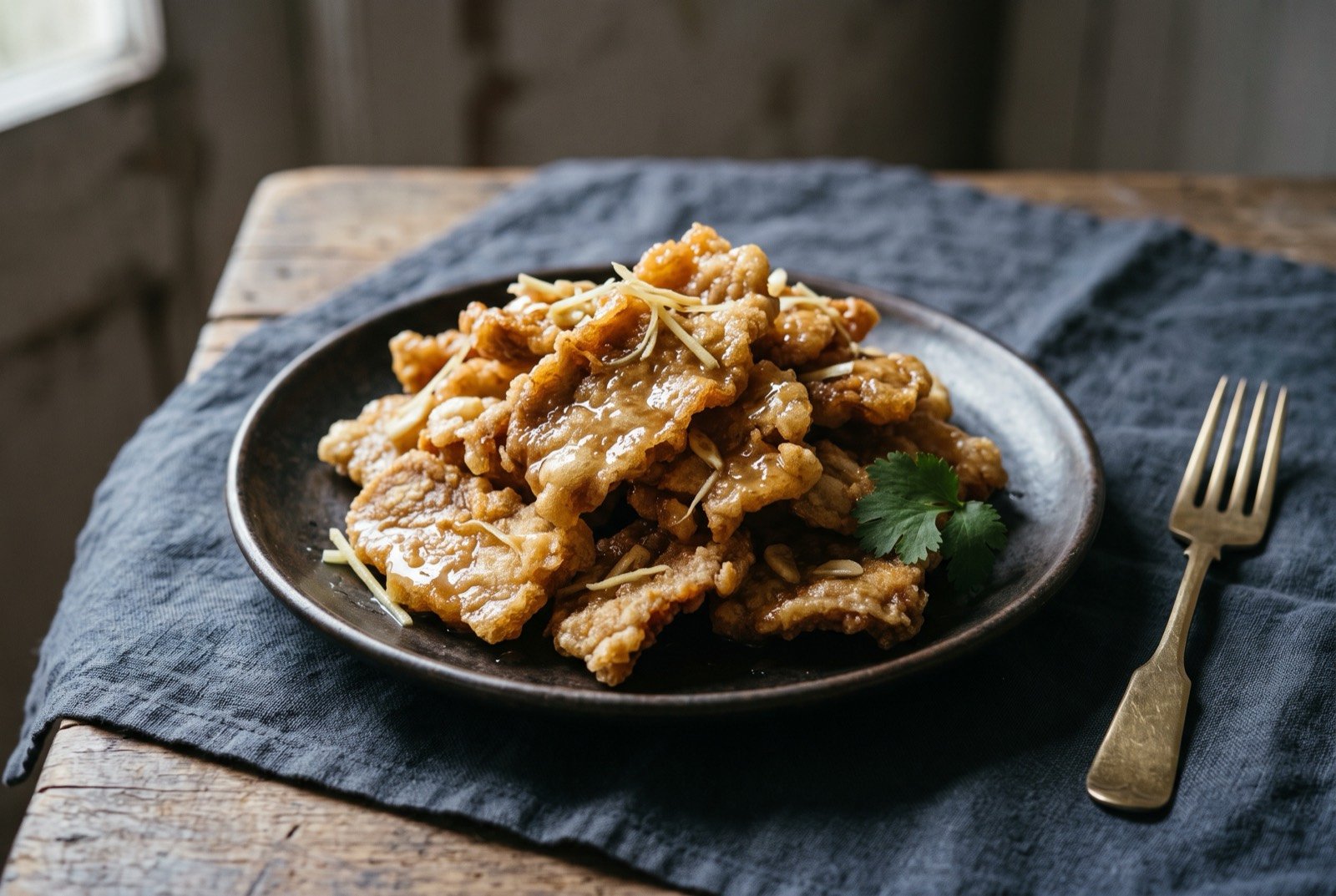
An illustration of the dish, not a photograph of it cooked.
- Time
- 40 minutes
- Reviewed
- Not yet reviewed from inside the tradition
- Cooked
- Not yet cooked and reported
Zheng Xingwen, head chef to the first Daotai of Harbin's Binjiang office, adapted a savoury, dry-fried Beijing-Shandong pork dish into a sweet-sour version for the office's Russian and European guests, and the dish survives in two live regional forms that still divide opinion across the three provinces: Harbin's older sugar-vinegar version, and Shenyang's later tomato-sauce variant. Both trace to Zheng's original invention; neither has fully displaced the other.
As tradition built it
Serves 4. About 40 minutes.
Ingredients
- 300 g pork loin or tenderloin, sliced roughly 0.5cm thick
- 120 g potato starch, mixed with just enough cold water to form a thick, wet paste
- for deep frying neutral oil, for deep-frying
- 100 g white sugar
- 60 ml rice vinegar or white vinegar
- a small handful of each julienned ginger, garlic and spring onion, a small handful of each
- for garnish coriander leaves, to finish
Method
- Coat the sliced pork thickly and evenly in the potato starch paste, working it in by hand until the mixture shows real resistance rather than sliding off.
- Heat the oil to 190 to 200°C. Fry the coated pork in batches, a few minutes, until pale gold and just set; remove.
- Reheat the oil back up towards 200°C and fry the pork a second time, briefly, until audibly crisp; drain well.
- In a separate pan, warm the sugar and vinegar together and let it reduce to a syrupy, concentrated glaze; do not thicken it with cornstarch.
- Add the ginger, garlic and spring onion to the glaze for a few seconds, then tip in the fried pork and toss briefly, just enough to coat without letting the crust sit in the liquid.
- Serve immediately, scattered with coriander.
What a modern chef changes
A precision double fry, and the Shenyang sibling served alongside rather than left out.
Rung 2, plus the chapter's own extrapolation onto a live regional dispute.
Method
- Hold both fry stages to an exact probe-thermometer reading, 195°C for the first fry and 200°C for the second, rather than judging by eye, the single change most likely to separate a reliably crisp result from an inconsistent one.
- Build a small second glaze in the Shenyang style, the same sugar-vinegar reduction with a spoonful of tomato paste worked in once it has reduced, and serve a portion of the fried pork tossed through each glaze side by side, letting a British kitchen taste the actual regional argument rather than reading about it, in the same spirit this atlas's Japan volume applies to Kanto and Kansai's own sukiyaki.
- Dry the sliced pork briefly on a rack before battering, fifteen minutes uncovered, or a short low pass in a dehydrator, to reduce surface moisture and improve the starch coating's adhesion, a genuinely useful, low-effort step this reader's own equipment makes easy.