The Sinosphere · Volume 37, The Barley Line, the Butter Churn and What Exile Carried Out
Tsampa
Ü-Tsang, central Tibet
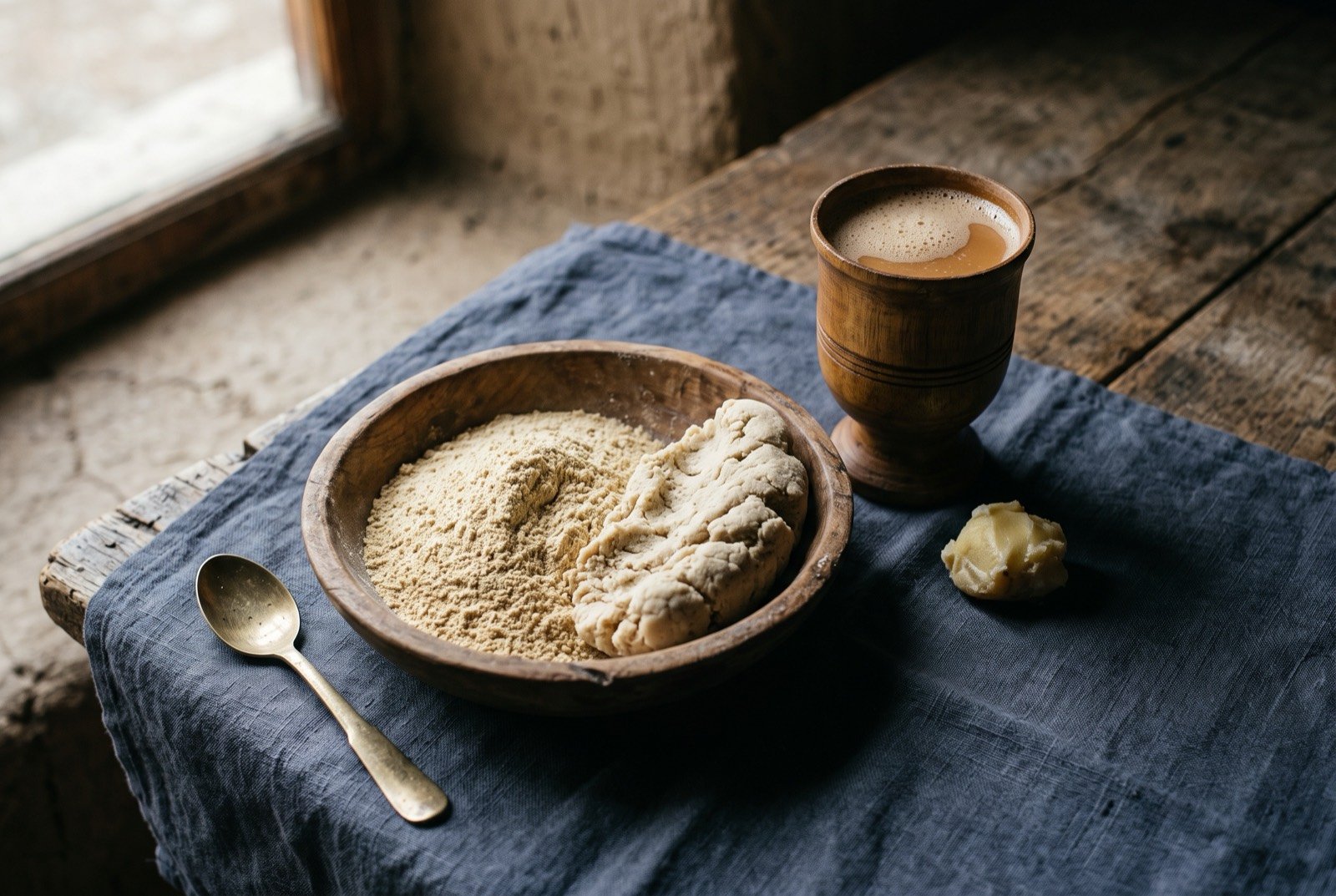
An illustration of the dish, not a photograph of it cooked.
- Time
- Not statedNo source states a time and the atlas has too few comparable dishes to estimate one.
- Reviewed
- Not yet reviewed from inside the tradition
- Cooked
- Not yet cooked and reported
The single most defining food in this chapter, eaten by hand rather than cooked to order, and, per Tibetan cultural sources themselves, the reason Tibetans are sometimes called tsampa-eaters. It is also, per the Central Tibetan Administration's own account, the first solid food many Tibetan children are given, and it is offered ritually to household deities and eaten at Losar from a carved wooden box, the chemar, held in every home.
As tradition built it
A hand-feel food, made to individual taste. About 30 minutes to roast and grind.
Ingredients
- 500 g hulled barley grain
- to cover freshly boiled water, enough to pour over and steam the grain
- to taste hot butter tea, added a little at a time
- a lump butter
- a little, if you have it chura
- a little, if you have it sugar
Method
- Wash 500g hulled barley grain thoroughly under running water.
- Pour freshly boiled water over it in a strainer, cover with a cloth and leave to stand around 15 minutes, the residual steam partially cooking the grain and improving the roast.
- Roast the grain in a dry pan over a steady flame, traditionally with hot sand as the conducting medium, stirring constantly, until it colours a deep golden brown and smells distinctly toasted, a matter of judgement by smell and sound rather than a fixed time.
- Grind the roasted grain to a fine flour, traditionally at a water mill or by hand quern.
- To eat, put a spoonful or two of tsampa in a bowl, add hot butter tea a little at a time, a lump of butter and, if you have it, a little chura and sugar, and knead directly with the fingers of one hand, turning the bowl with the other, until it comes together into a firm, cohesive dough called pa.
Notes
There is no fixed flour-to-liquid ratio: this is a hand-feel food, eaten to individual consistency, and no source consulted for this chapter gave one, a genuine gap rather than an omission.
What a modern chef changes
A tracked roast, a finer mill, and pa served two ways
Rungs 1 and 2
Method
- First, treat the roast the way a serious coffee roaster treats a bean: track it by colour and aroma against a held reference sample rather than by eye alone, aiming for a consistent, repeatable Maillard development rather than the variation a home pan roast produces batch to batch.
- Second, mill the roasted barley in a high-power blender rather than a stone quern, in short bursts to avoid heat build-up, for a finer, more even flour than hand-milling gives, opening tsampa up as a genuine pastry or dessert flour, its toasted-grain flavour standing in for a portion of the flour in a shortbread or a financier, rather than confining it only to butter-tea dough.
- Third, make a proper butter-tea emulsion in a high-power blender rather than churning by hand, thirty seconds against several minutes of real work, a straightforward substitution of modern equipment for traditional labour, honestly presented as such rather than as an improvement in flavour.
- Fourth, serve the pa itself with a quenelle of the elevated tsampa pastry alongside, so the same ingredient appears on the plate in both its ancient, hand-worked form and a modern, baked one, side by side rather than one replacing the other.