The Sinosphere · Volume 37, The Barley Line, the Butter Churn and What Exile Carried Out
Sha kampo
Pastoral Tibet, especially Amdo and Kham nomad country
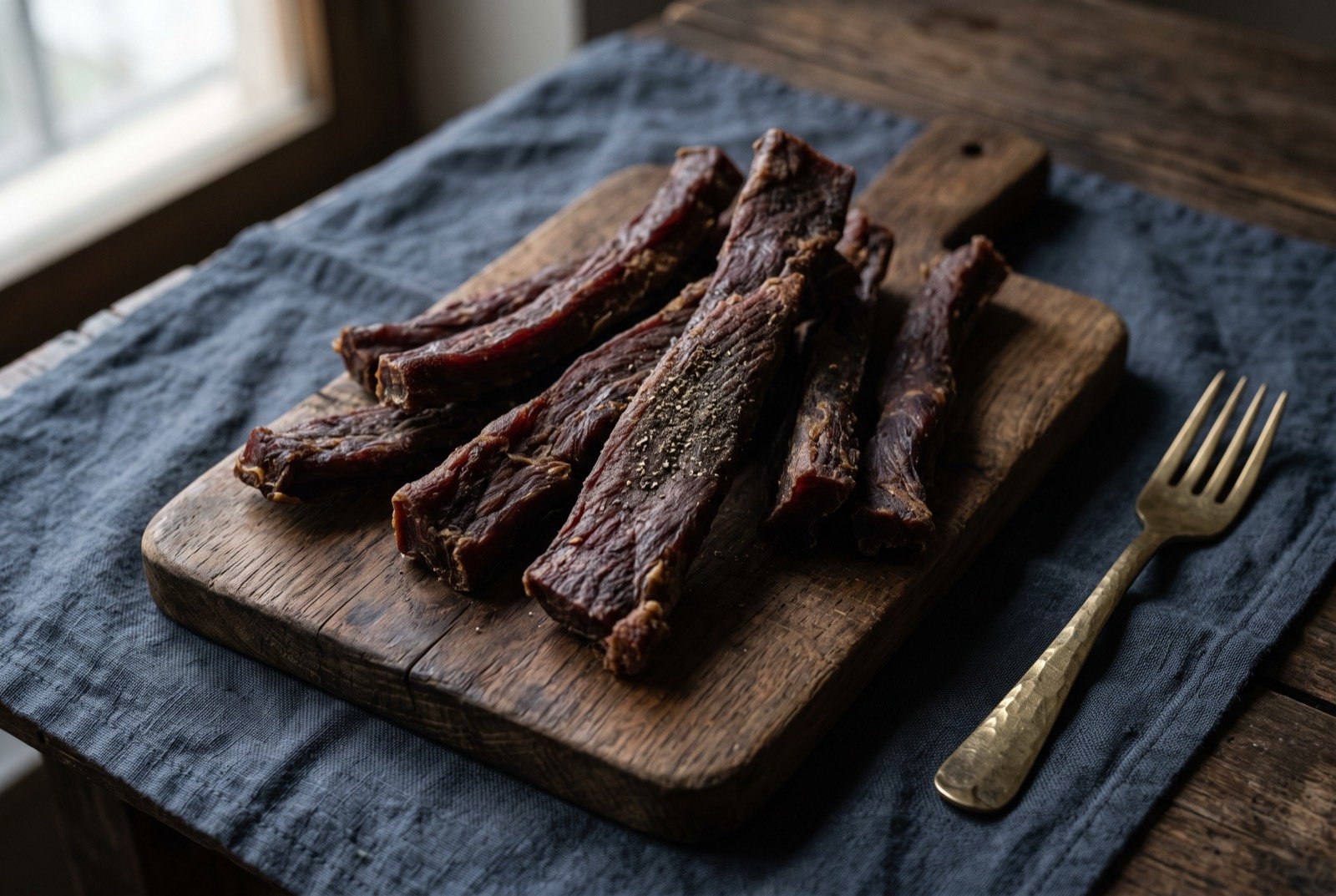
An illustration of the dish, not a photograph of it cooked.
- Time
- Not statedNo source states a time and the atlas has too few comparable dishes to estimate one.
- Reviewed
- Not yet reviewed from inside the tradition
- Cooked
- Not yet cooked and reported
Wind-dried yak jerky, a genuinely seasonal, climate-dependent food rather than a technique that works in any weather. Nomad families begin drying meat only once the cold, dry Drukpa wind blows steadily from the northwest and relative humidity drops below roughly 30 per cent, a real ecological threshold rather than a vague "in winter" claim.
As tradition built it
A whole cold season, weather permitting.
Ingredients
- as available fresh yak meat, or a British substitute, see Sourcing below, cut into strips roughly 10 to 15 cm long and about a thumb's thickness
- to taste salt
- to taste black pepper
- a little, optional chilli powder
Method
- Cut fresh yak meat, or, in Britain, see Sourcing below, into strips roughly 10 to 15cm long and about a thumb's thickness.
- Rub with salt, black pepper and a little chilli powder if you like, though a fully unseasoned version is equally traditional.
- Hang the strips in a cool, dry, well-ventilated, unheated space, traditionally a dedicated hut or tent lined with wooden beams, and leave to dry through the cold season.
Notes
No source consulted gives a total number of days; this is a process governed by the weather itself rather than a fixed timer, and this chapter has not invented a figure to fill that gap.
What a modern chef changes
The Drukpa wind replicated on demand, and a bresaola-style finish
Rung 3
Method
- First, replicate the Drukpa wind's conditions deliberately rather than by chance, using a dehumidifying dehydrator or a dedicated curing chamber held at a controlled low temperature and humidity, so the process runs reliably in a British kitchen regardless of the weather outside.
- Second, add a light dry-cure salt stage before drying, a deliberate departure from the traditionally salt-optional method, stated plainly as an elevation rather than a traditional step, for a firmer texture and longer shelf life.
- Third, finish the dried strips with a very brief pass over hot coals on a Big Green Egg, another honest addition, for a whisper of smoke the wind-only tradition never carries.
- Fourth, slice a portion paper-thin on a meat slicer once fully dried and serve it draped, bresaola-style, over a disc of the elevated tsampa flatbread from dish two, a genuinely new pairing built from two dishes already in this chapter rather than an ingredient from outside it.