The Sinosphere · Volume 35, The Sour Jar, the Steam Funnel and a Border That Runs Both Ways
Nuodeng ham and rushan, the Dali table
Yunlong county, Dali prefecture, Yunnan; Bai
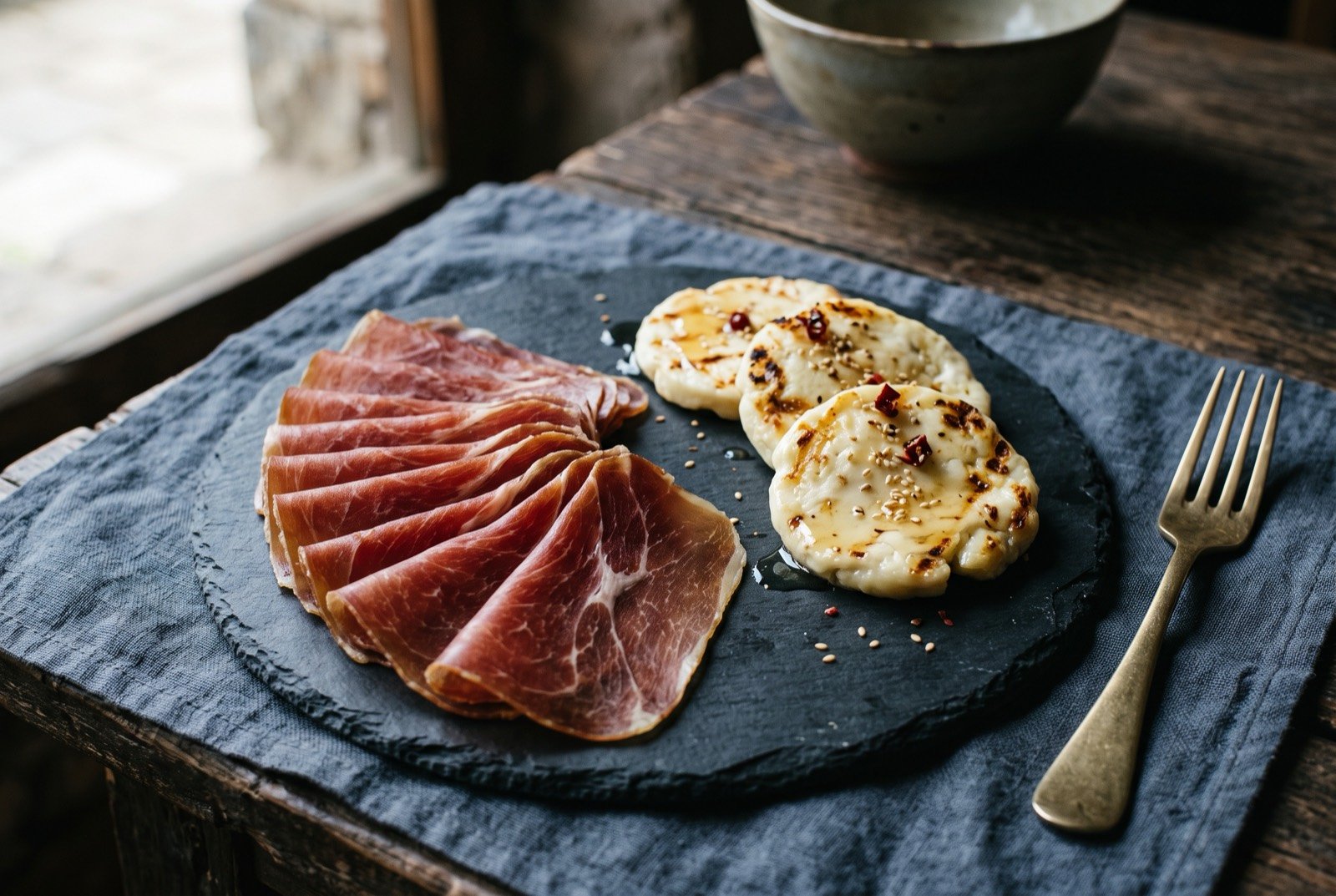
An illustration of the dish, not a photograph of it cooked.
- Time
- 20 minutes
- Reviewed
- Not yet reviewed from inside the tradition
- Cooked
- Not yet cooked and reported
Yunlong county, Dali prefecture, Yunnan. Bai. Two separate crafts from one place, served together.
As tradition built it
Ham: cured over one to three years, bought ready-cured. Rushan: made fresh, 20 minutes.
Ingredients
- 200 g Nuodeng or Xuanwei ham (or jamón serrano, see Sourcing), sliced paper-thin
- 500 ml whole milk
- 125 ml "sour water" starter (a reserved cup of whey from a previous batch, or 30 ml lemon juice diluted with 95 ml water as a home-cook approximation)
- a drizzle a little honey, to serve
Method
- Arrange the ham slices simply, at room temperature, with nothing added: the point of a ham this carefully cured is that it needs no dressing.
- Heat the milk to 60 to 70°C. Add the sour-water starter and stir gently; the milk should curdle into loose curds within a minute or two.
- Lift the curds out with a slotted spoon, draining well, and knead them briefly by hand while still warm until they form a single, elastic mass.
- Wind the warm curd thinly around a clean stick or rolling pin, stretching it as thin as it will go without tearing.
- Hang to dry between two supports for two to three days in a cool, airy spot, or serve fresh and soft the same day, unwound from the stick, as Bai households often do.
- Serve the ham and rushan on the same plate, the rushan lightly grilled or pan-fried until it blisters and turns golden, drizzled with a little honey.
What a modern chef changes
Both crafts read as one course, following Kunming's own Hong 0871.
Rungs 2 and 3
Method
- Cure a UK-legal ham analogue (jamón serrano) further at home, holding it in a temperature- and humidity-controlled space (a wine fridge set to 13 to 16°C with a humidity tray) for a further two to three months to concentrate flavour, following Xuanwei's own climate parameters rather than inventing new ones.
- Make the rushan using a dairy thermometer and a citric-acid coagulant rather than reserved whey, following the published Chinese food-science parameters exactly: curdle at 50°C, curd set within 60 seconds, stretch in water held at 70°C, checking the whey's pH reaches 4.6 before stretching.
- Cut both the ham and the rushan on a slicer to a uniform, near-translucent thickness, plating them fanned together on a single dark slate rather than as two separate dishes, the pairing Hong 0871 itself serves under the name "Three Years Ham and Dali Cheese."
- Finish the rushan under a blowtorch rather than a pan, blistering it evenly in seconds without the risk of scorching a thin sheet in a hot pan.