Oceania and the Pacific · Volume 01
Aboriginal and Torres Strait Islander Foodways
Fire, the Stone Trap and the Reef Garden
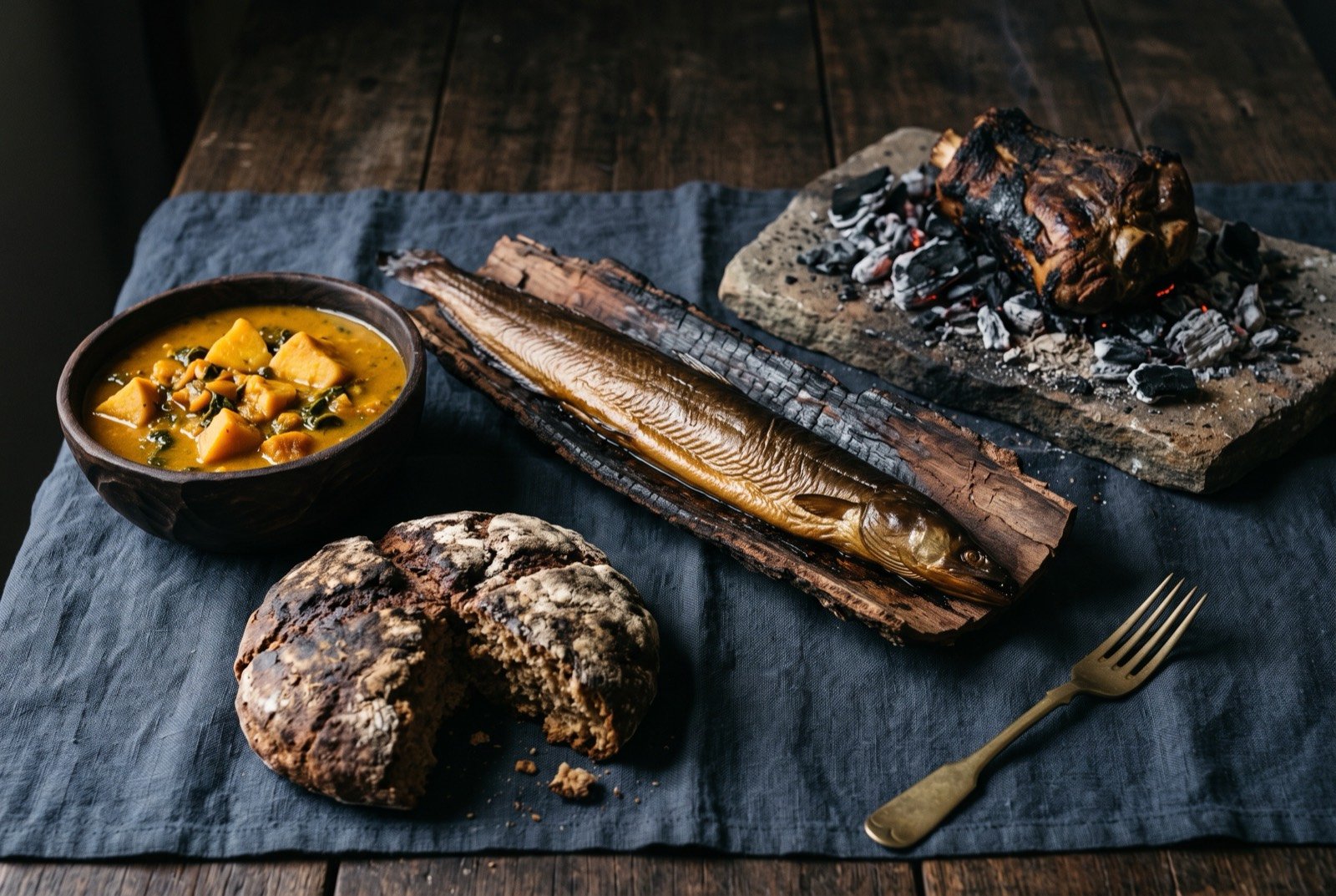
Budj Bim eel aquaculture predating Egypt's pyramids, witchetty grub and kangaroo tail, murnong and the bogong moth harvest, and the Torres Strait's garden-based, Melanesian-linked foodways sitting apart from the mainland's fire-managed ecologies. Two food worlds, not one, given real and separate weight, and every dish as tradition built it, then what a modern chef would change, once as tradition built it and once rebuilt with modernist technique, except where the sourcing will not honestly support an elevation.
Sources and review · What this chapter does not assert · How we research · Know this better? Tell us
A Sense of Place
Say this plainly at the outset, because it shapes every choice this chapter makes: Aboriginal and Torres Strait Islander food is not one cuisine any more than "European food" is one cuisine, and this volume does not pretend otherwise. Aboriginal Australia alone spans several hundred distinct language groups and nations across a continent's worth of ecology, desert, tropical wetland, alpine high country, temperate coast, each with its own staples, its own techniques and its own law governing how food is gathered, prepared and shared. The Torres Strait Islands, a strait of islands between Cape York and Papua New Guinea, are a different world again: Melanesian, not Aboriginal, gardening taro, yam and banana on volcanic soil rather than reading a fire-managed continent for bush tucker. This chapter gives both worlds real depth rather than one thin composite, and inside the mainland thread it refuses to let any single Nation's practice stand in for "Aboriginal food" generally, naming the specific peoples and Country behind each claim wherever the research allows it.
Mainland Aboriginal Australia organises around ecology and law rather than a single staple or fat, and this chapter follows three of its clearest, best documented zones. In the desert (Anangu, Pitjantjatjara, Arrernte and neighbouring peoples of Central Australia), food is built from what deep knowledge of Country makes findable: witchetty grub and honey ant dug from root and nest, quandong and bush tomato served in carved wooden piti, acacia and grass seed ground on stone into flour, all governed by Tjukurpa, the traditional law that also assigns gendered roles in gathering. In the tropical Top End (Yolŋu, Bininj/Mungguy and neighbouring peoples of Arnhem Land and the Kakadu wetlands), the wet-dry monsoon cycle drives a six-season calendar and a late dry-season magpie goose harvest, alongside a food source, cycad seed, whose safe use depends on real, transmitted, life-or-death processing knowledge. In the temperate southeast (Kulin nations and neighbouring peoples of Victoria and southern New South Wales), murnong, the yam daisy, was a genuine staple crop across what is now inner Melbourne until introduced livestock destroyed it within about five years of settlement, while further south and east the Ngarrindjeri still practise the pipi shuffle on the Coorong's beaches and the Wakka Wakka and neighbouring peoples still gather every third year beneath the Bunya Mountains' mast-fruiting pines.
Threaded through all three zones is the Budj Bim Cultural Landscape, Gunditjmara Country in western Victoria: a basalt weir, channel and eel-basket system built at least 6,600 years ago, UNESCO World Heritage listed in 2019, and today run directly by the Gunditj Mirring Traditional Owners Aboriginal Corporation as Victoria's first co-managed national park. It sits at the centre of a genuinely live, unresolved academic argument about how much of pre-colonial Aboriginal Australia should be called agriculture rather than hunting and gathering, an argument this chapter reports honestly rather than settles, below.
The Torres Strait Islands sit apart from all of this, and this chapter treats that apartness as the point rather than a complication. Language marks the split precisely: the Strait's western and central islands speak a language of the same Pama-Nyungan family found across mainland Australia, while the eastern islands speak Meriam Mìr, related instead to languages of the nearby Papua New Guinea coast. The high, volcanic Eastern Islands, Mer chief among them, support real, clan-owned garden agriculture, taro, yam, banana, sweet potato, in a way no mainland Aboriginal ecology does; the reef supplies dugong, green turtle, fish and shellfish under a shared framework the Strait calls Ailan Kastom, island custom. This chapter gives the Torres Strait its own real estate rather than a paragraph inside the mainland's story, the same explicit weight this atlas gives Māori food elsewhere in Oceania.
| World | What organises the food | The chapter's anchor |
|---|---|---|
| Desert Australia | Tjukurpa law; deep ecological knowledge of scarce, scattered resources | Maku (witchetty grub), ground seed flour |
| Tropical Top End | The monsoon's six-season calendar; wetland harvest timed to animal fat cycles | Magpie goose; cycad, and the real danger of getting its processing wrong |
| Temperate southeast | A once-staple root crop destroyed within years of contact; alpine and coastal feast gatherings | Budj Bim's kooyang; bogong moth; the Bunya Mountains; the pipi shuffle |
| Torres Strait Islands | Ailan Kastom; clan-owned garden agriculture plus a reef and marine economy | Sop sop, namas; dugong and turtle, treated with real care |
A word on how this chapter was researched, stated honestly rather than glossed over. All four research threads behind this chapter worked in English throughout. For mainland Aboriginal Australia this is not the gap it would be elsewhere in this atlas: English-language writing, journalism and scholarship by Aboriginal people, organisations and academics is itself the relevant local, in-tradition source base, and this chapter has prioritised it over settler ethnography wherever a real choice existed. The same is broadly true for the Torres Strait, though Meriam Mìr and Kala Lagaw Ya sources were not independently reachable within this research's scope. Some Aboriginal and Torres Strait Islander food knowledge is restricted, men's business, women's business, sacred or ceremonial, and this chapter does not press past what its cited sources already intended for public readership.
The History in Layers
The oldest continuous kitchen anywhere in this atlas
Human occupation in northern Australia is dated to at least 65,000 years at Madjedbebe, near Kakadu, among the oldest confirmed sites of human presence anywhere on earth, and the archaeological plant record there, waterlily seed, long yam, green plum and pandanus recovered by researchers working directly with Mirarr Traditional Owners May Nango and Djaykuk Djandjomerr, shows those foods becoming markedly more important in the diet as wetland vegetation expanded from around 4,000 years ago. The Conversation No volume elsewhere in this atlas reaches back this far, and this chapter states that plainly rather than reaching for a smaller, safer number.
Budj Bim, and the argument it sits inside
Monash University archaeologist Ian McNiven's radiocarbon dating of charcoal in the trap sediment puts construction of the Budj Bim system at at least 6,600 years ago, engineered from basalt left by the Budj Bim volcano's eruption: weirs, holding and growing ponds, and stone channels running hundreds of metres, worked with specialised eel baskets of river reed and spear grass built to regulate catch by size. The engineered wetlands supported permanent settlement, close to 300 stone house foundations survive along the lava flow, and kooyang, short-finned eel, was smoked and traded well beyond Gunditjmara Country. Parks Victoria The comparison often made in press coverage, that Budj Bim predates the Egyptian pyramids, is accurate arithmetic against McNiven's date, but it is a comparison introduced by outside journalists rather than one this chapter could find in the Gunditjmara's own self-description, and it is attributed here to the press, not asserted as Gunditjmara framing. Smithsonian Magazine Since July 2022 the Gunditj Mirring Traditional Owners Aboriginal Corporation runs Budj Bim Cultural Landscape Tourism directly, and Gunditjmara representative Dennis Rose has spoken of ancestors who "spent plenty of time studying the country, the hydrology of the Budj Bim Cultural Landscape," modifying it "but not to the point of destroying it." UNESCO
Budj Bim sits at the centre of a genuinely live, unresolved argument in Australian public and academic life, and this chapter reports it as a disagreement rather than adjudicating it. Bruce Pascoe's Dark Emu (2014) argues pre-colonial Aboriginal societies practised agriculture, aquaculture and permanent settlement more extensive than "hunter-gatherer" suggests, citing Budj Bim and Brewarrina among its evidence, and the book reshaped Australian public understanding of pre-colonial Aboriginal society, winning the 2016 NSW Premier's Literary Award for Indigenous Writing. Anthropologist Peter Sutton and archaeologist Keryn Walshe's Farmers or Hunter-Gatherers? The Dark Emu Debate (2021) is the most substantial published response: their case is not that Pascoe invented evidence but that he selectively edited and over-generalised it, and on Budj Bim specifically, Walshe accepts Gunditjmara engineering of the weirs and channels while stressing the underlying river channels are natural volcanic features, framing the work as sophisticated modification of a natural resource rather than agriculture built from nothing. The Conversation, book review Yuin academic Heidi Norman has made a further, separate point worth holding alongside both books: that the entire framing of this debate in Australian media has tended to happen "almost entirely in the absence of Aboriginal people." She credits Pascoe with having "made the deep ancient past and the present intelligible and imaginable for a wide audience" while judging both books, in different ways, limited by what they leave out. The Conversation, Norman A separate and distinct dispute, over Pascoe's own claimed Aboriginal identity, is named honestly in this chapter's closing section rather than smoothed into the historical argument above.
Fire as land management, not a resource used up
Historian Bill Gammage's The Biggest Estate on Earth (2011) argues Aboriginal groups across the continent used patterned, low-intensity cool burning to reduce fuel loads, draw grazing animals to predictable ground and maintain landscape-wide habitat diversity. This is supported by palaeoecologist Michael-Shawn Fletcher (Wiradjuri, Professor of Geography, University of Melbourne), whose pollen and charcoal record work argues Australian landscapes were actively structured by millennia of Aboriginal burning, and that the loss of that stewardship after colonisation changed vegetation and fire regimes still felt today. University of Melbourne Fire-stick farming is, in other words, the single clearest throughline between this chapter's deep history and its "deliberately not accidentally" thesis: cool, patterned burning is precise, transmitted technique, not the absence of agriculture.
Colonisation, and what it broke specifically
Colonisation did not simply disrupt Aboriginal food systems in the abstract, it broke named, specific staples. Murnong, the yam daisy that fed the Kulin nations across what is now inner Melbourne, was grazed and trampled to near disappearance within about five years of the first sheep and cattle arriving in 1835, and contemporaries at the time directly linked its loss to the conflict that followed, as people facing the loss of a staple turned to hunting settlers' sheep instead. Wikipedia, Murnong The bogong moth gatherings of the alpine high country, which had drawn the Ngarigo and visiting Ngunawal, Yuin, Omeo, Bidawal and Kranatungalung peoples for feasting, law-making and dispute settlement, collapsed within about 30 years of colonial contact. National Museum of Australia The Bunya Mountains gatherings, which had drawn the Wakka Wakka, Jarowair, Djaku-nde and Barrungam peoples, and visitors from as far as South Australia and Western Australia, in what were arguably the largest pre-colonial Aboriginal gatherings recorded anywhere in Australia, continued at scale only until around 1902. ORIC This chapter treats these as three separate, specific losses, not one vague colonial narrative, because that is what the evidence actually shows.
The present day: revival, governance and a live reckoning with who benefits
Recovery is real and ongoing, and this chapter names it with the same specificity as the losses above. Budj Bim is now co-managed and Gunditjmara-run. The Eastern Maar's AIATSIS-funded Cultural Landscape Project is mapping historic murnong ground as a basis for cultural and commercial cultivation, alongside an independent 2015 to 2017 nursery propagation study aimed at producing viable, storable tubers. AIATSIS Yumi Sabe The Bunya Mountains' triennial festival is now governed by the Bunya Peoples' Aboriginal Corporation, whose chair Lurlene Henderson has described its role as recognition of "this culturally sensitive space." Bogong moth gatherings have seen recent revival. And a distinct, live, present-tense reckoning runs alongside all of this: a 2019 Indigenous Native Foods Symposium found Aboriginal and Torres Strait Islander people represent fewer than 2 per cent of providers across the native food industry's supply chain, and separate 2026 academic advocacy states less than 1 per cent of that industry's revenue, now estimated at $100 million, reaches Aboriginal and Torres Strait Islander communities at all. Southern Cross University This is not a historical footnote, it is the present day, and this chapter returns to it in full below, in the section that draws the distinction the whole modernist half of this chapter is built around.
The Torres Strait's own history, kept as its own thread
Torres Strait Islanders are Melanesian, culturally closest to the coastal peoples of Papua New Guinea, and Ailan Kastom, island custom, the Strait's own umbrella term for its living cultural framework, is legally recognised as the body of customs, traditions and beliefs of Torres Strait Islanders, a genuine blend of Torres Strait, Melanesian, Polynesian, Aboriginal and European elements accumulated through the Strait's long trading history. structure.gov.au Mer (Murray Island), the volcanic Eastern Island whose land case became the 1992 Mabo native title decision, holds the best documented example of the Strait's clan-based garden agriculture, land organised into eight clan territories, Komet, Zagareb, Meuram, Magaram, Geuram, Peibre, Meriam-Samsep, Piadram and Dauer Meriam, each running as a strip from shore to reef, cultivated with what a senior Meriam landholder describes as deliberately "crooked boundaries," in contrast with the straight lines of introduced Australian land allotment. mabonativetitle.com From the 1870s, the pearling and bêche-de-mer trade brought Japanese, Filipino, Malay, Ceylonese and Chinese workers and, with them, real culinary influence still visible in the Strait's food today, alongside real and documented histories of unequal wages under that same pearling industry. Contemporary Torres Strait Islander life carries its own present-day pressures directly relevant to a reader of this chapter: a healthy diet costs an estimated 35 per cent more in the Torres Strait Islands than elsewhere in Queensland, and 40 per cent more than in Brisbane, a genuine, structural echo of the sourcing difficulty this chapter's own final section reports for Britain. Health and Wellbeing Queensland
The Flavour Arsenal
Starches
Murnong (yam daisy, Microseris spp.). A genuine staple root crop of the Kulin nations, near destroyed by introduced livestock within five years of contact, see above. Roasted in ash. This chapter treats it honestly as an ingredient a reader cannot currently obtain, in Australia or Britain, rather than a live sourcing option.
Karrbarda (long yam, Dioscorea transversa), a Top End and Arnhem Land staple whose dietary importance rose sharply from around 4,000 years ago as wetland vegetation expanded, documented at Madjedbebe alongside waterlily seed, green plum and pandanus.
Native grass and acacia seed, ground for flour: native millet and spinifex in Central Australia, supplemented by wattleseed; pigweed, prickly wattle, mulga, dead finish seed and bush bean elsewhere. Grinding used a tjiwa (base stone) and tjungari (handheld grindstone) in the desert, often passed down through generations of women, roughly two hours' grinding for half a kilogram of flour. Australian Museum
Igname (yam, Dioscorea alata and other species), the Torres Strait's own staple starch, roughly thirty documented varieties grown on Mer alone, cultivation wrapped in what the Mabo native title archive calls "secret garden lore," specialised knowledge passed through clan lines, with garden productivity itself historically promoted through mukeis zogo, ritual shrines and sacred stones traded in from other islands. Taro, banana, sweet potato and cassava are grown alongside it on the volcanic Eastern Islands.
Nuts and seeds
Wattleseed (Acacia spp.), roasted and ground, a coffee-like flour ingredient across much of the continent, and, alongside lemon myrtle, one of the two native ingredients now most visible in Australian modernist cooking, see the Sourcing section below for how thinly that visibility currently translates into Aboriginal-owned supply.
Bunya nut (Araucaria bidwillii), the mast crop of the Bunya Mountains, gathered every third year and described in language as "mother's milk," roasted and ground into paste at the historic gatherings named above.
Bogong moth (Agrotis infusa), exceptionally fat-rich, harvested from the high country between roughly October and February, ground on stone into cakes at gatherings dated by their grinding-stone evidence to around 2,000 years old. This chapter names bogong moth with real weight in this Arsenal and in the history above, but does not force it into the Dishes section below: no source found gives a quantified recipe, and no UK-available substitute exists that this chapter considers an honest stand-in for a food this ceremonially significant.
Fruits
Quandong (Santalum acuminatum), a tart native peach, cracked from its stone using a purpose-built "quandong stone," a specialised anvil-and-hammerstone tool distinct from general grindstones, and served, with kampurarpa (bush tomato, Solanum centrale), in piti, carved wooden bowls also used for water, across Central Australia.
Kakadu plum (Terminalia ferdinandiana), the highest-vitamin-C fruit known, and finger lime (bush caviar, Citrus australasica), now genuine fixtures of Australian modernist cooking, see Sourcing below for the real difference between an Australian native fruit and a Spanish-grown lookalike sold under the same English name in Britain.
Muntries (Kunzea pomifera), a native cranberry-like berry, essentially unobtainable anywhere outside Australia today, noted here for completeness rather than as a live ingredient.
Protein
Kangaroo, the most widely recognised Aboriginal protein internationally, and the one this chapter treats with the most care to keep two things distinct: kangaroo tail as a specific, whole-cut, ceremonially weighted traditional dish, and the kangaroo fillet steak now genuinely available in British game butchers, which is a different product entirely.
Maku (witchetty grub), chiefly the larvae of the cossid moth Endoxyla leucomochla, found in the roots of the witchetty bush and river red gum, roughly 38 per cent protein and nearly 40 per cent fat, traditionally gathered by women and children.
Magpie goose, the major seasonal wetland protein of the Top End, hunted late in the dry season once birds have fattened on the corms of blue lily and water chestnut and crowd around shrinking billabongs.
Cycad seed (Macrozamia/Cycas spp.) is a real and long-used food source across coastal and northern Australia, and this chapter states its risk plainly rather than treating it as bush-food colour: raw or under-processed seed contains cycasin, which releases the neurotoxin methylazoxymethanol on hydrolysis, causing acute vomiting and, with chronic exposure, irreversible nervous system and liver damage, the same toxin documented in cattle as "zamia staggers." European explorers on Cook's, Vlaming's, La Pérouse's and Flinders's voyages, and their livestock, were repeatedly and severely sickened eating it without the transmitted knowledge that makes it safe, among the earliest documented plant poisonings in colonial Australian history. Real processing exists, ageing, prolonged water-leaching, roasting in the east, pit fermentation in the southwest, but it depends on knowledge this chapter will not attempt to replace with a home recipe, see the Technique Ladder below.
Dugong and green turtle, the Torres Strait's two most culturally significant proteins, treated with the depth and care they deserve in this chapter's Voices section and Dishes section, rather than compressed into an ingredient line.
Reef fish, shellfish and crayfish, everyday Torres Strait protein, taken by hand-lining, diving, spearing, reef-gleaning, netting and trolling, and, historically, drawn through dense stone fish trap and weir complexes among the largest structures built anywhere by Aboriginal and Torres Strait Islander people, their construction and repair itself encoded in song. Rowland and Ulm
A negative finding worth stating plainly
This research found no strong, well documented fermentation tradition across mainland Aboriginal Australia or the Torres Strait comparable to, say, Melanesia's pit-fermented breadfruit or Vanuatu's namaraï, which this atlas has already documented in its neighbouring Pacific volumes. Southwestern cycad processing does use pit fermentation, but this chapter will not turn that dangerous, expert-held technique into a home ferment bench, see the Technique Ladder below. This chapter reports that absence as a real finding of this research, not a gap in the searching.
The ferment and preserve bench
This volume does not have one, and this chapter states that honestly rather than inventing a ferment to fill the section. No source found across any of the four research threads behind this chapter documented a fermentation tradition, beyond cycad's expert-held southwestern pit fermentation, which this chapter has already declined to turn into a home technique, above. This stands in real, worth-naming contrast to this atlas's neighbouring Pacific volumes, where breadfruit fermentation is a genuine, if fading, tradition.
The Technique Ladder
Six rungs, each a real, sourced mechanism, each stated with the same care this atlas gives every volume: what a cook does with a Big Green Egg, sous vide, dehydrator, high-power blender, chinois and spice grinder to elevate technique that is already, in its own right, deliberate and precise.
Rung 1. Stone and water, engineered on purpose
Budj Bim's weirs, holding ponds and stone channels are not an improvised trap, they are an engineered aquaculture system built and maintained over millennia, its eel baskets sized specifically to regulate catch. What a cook does with this rung. Treat any smoking or long, slow cook as an engineered system rather than an improvisation: a Big Green Egg run with a specific, chosen smoking wood and a controlled airflow setting is the same discipline in miniature, built to a deliberately chosen outcome, not left to whatever heat happens to be available.
Rung 2. The ground oven as engineered thermal mass
Kap mari, the Torres Strait's earth oven, and the ground ovens documented across mainland Aboriginal Australia, work the same way: a pit lined with stone, fired until the stones are red hot, food layered in with more hot stone and covered, left to steam-roast for hours on stored, even heat rather than direct flame. What a cook does with this rung. A Big Green Egg run in indirect mode, deflector plate in and fully stabilised at temperature before loading, reproduces this stored, even heat closely, the same principle this atlas has already applied to the Pacific's own earth-oven family in its Melanesia and Polynesia volumes.
Rung 3. Direct, brief, precise ember heat
Maku is roasted on coals for under a minute, the exact opposite of the ground oven's hours: a short, hot, precisely timed direct heat that a moment too long or too short genuinely changes. What a cook does with this rung. A Big Green Egg run direct and searingly hot, with a probe thermometer and a timer rather than judgement by eye, reproduces the precision the traditional method already has, rather than "improving" on a technique that does not need improving, only replicating exactly.
Rung 4. Seed and nut ground into flour or paste, not sprinkled on top
Damper's native-seed flour and the Bunya Mountains' roasted, ground nut paste both start from real grinding-stone labour, roughly two hours by hand for half a kilogram of seed flour. What a cook does with this rung. A spice grinder and a high-power blender let a cook reproduce that same fine, even grind in minutes rather than hours, worked fully through the dish rather than left as a coarse garnish.
Rung 5. Leaching, and where this chapter draws a real line
Cycad's safe use depends on prolonged water-leaching, ageing or, in the southwest, pit fermentation, transmitted expert knowledge this chapter will not turn into a home instruction, given the real, documented risk of getting it wrong. What this rung is, honestly. This chapter names the leaching principle, drawing bitter or toxic water-soluble compounds out of a seed or root over a controlled soak, as real, transferable technique, and demonstrates it below on a genuinely safe, UK-available ingredient rather than on cycad itself. A dehydrator lets a cook then dry and stabilise the leached ingredient with far more control than open air ever allows.
Rung 6. Citrus as the cooking medium, not a garnish
Namas, the Torres Strait's raw fish dish, is "cooked" entirely by citrus acid rather than heat, the same family of technique this atlas has already documented across the Pacific as poisson cru, kokoda and ika mata. What a cook does with this rung. A chinois produces a genuinely clean, pulp-free citrus liquid, letting a cook control exactly how much acid reaches the fish and for how long, a precision the traditional method's hand-squeezed juice does not offer.
Sourcing in Britain
The honest headline, stated once rather than repeated ingredient by ingredient: a real and growing UK specialty spice trade in Australian native ingredients exists, wattleseed, lemon myrtle, mountain pepper, but this research found no UK-based retailer with its own verified, direct relationship to an Aboriginal or Torres Strait Islander owned producer or exporter. The closest things found are an Australian Indigenous social enterprise's own supply-chain claim, resold by UK shops as an imported product rather than independently stated by them, and two genuinely Indigenous-owned Australian businesses that ship internationally direct to a UK buyer, at real shipping cost, rather than being stocked by any UK shop. State that plainly to a reader who wants their purchase to actually reach an Aboriginal or Torres Strait Islander producer: the more reliable route, on the evidence gathered here, is very often a direct international order from Australia, not a UK high street or online specialist.
What is genuinely sourceable
Lemon myrtle and mountain pepper are both well established UK specialty spice stock, via Spice Mountain, Seasoned Pioneers and Steenbergs, the last sourcing its mountain pepper directly from Parrawe Estate, Tasmania, a conventional rather than Indigenous-owned grower. Macadamia is fully mainstream at every large UK supermarket. Sago is easily and cheaply sourced via any UK Chinese or Asian grocer, relevant to this volume's Torres Strait Islander side, though most UK retail "sago" is in practice cassava starch rather than true sago palm starch, a minor technical point worth naming once rather than dwelling on.
Kangaroo meat is genuinely and repeatedly available via UK exotic and game-meat retailers, Rendalls, The Meat Man, Bromfields, Kezie Foods and others, but this chapter states directly that this is wild-harvested Australian export meat marketed as a lean protein, with no stated relationship to Aboriginal food culture in any listing found, and it is not the same thing as kangaroo tail, the specific traditional cut and cooking method this chapter's own second dish describes.
What needs a substitute, or an honest correction, named plainly
Wattleseed has no reliably in-stock UK retailer at the time of this research; the more dependable route is a direct international order from Warndu, an Indigenous co-founded South Australian producer, at real shipping cost. Kakadu plum exists in the UK only as powder, resold from Kakadu Plum Co, sold in the health-supplement market rather than as a culinary spice, with fresh fruit unobtainable outside Australia entirely. Finger lime carries a genuine confusion risk this chapter corrects directly: Riverford's "organic finger limes" are Spanish-grown, not Australian, while true UK-grown finger lime exists only via specialist glasshouse growers at real scale limits. Quandong, muntries and bunya nut are, on the evidence gathered here, not currently obtainable in the UK at all; this chapter's own damper and bunya nut entries above name honest substitutes rather than pretending otherwise.
Saltbush: a distinction worth making once, clearly
Live saltbush plants are genuinely sold for UK cultivation, and a branded saltbush and pepperberry seasoning is available via Panzer's. But "saltbush lamb," a phrase that recurs in Australian food writing, describes how the animal itself was raised, grazed on saltbush country in South Australia, not a plant product a UK cook could buy and season with. This chapter states that distinction directly rather than letting a reader believe a UK saltbush purchase replicates saltbush lamb.
Voices and Sources
From inside the tradition
Nornie Bero, Komet clan, Mer Island, Torres Strait, chef and founder of Mabu Mabu and Big Esso, Melbourne, whose kangaroo-tail bourguignon anchors this chapter's second dish, and whose stated mission, "to get native ingredients in every kitchen," runs through this whole volume's modernist half. Mark Olive, Bundjalung, chef and founder of Midden by Mark Olive, Sydney Opera House. Mindy Woods, Bundjalung, chef, Karkalla on Country, and board member of Black Duck Foods, on native food's role in reconciliation. Evelyn Billy, Torres Strait Islander and Aboriginal, Cape York, whose sop sop and namas anchor this chapter's ninth and tenth dishes, and whose own words on cooking as "actioning my forgiveness" belong to this chapter as much as her recipes do. Clayton Donovan, Gumbaynggirr and Bundjalung, chef, The Jaaning Tree. Josh "Koomal" Whiteland, Wadandi, Koomal Dreaming, named in the peer-reviewed academic literature as this country's strongest documented example of the native-foods and Indigenous-tourism interface working as genuine self-determination.
Rayleen Brown, Kungkas Can Cook and the First Nations Bushfood and Botanical Alliance Australia; Pat Torres, Mamanyjun Tree Enterprises and FNBBAA; Damien Coulthard, Adnyamathanha and Dieri, Warndu, on ethical sourcing: "We buy first through Aboriginal businesses that are supporting their direct communities." Sharon Winsor, Ngemba Weilwan, Indigiearth, on the industry's real imbalance: "Aboriginal people only make up one per cent of the bush-food industry, and yet... they're all using traditional knowledge." Clinton Schultz, Gamilaroi, Sobah, on why purchasing choices matter structurally. Dale Tilbrook, Wardandi and Bibbulmun, Maalinup, on superficial branding: "Having a logo that looks a bit Aboriginal... doesn't make you deeply connected." Arabella Douglas, Minyunbal, on the case for chefs being led in foraging by, and in partnership with, local First Nations people.
Zena Cumpston, Barkandji, University of Melbourne, writer and curator on Aboriginal plant knowledge. Michael-Shawn Fletcher, Wiradjuri, Professor of Geography, University of Melbourne, on fire and Country. Heidi Norman, Yuin, on how the Dark Emu debate itself gets conducted. Dennis Rose, Gunditjmara, on Budj Bim's own hydrological knowledge. Dr Alana Gall, Truwulway and Litamirimina, and Dr Luke Williams, Gumbaynggirr, on native food industry reform.
Institutions
Gunditj Mirring Traditional Owners Aboriginal Corporation, running Budj Bim directly. The First Nations Bushfood and Botanical Alliance Australia, the sector's own Indigenous-led peak body. The Torres Strait Regional Authority, through which Torres Strait Islanders manage their own affairs. AIATSIS, whose Yumi Sabe project holds several of this chapter's strongest sources. Supply Nation, which investigates and acts against "black cladding," non-Indigenous companies claiming or implying Indigenous ownership without money or decision-making power reaching Aboriginal people.
The honest contrast, named once more plainly
Scottish-born chef Jock Zonfrillo built Orana, Adelaide, explicitly around native ingredients, personally funding real infrastructure for Indigenous partners, and also drew serious, specific and ultimately unresolved criticism over a promised Native Foods Database that reporting alleged was not delivered despite significant government funding; he died in 2023 with the matter reported, contested and never publicly settled. René Redzepi's 2016 Noma pop-up in Sydney is credited with creating intense public interest in Australian native foods, and directly prompted a collective of Aboriginal women bushfood leaders, "the Five Kungkas," to publicly challenge him to source from them rather than from non-Indigenous distributors. This chapter reports both cases honestly, as genuinely mixed, not as settled verdicts.
Things this chapter has deliberately not asserted
- That the "Budj Bim predates the Egyptian pyramids" comparison is the Gunditjmara's own self-description. It is accurate arithmetic against the site's radiocarbon date, but this chapter could not find it stated on the Gunditj Mirring Traditional Owners Aboriginal Corporation's own site, and attributes the comparison to the press coverage that popularised it.
- A settled resolution to the Dark Emu debate. Peter Sutton and Keryn Walshe's published critique of Bruce Pascoe's method is real and substantial; Pascoe's underlying argument about the sophistication of pre-colonial Aboriginal land and food management is also real and widely credited with reshaping public understanding. This chapter reports the disagreement as live and reports Heidi Norman's separate observation that it is usually conducted without Aboriginal people present, rather than choosing a side.
- Bruce Pascoe's own claimed Aboriginal identity, one way or the other. Named Aboriginal organisations, the Bunurong Land and Sea Council and the Aboriginal Land Council of Tasmania, have publicly rejected his claim to descent from their communities; this chapter states that bare, corroborated fact and goes no further into contested genealogical detail carried mainly by openly polemical sources this chapter has deliberately not drawn on.
- Precise quantities or cooking times for magpie goose, sop sop, or the specific traditional Kakadu Plum Co supply chain figures, where no source consulted gave them.
- A cycad detoxification method a reader could follow at home. This chapter names the real danger and the real, expert-held technique, and deliberately declines to compress genuinely life-or-death knowledge into a recipe.
- That dugong or green turtle can or should be sourced, hunted, cooked or substituted for by a UK reader in any form. Both are legally protected, culturally restricted traditional foods, and this chapter gives them real weight without offering a home elevation.
- That bogong moth cakes belong in this chapter's numbered Dishes section. This chapter judged that no honest UK substitute exists for a food this ceremonially significant, and gave it real weight in the Flavour Arsenal and History instead.
- That the UK's native-ingredient retail sector has any verified, direct relationship to an Aboriginal or Torres Strait Islander owned producer. This research found none, and states that as this volume's single most important sourcing finding rather than smoothing it into a generic "support Indigenous producers" line.
- That sago is a documented traditional Torres Strait staple, as distinct from the neighbouring Papua New Guinea coast it borders. This chapter's research could not verify that specific claim and does not assert it.
- Full resolution of the Jock Zonfrillo Orana Foundation funding dispute. It was reported, contested by his lawyers, and never, as far as this chapter's research could establish, publicly settled before his death in 2023.
Stone and water, engineered on purpose
Budj Bim's weirs, holding ponds and stone channels are not an improvised trap, they are an engineered aquaculture system built and maintained over millennia...
The ground oven as engineered thermal mass
Kap mari, the Torres Strait's earth oven, and the ground ovens documented across mainland Aboriginal Australia, work the same way: a pit lined with stone...
Direct, brief, precise ember heat
Maku is roasted on coals for under a minute, the exact opposite of the ground oven's hours: a short, hot, precisely timed direct heat that a moment too long or...
Seed and nut ground into flour or paste, not sprinkled on top
Damper's native-seed flour and the Bunya Mountains' roasted, ground nut paste both start from real grinding-stone labour, roughly two hours by hand for half a...
Leaching, and where this chapter draws a real line
Cycad's safe use depends on prolonged water-leaching, ageing or, in the southwest, pit fermentation, transmitted expert knowledge this chapter will not turn...
Citrus as the cooking medium, not a garnish
Namas, the Torres Strait's raw fish dish, is "cooked" entirely by citrus acid rather than heat, the same family of technique this atlas has already documented...
The dishes
- Kooyang, Budj Bim smoked eel Gunditjmara Country, western Victoria
- Kangaroo tail Pan-continental
- Maku, witchetty grub Central Australia
- Magpie goose Arnhem Land and the Top End
- Cycad bread or paste Coastal New South Wales and Queensland, and, using a different method, the southwest
- Damper Pan-continental, and genuinely contested
- Bunya nut paste The Bunya Mountains, southern Queensland
- Pipis, kuti The Coorong, South Australia
- Sop sop Torres Strait, Cape York
- Namas Torres Strait
Sources and review
- Researched
- 22 sources cited
Where this volume comes from
5 research briefs on file for this volume, researched to the rules on How we research. Published 3 September 2026. Last changed 20 September 2026.
The brief's own account of its sources
Roughly 30 to 35 sources were consulted in depth. Genuinely Aboriginal-authored or Aboriginal-institution published (roughly 10 to 12 of the sources used for substantive claims): Gunditj Mirring Traditional Owners Aboriginal Corporation's own site and tour material, the UNESCO piece quoting Dennis Rose directly, Zena Cumpston's and Michael-Shawn Fletcher's academic material, Heidi Norman's Conversation piece, the Mirarr-co-authored Madjedbebe article, Bunya Peoples' Aboriginal Corporation via ORIC, SBS NITV on the Ngarrindjeri pipi shuffle, National Indigenous Times on Budj Bim tourism.