Aotearoa and Australia · Volume 01, Fire, the Stone Trap and the Reef Garden
Damper
Pan-continental, and genuinely contested
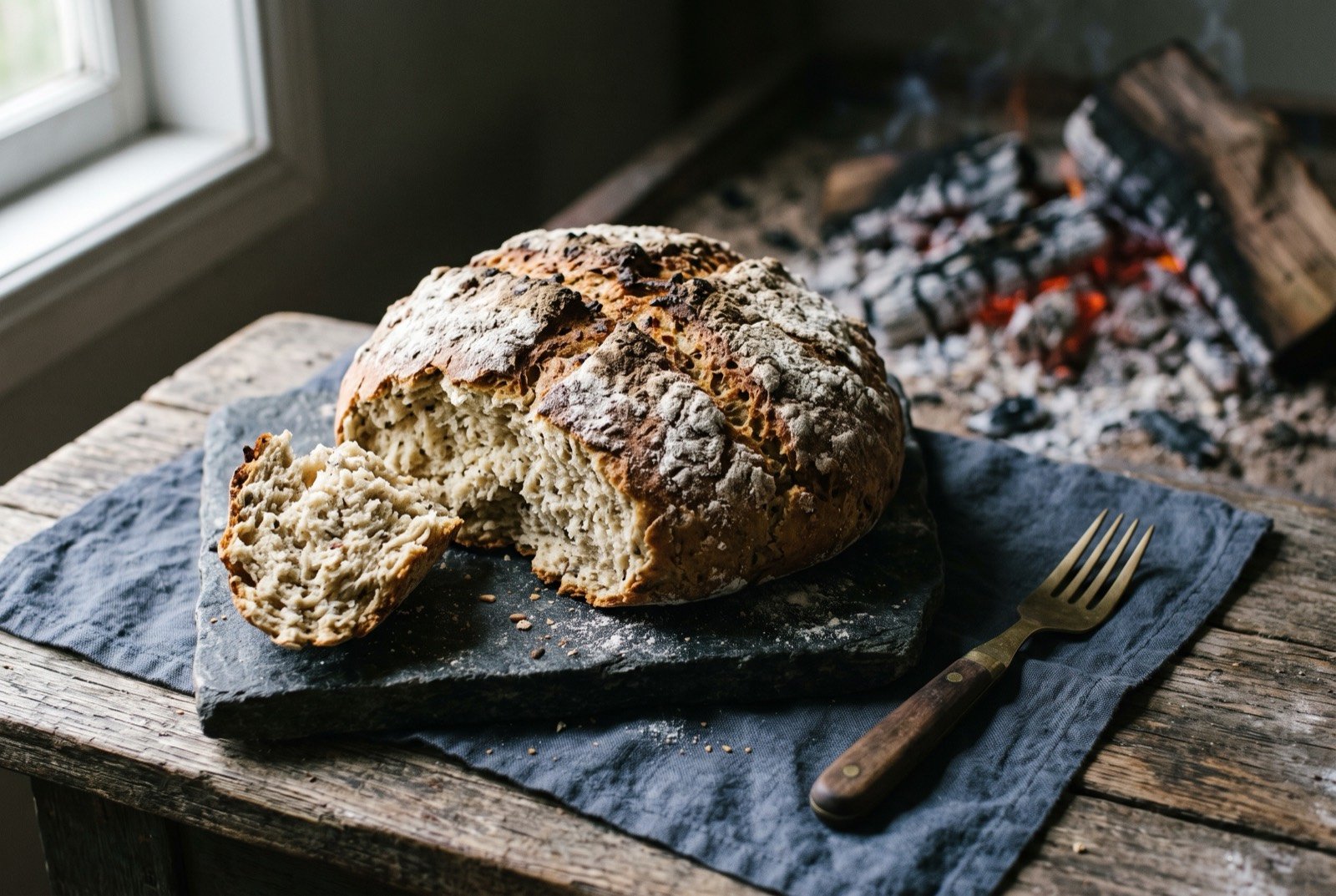
An illustration of the dish, not a photograph of it cooked.
- Time
- Not statedNo source states a time and the atlas has too few comparable dishes to estimate one.
- Researched
- 22 sources cited
- Reviewed
- Not yet reviewed from inside the tradition
- Cooked
- Not yet cooked and reported
This chapter keeps two claims separate rather than collapsing them into one story. Deep-time seed grinding and ash-baked bread, using ground native millet, spinifex, wattleseed, pigweed or acacia seed mixed with water, is independently evidenced by grinding stones dated to roughly 30,000 to 36,000 years at Cuddie Springs, a site whose dating this chapter notes below carries a real, named scholarly dispute over post-depositional disturbance, and separately by starch residue dated to around 65,000 years at Madjedbebe. Gillespie, Archaeology in Oceania, 2006 "Damper" as a named dish, by contrast, is first documented in its familiar wheat-flour, campfire-baked form among colonial stockmen, drovers and swagmen. Whether today's damper is a colonial adaptation of Aboriginal grinding-stone technique, a renamed continuation of a pre-existing practice, or two distinct traditions collapsed under one English word, is a real, unresolved question this chapter does not settle.
As tradition built it
The deep-time method, as documented
Roughly two hours' hand grinding for half a kilogram of flour, then baked in ash.
Ingredients
An outline, not yet a recipe: the tradition's method with its ingredients named but not weighed. Quantities are being added from sources inside the tradition, lead dishes first.
- 500g ground native millet, spinifex, wattleseed, pigweed or acacia seed
- water
Method
- Grind native seed, roughly two hours' hand grinding for half a kilogram of flour, on a stone base with a handheld grindstone.
- Mix with water to a workable dough.
- Bake directly in hot ash.
What a modern chef changes
Wattleseed ground fine, ash-baking reproduced with even, enclosed heat
Rung 4
Ingredients
- wattleseed, ground fine
- quandong paste, sourced as in the Sourcing section
Method
- Grind wattleseed to a fine, even flour in a spice grinder, in minutes rather than the traditional two hours by hand, worked fully through the dough rather than added as a coarse garnish.
- Bake in a Big Green Egg run indirect and fully stabilised, reproducing ash-baking's even, enclosed heat more reliably than open coals.
- Serve with a quandong paste, sourced as below, echoing Olive's own native-fruit pairing rather than the plain butter a colonial-era damper would carry.
Notes
In the spirit of Mark Olive's Midden by Mark Olive, at the Sydney Opera House, which pairs native ingredients including quandong paste and eucalyptus-whipped butter with an elevated Aboriginal table.