Aotearoa and Australia · Volume 02, The Ration, the Milk Bar and the Bush Table
The meat pie, and the pie floater
Australia-wide (the pie floater: Adelaide)
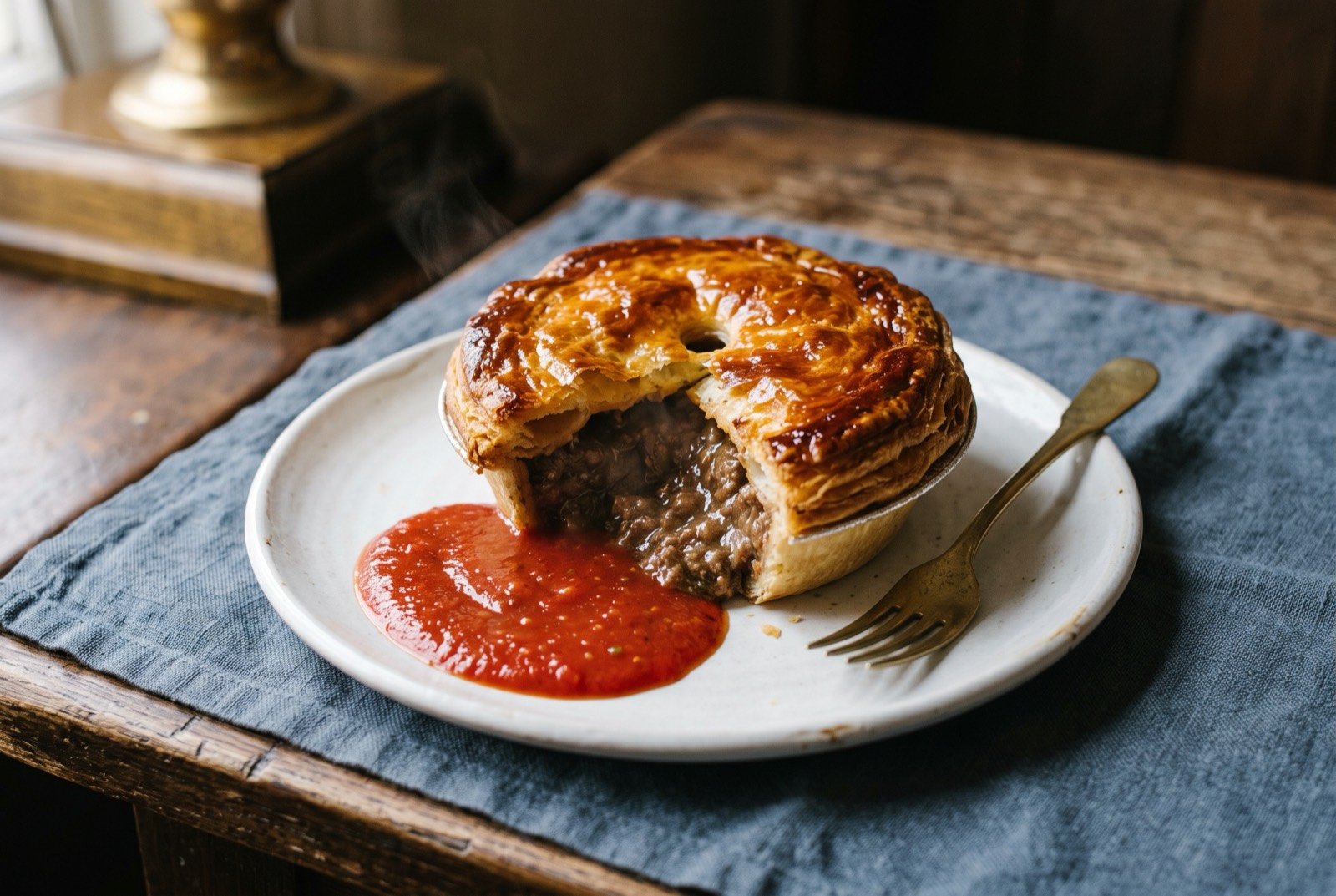
An illustration of the dish, not a photograph of it cooked.
- Time
- 1 hour 35
- Reviewed
- Not yet reviewed from inside the tradition
- Cooked
- Not yet cooked and reported
Pies arrived with the earliest British settlers and closely resembled English meat pies of the day, typically lamb or mutton given the colony's own livestock; commercial pie-making followed with real, checkable company dates, Sargents from 1891, Four'n Twenty from 1947 in Bendigo, Herbert Adams from 1909. NSW Premier Bob Carr called it Australia's "national dish" in 2003, the specific citable source for a claim usually repeated without one; the equally common "12 pies a year, 270 million pies annually" figure comes from Food Standards Australia New Zealand's own consumer page, but FSANZ does not itself cite an underlying study, and this chapter uses the figure with that caveat attached rather than as verified national data.
The pie floater, meat pie served upside down or submerged in thick pea soup, finished with tomato sauce, is Adelaide's own contribution, dating to the 1890s and carried by two competing named originators neither claim fully settles: Ern "Shorty" Bradley of Port Pirie, credited by South Australian heritage sources, and Jim Gibbs, a Scottish emigrant Adelaide pastry cook who is also described in some accounts as Bradley's former employer, which suggests the two stories may not even be fully independent. ABC News's own 2017 investigation is honest about the uncertainty and quotes food historian Jan O'Connell suggesting the format's real inspiration may be English rather than purely local, northern England's own "pea and pie suppers" predating the Adelaide dish; what is genuinely Australian is the specific combination as one dish in a bowl, and its Adelaide street-food institutionalisation. Pie carts peaked at around 13 in Adelaide in the late 1800s, fell to three by the late 1950s and were gone entirely by 2011; the National Trust of South Australia named the floater a Heritage Icon in 2003. A handful of vendors still serve one today: Café de Vilis, Enjoy Bakery on Norwood Parade, O'Connell Street Bakery, and the Upper Sturt General Store.
As tradition built it
A traditional meat pie, from The Australian Women's Weekly. Makes 6. About 1 hour 35 minutes.
Ingredients
- 225 g plain flour
- 100 g cold butter
- 1 egg
- 1 tbsp iced water
- 2 sheets shop-bought puff pastry, for the lids
- 600 g minced beef
- 80 g brown onion, finely chopped
- 410 g crushed tomatoes
- 2 tbsp tomato paste
- 2 tbsp Worcestershire sauce
- 180 ml beef stock
Method
- Make a shortcrust pastry from the flour, butter, egg and iced water; rest, chilled, for 30 minutes.
- Simmer the beef, onion, tomatoes, tomato paste, Worcestershire sauce and stock uncovered for about 20 minutes, until thickened; cool completely.
- Blind-bake the pastry cases at 200°C for 10 minutes with baking beans, then 5 minutes without.
- Fill with the cooled meat mixture, top with puff pastry, egg-wash, vent, and bake around 20 minutes until browned.
Notes
Yields six individual pies.
What a modern chef changes
This chapter's own technique work: no fine-dining precedent for the meat pie or the floater was found anywhere in this research, and this elevation is offered plainly as that rather than attributed reportage.
Rung 2
Method
- Brine and slow-cook a proper brisket for the filling, rather than plain mince, following the barrel-and-brine logic of Rung 2 but with a controlled overnight fridge cure and a low sous vide finish in place of months in salt. Rung 2.
- Reduce the gravy separately as a proper stock reduction, built from the braising liquid rather than thickened at the last minute, so the filling holds its shape when cut rather than running.
- For the floater, strain the pea soup through a chinois for a genuinely smooth purée rather than a rustic one, and plate the pie on top rather than submerging it, keeping the pastry crisp until the moment of eating.