The Sinosphere · Volume 26, The Hung Oven, the Clear Stock and a Banquet That Never Quite Existed
Peking Duck
Beijing
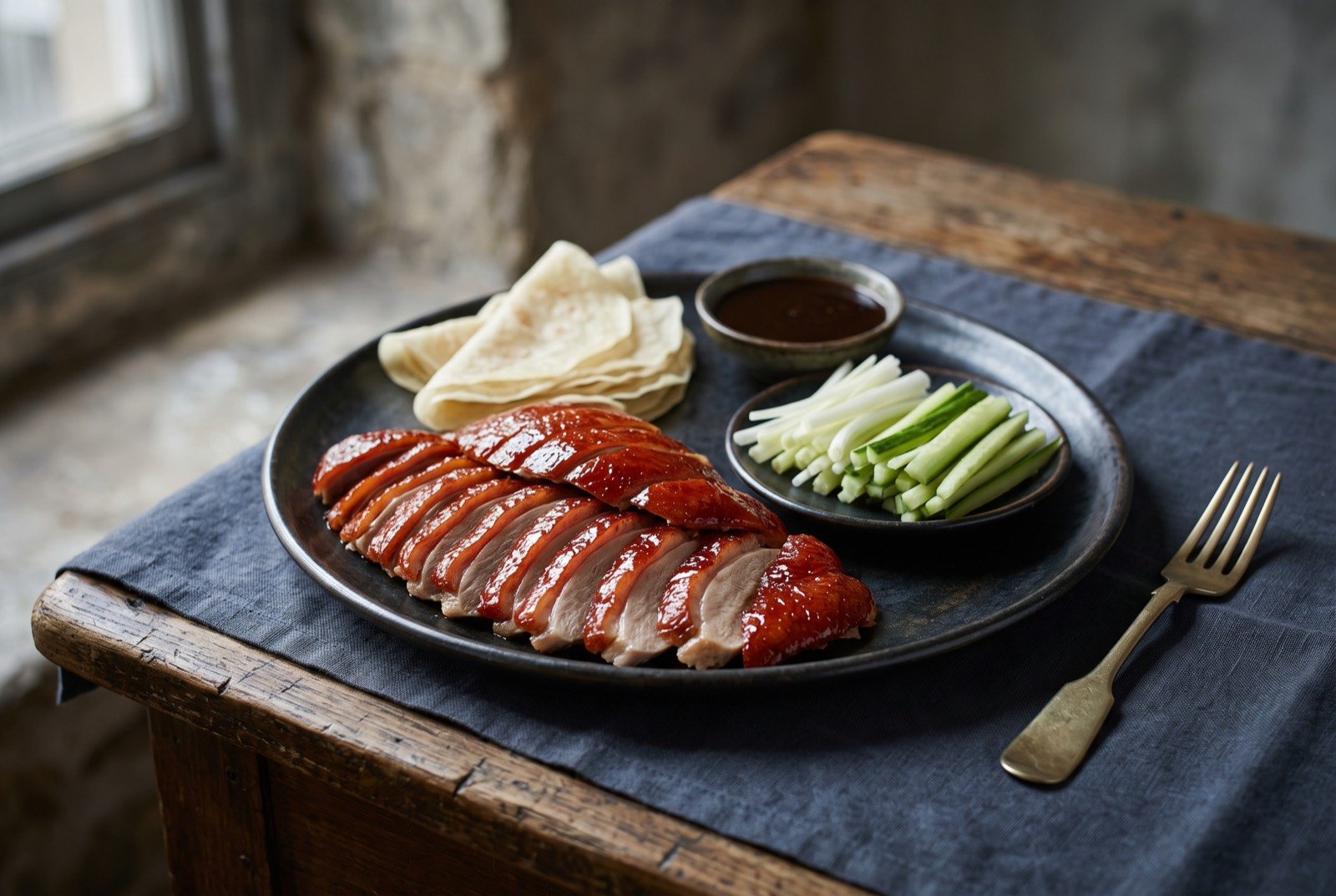
An illustration of the dish, not a photograph of it cooked.
- Time
- 24 hours
- Reviewed
- Not yet reviewed from inside the tradition
- Cooked
- Not yet cooked and reported
Quanjude was founded in 1864 by Yang Quanren, a Hebei dry-goods trader, who hired a cook remembered as "Chef Sun," trained in the Qing court's own meat-roasting bureau, to adapt the palace's open-spit suckling-pig method to duck instead. Bianyifang's rival closed-oven method is older still, tracing to 1416, and cooks the bird by residual heat alone with the cavity filled with stock rather than water. Both hold separate national Intangible Cultural Heritage status as genuinely distinct crafts.
As tradition built it
Hung-oven style, after Quanjude's own documented method.
Serves 4. About 24 hours including drying time, 40 to 70 minutes roasting.
Ingredients
- 1 whole duck, roughly 2kg, Silver Hill or a genuine Pekin breed (see Sourcing)
- as needed boiling water, for scalding the skin
- 50g maltose (饴糖)
- 450ml water, for the glaze
- to serve Mandarin pancakes, to serve
- 100g, or to taste Zhangqiu scallion or a thick UK leek substitute, shredded
- 150g, or to taste cucumber, cut into batons
- 120g, or to taste tianmianjiang (sweet bean sauce)
Method
- Insert a tube or pump nozzle through the neck incision and pump air between the skin and the fat until the skin is inflated roughly 80% taut (rung 1).
- Pour boiling water evenly over the whole skin to tighten and set the surface.
- Warm the maltose with the 450ml water until fully dissolved, then ladle this glaze over the whole bird, twice, coating evenly.
- Hang the duck in a cool, shaded, well-ventilated place for several hours, until the skin is fully dry to the touch, inside and out (rung 2).
- Roast in a very hot oven or a hung-oven-style setup, 230 to 250°C, rotating regularly, until the skin is a deep jujube-red and paper-crisp, 40 to 70 minutes depending on size (rung 3).
- Rest briefly, then carve into thin slices while still hot, skin and a little fat with each slice.
- Serve with warm pancakes, shredded scallion, cucumber batons and sweet bean sauce, for the diner to assemble.
What a modern chef changes
A younger, leaner bird and a longer, gentler roast, after Da Dong's own documented reinvention.
Rungs 1, 2 and 3
Method
- Source a younger, leaner bird specifically, since Da Dong's own "crispy, not greasy" reinvention is built on controlling subcutaneous fat thickness at source rather than compensating for a fattier traditional bird; a home cook cannot buy a duck slaughtered at Da Dong's reported 22 days, but choosing the leanest suitable bird available and trimming excess fat before glazing moves in the same direction.
- Extend the roast and lower the average heat, closer to Da Dong's reported 70 minutes than Quanjude's 40, using a Big Green Egg's genuine airflow and temperature control to hold a long, steady roast rather than a fast, high-heat one, which is reported to render more of the subdermal fat layer away over time rather than relying on a shorter, hotter cook.
- Trust a probe thermometer over visual colour, since a peer-reviewed study of the roasting process found duck surface temperature can reach over 170°C while the centre sits close to 100°C, meaning the crust and the meat cook on genuinely different timescales; pull the bird by internal temperature, not by how dark the skin looks.