The Sinosphere · Volume 26, The Hung Oven, the Clear Stock and a Banquet That Never Quite Existed
Sweet and Sour Yellow River Carp
Shandong (Jinan)
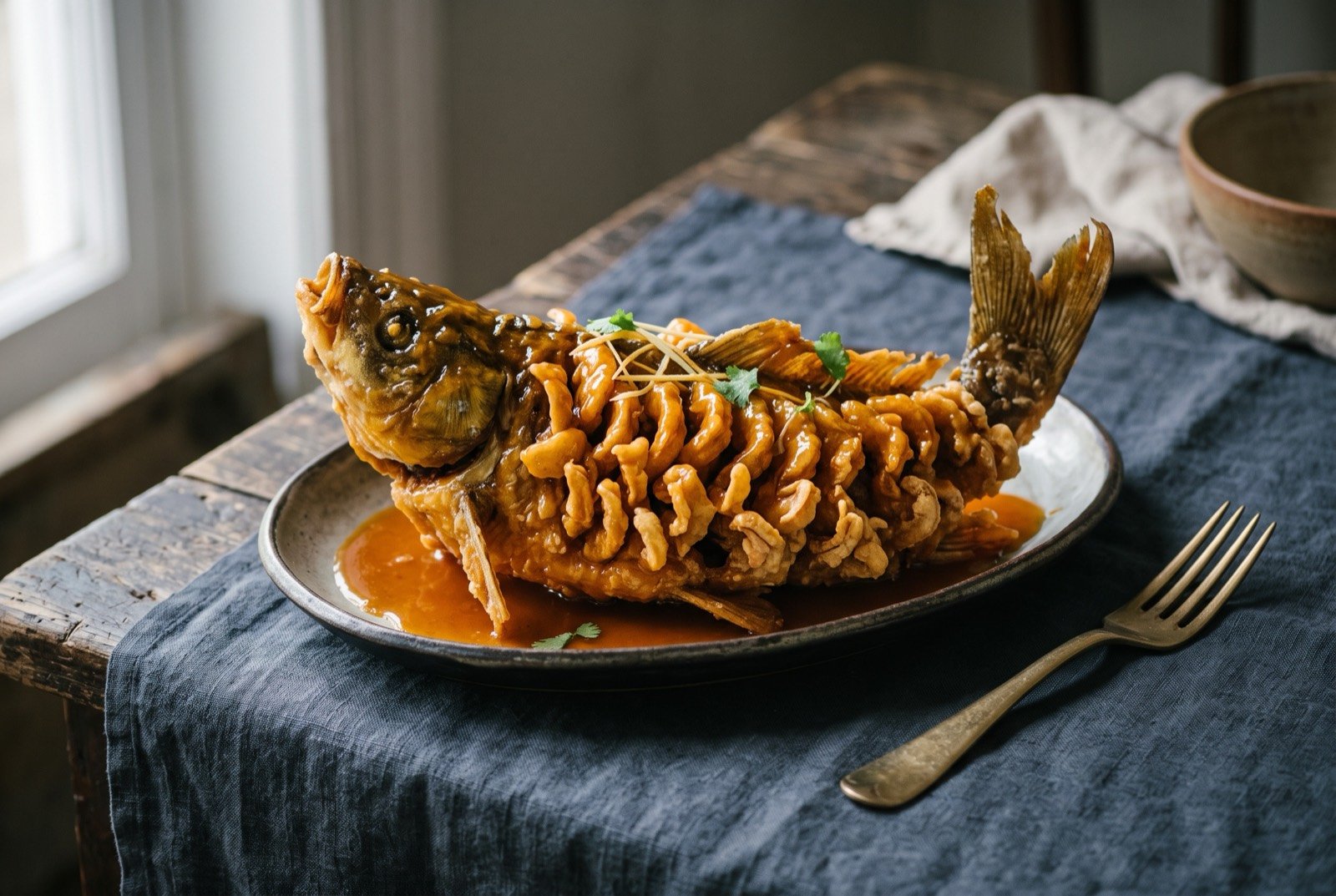
An illustration of the dish, not a photograph of it cooked.
- Time
- 45 minutes
- Reviewed
- Not yet reviewed from inside the tradition
- Cooked
- Not yet cooked and reported
The Jinan Fu Zhi gazetteer records Yellow River carp alongside Nanyang crab as dishes that "entered the recipe books," real evidence of the fish's standing as a delicacy, though not proof of this exact recipe's antiquity. The dish itself is traced to Luokou, a Yellow River trading town near Jinan, where cooks worked with live carp and a locally made aged vinegar, later refined by the city's own chefs.
As tradition built it
Serves 4. About 45 minutes.
Ingredients
- 1 whole carp, roughly 800g to 1kg, scaled and gutted
- as needed cornflour, for coating
- as needed oil, for deep-frying
- 100ml aged vinegar
- 80g sugar
- 5g; 1 clove; 1 tbsp, mixed with 2 tbsp water ginger, garlic, cornflour slurry, for the sauce
Method
- Score the whole carp's flesh on both flanks in a tight, symmetric cross-hatch, matching each cut for width and depth (rung 4's precision, applied with a knife rather than a stock).
- Coat the scored fish in a wet batter or cornflour.
- Deep-fry in the hot oil in three stages: high heat first, then a drop to low heat, then a final blast of high heat, until the scored flesh has curled into "petals" and the skin is crisp.
- Arrange the fish with head and tail curled upward.
- Reduce the vinegar and sugar with ginger and garlic into a sauce, thicken with a cornflour slurry.
- Pour the hot sauce over the fish at the table.
What a modern chef changes
A precision fryer temperature and a reduced, concentrated vinegar. Rung 4's reduction logic, applied to a sweet-sour glaze.
Rung 4
Method
- Hold the three-stage fry temperature with a probe thermometer rather than judging by eye, for a more consistently curled, evenly crisp result across the whole fish.
- Reduce the vinegar separately and further before combining with the sugar, concentrating its aroma the way a Western kitchen reduces a wine sauce, a genuine intensification of the traditional Luokou vinegar's own character.
- Rest the fried fish briefly on a rack before saucing rather than sauce it the instant it leaves the oil, keeping the crisp scored flesh from softening under the hot sauce's steam.