Korea and Japan · Volume 54, The Kingdom, the Battle and the Base
Ashitibichi
Okinawa
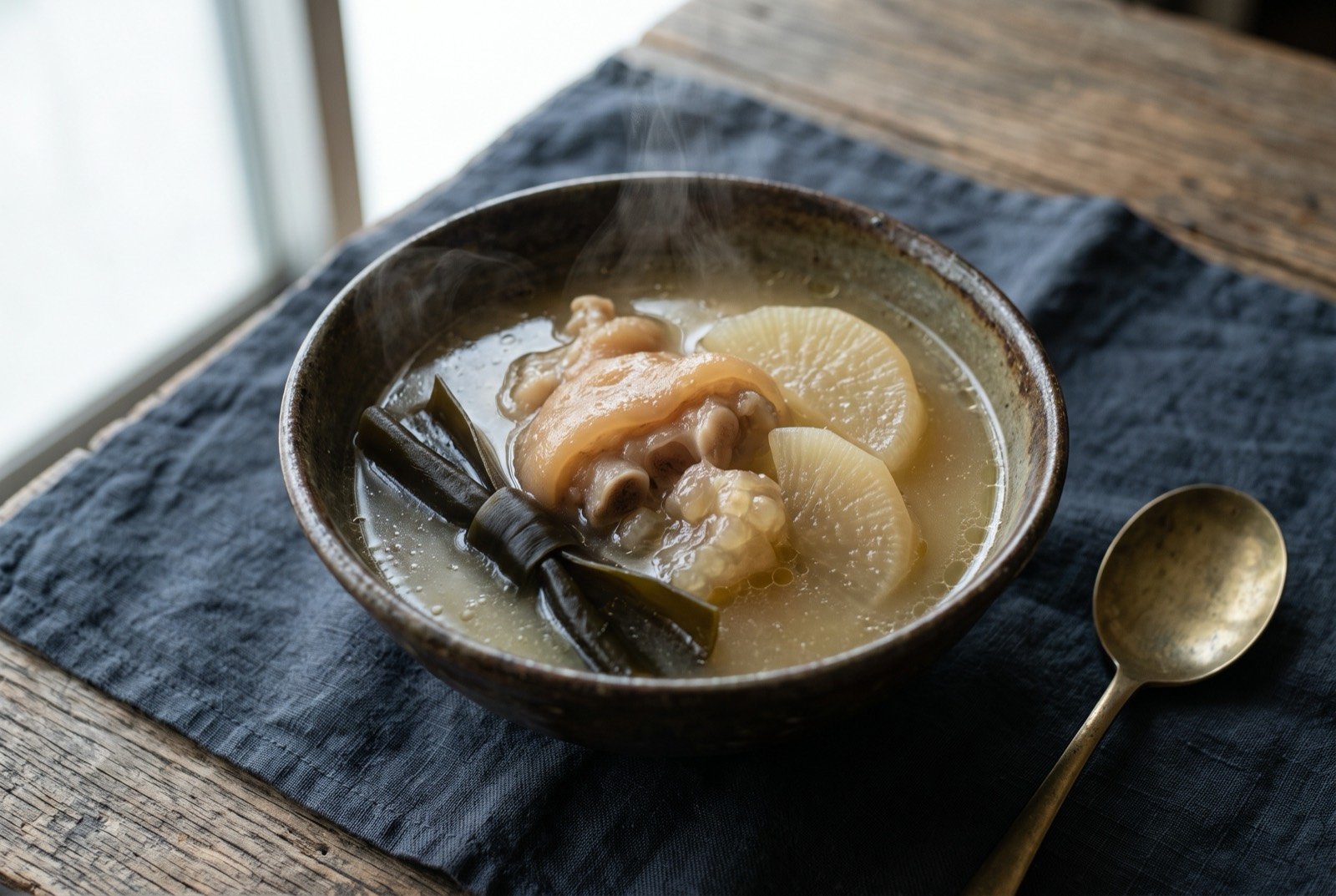
An illustration of the dish, not a photograph of it cooked.
- Time
- 4 hours
- Reviewed
- Not yet reviewed from inside the tradition
- Cooked
- Not yet cooked and reported
Ashitibichi, chimagū in Uchinaaguchi, is documented by MAFF's official registry as having been served as court cuisine before it reached ordinary households. Its cultural logic rests on the folk-medicine principle of 以類補類, "like strengthens like," the belief that eating a joint benefits the eater's own joints; this chapter names that belief honestly as tradition's own stated reasoning, not as a claim this chapter itself makes about the dish's nutritional effect.
As tradition built it
Serves 4. About 4 hours.
Ingredients
An outline, not yet a recipe: the tradition's method with its ingredients named but not weighed. Quantities are being added from sources inside the tradition, lead dishes first.
- 1 kg pig's trotters, cleaned and singed
- 200 ml awamori
- 1 piece kombu, about 10cm
- 300 g daikon, thickly sliced
- dashi or water, to cover
- 1 tsp salt, to taste
Method
- Singe any remaining hair from the trotters over a flame, then wash thoroughly.
- Place in a large pot with the awamori and enough water to cover, bring to the boil, and simmer for 20 minutes, skimming the surface regularly; this is the pre-boil in spirit described in the technique ladder, and it should not be skipped.
- Drain and rinse the trotters again.
- Return to the pot with the kombu and fresh dashi or water to cover, and simmer gently for around 3 hours, skimming regularly, until the meat is falling-tender and the connective tissue has turned properly gelatinous.
- Add the daikon for the final 40 minutes of cooking, so it softens without disintegrating.
- Season with salt only towards the end; the dish should taste clean and only lightly seasoned, letting the collagen's own richness carry it.
What a modern chef changes
A sous vide braise after the spirit pre-boil, and a low, patient kombu infusion
Rungs 3 and 5
Method
- The trotters are cooked sous vide at 85°C for 24 hours after the conventional awamori pre-boil, rather than simmered directly on the stove for three hours (Rung 5). This delivers fully rendered collagen with none of the risk of catching or over-reducing that a long open simmer carries, and produces a more consistently tender result across every piece in the batch.
- The kombu dashi is built separately as a low-temperature infusion, steeped at 60°C for 90 minutes rather than simmered directly with the trotters, avoiding the bitterness kombu can release under prolonged high heat, then strained through a chinois for a completely clear stock (Rung 3, applied here to kombu rather than offal, on the same principle of letting a gentle, patient process do work that direct heat would spoil).
- The daikon is cooked separately sous vide at 85°C for 45 minutes, in its own portion of the finished braising liquid, rather than simmered directly in the pot with the trotters, giving perfectly even, translucent slices rather than the softer, more variable result of cooking it alongside a much longer-cooking cut.
- A portion of the trotter skin is removed after cooking, dried, and crisped on the Big Green Egg, offering the same textural contrast principle used in rafute's elevation, crisp skin against the gelatinous meat beneath.