Korea and Japan · Volume 54, The Kingdom, the Battle and the Base
Pōku Tamago
Okinawa
Illustration
- Time
- 10 minutes
- Researched
- Researched from 85 sources in the brief
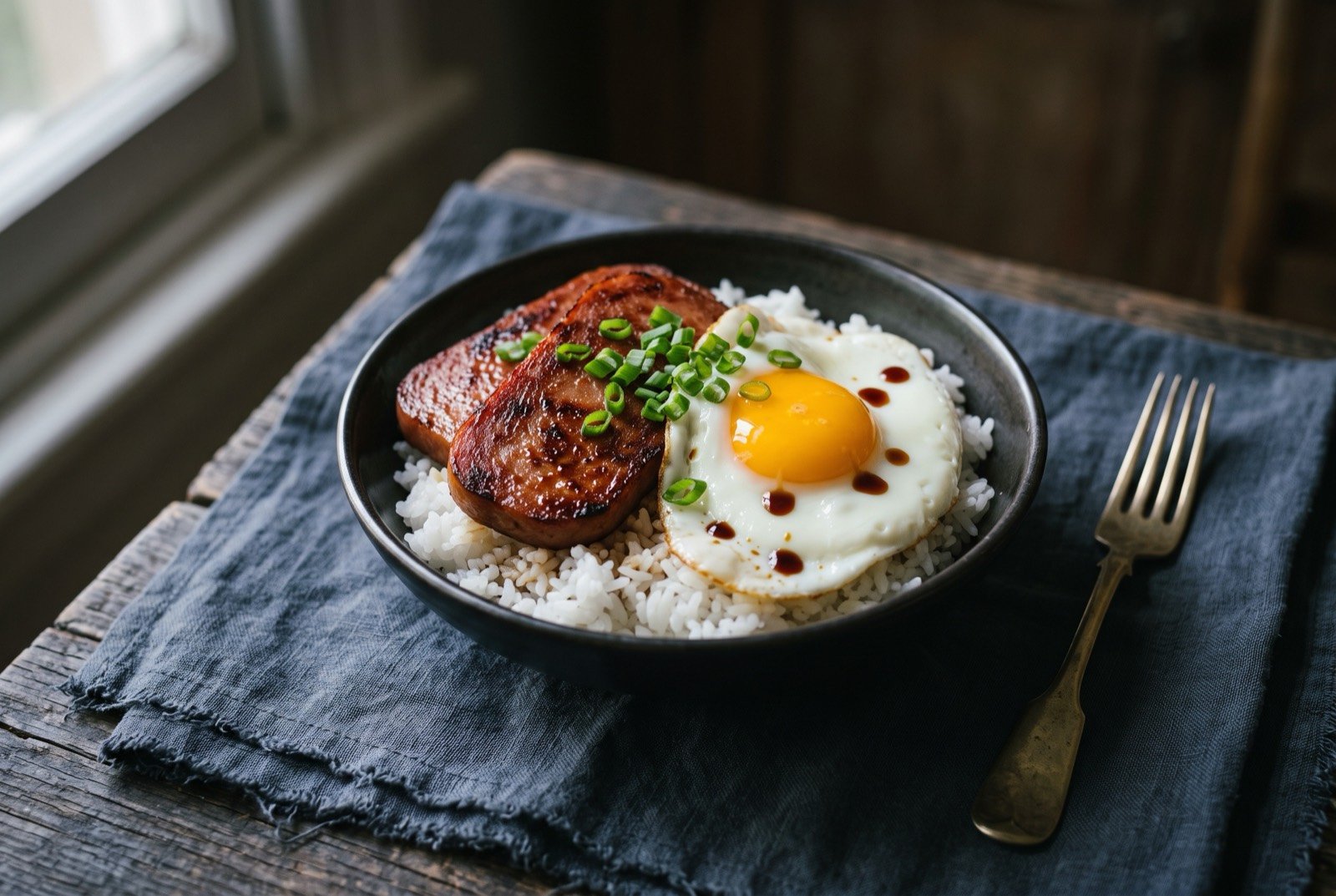
This dish, simply "pork and egg" in everyday Okinawan speech, is the quieter, more domestic counterpart to taco rice's fame: pork luncheon meat, distributed as American rations and adopted where mainland Japan largely let the same rations pass out of memory, pan-fried until caramelised at the edges and served over rice with a fried egg, exactly the kind of postwar, base-adjacent food this chapter treats as its own honest history rather than folding quietly into "traditional Okinawan cooking."
As tradition built it
Serves 2. About 10 minutes.
Ingredients
- 200 g pork luncheon meat, sliced
- 2 eggs
- 2 portions cooked rice
- to taste light soy sauce, a few drops
- for garnish spring onion, sliced, to finish
Method
- Fry the luncheon meat slices in a dry or very lightly oiled pan over medium-high heat until well caramelised and slightly crisp at the edges on both sides.
- Remove and keep warm.
- In the same pan, fry the eggs to the diner's liking, sunny side up is standard.
- Serve the rice topped with the luncheon meat and a fried egg, a few drops of soy sauce over the egg, and a scatter of spring onion.
What a modern chef changes
House-made luncheon meat as a proper charcuterie project, and a sous vide egg finished hot
Four named variables
Method
- The luncheon meat is made from scratch: pork shoulder and belly, roughly two to one, minced fine and emulsified in the high-power blender with a little iced water, salt and a touch of kokuto, packed into a terrine mould, then cooked sous vide at 70°C for 90 minutes and chilled fully before slicing. This reclaims a genuinely industrial, rationed ingredient as a proper charcuterie project, using the reader's own kit rather than a tin, and honours the dish's postwar history rather than pretending it away.
- The sliced house-made luncheon meat is seared on the Big Green Egg at very high direct heat for a harder, more deliberate char than a domestic pan easily achieves, giving the dish's simplest, most iconic element real technical attention.
- The egg is cooked sous vide at 63°C for 45 minutes to a fully set white and a custard-soft yolk, then finished with 20 seconds in a very hot pan just to set the exterior, rather than fried straight through, a genuine, controllable texture upgrade on the classic diner-style fried egg.
- A thin dashi and soy glaze, reduced through a chinois, replaces the few drops of plain soy sauce, adding savoury depth without changing the dish's own simple, unpretentious character.