Korea and Japan · Volume 54, The Kingdom, the Battle and the Base
Rafute
Okinawa
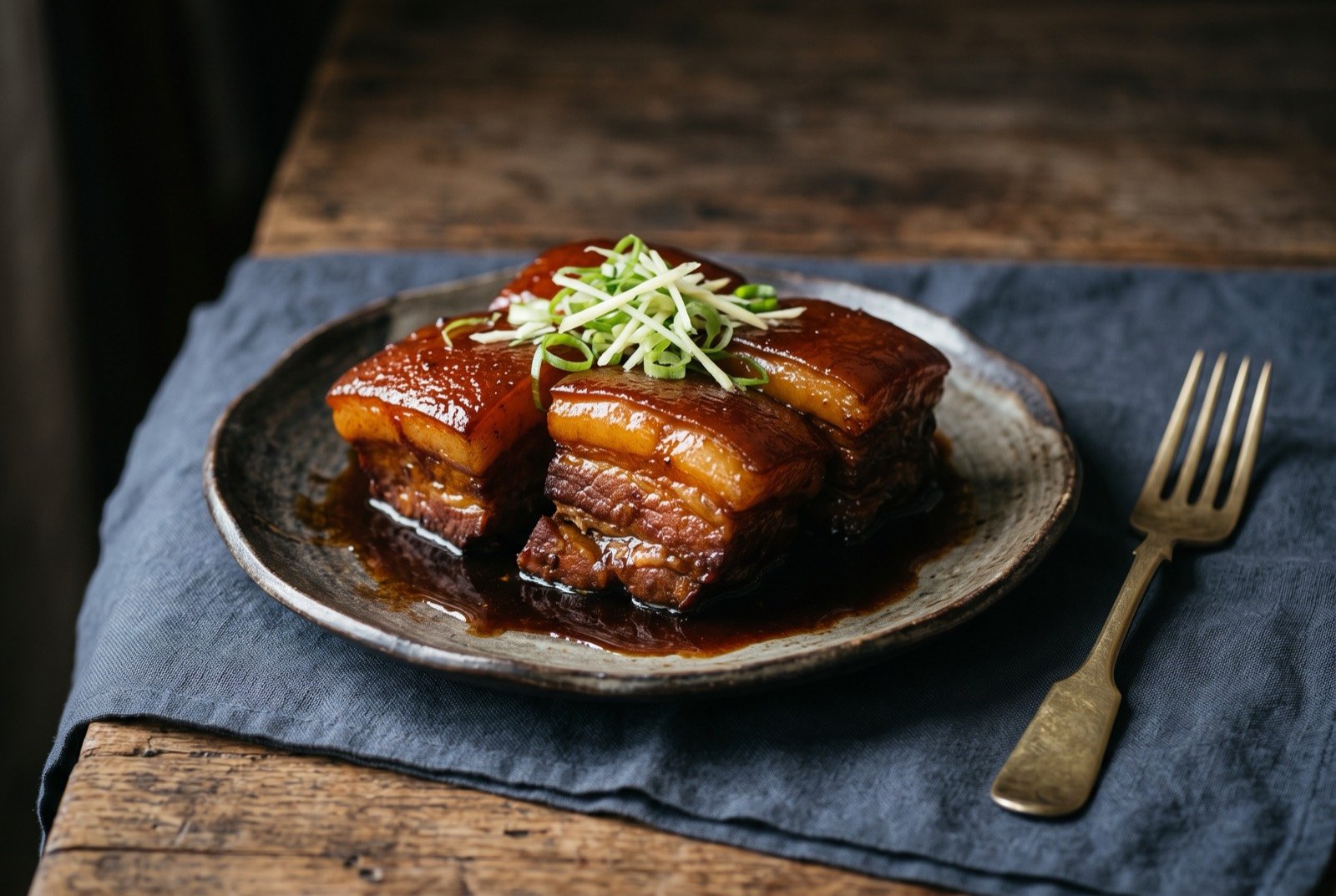
An illustration of the dish, not a photograph of it cooked.
- Time
- Hands on 3 hours · Waiting 8 hours
- Reviewed
- Not yet reviewed from inside the tradition
- Cooked
- Not yet cooked and reported
Rafute began as a preservation food, not a delicacy: MAFF's own regional cuisine registry records it as a Ryukyu Kingdom-era response to Okinawa's heat, intensely seasoned to keep for roughly a month, only later refined into the celebration and memorial-service dish it is today. It was named one of Japan's Agency for Cultural Affairs "100-Year Foods" in 2022. Its own etymology is genuinely unresolved: the common reading, 羅火腿, links it to Dongpo pork, the Song-dynasty Chinese dish it structurally resembles, but a more linguistically careful reading, 臘火腿, referring to a Chinese meat-curing method, fits the word's actual sound more precisely. This chapter states both rather than picking one.
As tradition built it
Serves 4 to 6. About 3 hours, plus overnight resting.
Ingredients
- 1 kg pork belly, skin on, in one piece
- 300 ml awamori
- 100 g kokuto (Okinawan black sugar), roughly chopped
- 150 ml soy sauce, divided into three 50ml additions
- 500 ml dashi (bonito based), or water
- 8g fresh ginger, a few slices
Method
- Sear the skin of the pork belly directly over a flame or under a hot grill until lightly blistered, then blanch the whole piece in boiling water for a few minutes and rinse.
- Cut into large chunks, roughly 5cm.
- Place in a heavy pot with water to cover and simmer gently for 60 to 90 minutes, skimming regularly, until the fat has begun to render and the meat has softened.
- Drain, discarding this first water.
- Return the pork to the pot with the awamori, ginger and enough dashi or water to cover, and bring back to a simmer.
- Add the kokuto and simmer a further 20 to 30 minutes, until the sugar has fully dissolved into the liquid.
- Add the first 50ml of soy sauce and simmer 10 minutes; add the second 50ml and simmer a further 10 minutes; add the final 50ml and simmer a last 10 minutes.
- Continue simmering gently, topping up liquid if needed, until the skin is soft enough to cut with chopsticks and the sauce has reduced to a deep, glossy coating, up to a further hour depending on the cut.
- Rest overnight in the fridge for the flavour to penetrate fully; reheat gently to serve, sauce spooned over.
What a modern chef changes
The braise moves to sous vide, and the soy sauce splits into two painted glazes
Rungs 1, 4 and 5
Method
- The braise moves to sous vide after the initial awamori pre-boil and kokuto reduction are built conventionally on the stove (Rung 5 and Rung 4). Bag the seared, blanched pork with the fully built braising liquid, awamori, kokuto and the first stage of soy sauce already incorporated, and hold at 82°C for 18 to 24 hours. This extends the same patient, layered reduction the tradition recipe achieves over three hours into an unattended, perfectly even process, with more consistent collagen breakdown than an open pot's fluctuating heat delivers.
- The remaining two soy sauce additions are reduced separately through a chinois into two distinct, concentrated glazes, rather than added directly to the braise, and painted onto the pork in two passes at plating (Rung 1). This preserves rafute's own staged-seasoning logic while giving a cleaner, glossier finish than a braise the soy has been simmering inside for an hour.
- The pork skin is separated after the sous vide stage, dried briefly, and crisped directly on a Big Green Egg at maximum dome heat for two to three minutes, rather than left soft inside the sauce, giving a genuine textural contrast, crackling skin against meltingly tender meat, that the single-vessel tradition method cannot deliver in one step.
- A portion of the kokuto is caramelised separately and set into a thin, brittle shard in a dehydrator, rather than dissolved entirely into the braise, and shattered over the dish at service; this keeps a genuine crystalline sweetness distinct from the braise's own deep, savoury reduction, a contrast the tradition method's fully-dissolved sugar cannot offer.